


Global Smart Thermostat Market
Market Size in USD Billion
CAGR :
% 
 USD
2.97 Billion
USD
14.91 Billion
2025
2033
USD
2.97 Billion
USD
14.91 Billion
2025
2033
 Forecast Period Forecast Period |
2026 –2033 |
 Market Size (Base Year) Market Size (Base Year) |
USD 2.97 Billion |
 Market Size (Forecast Year) Market Size (Forecast Year) |
USD 14.91 Billion |
 CAGR CAGR |
% |
| Major Markets Players |
|
Smart Thermostat Market Size
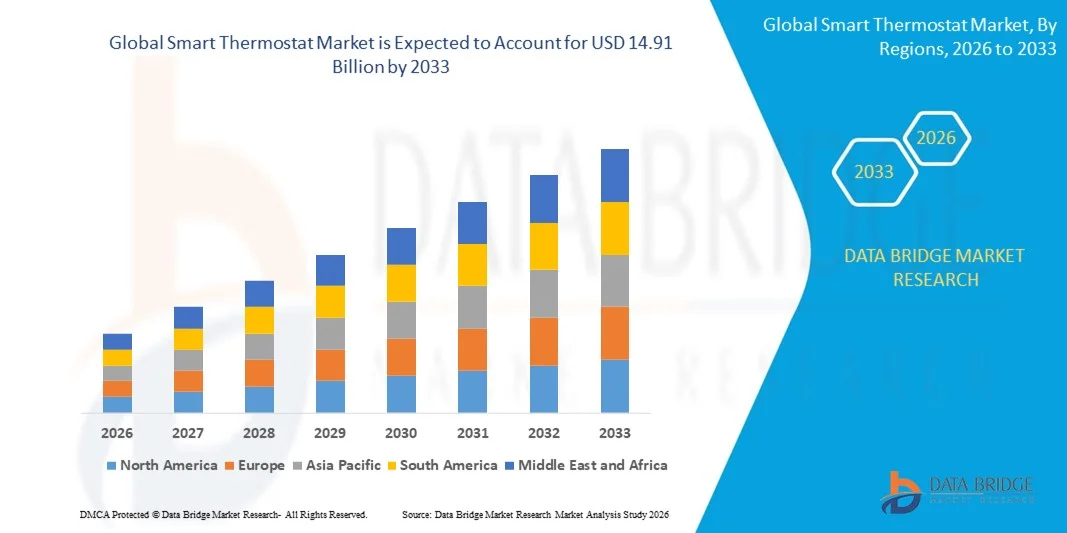
- The global smart thermostat market size was valued at USD 2.97 billion in 2025 and is expected to reach USD 14.91 billion by 2033, at a CAGR of 22.30% during the forecast period
- The market growth is largely fuelled by increasing adoption of energy-efficient solutions in residential and commercial buildings, rising demand for home automation, and government initiatives promoting energy conservation
- Growing consumer awareness of smart home technologies and the convenience of remote climate control are also driving market expansion
Smart Thermostat Market Analysis
- The market is witnessing strong innovation in smart thermostat features, including voice control, predictive energy management, and integration with renewable energy systems
- Rising urbanization, smart city initiatives, and energy cost concerns are prompting higher adoption rates across North America, Europe, and Asia-Pacific
- North America dominated the smart thermostat market with the largest revenue share of 38.75% in 2025, driven by rising demand for energy-efficient home automation solutions and increasing awareness of smart home technologies
- Asia-Pacific region is expected to witness the highest growth rate in the global smart thermostat market, driven by government initiatives promoting energy efficiency, rising smart home adoption, technological advancements, and the expansion of manufacturing and distribution networks for connected devices
- The Connected segment held the largest market revenue share in 2025, driven by the increasing adoption of IoT-enabled home automation systems and the ability to remotely control and monitor HVAC systems via smartphone apps. Connected smart thermostats offer real-time energy usage insights and seamless integration with other smart home devices, making them a preferred choice for energy-conscious residential users. In addition, these thermostats often support voice assistant integration, scheduling features, and notifications for maintenance, enhancing user convenience and efficiency. The ease of installation and continuous software updates further strengthen their market position
Report Scope and Smart Thermostat Market Segmentation
|
Attributes |
Smart Thermostat Key Market Insights |
|
Segments Covered |
|
|
Countries Covered |
North America
Europe
Asia-Pacific
Middle East and Africa
South America
|
|
Key Market Players |
|
|
Market Opportunities |
|
|
Value Added Data Infosets |
In addition to the insights on market scenarios such as market value, growth rate, segmentation, geographical coverage, and major players, the market reports curated by the Data Bridge Market Research also include in-depth expert analysis, geographically represented company-wise production and capacity, network layouts of distributors and partners, detailed and updated price trend analysis and deficit analysis of supply chain and demand. |
Smart Thermostat Market Trends
Rising Adoption of Energy-Efficient and Connected Home Solutions
- The increasing focus on energy conservation and home automation is significantly shaping the smart thermostat market, as consumers and businesses seek solutions that reduce energy consumption while improving comfort. Smart thermostats are gaining popularity due to their ability to optimize heating and cooling systems, provide remote control, and integrate with other connected devices, supporting sustainability initiatives
- Growing awareness of cost savings, energy efficiency, and environmental impact has accelerated the adoption of smart thermostats in residential and commercial buildings. Consumers are actively seeking devices that offer programmable settings, AI-based learning, and integration with IoT platforms, prompting manufacturers to develop more advanced and user-friendly solutions
- Energy efficiency and sustainability trends are influencing purchasing decisions, with manufacturers emphasizing features such as adaptive scheduling, remote access, and integration with renewable energy sources. These factors help differentiate products in a competitive market and enhance brand positioning among environmentally conscious consumers
- For instance, in 2024, Nest in the U.S. and Honeywell Home in Germany launched updated smart thermostat models with enhanced AI learning, energy usage analytics, and compatibility with multiple smart home platforms. These innovations were introduced in response to rising consumer demand for connected, energy-efficient homes, with distribution through retail, online, and smart home installers
- While demand for smart thermostats is growing, sustained market expansion depends on continuous innovation, cost-effective production, and interoperability with other smart home devices. Manufacturers are also focusing on improving user experience, connectivity reliability, and advanced features such as predictive climate control to encourage broader adoption
Smart Thermostat Market Dynamics
Driver
Rising Demand for Energy-Efficient and Connected Home Solutions
- Increasing consumer interest in reducing energy consumption and utility costs is a major driver for the smart thermostat market. Users are adopting connected devices that allow remote control, automation, and AI-based optimization of heating and cooling systems to improve efficiency
- Expanding applications in residential, commercial, and industrial buildings are influencing market growth. Smart thermostats help maintain comfortable indoor environments, lower energy bills, and support sustainability initiatives, aligning with regulatory incentives for energy efficiency
- Smart home solution providers are actively promoting smart thermostat adoption through marketing campaigns, integration with IoT platforms, and partnerships with utility companies. These efforts are supported by growing consumer awareness of energy conservation and connected home technologies
- For instance, in 2023, Ecobee in Canada and Tado in Germany reported increased adoption of smart thermostats in multi-family and commercial properties. This expansion followed rising consumer and regulatory emphasis on energy efficiency, as well as the ability to integrate with smart assistants and renewable energy systems
- Although increasing awareness and energy-saving benefits support growth, wider adoption depends on affordability, compatibility with existing HVAC systems, and ease of installation. Investment in connectivity solutions, user-friendly interfaces, and energy analytics technology will be critical for meeting global demand
Restraint/Challenge
High Initial Cost And Integration Complexity
- The relatively high upfront cost of smart thermostats compared to conventional thermostats remains a key challenge, limiting adoption among price-sensitive consumers and small businesses. Additional costs for installation and integration with existing HVAC systems can further affect market penetration
- Consumer awareness and technical knowledge remain uneven, particularly in emerging markets where smart home adoption is still nascent. Limited understanding of functional benefits and energy-saving potential restricts adoption across certain regions
- Integration and interoperability challenges also impact market growth, as smart thermostats require compatibility with various HVAC systems, smart home platforms, and communication protocols. Technical issues during installation or setup can increase operational costs and reduce user satisfaction
- For instance, in 2024, distributors in India and Southeast Asia reported slower adoption of smart thermostats due to higher prices, limited consumer awareness, and complexity in integrating with older HVAC systems. These factors also limited shelf space and visibility in retail channels, affecting sales
- Overcoming these challenges will require cost-effective production, improved installation support, and educational initiatives for consumers and installers. Collaboration with HVAC manufacturers, utility companies, and smart home platforms can help unlock the long-term growth potential of the global smart thermostat market. Developing user-friendly, interoperable, and energy-efficient solutions will be essential for broader adoption
Smart Thermostat Market Scope
The market is segmented on the basis of product, connectivity technology, installation type, and vertical
- By Product
On the basis of product, the smart thermostat market is segmented into Connected, Learning, and Standalone. The Connected segment held the largest market revenue share in 2025, driven by the increasing adoption of IoT-enabled home automation systems and the ability to remotely control and monitor HVAC systems via smartphone apps. Connected smart thermostats offer real-time energy usage insights and seamless integration with other smart home devices, making them a preferred choice for energy-conscious residential users. In addition, these thermostats often support voice assistant integration, scheduling features, and notifications for maintenance, enhancing user convenience and efficiency. The ease of installation and continuous software updates further strengthen their market position
The Learning segment is expected to witness the fastest growth rate from 2026 to 2033, driven by its ability to automatically adapt to user behavior and preferences, optimizing energy consumption without manual input. Learning smart thermostats are particularly popular for their AI-powered scheduling and predictive comfort features, which enhance convenience and reduce energy costs over time. These devices can analyze occupancy patterns, detect temperature trends, and even adjust settings based on weather forecasts. Their advanced analytics and self-learning capabilities make them highly appealing in both residential and commercial environments
- By Connectivity Technology
On the basis of connectivity technology, the market is segmented into Wireless and Wired. The Wireless segment held the largest market revenue share in 2025 due to the ease of installation and flexibility it offers in connecting with home Wi-Fi networks and mobile applications. Wireless smart thermostats are widely preferred in residential and commercial settings for their remote monitoring capabilities and integration with voice assistants. In addition, wireless solutions allow users to manage multiple zones or units from a single app, enhancing overall control and energy optimization. The convenience of mobility and reduced wiring requirements further fuel adoption
The Wired segment is expected to grow steadily from 2026 to 2033, driven by industrial and commercial applications where stable and uninterrupted connectivity is crucial for large-scale HVAC system management. Wired smart thermostats offer reliable communication without the risk of signal interference or network downtime. They are particularly suited for environments requiring constant climate control, such as factories, hospitals, and large office complexes. The robustness, security, and consistency of wired connectivity make it a preferred option for critical operations
- By Installation Type
On the basis of installation type, the market is segmented into New Installation and Retrofit Installation. The New Installation segment dominated the market in 2025, driven by the rising construction of smart homes and commercial buildings equipped with integrated automation systems. New Installation smart thermostats allow for seamless integration with modern HVAC setups, enhancing energy efficiency from the outset. They often come pre-configured with advanced features, supporting multi-zone control, occupancy detection, and automated schedules. Builders and developers increasingly prefer new installation solutions to meet green building standards and energy regulations
The Retrofit Installation segment is expected to register significant growth from 2026 to 2033, fueled by increasing demand for upgrading existing HVAC systems with smart capabilities without major infrastructural changes. Retrofit smart thermostats provide an economical solution for homeowners and businesses seeking to modernize their systems. These devices are designed for compatibility with older HVAC units, enabling remote control, energy monitoring, and scheduling. Growing awareness about energy savings and the environmental impact of inefficient HVAC systems drives adoption in this segment
- By Vertical
On the basis of vertical, the market is segmented into Residential, Commercial, and Industrial. The Residential segment held the largest market revenue share in 2025, driven by the growing consumer awareness of energy efficiency and the convenience offered by smart home solutions. Residential smart thermostats allow homeowners to remotely control temperature settings, monitor energy usage, and reduce utility costs. In addition, features such as geofencing, voice control, and integration with other smart home devices enhance comfort and lifestyle. The increasing adoption of connected home ecosystems and government incentives for energy efficiency further boost growth
The Commercial segment is expected to witness the fastest growth rate from 2026 to 2033, driven by the adoption of smart thermostats in offices, retail spaces, and hospitality environments to optimize energy consumption, reduce operational costs, and maintain comfortable environments for occupants. Commercial smart thermostats provide advanced analytics, remote monitoring, and multi-zone control, which help businesses manage large facilities efficiently. They also support integration with building management systems (BMS), enhancing operational efficiency and compliance with energy regulations. Growing emphasis on sustainable and energy-efficient infrastructure accelerates market expansion
Smart Thermostat Market Regional Analysis
- North America dominated the smart thermostat market with the largest revenue share of 38.75% in 2025, driven by rising demand for energy-efficient home automation solutions and increasing awareness of smart home technologies
- Consumers in the region highly value remote temperature control, energy optimization, and seamless integration of smart thermostats with other connected devices such as lighting and security systems
- This widespread adoption is further supported by high disposable incomes, a tech-savvy population, and government incentives promoting energy efficiency, establishing smart thermostats as a preferred solution for residential and commercial properties
U.S. Smart Thermostat Market Insight
The U.S. smart thermostat market captured the largest revenue share in 2025 within North America, fueled by the rapid adoption of connected home devices and growing interest in energy-efficient solutions. Homeowners are increasingly prioritizing temperature automation and real-time energy monitoring to reduce utility costs. The rising popularity of voice-controlled systems, mobile app integration, and DIY smart home setups further drives market growth. In addition, integration with platforms such as Alexa, Google Assistant, and Apple HomeKit is significantly expanding the smart thermostat ecosystem.
Europe Smart Thermostat Market Insight
The Europe smart thermostat market is expected to witness the fastest growth rate from 2026 to 2033, driven by stringent energy regulations and increasing demand for efficient heating and cooling solutions. Urbanization and the adoption of connected devices are fostering smart thermostat usage across residential and commercial buildings. European consumers are attracted to features that enhance comfort, convenience, and energy savings. Growth is particularly strong in new constructions and renovation projects, with smart thermostats being integrated into building management systems and energy-efficient infrastructures.
U.K. Smart Thermostat Market Insight
The U.K. smart thermostat market is expected to witness the fastest growth rate from 2026 to 2033, supported by increasing interest in smart home automation and energy-efficient living. Rising awareness of energy costs and environmental sustainability is encouraging adoption among homeowners and businesses. The U.K.’s well-developed digital infrastructure, combined with strong e-commerce and retail penetration, is facilitating the availability and uptake of smart thermostats. Integration with connected devices and remote monitoring capabilities continues to drive market expansion.
Germany Smart Thermostat Market Insight
The Germany smart thermostat market is expected to witness the fastest growth rate from 2026 to 2033, fueled by heightened awareness of energy conservation, sustainability, and smart home technologies. Germany’s focus on innovation, eco-friendly solutions, and energy-efficient building standards is promoting the adoption of smart thermostats in both residential and commercial applications. The integration of smart thermostats with heating systems, home automation platforms, and renewable energy solutions is increasingly prevalent. Consumers are showing preference for solutions that optimize comfort while reducing energy consumption.
Asia-Pacific Smart Thermostat Market Insight
The Asia-Pacific smart thermostat market is expected to witness the fastest growth rate from 2026 to 2033, driven by rapid urbanization, rising disposable incomes, and increasing adoption of smart homes in countries such as China, Japan, and India. Government initiatives supporting digitalization and energy efficiency are further stimulating market demand. The region is becoming a key manufacturing hub for smart thermostat components, making devices more accessible and affordable. The growing awareness of energy management and sustainability is expanding the consumer base across residential and commercial sectors.
Japan Smart Thermostat Market Insight
The Japan smart thermostat market is expected to witness the fastest growth rate from 2026 to 2033, due to the country’s tech-oriented culture, rapid urbanization, and strong demand for convenience and energy-efficient solutions. Smart homes and connected buildings are increasingly integrating smart thermostats with other IoT devices, such as lighting and security systems. The aging population also drives demand for easy-to-use, automated temperature management solutions in residential and commercial properties. Advanced features, predictive control, and energy optimization are key growth drivers.
China Smart Thermostat Market Insight
The China smart thermostat market accounted for the largest market revenue share in Asia Pacific in 2025, attributed to the country’s growing middle class, rapid urbanization, and high rates of technology adoption. Smart thermostats are increasingly deployed in residential, commercial, and multi-unit rental properties. Government initiatives promoting energy-efficient buildings, along with the presence of strong domestic manufacturers, support affordability and accessibility. The push towards smart cities and integration with broader home automation platforms are significant factors propelling market growth in China.
Smart Thermostat Market Share
The Smart Thermostat industry is primarily led by well-established companies, including:
- Alphabet Inc. (U.S.)
- Emerson Electric Co. (U.S.)
- Honeywell International Inc. (U.S.)
- Lennox International (U.S.)
- Ecobee (Canada)
- Carrier (U.S.)
- Johnson Controls (U.S.)
- Legrand (France)
- Resideo Technologies (U.S.)
- Siemens (Germany)
- Trane Technologies plc (Ireland)
- Control4 Corporation (U.S.)
- Nortek Control (U.S.)
- tado GmbH (Germany)
- Alarm.com Incorporated (U.S.)
- Bosch Thermotechnik GmbH (Germany)
- Centrica plc (U.K.)
- Cielo WiGle Inc. (U.S.)
- Climote Limited (Ireland)
- Mysa Smart Thermostats (Canada)
- Eve Systems GmbH (Germany)
- MRCOOL (U.S.)
- Radio Thermostat Company of America (U.S.)
- SALUS Controls (U.K.)
- Vine Connected Corporation (U.S.)
- Vivint, Inc. (U.S.)
• Zen Within Inc. (U.S.)
Latest Developments in Global Smart Thermostat Market
- In February 2024, Carrier Corporation launched a new smart thermostat aimed at enhancing comfort and energy efficiency for residential and light commercial applications. The device features remote access, geofencing, and intelligent scheduling, allowing users to optimize energy usage while maintaining personalized temperature settings. Its user-friendly design simplifies control and monitoring, improving homeowner satisfaction. This launch strengthens Carrier’s position in the smart thermostat market and is expected to drive adoption of connected HVAC solutions in both homes and small businesses
- In December 2023, Sinope introduced the TH1123WF smart Wi-Fi thermostat designed for electric baseboard and convector heating systems. The thermostat enables remote control through the Neviweb app and is compatible with major smart home platforms, including Apple HomeKit, Alexa, and Google Home. By offering convenience, energy efficiency, and seamless ecosystem integration, Sinope reinforces its competitive presence in the smart thermostat market
- In May 2022, Ecobee launched the SmartThermostat Premium along with the Ecobee SmartCamera with Voice Control. The SmartThermostat Premium includes built-in Alexa voice service, a glass touchscreen display, and high-quality audio for whole-home sound. These innovations enhance smart home automation by combining voice control, advanced sensing, and entertainment features, strengthening Ecobee’s reputation as a market leader in connected home solutions
SKU-
Get online access to the report on the World's First Market Intelligence Cloud

- Interactive Data Analysis Dashboard
- Company Analysis Dashboard for high growth potential opportunities
- Research Analyst Access for customization & queries
- Competitor Analysis with Interactive dashboard
- Latest News, Updates & Trend analysis
- Harness the Power of Benchmark Analysis for Comprehensive Competitor Tracking
Global Smart Thermostat Market, Supply Chain Analysis and Ecosystem Framework
To support market growth and help clients navigate the impact of geopolitical shifts, DBMR has integrated in-depth supply chain analysis into its Global Smart Thermostat Market research reports. This addition empowers clients to respond effectively to global changes affecting their industries. The supply chain analysis section includes detailed insights such as Global Smart Thermostat Market consumption and production by country, price trend analysis, the impact of tariffs and geopolitical developments, and import and export trends by country and HSN code. It also highlights major suppliers with data on production capacity and company profiles, as well as key importers and exporters. In addition to research, DBMR offers specialized supply chain consulting services backed by over a decade of experience, providing solutions like supplier discovery, supplier risk assessment, price trend analysis, impact evaluation of inflation and trade route changes, and comprehensive market trend analysis.
Research Methodology
Data collection and base year analysis are done using data collection modules with large sample sizes. The stage includes obtaining market information or related data through various sources and strategies. It includes examining and planning all the data acquired from the past in advance. It likewise envelops the examination of information inconsistencies seen across different information sources. The market data is analysed and estimated using market statistical and coherent models. Also, market share analysis and key trend analysis are the major success factors in the market report. To know more, please request an analyst call or drop down your inquiry.
The key research methodology used by DBMR research team is data triangulation which involves data mining, analysis of the impact of data variables on the market and primary (industry expert) validation. Data models include Vendor Positioning Grid, Market Time Line Analysis, Market Overview and Guide, Company Positioning Grid, Patent Analysis, Pricing Analysis, Company Market Share Analysis, Standards of Measurement, Global versus Regional and Vendor Share Analysis. To know more about the research methodology, drop in an inquiry to speak to our industry experts.
Customization Available
Data Bridge Market Research is a leader in advanced formative research. We take pride in servicing our existing and new customers with data and analysis that match and suits their goal. The report can be customized to include price trend analysis of target brands understanding the market for additional countries (ask for the list of countries), clinical trial results data, literature review, refurbished market and product base analysis. Market analysis of target competitors can be analyzed from technology-based analysis to market portfolio strategies. We can add as many competitors that you require data about in the format and data style you are looking for. Our team of analysts can also provide you data in crude raw excel files pivot tables (Fact book) or can assist you in creating presentations from the data sets available in the report.












