


Global Smart Ticketing Market
Market Size in USD Billion
CAGR :
% 
 USD
14.51 Billion
USD
43.93 Billion
2025
2033
USD
14.51 Billion
USD
43.93 Billion
2025
2033
 Forecast Period Forecast Period |
2026 –2033 |
 Market Size (Base Year) Market Size (Base Year) |
USD 14.51 Billion |
 Market Size (Forecast Year) Market Size (Forecast Year) |
USD 43.93 Billion |
 CAGR CAGR |
% |
| Major Markets Players |
|
Smart Ticketing Market Size
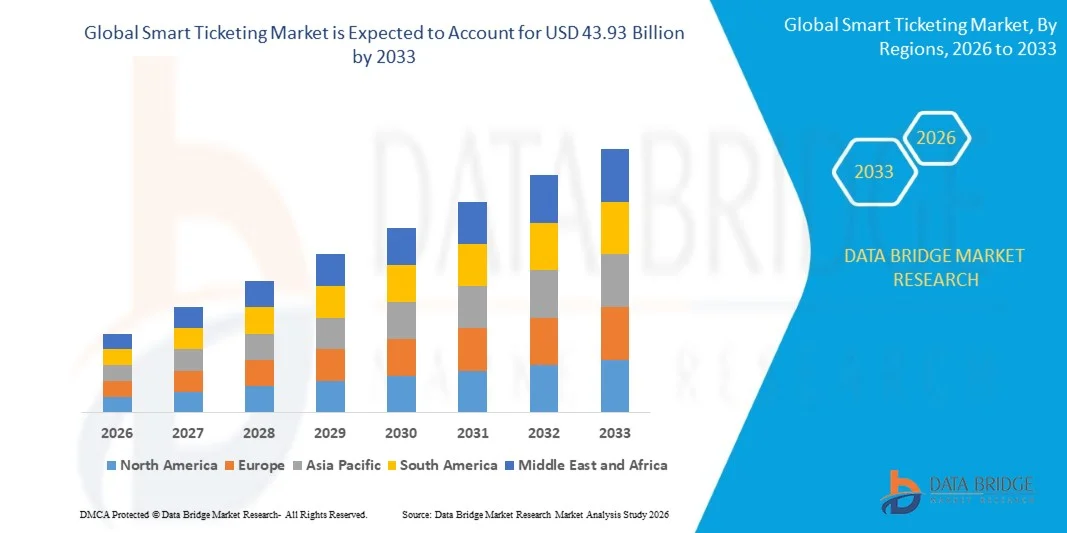
- The global smart ticketing market size was valued at USD 14.51 billion in 2025 and is expected to reach USD 43.93 billion by 2033, at a CAGR of 14.85% during the forecast period
- The market growth is largely fuelled by the increasing adoption of contactless payment systems, digital ticketing solutions, and the rising preference for seamless travel experiences among commuters
- Growing urbanization, expansion of public transportation networks, and the integration of smart ticketing with mobile applications and IoT platforms are driving market demand
Smart Ticketing Market Analysis
- The market is witnessing a rapid shift toward digitalization, with transit authorities, event organizers, and private operators increasingly implementing smart ticketing solutions to improve user experience and operational efficiency
- Rising government initiatives for smart cities, adoption of integrated mobility solutions, and increasing consumer awareness about cashless and contactless ticketing are contributing to market expansion
- North America dominated the global smart ticketing market with the largest revenue share of 38.7% in 2025, driven by the rapid adoption of digital payment solutions, modernization of public transport infrastructure, and increasing preference for contactless and automated ticketing methods
- Asia-Pacific region is expected to witness the highest growth rate in the global smart ticketing market, driven by rising urban populations, government-backed smart city initiatives, increasing investments in public transit infrastructure, and the growing preference for cashless, contactless, and mobile ticketing solutions
- The E-Ticket segment held the largest market revenue share in 2025, driven by the growing adoption of digital solutions in transportation and events. E-Tickets offer convenience, instant delivery, and reduced operational costs, making them a preferred choice for passengers and event-goers. The rising penetration of smartphones and mobile apps further supports the adoption of E-Tickets, providing seamless integration with travel and event management platforms
Report Scope and Smart Ticketing Market Segmentation
|
Attributes |
Smart Ticketing Key Market Insights |
|
Segments Covered |
|
|
Countries Covered |
North America
Europe
Asia-Pacific
Middle East and Africa
South America
|
|
Key Market Players |
• Thales Group (France) |
|
Market Opportunities |
• Expansion Of Contactless And Mobile Ticketing Solutions |
|
Value Added Data Infosets |
In addition to the insights on market scenarios such as market value, growth rate, segmentation, geographical coverage, and major players, the market reports curated by the Data Bridge Market Research also include in-depth expert analysis, geographically represented company-wise production and capacity, network layouts of distributors and partners, detailed and updated price trend analysis and deficit analysis of supply chain and demand. |
Smart Ticketing Market Trends
“Rising Adoption of Contactless And Mobile Ticketing Solutions”
• The growing focus on seamless and digitalized transit experiences is significantly shaping the smart ticketing market, as consumers increasingly prefer convenient, fast, and secure payment and ticketing methods. Smart ticketing solutions are gaining traction due to their ability to reduce queues, minimize cash handling, and improve operational efficiency across public transport systems. This trend strengthens adoption across rail, metro, bus, and multi-modal transit networks, encouraging operators to innovate with new digital ticketing platforms
• Increasing awareness around safety, hygiene, and time efficiency has accelerated the demand for contactless smart ticketing in airports, railways, and urban mobility solutions. Commuters are actively seeking digital ticketing options that allow touch-free access and real-time validation, prompting service providers to integrate mobile apps, NFC cards, and QR code-based systems. This has also led to partnerships between technology vendors and transport authorities to enhance user convenience and interoperability
• The digitalization and interoperability trend is influencing purchasing and adoption decisions, with operators emphasizing scalable, secure, and user-friendly solutions. These factors help transit providers differentiate their services, improve passenger satisfaction, and enable data-driven operations, while also driving the integration of loyalty programs and multi-operator ticketing. Marketing campaigns increasingly highlight these benefits to promote awareness and adoption among commuters
• For instance, in 2024, Transport for London in the U.K. and New York Metropolitan Transportation Authority expanded their smart ticketing systems by incorporating mobile app-based ticketing and contactless payment options. These launches responded to increasing passenger preference for digital and convenient travel solutions, with deployment across rail, bus, and metro networks. The solutions were also promoted for efficiency, reducing operational costs and enhancing commuter satisfaction
• While adoption of smart ticketing is growing, sustained market expansion depends on continuous technology upgrades, integration with existing infrastructure, and ensuring cybersecurity and data privacy. Providers are focusing on improving system scalability, platform interoperability, and cost-effective deployment to cater to a larger commuter base and achieve long-term growth
Smart Ticketing Market Dynamics
Driver
“Growing Preference For Contactless And Mobile Ticketing Solutions”
• Rising commuter demand for fast, secure, and contactless payment and ticketing methods is a major driver for the smart ticketing market. Transit authorities are increasingly replacing traditional paper tickets and cash-based systems with digital alternatives to meet passenger expectations, enhance operational efficiency, and comply with evolving urban mobility standards. This trend is also pushing investment in mobile apps, NFC, and QR-based platforms
• Expanding applications across metros, buses, railways, airports, and multimodal transport networks are driving market growth. Smart ticketing improves travel efficiency, reduces congestion, and supports real-time data collection for transport operators, enabling better route planning and passenger management. The global push for urban mobility modernization further reinforces this trend
• Transportation operators are actively promoting smart ticketing through system integration, user-friendly apps, and marketing campaigns. These efforts are supported by growing consumer preference for convenience, safety, and time savings, and they also encourage collaborations between technology providers and transit authorities to improve system interoperability and enhance commuter experience
• For instance, in 2023, New York MTA and Singapore Land Transport Authority reported increased adoption of mobile ticketing and contactless fare collection across multiple transit networks. This expansion followed rising commuter demand for seamless and digital travel solutions, improving passenger convenience, operational efficiency, and service differentiation. Both authorities also highlighted sustainability benefits by reducing paper ticket usage
• Although rising digitalization and contactless trends support growth, wider adoption depends on technology costs, system integration challenges, and data security concerns. Investment in cybersecurity, cloud infrastructure, and real-time validation systems will be critical for meeting global demand and maintaining competitive advantage
Restraint/Challenge
“High Implementation Costs And Integration Complexity”
• The relatively high cost of deploying smart ticketing systems compared to traditional methods remains a key challenge, limiting adoption among smaller transit authorities and operators. Expenses related to hardware installation, software licensing, and staff training contribute to elevated upfront investment
• Variability in commuter awareness and acceptance across regions, particularly in emerging markets, restricts adoption. Limited understanding of digital ticketing benefits can slow the uptake in certain transit networks, resulting in delayed implementation timelines
• System integration and interoperability challenges also impact market growth, as smart ticketing must be compatible with existing infrastructure, payment platforms, and multiple transport operators. Technical complexity, software maintenance, and ensuring real-time data accuracy increase operational burdens
• For instance, in 2024, smaller municipal transit authorities in Southeast Asia and Latin America reported slower adoption due to high initial costs, integration complexity, and limited user awareness. These factors prompted some operators to maintain hybrid systems combining paper tickets and digital solutions
• Overcoming these challenges will require cost-effective deployment, robust training programs, and partnerships with technology providers. Collaboration with governments, public transport authorities, and payment solution providers can help unlock the long-term growth potential of the global smart ticketing market. In addition, developing scalable and interoperable platforms will be essential for widespread adoption
Smart Ticketing Market Scope
The market is segmented on the basis of product, component, revenue channel, system, and application.
• By Product
On the basis of product, the global smart ticketing market is segmented into Ticket Machine, E-Ticket, E-Kiosk, Smart Parking System, E-Toll, and Request Tracker. The E-Ticket segment held the largest market revenue share in 2025, driven by the growing adoption of digital solutions in transportation and events. E-Tickets offer convenience, instant delivery, and reduced operational costs, making them a preferred choice for passengers and event-goers. The rising penetration of smartphones and mobile apps further supports the adoption of E-Tickets, providing seamless integration with travel and event management platforms.
The Smart Parking System segment is expected to witness the fastest growth rate from 2026 to 2033, fueled by increasing urbanization and the need for efficient parking management. Smart parking solutions provide real-time availability updates, automated payment, and enhanced user experience, making them attractive for both municipal authorities and private operators. Growing traffic congestion and government initiatives to modernize urban mobility infrastructure are key factors driving this segment’s adoption.
• By Component
On the basis of component, the market is segmented into Software, Hardware, and Service. The Software segment accounted for the largest market share in 2025, due to the increasing reliance on analytics, ticketing management platforms, and integration with mobile applications. Software solutions enhance efficiency, enable seamless transactions, and allow for personalized user experiences. Cloud-based software offerings and AI-powered analytics further strengthen operational efficiency and predictive insights for operators.
The Service segment is projected to grow rapidly from 2026 to 2033, driven by rising demand for installation, maintenance, and support services associated with smart ticketing systems. Services ensure operational reliability, user satisfaction, and long-term adoption of smart ticketing solutions. In addition, managed services and consultancy for implementing large-scale ticketing projects contribute to the increasing revenue share of this segment.
• By Revenue Channel
On the basis of revenue channel, the market is segmented into Users and Suppliers. The Users segment dominated the market in 2025, as end-users increasingly prefer digital and contactless ticketing methods over traditional paper-based solutions. User adoption is accelerated by convenience, security, and the integration of ticketing with mobile wallets and travel apps. Growing awareness of smart city initiatives and digital payment adoption further support this segment’s expansion.
The Suppliers segment is expected to register significant growth during 2026–2033, driven by the expansion of service providers offering advanced ticketing platforms, smart devices, and integrated solutions to transport authorities and commercial enterprises. Suppliers are focusing on product innovation and strategic partnerships to enhance market reach and provide scalable ticketing solutions. The trend toward turnkey smart ticketing solutions is creating new business opportunities for this segment.
• By System
On the basis of system, the market is segmented into Smart Card, Open Payment System, and Near-Field Communication (NFC) System. The Smart Card system held the largest market share in 2025, driven by widespread deployment in metro rail and public transport networks across developed regions. Smart cards provide secure transactions, quick processing, and multi-modal integration. Their durability, reusability, and integration with loyalty programs further contribute to their popularity in public transport networks.
The Open Payment System segment is expected to witness the fastest growth from 2026 to 2033, fueled by the adoption of contactless bank cards, mobile wallets, and QR-based payment methods. Open payment systems enhance user convenience by reducing the need for proprietary tickets and allowing interoperability across transport networks. Increasing partnerships between banks, fintech providers, and transit authorities are expected to accelerate market penetration for this segment.
• By Application
On the basis of application, the market is segmented into Railways and Metros, Sports and Entertainment, Airlines, Buses, and Others. The Railways and Metros segment dominated the market in 2025, driven by the modernization of public transport infrastructure and increased adoption of automated ticketing solutions. Smart ticketing improves operational efficiency, reduces queues, and enables real-time passenger management. Government initiatives to implement cashless transit systems further support the widespread deployment of smart ticketing in this segment.
The Sports and Entertainment segment is projected to witness the highest growth rate from 2026 to 2033, driven by the rising demand for digital ticketing at stadiums, concert venues, and event arenas. These solutions provide seamless access control, personalized experiences, and enhanced security for attendees. The growing popularity of online ticket booking platforms and integration with mobile apps further contributes to the rapid adoption of smart ticketing in this sector.
Smart Ticketing Market Regional Analysis
• North America dominated the global smart ticketing market with the largest revenue share of 38.7% in 2025, driven by the rapid adoption of digital payment solutions, modernization of public transport infrastructure, and increasing preference for contactless and automated ticketing methods
• Consumers in the region highly value the convenience, speed, and security offered by smart ticketing systems, as well as seamless integration with mobile apps, travel cards, and multi-modal transport networks
• This widespread adoption is further supported by advanced technological infrastructure, high smartphone penetration, and the growing implementation of smart city initiatives, establishing smart ticketing as a preferred solution across railways, metros, and event venues
U.S. Smart Ticketing Market Insight
The U.S. smart ticketing market captured the largest revenue share in 2025 within North America, fueled by the increasing digitization of transport services and growing demand for automated ticketing solutions. Passengers are increasingly prioritizing convenience, faster boarding, and cashless transactions through mobile apps and smart cards. The rising trend of integrating ticketing with contactless payment systems and transport management platforms is further accelerating market growth. In addition, the push towards modernized public transport and smart city projects is significantly contributing to the expansion of the smart ticketing industry.
Europe Smart Ticketing Market Insight
The Europe smart ticketing market is expected to witness the fastest growth rate from 2026 to 2033, driven by government initiatives promoting digital and contactless ticketing in public transport. Strict regulations on fare collection, rising urbanization, and the demand for eco-friendly and efficient solutions are fostering adoption. European consumers are increasingly attracted to the convenience and flexibility offered by smart ticketing systems. The integration of ticketing solutions in metros, buses, and railways, along with the modernization of infrastructure, is supporting growth across multiple applications.
U.K. Smart Ticketing Market Insight
The U.K. smart ticketing market is expected to witness the fastest growth rate from 2026 to 2033, driven by rising urbanization, the shift towards cashless payments, and the demand for faster, contactless transit solutions. Government initiatives to implement interoperable ticketing systems across transport networks are further boosting adoption. Passengers increasingly prefer mobile-based and smart card ticketing solutions for convenience and reduced waiting times. The growth of event ticketing platforms integrated with digital payments is also contributing to market expansion in both transport and entertainment sectors.
Germany Smart Ticketing Market Insight
The Germany smart ticketing market is expected to witness the fastest growth rate from 2026 to 2033, fueled by the country’s well-developed public transport network and the adoption of innovative digital solutions. Growing urbanization, combined with government-backed smart city initiatives, promotes the use of automated ticketing systems across metros, buses, and railways. Passengers and transport operators increasingly favor smart cards and open payment systems for their speed, reliability, and interoperability. In addition, the demand for energy-efficient and environmentally friendly solutions is further driving market growth.
Asia-Pacific Smart Ticketing Market Insight
The Asia-Pacific smart ticketing market is expected to witness the fastest growth rate from 2026 to 2033, driven by rapid urbanization, rising disposable incomes, and increased adoption of smartphones and mobile apps in countries such as China, India, and Japan. Government initiatives to modernize public transport and implement cashless ticketing systems are encouraging adoption. The growing popularity of smart cards, E-Tickets, and NFC-based solutions is expanding market reach across railways, metros, and event venues. Furthermore, the region is emerging as a manufacturing hub for smart ticketing components, improving affordability and accessibility.
Japan Smart Ticketing Market Insight
The Japan smart ticketing market is expected to witness the fastest growth rate from 2026 to 2033 due to the country’s advanced technological infrastructure, high urban population density, and demand for convenient and secure transit solutions. The integration of smart ticketing with mobile apps, NFC systems, and public transport networks is fueling adoption. Passengers increasingly value speed, reliability, and contactless payment options. In addition, smart ticketing solutions are being adopted in sports, entertainment, and airline sectors, contributing to overall market expansion.
China Smart Ticketing Market Insight
The China smart ticketing market accounted for the largest revenue share in Asia-Pacific in 2025, attributed to the country’s expanding urban population, growing middle class, and high rates of smartphone and digital payment adoption. Smart ticketing is increasingly deployed across metros, buses, railways, and airports, offering cashless, efficient, and secure transactions. Government initiatives for smart city development, along with the availability of affordable smart ticketing solutions from domestic manufacturers, are key factors driving market growth in China.
Smart Ticketing Market Share
The Smart Ticketing industry is primarily led by well-established companies, including:
• Thales Group (France)
• Cubic Corporation (U.S.)
• Infineon Technologies AG (Germany)
• NXP Semiconductors (Netherlands)
• INDRA SISTEMAS, S.A. (Spain)
• HID Global Corporation (U.S.)
• ASSA ABLOY (Sweden)
• Softjourn, Inc. (U.S.)
• Giesecke & Devrient GmbH (Germany)
• Paragon Group Limited (U.K.)
• CPI Card Group Inc (U.S.)
• Xiamen Innov Information Technology Co., LTD (China)
• Oberthur Technologies (France)
• Masabi Ltd (U.K.)
• Rambus (U.S.)
• Xerox Corporation (U.S.)
• Vix Technology (Australia)
• Confidex Oy (Finland)
• Scheidt & Bachmann GmbH (Germany)
• Inside Secure (France)
Latest Developments in Global Smart Ticketing Market
- In February 2026, Indicio launched Proven AI for Digital Travel, deploying artificial-intelligence agents to verify digital passports and streamline border-crossing authentication at airports and international rail. This development enhances passenger safety and reduces manual verification time. By automating border checks, it improves operational efficiency for authorities and minimizes delays. The adoption of AI-driven travel solutions is expected to accelerate in international transit hubs, boosting the overall digital ticketing and travel technology market
- In January 2026, New York Metropolitan Transportation Authority completed the OMNY rollout, removed all MetroCard machines, and implemented system-wide fare capping. This initiative allows passengers to pay seamlessly with contactless cards or mobile devices. It improves commuter convenience, reduces reliance on cash or pre-loaded cards, and promotes faster boarding. The move is expected to drive broader adoption of digital ticketing solutions across U.S. urban transport networks, supporting a shift toward fully automated transit systems.
- In December 2025, Vix Technology received a GBP 885,795 (USD 1.1 million) contract from Rail Delivery Group to update ITSO on Mobile firmware across the U.K. rail network. The upgrade improves mobile ticketing performance, enhances user experience, and enables real-time ticket validation. It supports modernization efforts in the U.K. rail sector and encourages adoption of mobile-first ticketing solutions. This also strengthens interoperability across public transport modes, fostering seamless travel for passengers.
- In September 2025, Cubic Corporation introduced open payments on its Umo mobility platform, enabling passengers to use bank cards without proprietary tickets or media. The innovation expands payment flexibility and reduces dependency on specialized fare cards. It promotes interoperability between payment providers and public transit systems, enhancing convenience for users. This launch positions Cubic as a key player in the shift toward fully contactless and integrated mobility solutions globally.
- In October 2024, Cubic Corporation was selected by the Tasmanian Government to implement a state-wide smart ticketing system for buses and ferries. The system allows contactless payments through bank cards and mobile devices, eliminating cash and pre-loaded cards. Integration of real-time journey planning and tracking improves operational efficiency and passenger satisfaction. This initiative demonstrates the scalability of digital ticketing in regional public transport networks, encouraging adoption of similar systems in other markets
- In September 2024, FPT IS partnered with Mastercard to deploy an open-loop EMV electronic payment system for Metro Line 1 in Ho Chi Minh City. Passengers can pay using bank cards, QR codes, or citizen ID cards, enabling multiple payment options. The system improves commuter convenience, reduces cash handling, and accelerates adoption of modern ticketing technology. By combining banking infrastructure with transit operations, this collaboration drives innovation in Southeast Asia’s digital mobility landscape
SKU-
Get online access to the report on the World's First Market Intelligence Cloud

- Interactive Data Analysis Dashboard
- Company Analysis Dashboard for high growth potential opportunities
- Research Analyst Access for customization & queries
- Competitor Analysis with Interactive dashboard
- Latest News, Updates & Trend analysis
- Harness the Power of Benchmark Analysis for Comprehensive Competitor Tracking
Global Smart Ticketing Market, Supply Chain Analysis and Ecosystem Framework
To support market growth and help clients navigate the impact of geopolitical shifts, DBMR has integrated in-depth supply chain analysis into its Global Smart Ticketing Market research reports. This addition empowers clients to respond effectively to global changes affecting their industries. The supply chain analysis section includes detailed insights such as Global Smart Ticketing Market consumption and production by country, price trend analysis, the impact of tariffs and geopolitical developments, and import and export trends by country and HSN code. It also highlights major suppliers with data on production capacity and company profiles, as well as key importers and exporters. In addition to research, DBMR offers specialized supply chain consulting services backed by over a decade of experience, providing solutions like supplier discovery, supplier risk assessment, price trend analysis, impact evaluation of inflation and trade route changes, and comprehensive market trend analysis.
Research Methodology
Data collection and base year analysis are done using data collection modules with large sample sizes. The stage includes obtaining market information or related data through various sources and strategies. It includes examining and planning all the data acquired from the past in advance. It likewise envelops the examination of information inconsistencies seen across different information sources. The market data is analysed and estimated using market statistical and coherent models. Also, market share analysis and key trend analysis are the major success factors in the market report. To know more, please request an analyst call or drop down your inquiry.
The key research methodology used by DBMR research team is data triangulation which involves data mining, analysis of the impact of data variables on the market and primary (industry expert) validation. Data models include Vendor Positioning Grid, Market Time Line Analysis, Market Overview and Guide, Company Positioning Grid, Patent Analysis, Pricing Analysis, Company Market Share Analysis, Standards of Measurement, Global versus Regional and Vendor Share Analysis. To know more about the research methodology, drop in an inquiry to speak to our industry experts.
Customization Available
Data Bridge Market Research is a leader in advanced formative research. We take pride in servicing our existing and new customers with data and analysis that match and suits their goal. The report can be customized to include price trend analysis of target brands understanding the market for additional countries (ask for the list of countries), clinical trial results data, literature review, refurbished market and product base analysis. Market analysis of target competitors can be analyzed from technology-based analysis to market portfolio strategies. We can add as many competitors that you require data about in the format and data style you are looking for. Our team of analysts can also provide you data in crude raw excel files pivot tables (Fact book) or can assist you in creating presentations from the data sets available in the report.












