




Global Smart Water Pumps Market
Market Size in USD Billion
CAGR :
% 
 USD
4.02 Billion
USD
7.06 Billion
2025
2033
USD
4.02 Billion
USD
7.06 Billion
2025
2033
 Forecast Period Forecast Period |
2026 - 2033 |
 Market Size (Base Year) Market Size (Base Year) |
USD 4.02 Billion |
 Market Size (Forecast Year) Market Size (Forecast Year) |
USD 7.06 Billion |
 CAGR CAGR |
% |
| Major Markets Players |
|
Smart Water Pumps Market Overview
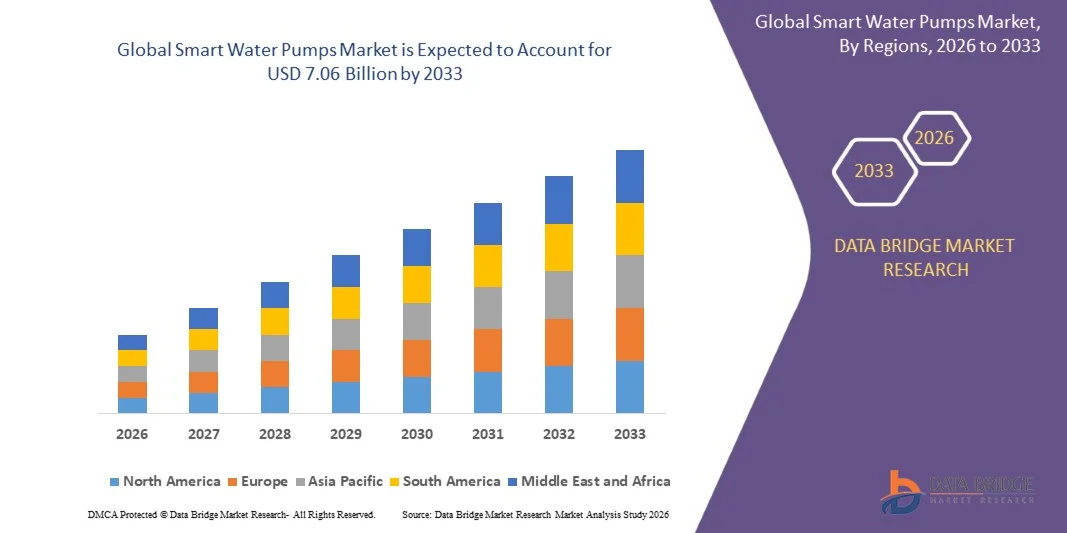
The Smart Water Pumps Market was valued at USD 4.02 Billion in 2025 and is projected to reach USD 7.06 Billion by 2033, growing at a CAGR of 7.3% from 2026 to 2033. The market is experiencing consistent growth driven by increasing demand for intelligent water management systems, rising adoption of IoT-enabled pumping solutions, and growing investments in smart city and water infrastructure modernization projects. Expanding deployment of energy-efficient pumping systems and advancements in predictive maintenance and real-time monitoring technologies are further supporting market expansion across municipal, industrial, and agricultural applications.
The increasing global focus on water conservation, operational efficiency, and sustainable resource management, combined with rising pressure on aging water infrastructure, is driving adoption of smart water pumps across utilities and industries. Integration of digital technologies such as AI-based analytics, remote monitoring, and automated control systems is replacing traditional pumping operations, helping reduce water losses, energy consumption, and maintenance costs while improving overall system reliability and performance.
Key Market Trends & Insights
- Asia-Pacific dominated the Smart Water Pumps Market with the largest revenue share of 45% in 2025, supported by rapid urbanization, expanding industrial infrastructure, and large-scale deployment of smart water management systems across municipal and industrial sectors
- The centrifugal pumps segment led the market with a 65% share in 2025, driven by its wide deployment in municipal water distribution and large-scale industrial fluid handling systems
- North America is expected to be the fastest-growing region at a CAGR of 10.9% from 2026 to 2033, fueled by rapid adoption of advanced water management technologies, strong industrial automation, and increasing investments in smart infrastructure
- Oil & gas industry are the fastest-growing application type, projected to register a CAGR of 10.5% from 2026 to 2033, supported by increasing adoption of intelligent pumping systems in upstream and midstream operations
- The water & wastewater industry segment dominated the application category with a 38% revenue share in 2025, led by large-scale municipal infrastructure upgrades and increasing demand for efficient water management systems
- The positive displacement pump segment is the fastest-growing product type category, with a CAGR of 9.8% from 2026 to 2033, driven by rising demand for precise flow control in high-viscosity and high-pressure applications
Market Size & Forecast
- Global Market Value (2025): USD 4.02 Billion
- Expected Market Value (2033): USD 7.06 Billion
- Forecast CAGR (2026–2033): 7.3%
- Leading Region in 2025: Asia-Pacific
- Fastest Growing Region: North America
Report Scope and Smart Water Pumps Market Segmentation
|
Attributes |
Smart Water Pumps Key Market Insights |
|
Segments Covered |
|
|
Countries Covered |
North America · U.S. · Canada · Mexico Europe · Germany · France · U.K. · Netherlands · Switzerland · Belgium · Russia · Italy · Spain · Turkey · Rest of Europe Asia-Pacific · China · Japan · India · South Korea · Singapore · Malaysia · Australia · Thailand · Indonesia · Philippines · Rest of Asia-Pacific Middle East and Africa · Saudi Arabia · U.A.E. · South Africa · Egypt · Israel · Rest of Middle East and Africa South America · Brazil · Argentina · Rest of South America |
|
Key Market Players |
· Colfax Corporation (U.S.) · Flowserve Corporation (U.S.) · GRUNWL (Germany) · GRUNDFOS (Denmark) · ITT Inc. (U.S.) · KSB SE & Co. KGaA (Germany) · Kirloskar Brothers Limited (India) · Pentair plc (U.K.) · Regal Beloit Corporation (U.S.) · SEEPEX GmbH (Germany) · Spirax-Sarco Engineering plc (U.K.) · Sulzer Ltd (Switzerland) · WILO SE (Germany) · Xylem Inc. (U.S.) · Yaskawa America, Inc. (U.S.) |
|
Market Opportunities |
· Expansion of Smart City and Urban Water Infrastructure Projects · Growing Deployment in Agricultural Irrigation Modernization Systems · Increasing Adoption in Industrial Water Recycling and Wastewater Treatment Applications |
|
Value Added Data Infosets |
In addition to the insights on market scenarios such as market value, growth rate, segmentation, geographical coverage, and major players, the market reports curated by the Data Bridge Market Research also include in-depth expert analysis, pricing analysis, brand share analysis, consumer survey, demography analysis, supply chain analysis, value chain analysis, raw material/consumables overview, vendor selection criteria, PESTLE Analysis, Porter Analysis, and regulatory framework. |
Smart Water Pumps Market Trends
Trend: Increasing Adoption of IoT-Enabled Predictive Maintenance in Water Infrastructure
Smart Water Pumps are increasingly integrating IoT-based sensors and cloud analytics to enable real-time monitoring, fault detection, and predictive maintenance across water distribution systems. This trend is reducing unplanned downtime, improving asset lifespan, and optimizing energy consumption in municipal and industrial pumping networks. Utilities are deploying smart monitoring platforms to enhance operational visibility and minimize water losses in aging infrastructure.
For instance, Xylem’s “Flygt SmartRun” and digital monitoring solutions are widely used in wastewater pumping stations across Europe and North America to enable condition-based maintenance and improve system reliability through continuous performance tracking.
Smart Water Pumps Market Dynamics
Key Market Driver: Rising Demand for Energy-Efficient and Smart Water Management Systems
The increasing global focus on energy efficiency and sustainable water usage is significantly driving demand for smart water pumps equipped with automation and digital control capabilities. These systems help reduce electricity consumption, optimize flow rates, and improve operational efficiency in water supply and wastewater networks. Governments and utilities are investing heavily in smart infrastructure upgrades to address rising water scarcity and aging pipeline systems.
Companies such as Grundfos are advancing energy-efficient pumping solutions with integrated digital monitoring platforms such as Grundfos iSOLUTIONS, enabling optimized pump performance and reduced lifecycle energy costs across municipal water systems.
Key Restraint/Challenge: High Initial Installation and Integration Cost of Smart Pumping Solutions
The adoption of smart water pumps is constrained by high upfront costs associated with IoT integration, sensor deployment, software platforms, and system modernization of existing infrastructure. Small municipalities and developing regions often face budget limitations that delay large-scale implementation of intelligent pumping systems. Integration with legacy water networks also increases engineering complexity and project execution costs.
For instance, deployment of advanced smart wastewater monitoring systems in large urban utilities such as Thames Water in the U.K. involves significant investment in digital infrastructure upgrades, remote monitoring platforms, and control system modernization.
Key Market Opportunity: Expansion of Smart City and Urban Water Infrastructure Projects
Rapid growth in smart city initiatives is creating strong opportunities for smart water pump deployment in urban water distribution, wastewater management, and flood control systems. Governments are increasingly integrating intelligent pumping solutions into city-wide digital infrastructure to improve water efficiency, reduce leakage, and enhance service reliability. Expanding urbanization and infrastructure modernization programs are further accelerating adoption across developing economies.
For instance, India’s Smart Cities Mission has driven the deployment of advanced water management systems in cities such as Pune and Surat, where IoT-enabled pumping and monitoring systems are improving water distribution efficiency and reducing non-revenue water losses.
Smart Water Pumps Market Scope
The smart water pumps market is segmented on the basis of product type and application.
- By Product Type
On the basis of product type, the Smart Water Pumps Market is segmented into centrifugal pumps and positive displacement pumps. The centrifugal pumps segment dominated the market with the largest share of 65% in 2025, supported by its wide deployment in municipal water distribution and large-scale industrial fluid handling systems. These pumps are preferred due to their high efficiency in continuous flow applications and lower maintenance requirements. Strong adoption across water and wastewater infrastructure modernization programs further reinforces segment leadership. Increasing integration of IoT-enabled monitoring systems in centrifugal pumps is improving operational reliability and driving demand across developed and emerging economies.
The positive displacement pumps segment is projected to register the fastest growth at a CAGR of 9.8% from 2026 to 2033, driven by rising demand for precise flow control in high-viscosity and high-pressure applications. These pumps are increasingly used in oil and gas processing, chemical dosing, and specialized industrial operations requiring accurate fluid handling. Advancements in smart control systems and predictive maintenance capabilities are enhancing their operational efficiency. Growing industrial automation and digitalization trends are further accelerating adoption across process-intensive sectors. Expanding use in energy-efficient pumping solutions is expected to sustain strong growth momentum over the forecast period.
- By Application
On the basis of application, the Smart Water Pumps Market is segmented into oil & gas industry, water & wastewater industry, power industry, chemical industry, and general industry. The water & wastewater industry segment dominated the market with a share of 38% in 2025, driven by large-scale municipal infrastructure upgrades and increasing demand for efficient water management systems. Smart pumps are widely deployed for leak detection, pressure optimization, and real-time monitoring in urban water networks. Government initiatives focused on water conservation and sustainable resource utilization further strengthen segment growth. Continuous expansion of smart city projects across developing regions is reinforcing the leading position of this segment.
The oil & gas industry segment is projected to register the fastest growth at a CAGR of 10.5% from 2026 to 2033, driven by increasing adoption of intelligent pumping systems in upstream and midstream operations. These systems enable enhanced monitoring of fluid transfer processes and improve operational safety in harsh offshore and onshore environments. Rising focus on energy efficiency and digital transformation in oilfield operations is supporting wider deployment. Integration of predictive analytics and remote monitoring technologies is further optimizing performance. Expanding investment in automation across global energy infrastructure is expected to accelerate segment growth significantly.
Smart Water Pumps Market Regional Analysis
Asia-Pacific dominated the smart water pumps market and accounted for the largest revenue share of 45% in 2025, supported by rapid urbanization, expanding industrial infrastructure, and large-scale deployment of smart water management systems across municipal and industrial sectors. The region benefits from strong investments in water supply modernization, smart city initiatives, and increasing adoption of IoT-enabled pumping solutions for efficient resource utilization. Growing water scarcity concerns, rising industrial automation, and government-led digital infrastructure programs are further accelerating regional market expansion across key economies.
China Smart Water Pumps Market Insight
China held the largest share in the Asia-Pacific Smart Water Pumps market in 2025, driven by extensive deployment in municipal water distribution networks, industrial manufacturing facilities, and large-scale infrastructure projects. The country’s strong focus on smart city development and water conservation initiatives is significantly boosting adoption of intelligent pumping systems. Integration of AI-based monitoring, predictive maintenance technologies, and industrial IoT platforms is enhancing operational efficiency. In addition, rapid expansion of wastewater treatment capacity and water recycling systems is reinforcing China’s leadership in regional market growth.
India Smart Water Pumps Market Insight
India is witnessing the fastest growth in the Asia-Pacific region, projected to expand at a CAGR of 11.2% from 2026 to 2033, driven by rising investments in urban water infrastructure, agricultural irrigation modernization, and smart city projects. Increasing demand for energy-efficient pumping systems in water supply and wastewater management is significantly supporting market adoption. Government initiatives focused on water conservation, digital infrastructure development, and rural water accessibility are further strengthening growth. In addition, expanding industrialization and growing penetration of smart IoT-based pump monitoring solutions are accelerating long-term market expansion.
Europe Smart Water Pumps Market Insight
The Europe Smart Water Pumps market is expanding steadily, supported by strong emphasis on energy efficiency regulations, water conservation policies, and modernization of aging water infrastructure. Increasing adoption of smart monitoring systems in municipal water networks and industrial facilities is enhancing operational efficiency and reducing water losses. Demand from industries such as chemicals, power generation, and food processing is further supporting market growth. In addition, rising integration of digital twin technology and predictive maintenance solutions is strengthening regional adoption of advanced smart pumping systems.
Germany Smart Water Pumps Market Insight
Germany accounted for the largest share in the Europe Smart Water Pumps market in 2025, driven by advanced industrial automation, strong municipal water infrastructure, and high adoption of energy-efficient technologies. The country’s focus on sustainability and strict regulatory standards for water usage efficiency are boosting deployment of smart pumping systems. Integration of Industry 4.0 technologies in manufacturing and utilities is further enhancing system performance. In addition, strong presence of leading engineering and automation companies is reinforcing Germany’s leadership in the regional market.
U.K. Smart Water Pumps Market Insight
The U.K. market is supported by increasing investments in water infrastructure modernization, leakage reduction programs, and digital transformation of utility networks. Rising demand for real-time monitoring and remote-control pumping systems is driving adoption across municipal and industrial sectors. Growing focus on sustainability and carbon reduction targets is further encouraging deployment of energy-efficient smart pumps. In addition, expansion of smart city initiatives and upgraded wastewater treatment systems is strengthening market growth across the country.
North America Smart Water Pumps Market Insight
North America is projected to grow at the fastest CAGR of 10.9% from 2026 to 2033, driven by rapid adoption of advanced water management technologies, strong industrial automation, and increasing investments in smart infrastructure. Rising concerns over water scarcity and aging water distribution systems are accelerating deployment of intelligent pumping solutions. High demand from oil & gas, power, and municipal sectors is further supporting regional expansion. In addition, widespread integration of IoT, cloud-based monitoring, and predictive analytics is enhancing system efficiency and boosting market growth.
U.S. Smart Water Pumps Market Insight
The U.S. accounted for the largest share in the North America Smart Water Pumps market in 2025, supported by strong municipal infrastructure upgrades, extensive industrial applications, and early adoption of smart water technologies. The country benefits from advanced digital infrastructure and high penetration of IoT-based monitoring systems in water utilities. Increasing focus on reducing water losses, improving energy efficiency, and optimizing operational performance is further driving demand. In addition, strong presence of leading technology providers and utility modernization programs is reinforcing the U.S. leadership position in the regional market.
Smart Water Pumps Market Share
The smart water pumps industry is primarily led by well-established companies, including:
- Colfax Corporation (U.S.)
- Flowserve Corporation (U.S.)
- GRUNWL (Germany)
- GRUNDFOS (Denmark)
- ITT Inc. (U.S.)
- KSB SE & Co. KGaA (Germany)
- Kirloskar Brothers Limited (India)
- Pentair plc (U.K.)
- Regal Beloit Corporation (U.S.)
- SEEPEX GmbH (Germany)
- Spirax-Sarco Engineering plc (U.K.)
- Sulzer Ltd (Switzerland)
- WILO SE (Germany)
- Xylem Inc. (U.S.)
- Yaskawa America, Inc. (U.S.)
Latest Developments in Smart Water Pumps Market
- In May 2025, Grundfos enhanced its smart wastewater management capabilities through the expansion of its digital pump ecosystem with new connectivity solutions and intelligent monitoring platforms. This development strengthens the Smart Water Pumps market by improving real-time operational visibility, enabling predictive maintenance, and reducing system downtime in municipal and industrial wastewater networks. It also accelerates the shift toward fully integrated smart water infrastructure by combining IoT-enabled pumps with advanced analytics for optimized flow control and energy efficiency. The move further reinforces digital transformation across water utilities, supporting long-term demand for connected pumping systems
- In October 2024, Sulzer introduced its next-generation high-efficiency pump solution designed to optimize energy consumption and improve fluid handling performance in water and industrial applications. This launch positively impacts the Smart Water Pumps market by addressing rising demand for energy-efficient and low-operational-cost pumping systems across utilities and process industries. The improved hydraulic design and efficiency enhancements help reduce lifecycle costs and support sustainability goals. It also strengthens adoption of smart pump technologies in infrastructure modernization projects focused on reducing carbon and energy footprints
- In May 2024, Grundfos completed the acquisition of the Commercial & Industrial water treatment business of Culligan across key European markets. This acquisition significantly impacts the Smart Water Pumps market by expanding integrated water treatment and pumping solutions under a unified smart water ecosystem. It enhances Grundfos’ ability to deliver end-to-end digital water management systems combining treatment, monitoring, and pumping optimization. The deal also strengthens market consolidation trends and accelerates adoption of smart, data-driven water infrastructure solutions in industrial and municipal sectors
- In 2024, KSB increased its strategic investment in AI-omatic, expanding its stake to strengthen AI-driven predictive maintenance capabilities for pump systems. This development boosts the Smart Water Pumps market by advancing artificial intelligence integration into pump monitoring and operational management systems. It enables early fault detection, reduces unplanned maintenance costs, and improves asset reliability across water and industrial applications. The initiative also reinforces the growing shift toward intelligent, self-optimizing pumping infrastructure supported by machine learning technologies
- In 2023, Xylem expanded its smart water ecosystem through a partnership with LORENTZ to scale deployment of solar-powered pumping solutions globally. This development positively influences the Smart Water Pumps market by combining renewable energy with intelligent pumping systems for off-grid and remote water applications. It improves water accessibility in agriculture and rural supply systems while reducing dependency on conventional power sources. The partnership also supports sustainability-driven adoption of hybrid smart pumping solutions across developing and energy-constrained regions
SKU-
Get online access to the report on the World's First Market Intelligence Cloud

- Interactive Data Analysis Dashboard
- Company Analysis Dashboard for high growth potential opportunities
- Research Analyst Access for customization & queries
- Competitor Analysis with Interactive dashboard
- Latest News, Updates & Trend analysis
- Harness the Power of Benchmark Analysis for Comprehensive Competitor Tracking
Research Methodology
Data collection and base year analysis are done using data collection modules with large sample sizes. The stage includes obtaining market information or related data through various sources and strategies. It includes examining and planning all the data acquired from the past in advance. It likewise envelops the examination of information inconsistencies seen across different information sources. The market data is analysed and estimated using market statistical and coherent models. Also, market share analysis and key trend analysis are the major success factors in the market report. To know more, please request an analyst call or drop down your inquiry.
The key research methodology used by DBMR research team is data triangulation which involves data mining, analysis of the impact of data variables on the market and primary (industry expert) validation. Data models include Vendor Positioning Grid, Market Time Line Analysis, Market Overview and Guide, Company Positioning Grid, Patent Analysis, Pricing Analysis, Company Market Share Analysis, Standards of Measurement, Global versus Regional and Vendor Share Analysis. To know more about the research methodology, drop in an inquiry to speak to our industry experts.
Customization Available
Data Bridge Market Research is a leader in advanced formative research. We take pride in servicing our existing and new customers with data and analysis that match and suits their goal. The report can be customized to include price trend analysis of target brands understanding the market for additional countries (ask for the list of countries), clinical trial results data, literature review, refurbished market and product base analysis. Market analysis of target competitors can be analyzed from technology-based analysis to market portfolio strategies. We can add as many competitors that you require data about in the format and data style you are looking for. Our team of analysts can also provide you data in crude raw excel files pivot tables (Fact book) or can assist you in creating presentations from the data sets available in the report.












