


What is the Smoke Ingredients Market Size and Overview?
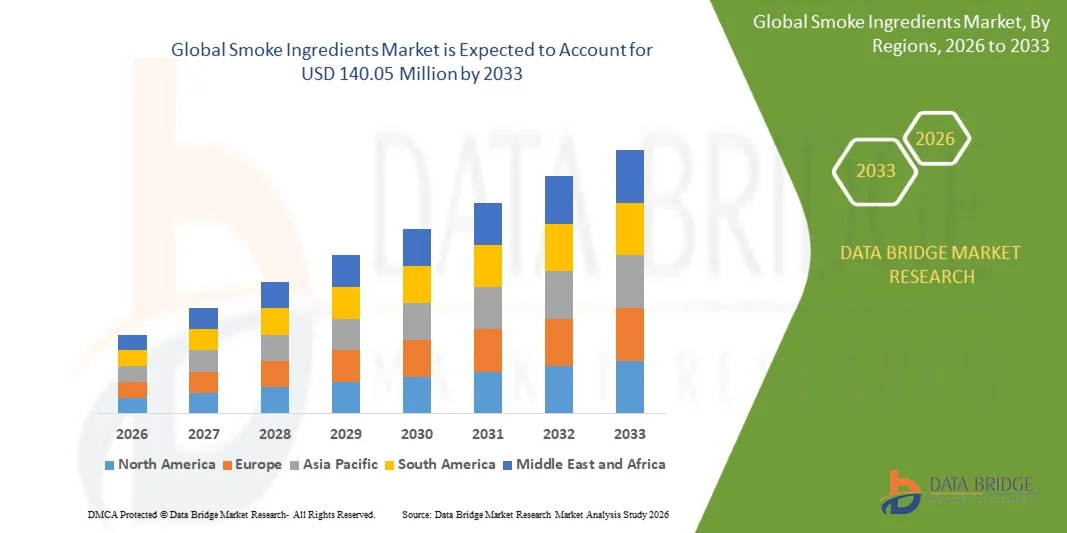
As per Data Bridge Market Research Analysis the global smoke ingredients market was valued at USD 87.21 million in 2025 and is projected to reach USD 140.05 million by 2033, growing at a CAGR of 6.10% from 2026 to 2033. The market is experiencing consistent growth driven by the expanding processed food sector, busy lifestyles increasing demand for ready-to-eat meals, and the growing popularity of barbecue and grilled cuisines.
Furthermore, the industry is witnessing a significant shift towards clean-label, natural ingredients, with manufacturers increasingly adopting naturally derived smoke flavorings that align with consumer health and wellness trends.
Market Size & Forecast
- Global Market Value (2025): USD 87.21 Million
- Expected Market Value (2033): USD 140.05 Million
- Forecast CAGR (2026–2033): 6.10%
- Leading Region in 2025: North America
- Fastest Growing Region: Asia-Pacific
Key Market Trends & Insights
- North America dominated the smoke ingredients market with the largest revenue share in 2025, supported by strong demand for processed meats, barbecue products, savory snacks, sauces, and ready-to-eat foods.
- Asia-Pacific smoke ingredients market is expected to witness the fastest growth rate from 2026 to 2033, supported by expanding food processing industries, rising disposable incomes, and increasing consumer interest in bold and internationally inspired flavors across China, Japan, India, and Southeast Asia.
- The hickory segment held the largest market revenue share in 2025, driven by its widespread use in processed meats, barbecue products, snacks, sauces, and ready-to-eat foods. Hickory smoke ingredients are preferred due to their strong, distinctive smoky profile and ability to deliver authentic grilled and wood-smoked flavors across diverse food formulations.
- The mesquite segment is projected to register the fastest growth at a CAGR from 2026 to 2033, driven by increasing consumer demand for bold, charred, and barbecue-inspired flavor profiles. Rising adoption of mesquite smoke ingredients in meat products, snacks, sauces, and plant-based foods is accelerating segment expansion.
- The meat and seafood segment held the largest market revenue share in 2025, driven by extensive use of smoke ingredients to enhance flavor, aroma, and sensory appeal in processed meats, poultry, fish, and seafood products. Smoke ingredients are preferred due to their ability to provide consistent smoked and grilled characteristics while supporting large-scale food processing.
- The snacks and sauces segment is projected to register the fastest growth at a CAGR from 2026 to 2033, driven by increasing demand for bold flavors, barbecue-inspired snacks, flavored sauces, and convenient ready-to-eat products. Rising adoption of smoky flavor profiles in chips, dips, condiments, and plant-based formulations is accelerating segment expansion.
Report Scope and Smoke Ingredients Market Segmentation
|
Attributes |
Smoke Ingredients Market Insights |
|
Segments Covered |
|
|
Countries Covered |
North America
Europe
Asia-Pacific
Middle East and Africa
South America
|
|
Key Market Players |
|
|
Market Opportunities |
|
|
Value Added Data Infosets |
In addition to the insights on market scenarios such as market value, growth rate, segmentation, geographical coverage, and major players, the market reports curated by the Data Bridge Market Research also include in-depth expert analysis, pricing analysis, brand share analysis, consumer survey, demography analysis, supply chain analysis, value chain analysis, raw material/consumables overview, vendor selection criteria, PESTLE Analysis, Porter Analysis, and regulatory framework. |
What is the Key Trend in the Smoke Ingredients Market?
Trend: Rising Demand For Authentic And Clean-Label Smoke Flavors
Growing consumer preference for authentic, bold, and distinctive flavors is accelerating the adoption of smoke ingredients across the food and beverage industry. Food manufacturers are increasingly incorporating smoke flavors, smoke condensates, smoked sugars, smoked vinegar, smoked garlic, and other smoke-derived ingredients into processed meats, snacks, sauces, ready meals, plant-based foods, and condiments to deliver charred and fire-cooked taste profiles. Increasing demand for natural flavor declarations, consistent taste, and convenient flavor solutions is further strengthening the use of smoke ingredients across commercial food applications.
The rapid expansion of barbecue-inspired foods, premium savory snacks, plant-based meat alternatives, and globally inspired flavors is creating sustained demand for smoke ingredients across food manufacturing. For instance, in October 2025, Kerry highlighted that Europe accounted for 47% of global savory new product launches featuring smoke or roasted notes, while BBQ-flavored snacks ranked fifth in new product development. The company also highlighted the growing need for compliant smoke solutions as European regulations on smoke flavorings change from July 2026.
The growing shift toward authentic flavor experiences and continued development of clean-label smoke solutions are expected to reinforce long-term demand for smoke ingredients, positioning manufacturers to benefit from increasing consumption of premium, savory, and fire-inspired food products.
Smoke Ingredients Market Dynamics
Key Market Driver: Increasing Consumer Demand For Authentic And Bold Flavor Profiles
The food industry continues to experience rising demand for products that provide distinctive taste experiences, ingredient transparency, and culinary authenticity. Consumers are increasingly choosing smoky, grilled, charred, and barbecue-inspired foods, encouraging manufacturers to expand product portfolios utilizing smoke ingredients across snacks, processed meats, sauces, ready meals, and plant-based foods.
Major flavor manufacturers continue investing in smoke and grill solutions to meet evolving consumer preferences. According to IFF's February 2025 flavor trend report, global consumers are increasingly embracing familiar and emerging flavor profiles, while the company's smoke and grill portfolio provides scalable solutions ranging from mesquite and applewood to charcoal and grilled meat profiles. IFF also offers smoke-free smoke flavors designed to recreate authentic smoke signatures when traditional smoke inputs are restricted.
As consumer interest in bold, authentic, and globally inspired flavors continues to expand, smoke ingredient manufacturers are expected to benefit from sustained demand driven by barbecue trends, premium savory products, plant-based foods, and clean-label flavor development worldwide.
Key Restraint/Challenge: Stringent Regulations On Smoke Flavorings And Food Safety Requirement
Smoke ingredient manufacturers face increasing regulatory requirements related to the safety, composition, labeling, and permitted use of smoke flavorings. Regulatory changes can require food manufacturers to reformulate products, qualify alternative ingredients, conduct additional testing, and modify production processes, increasing development costs and creating uncertainty for suppliers serving highly regulated markets.
In addition, manufacturers must maintain authentic smoky taste while complying with evolving regulations and consumer expectations. Kerry reported that, from July 1, 2026, currently authorized smoke flavorings will no longer be permitted in savory snacks in the European Union, requiring manufacturers to reformulate affected products. Kerry has responded by developing smoke type flavors, grill flavors, and smoked ingredients designed to provide compliant alternatives while maintaining smoky taste characteristics.
Despite robust consumer demand, regulatory restrictions and reformulation requirements for smoke flavorings are expected to remain significant challenges, increasing compliance costs, product development requirements, and formulation complexity throughout the forecast period.
Key Market Opportunity: Expansion Of Smoke Ingredients In Plant-Based And Processed Food Application
Food manufacturers are increasingly developing products that replicate traditional cooking methods and premium culinary experiences while improving processing efficiency and meeting changing labeling requirements. Smoke ingredients offer significant opportunities due to their ability to provide authentic smoky, grilled, and charred profiles across meat, plant-based, snack, sauce, and ready-meal formulations, creating substantial long-term opportunities for ingredient suppliers globally.
Leading companies are strengthening investments in innovative smoke and grill technologies and compliant ingredient solutions. For instance, Kerry's smoke portfolio includes smoke condensates derived from wood species such as hickory, applewood, mesquite, pecan, beechwood, cherrywood, oak, and maple, alongside smoked sugar, smoked maltodextrin, smoked garlic powder, smoked onion powder, and smoked vinegar. The company also provides smoke solutions for plant-based foods, snacks, prepared meals, meat products, and foodservice applications.
As consumers increasingly seek authentic fire-cooked flavors and food manufacturers accelerate innovation in plant-based, processed, and premium savory products, expanding applications of smoke ingredients across snacks, processed meats, sauces, ready meals, meat alternatives, and condiments are expected to create substantial long-term growth opportunities for the smoke ingredients market.
How is the Smoke Ingredients Market Segmented?
The market is segmented on the basis of type, application, and form.
- By Type
On the basis of type, the smoke ingredients market is segmented into hickory, mesquite, applewood, and others. The hickory segment held the largest market revenue share in 2025, driven by its widespread use in processed meats, barbecue products, snacks, sauces, and ready-to-eat foods. Hickory smoke ingredients are preferred due to their strong, distinctive smoky profile and ability to deliver authentic grilled and wood-smoked flavors across diverse food formulations.
The mesquite segment is projected to register the fastest growth at a CAGR from 2026 to 2033, driven by increasing consumer demand for bold, charred, and barbecue-inspired flavor profiles. Rising adoption of mesquite smoke ingredients in meat products, snacks, sauces, and plant-based foods is accelerating segment expansion.
- By Application
On the basis of application, the smoke ingredients market is segmented into meat and seafood, snacks and sauces, pet food, bakery and confectionery, dairy products, and others. The meat and seafood segment held the largest market revenue share in 2025, driven by extensive use of smoke ingredients to enhance flavor, aroma, and sensory appeal in processed meats, poultry, fish, and seafood products. Smoke ingredients are preferred due to their ability to provide consistent smoked and grilled characteristics while supporting large-scale food processing.
The snacks and sauces segment is projected to register the fastest growth at a CAGR from 2026 to 2033, driven by increasing demand for bold flavors, barbecue-inspired snacks, flavored sauces, and convenient ready-to-eat products. Rising adoption of smoky flavor profiles in chips, dips, condiments, and plant-based formulations is accelerating segment expansion.
- By Form
On the basis of form, the smoke ingredients market is segmented into liquid, powder, oil, and others. The liquid segment held the largest market revenue share in 2025, driven by its widespread use in meat, seafood, sauces, snacks, and prepared food applications. Liquid smoke ingredients are preferred due to their ease of application, consistent flavor distribution, and compatibility with spraying, marinating, dipping, and blending processes.
The powder segment is projected to register the fastest growth at a CAGR from 2026 to 2033, driven by increasing demand for convenient dry flavoring solutions in snacks, seasonings, bakery products, sauces, and processed foods. Rising adoption of powdered smoke ingredients due to their ease of handling, storage stability, and suitability for dry formulations is accelerating segment expansion.
Which Region Holds the Largest Share of the Smoke Ingredients Market?
North America Smoke Ingredients Market Insight
North America dominated the smoke ingredients market with the largest revenue share in 2025, supported by strong demand for processed meats, barbecue products, savory snacks, sauces, and ready-to-eat foods. Consumers in the region increasingly prefer bold, grilled, smoked, and authentic flavor profiles, encouraging food manufacturers to incorporate smoke ingredients into diverse formulations. The region's well-established meat processing industry, advanced food manufacturing infrastructure, and presence of leading flavor ingredient suppliers further support market growth.
U.S. Smoke Ingredients Market Insight
U.S. smoke ingredients market captured the largest revenue share in 2025 within North America, fueled by strong consumer demand for barbecue, grilled, and smoked food products. Smoke ingredients are widely utilized across processed meats, seafood, snacks, sauces, and prepared foods to deliver consistent smoky flavor and aroma. Moreover, the growing popularity of premium savory products, plant-based meat alternatives, and convenient ready-to-eat foods is significantly contributing to the market's expansion.
Europe Smoke Ingredients Market Insight
Europe smoke ingredients market is expected to witness significant growth from 2026 to 2033, primarily driven by rising demand for authentic flavors, premium processed foods, and innovative savory products. Food manufacturers are increasingly utilizing smoke ingredients across meat, seafood, snacks, sauces, and plant-based applications to provide grilled and fire-cooked flavor profiles. In addition, growing consumer interest in natural and clean-label ingredients, alongside regulatory changes affecting traditional smoke flavorings, is encouraging the development of alternative smoke solutions across the region.
U.K. Smoke Ingredients Market Insight
U.K. smoke ingredients market is expected to witness strong growth from 2026 to 2033, driven by increasing consumer demand for barbecue, smoked, and globally inspired flavor profiles. The growing popularity of savory snacks, sauces, processed meats, and plant-based foods is encouraging manufacturers to utilize smoke ingredients for distinctive taste experiences. In addition, increasing demand for convenient and premium food products, alongside the development of compliant smoke flavor alternatives, is expected to continue stimulating market growth.
Germany Smoke Ingredients Market Insight
Germany smoke ingredients market is expected to witness steady growth from 2026 to 2033, fueled by strong demand for processed meats, sausages, savory snacks, sauces, and ready-to-eat food products. The country's established meat processing and food manufacturing industries support extensive use of smoke ingredients for flavor enhancement and product differentiation. Furthermore, increasing emphasis on food quality, ingredient transparency, and innovative flavor solutions is promoting the adoption of smoke ingredients across various food applications.
Asia-Pacific Smoke Ingredients Market Insight
The Asia-Pacific smoke ingredients market is expected to witness the fastest growth rate from 2026 to 2033, supported by expanding food processing industries, rising disposable incomes, and increasing consumer interest in bold and internationally inspired flavors across China, Japan, India, and Southeast Asia. The growing consumption of processed meats, snacks, sauces, ready meals, and convenience foods is creating new applications for smoke ingredients. Furthermore, the expansion of modern retail, foodservice, and packaged food industries is improving the accessibility and adoption of smoky flavor products across the region.
Japan Smoke Ingredients Market Insight
Japan smoke ingredients market is expected to witness significant growth from 2026 to 2033 due to increasing demand for premium food products, distinctive flavors, and convenient prepared foods. Japanese consumers place strong emphasis on quality and sensory characteristics, encouraging manufacturers to use smoke ingredients in seafood, meat products, sauces, snacks, and prepared meals. Moreover, growing interest in grilled and roasted flavor profiles and continued food product innovation are supporting the expansion of smoke ingredients across the country.
China Smoke Ingredients Market Insight
China smoke ingredients market accounted for the largest market revenue share in Asia Pacific in 2025, attributed to the country's expanding processed food industry, rising consumption of packaged foods, and increasing demand for diverse flavor profiles. Smoke ingredients are increasingly utilized in processed meats, snacks, sauces, seafood, and ready-to-eat products as manufacturers respond to growing consumer interest in bold and barbecue-inspired flavors. The expansion of food processing facilities, modern retail channels, and convenience food consumption are key factors propelling the market in China.
Which are the Top Companies in Smoke Ingredients Market?
The smoke ingredients industry is led by a mix of major global flavor and ingredient companies, including:
- Kerry Group plc (Ireland)
- International Flavors & Fragrances Inc. (U.S.)
- Azelis Group NV (Belgium)
- Sensient Technologies Corporation (U.S.)
- Besmoke Ltd (U.K.)
- Red Arrow International (U.S.)
- Lallemand Inc. (Canada)
- Bell Flavors & Fragrances, Inc. (U.S.)
- Lesaffre (France)
- MANE (France)
- MSK Ingredients Ltd (U.K.)
- Essentia Protein Solutions (U.S.)
- Ruitenberg Ingredients B.V. (Netherlands)
- Colgin, Inc. (U.S.)
- Stringer Flavour Ltd (U.K.)
What are Latest Developments in Smoke Ingredients Market?
- In March 2025, French plant extract manufacturer Plantex introduced Smok’EXTRACT, an innovative natural smoke flavouring designed as a safe and aromatic alternative to traditional smoke flavourings containing harmful polycyclic aromatic hydrocarbons (PAHs).
- In June 2024, I.T.S has launched a range of ‘smoke-free’ natural smoke flavorings as a compliant alternative for food and beverage manufacturers. These new natural flavors allow producers to legally incorporate smoky aromas without the need for complex on-pack labelling declarations, facilitating clean-label appeal.
- In January 2023, Azelis Holdings acquired Smoky Light B.V., an ingredients distributor in the BENELUX region. For the food and nutrition industries, Smoky Light B.V. provides smoke, grill, cooking flavors, browning agents, and additives. With this acquisition, Azelis aims to increase its market share in the Benelux region as well as throughout Europe, the Middle East, and Africa for smoke ingredients.

- Interactive Data Analysis Dashboard
- Company Analysis Dashboard for high growth potential opportunities
- Research Analyst Access for customization & queries
- Competitor Analysis with Interactive dashboard
- Latest News, Updates & Trend analysis
- Harness the Power of Benchmark Analysis for Comprehensive Competitor Tracking
Global Smoke Ingredients Market, Supply Chain Analysis and Ecosystem Framework
To support market growth and help clients navigate the impact of geopolitical shifts, DBMR has integrated in-depth supply chain analysis into its Global Smoke Ingredients Market research reports. This addition empowers clients to respond effectively to global changes affecting their industries. The supply chain analysis section includes detailed insights such as Global Smoke Ingredients Market consumption and production by country, price trend analysis, the impact of tariffs and geopolitical developments, and import and export trends by country and HSN code. It also highlights major suppliers with data on production capacity and company profiles, as well as key importers and exporters. In addition to research, DBMR offers specialized supply chain consulting services backed by over a decade of experience, providing solutions like supplier discovery, supplier risk assessment, price trend analysis, impact evaluation of inflation and trade route changes, and comprehensive market trend analysis.
Data collection and base year analysis are done using data collection modules with large sample sizes. The stage includes obtaining market information or related data through various sources and strategies. It includes examining and planning all the data acquired from the past in advance. It likewise envelops the examination of information inconsistencies seen across different information sources. The market data is analysed and estimated using market statistical and coherent models. Also, market share analysis and key trend analysis are the major success factors in the market report. To know more, please request an analyst call or drop down your inquiry.
The key research methodology used by DBMR research team is data triangulation which involves data mining, analysis of the impact of data variables on the market and primary (industry expert) validation. Data models include Vendor Positioning Grid, Market Time Line Analysis, Market Overview and Guide, Company Positioning Grid, Patent Analysis, Pricing Analysis, Company Market Share Analysis, Standards of Measurement, Global versus Regional and Vendor Share Analysis. To know more about the research methodology, drop in an inquiry to speak to our industry experts.
Data Bridge Market Research is a leader in advanced formative research. We take pride in servicing our existing and new customers with data and analysis that match and suits their goal. The report can be customized to include price trend analysis of target brands understanding the market for additional countries (ask for the list of countries), clinical trial results data, literature review, refurbished market and product base analysis. Market analysis of target competitors can be analyzed from technology-based analysis to market portfolio strategies. We can add as many competitors that you require data about in the format and data style you are looking for. Our team of analysts can also provide you data in crude raw excel files pivot tables (Fact book) or can assist you in creating presentations from the data sets available in the report.













