




Global Sodium Dodecyl Sulphate Polyacrylamide Gel Electrophoresis Market
Market Size in USD Million
CAGR :
% 
 USD
559.58 Million
USD
871.89 Million
2025
2033
USD
559.58 Million
USD
871.89 Million
2025
2033
 Forecast Period Forecast Period |
2026 –2033 |
 Market Size (Base Year) Market Size (Base Year) |
USD 559.58 Million |
 Market Size (Forecast Year) Market Size (Forecast Year) |
USD 871.89 Million |
 CAGR CAGR |
% |
| Major Markets Players |
|
Sodium Dodecyl Sulphate-Polyacrylamide Gel Electrophoresis (SDS-PAGE) Market Size
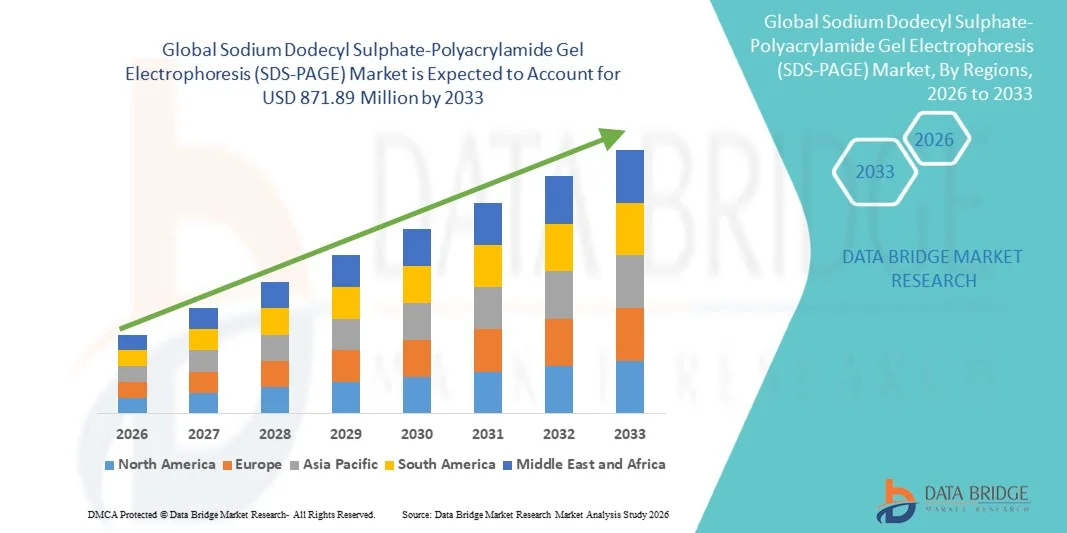
- The global sodium dodecyl sulphate-polyacrylamide gel electrophoresis (SDS-PAGE) market size was valued at USD 559.58 Million in 2025 and is expected to reach USD 871.89 Million by 2033, at a CAGR of 5.70% during the forecast period
- The market growth is largely fueled by the increasing demand for protein analysis and molecular biology research, leading to greater adoption of Sodium Dodecyl Sulphate-Polyacrylamide Gel Electrophoresis (SDS-PAGE) techniques across biotechnology companies, pharmaceutical laboratories, and academic research institutes
- Furthermore, rising investments in proteomics research, drug discovery, and life sciences studies are establishing SDS-PAGE as a fundamental laboratory technique for protein separation and characterization. These converging factors are accelerating the uptake of Sodium Dodecyl Sulphate-Polyacrylamide Gel Electrophoresis (SDS-PAGE) solutions, thereby significantly boosting the industry's growth
Sodium Dodecyl Sulphate-Polyacrylamide Gel Electrophoresis (SDS-PAGE) Market Analysis
- Sodium Dodecyl Sulphate-Polyacrylamide Gel Electrophoresis (SDS-PAGE), a widely used technique for protein separation and molecular weight analysis, is increasingly vital for modern life sciences and proteomics research across biotechnology companies, pharmaceutical laboratories, and academic research institutes due to its ability to provide precise protein characterization and analysis
- The escalating demand for SDS-PAGE is primarily fueled by the growing focus on proteomics research, increasing drug discovery activities, and the rising need for advanced protein analysis techniques in biotechnology and pharmaceutical industries
- North America dominated the sodium dodecyl sulphate-polyacrylamide gel electrophoresis (SDS-PAGE) market with the largest revenue share of approximately 41.2% in 2025, supported by strong research infrastructure, high investments in biotechnology and pharmaceutical R&D, and the presence of leading life sciences companies. The U.S. is experiencing substantial growth in SDS-PAGE adoption across research laboratories, biotechnology firms, and academic institutes due to increasing proteomics and molecular biology research activities
- Asia-Pacific is expected to be the fastest-growing region in the sodium dodecyl sulphate-polyacrylamide gel electrophoresis (SDS-PAGE) market during the forecast period, registering a CAGR of approximately 9.0%, driven by expanding biotechnology research, rising pharmaceutical R&D investments, and the rapid development of life sciences infrastructure in countries such as China, India, and Japan
- The reagents segment dominated the largest market revenue share of approximately 44.6% in 2025, driven by their essential role in protein separation and analysis workflows across laboratories and research facilities
Report Scope and Sodium Dodecyl Sulphate-Polyacrylamide Gel Electrophoresis (SDS-PAGE) Market Segmentation
|
Attributes |
Sodium Dodecyl Sulphate-Polyacrylamide Gel Electrophoresis (SDS-PAGE) Key Market Insights |
|
Segments Covered |
|
|
Countries Covered |
North America
Europe
Asia-Pacific
Middle East and Africa
South America
|
|
Key Market Players |
• Thermo Fisher Scientific Inc. (U.S.) |
|
Market Opportunities |
|
|
Value Added Data Infosets |
In addition to the insights on market scenarios such as market value, growth rate, segmentation, geographical coverage, and major players, the market reports curated by the Data Bridge Market Research also include in-depth expert analysis, patient epidemiology, pipeline analysis, pricing analysis, and regulatory framework. |
Sodium Dodecyl Sulphate-Polyacrylamide Gel Electrophoresis (SDS-PAGE) Market Trends
“Increasing Integration of Automation and Advanced Imaging in Protein Analysis”
- A significant and accelerating trend in the global sodium dodecyl sulphate-polyacrylamide gel electrophoresis (SDS-PAGE) market is the growing integration of automation, high-resolution imaging systems, and digital analysis platforms in laboratory workflows. This technological advancement is improving the efficiency, accuracy, and reproducibility of protein separation and analysis processes in research laboratories and diagnostic facilities
- For instance, several biotechnology companies are introducing automated electrophoresis systems capable of performing gel preparation, electrophoresis, staining, and imaging in a single integrated workflow. These systems significantly reduce manual intervention and minimize experimental variability. Automated gel documentation systems also allow researchers to capture and analyze protein bands with high precision
- Advanced imaging technologies and digital gel analysis software are increasingly being adopted to enhance protein visualization and quantification. Modern imaging systems enable high-resolution detection of protein bands, facilitating more accurate protein characterization in proteomics and molecular biology studies. These technologies also allow researchers to digitally store and analyze electrophoresis data for reproducibility and regulatory documentation
- Furthermore, integration of automated electrophoresis platforms with laboratory information management systems (LIMS) enables streamlined data management and efficient workflow optimization. Researchers can monitor experiments, analyze protein expression patterns, and share results across collaborative research teams through centralized digital platforms
- This trend toward automation and digitalization is transforming protein analysis workflows by improving throughput, reducing laboratory errors, and enhancing research productivity. As a result, biotechnology companies and academic research institutions are increasingly investing in advanced SDS-PAGE systems that offer improved precision and efficiency
- The demand for automated electrophoresis systems and advanced protein analysis tools is growing rapidly across pharmaceutical research, academic laboratories, and clinical research organizations as they seek faster and more reliable protein characterization techniques
Sodium Dodecyl Sulphate-Polyacrylamide Gel Electrophoresis (SDS-PAGE) Market Dynamics
Driver
“Growing Demand for Protein Analysis in Biotechnology and Pharmaceutical Research”
- The increasing demand for protein characterization and analysis in biotechnology, pharmaceutical research, and molecular biology studies is a major driver for the growth of the SDS-PAGE market. Protein electrophoresis techniques play a crucial role in studying protein structure, function, and expression patterns in biological samples
- For instance, the rapid expansion of proteomics research and drug discovery programs has significantly increased the demand for reliable protein separation techniques such as SDS-PAGE. Pharmaceutical companies frequently utilize SDS-PAGE to analyze protein purity, verify molecular weight, and monitor protein expression during drug development
- The growing number of research projects focused on biomarker discovery, vaccine development, and therapeutic protein production is further supporting the adoption of electrophoresis technologies in laboratories worldwide. SDS-PAGE remains a fundamental technique in protein analysis due to its simplicity, reliability, and cost-effectiveness
- In addition, academic institutions and research laboratories are increasingly using SDS-PAGE in molecular biology experiments, protein identification studies, and disease research. The availability of advanced reagents, pre-cast gels, and high-resolution electrophoresis equipment is further improving laboratory efficiency
- The rising prevalence of chronic diseases and the increasing demand for biologics and protein-based therapeutics are also driving research activities in the biotechnology sector. These developments are significantly increasing the demand for reliable protein analysis techniques such as SDS-PAGE
- Consequently, the expanding biotechnology and life sciences research ecosystem is expected to drive sustained growth in the SDS-PAGE market during the forecast period
Restraint/Challenge
“Limitations of Traditional Gel-Based Techniques and Availability of Alternative Technologies”
- Despite its widespread use, the SDS-PAGE market faces challenges due to limitations associated with traditional gel-based electrophoresis techniques. The process can be time-consuming and requires skilled laboratory personnel to perform multiple preparation and analysis steps accurately
- In addition, gel-based protein separation techniques may sometimes provide limited resolution for highly complex protein samples. Researchers working with large proteomic datasets may require more advanced analytical tools to obtain deeper insights into protein structures and interactions
- The increasing availability of advanced protein analysis technologies such as capillary electrophoresis, mass spectrometry, and automated protein analysis platforms is also creating competition for traditional SDS-PAGE techniques. These modern technologies often provide higher throughput, improved sensitivity, and automated workflows
- Furthermore, maintaining consistent gel quality and ensuring reproducible results can sometimes be challenging in manual SDS-PAGE procedures. Variability in gel preparation, staining, and electrophoresis conditions may affect the accuracy of experimental results
- Cost considerations related to laboratory equipment, reagents, and imaging systems can also present challenges for smaller research institutions or laboratories operating with limited budgets
- Overcoming these challenges through the development of automated electrophoresis systems, improved gel reagents, and advanced imaging technologies will be crucial for sustaining the adoption of SDS-PAGE in modern life sciences research
Sodium Dodecyl Sulphate-Polyacrylamide Gel Electrophoresis (SDS-PAGE) Market Scope
The market is segmented on the basis of product type and end-user.
• By Product Type
On the basis of product type, the Sodium Dodecyl Sulphate-Polyacrylamide Gel Electrophoresis (SDS-PAGE) market is segmented into gels, reagents, and instruments. The reagents segment dominated the largest market revenue share of approximately 44.6% in 2025, driven by their essential role in protein separation and analysis workflows across laboratories and research facilities. Reagents such as buffers, staining solutions, and electrophoresis chemicals are required for every SDS-PAGE experiment, resulting in consistent and repeated demand. Their frequent usage in routine laboratory protocols within biotechnology companies, pharmaceutical research laboratories, and academic institutions significantly contributes to their dominant market position. Additionally, advancements in high-purity reagents designed for enhanced protein resolution and reproducibility are further strengthening their adoption. The increasing volume of proteomics research and protein characterization studies is also driving continuous demand for SDS-PAGE reagents. Moreover, growing investments in life sciences research and increasing government funding for molecular biology studies are expanding the utilization of these reagents. The availability of ready-to-use reagent kits has also simplified laboratory workflows and improved experimental efficiency. Furthermore, the expansion of biotechnology startups and pharmaceutical R&D activities is increasing the consumption of SDS-PAGE reagents worldwide. Their relatively lower cost compared to instruments also supports wider accessibility among smaller research laboratories. As proteomics and molecular biology research continue to expand globally, the demand for high-quality SDS-PAGE reagents is expected to remain strong across various research environments.
The gels segment is anticipated to witness the fastest growth rate with a CAGR of approximately 8.7% from 2026 to 2033, fueled by increasing adoption of pre-cast gels that improve experimental consistency and reduce laboratory preparation time. Pre-cast gels offer enhanced convenience and reproducibility compared to traditional hand-cast gels, making them highly preferred among researchers conducting high-throughput protein analysis. These gels are increasingly utilized in biotechnology companies and academic laboratories involved in protein purification and molecular weight determination studies. In addition, pre-cast gels reduce the risk of preparation errors and contamination, improving the reliability of experimental outcomes. Their compatibility with automated electrophoresis systems is also supporting adoption in modern laboratories focused on workflow efficiency. The growing focus on proteomics, biomarker discovery, and therapeutic protein development is further driving demand for advanced gel systems. Manufacturers are also developing gels with improved polymer composition and gradient capabilities to enable better protein separation and resolution. Furthermore, the expansion of contract research organizations (CROs) and increasing collaborations between pharmaceutical companies and academic research institutions are boosting the utilization of SDS-PAGE gel products. As laboratories increasingly prioritize efficiency, accuracy, and reproducibility in protein analysis workflows, the gels segment is expected to experience strong growth during the forecast period.
• By End-User
On the basis of end-user, the Sodium Dodecyl Sulphate-Polyacrylamide Gel Electrophoresis (SDS-PAGE) market is segmented into clinical research, biotechnology and pharmaceutical industry, government agencies, and academic institutes. The biotechnology and pharmaceutical industry segment accounted for the largest market revenue share of approximately 42.3% in 2025, driven by extensive use of SDS-PAGE technologies in drug discovery, protein characterization, and quality control processes. Pharmaceutical companies rely heavily on SDS-PAGE techniques to analyze therapeutic proteins, monoclonal antibodies, and other biologics during research and development stages. The rapid expansion of biologics and biosimilars development has significantly increased the demand for protein analysis tools within pharmaceutical laboratories. Additionally, biotechnology companies frequently utilize SDS-PAGE for protein expression studies, enzyme analysis, and biomarker research. The growing number of biotechnology startups and increasing global investments in biopharmaceutical research are also strengthening the adoption of SDS-PAGE technologies. Furthermore, strict regulatory requirements for protein-based drug development require accurate analytical methods, which further supports the use of SDS-PAGE in pharmaceutical quality control laboratories. The increasing focus on personalized medicine and targeted therapeutics is also expanding protein research activities. As the global biopharmaceutical industry continues to grow, the demand for reliable protein separation techniques such as SDS-PAGE is expected to remain high within this end-user segment.
The academic institutes segment is expected to witness the fastest growth with a CAGR of approximately 9.1% from 2026 to 2033, supported by increasing academic research activities in molecular biology, proteomics, and genetic engineering. Universities and research institutes frequently use SDS-PAGE as a fundamental laboratory technique for studying protein structure, protein interactions, and gene expression. Growing government funding for scientific research and life sciences education is encouraging universities to expand laboratory capabilities and invest in advanced analytical technologies. In addition, the rising number of biotechnology and biomedical research programs in universities is increasing the demand for SDS-PAGE equipment and consumables. Academic researchers also utilize SDS-PAGE for experimental validation in various fields such as cancer biology, immunology, and microbiology. Collaborations between academic institutions and biotechnology companies are further boosting research activities involving protein analysis. Moreover, the increasing number of postgraduate research students and laboratory training programs is contributing to the rising utilization of SDS-PAGE technologies in academic laboratories. As global scientific research continues to expand, academic institutions are expected to play a crucial role in driving future growth in the SDS-PAGE market.
Sodium Dodecyl Sulphate-Polyacrylamide Gel Electrophoresis (SDS-PAGE) Market Regional Analysis
- North America dominated the Sodium Dodecyl Sulphate-Polyacrylamide Gel Electrophoresis (SDS-PAGE) market with the largest revenue share of approximately 41.2% in 2025, supported by strong research infrastructure, high investments in biotechnology and pharmaceutical R&D, and the presence of leading life sciences companies. The region benefits from a well-established network of biotechnology firms, pharmaceutical companies, and advanced research laboratories actively engaged in proteomics, molecular biology, and drug discovery studies
- For instance, research laboratories and biotechnology companies increasingly utilize SDS-PAGE systems and reagents developed by companies such as Bio‑Rad Laboratories and Thermo Fisher Scientific for protein separation, molecular weight determination, and biomarker research in various biomedical studies
- The U.S. is experiencing substantial growth in SDS-PAGE adoption across research laboratories, biotechnology firms, and academic institutes due to increasing proteomics and molecular biology research activities. Expanding government funding for biomedical research, growing collaborations between academic institutions and pharmaceutical companies, and rising investments in life sciences innovation are further supporting the market expansion across North America
U.S. Sodium Dodecyl Sulphate-Polyacrylamide Gel Electrophoresis (SDS-PAGE) Market Insight
The U.S. sodium dodecyl sulphate-polyacrylamide gel electrophoresis (SDS-PAGE) market captured the largest revenue share within North America in 2025, driven by strong biotechnology research capabilities and significant investments in pharmaceutical and life sciences innovation. Research institutes, biotechnology firms, and pharmaceutical companies widely utilize SDS-PAGE technology for protein analysis, drug discovery studies, and quality control in biologics development. The growing demand for advanced proteomics research, combined with increasing funding from government agencies such as the National Institutes of Health (NIH), is significantly contributing to market growth. In addition, collaborations between universities, biotechnology startups, and pharmaceutical companies are accelerating innovation in protein analysis technologies, further strengthening the adoption of SDS-PAGE systems across laboratories in the U.S.
Europe Sodium Dodecyl Sulphate-Polyacrylamide Gel Electrophoresis (SDS-PAGE) Market Insight
The Europe sodium dodecyl sulphate-polyacrylamide gel electrophoresis (SDS-PAGE) market is projected to expand at a substantial CAGR throughout the forecast period, primarily driven by increasing investments in life sciences research and growing pharmaceutical and biotechnology industries across the region. Countries such as Germany, the U.K., and France are actively investing in advanced research infrastructure and promoting molecular biology studies. In addition, rising interest in proteomics research, biomarker discovery, and drug development programs is encouraging the adoption of protein analysis technologies such as SDS-PAGE in research laboratories and academic institutions throughout Europe.
U.K. Sodium Dodecyl Sulphate-Polyacrylamide Gel Electrophoresis (SDS-PAGE) Market Insight
The U.K. sodium dodecyl sulphate-polyacrylamide gel electrophoresis (SDS-PAGE) market is anticipated to grow at a noteworthy CAGR during the forecast period, driven by strong academic research activities and increasing investments in biotechnology innovation. Universities and biomedical research institutes across the country frequently utilize SDS-PAGE technology for protein characterization, gene expression studies, and disease research. Additionally, government initiatives promoting biomedical research and collaborations between academic institutions and biotechnology companies are further contributing to the growth of the SDS-PAGE market in the U.K.
Germany Sodium Dodecyl Sulphate-Polyacrylamide Gel Electrophoresis (SDS-PAGE) Market Insight
The Germany sodium dodecyl sulphate-polyacrylamide gel electrophoresis (SDS-PAGE) market is expected to expand at a considerable CAGR during the forecast period, supported by the country’s well-developed biotechnology sector and strong investments in pharmaceutical research and development. Germany hosts numerous research institutes and biotechnology companies engaged in molecular biology and proteomics research. The presence of advanced laboratory infrastructure and strong government support for life sciences innovation are encouraging the widespread adoption of SDS-PAGE technologies across research laboratories and diagnostic centers.
Asia-Pacific Sodium Dodecyl Sulphate-Polyacrylamide Gel Electrophoresis (SDS-PAGE) Market Insight
The Asia-Pacific sodium dodecyl sulphate-polyacrylamide gel electrophoresis (SDS-PAGE) market is expected to be the fastest-growing region during the forecast period, registering a CAGR of approximately 9.0%, driven by expanding biotechnology research, rising pharmaceutical R&D investments, and the rapid development of life sciences infrastructure in countries such as China, India, and Japan. Governments across the region are increasing funding for scientific research and promoting biotechnology innovation, which is encouraging the adoption of advanced laboratory technologies. Furthermore, the expansion of pharmaceutical manufacturing and biotechnology startups is increasing the demand for protein analysis tools such as SDS-PAGE across research and industrial laboratories.
Japan Sodium Dodecyl Sulphate-Polyacrylamide Gel Electrophoresis (SDS-PAGE) Market Insight
The Japan sodium dodecyl sulphate-polyacrylamide gel electrophoresis (SDS-PAGE) market is gaining momentum due to the country’s strong research infrastructure and focus on biotechnology and biomedical innovation. Universities and research institutions actively conduct molecular biology and proteomics studies, driving the demand for protein analysis technologies. Additionally, Japan’s growing pharmaceutical industry and increasing investments in advanced drug discovery research are contributing to the expansion of SDS-PAGE adoption across laboratories.
China Sodium Dodecyl Sulphate-Polyacrylamide Gel Electrophoresis (SDS-PAGE) Market Insight
The China sodium dodecyl sulphate-polyacrylamide gel electrophoresis (SDS-PAGE) market accounted for the largest market revenue share in Asia Pacific in 2025, attributed to the country’s rapidly expanding biotechnology sector and increasing investments in scientific research. China has significantly increased funding for life sciences research and laboratory infrastructure, enabling greater adoption of advanced protein analysis technologies. Additionally, the presence of domestic biotechnology companies and increasing collaborations with international pharmaceutical firms are accelerating research activities, further driving demand for SDS-PAGE systems and reagents across the country.
Sodium Dodecyl Sulphate-Polyacrylamide Gel Electrophoresis (SDS-PAGE) Market Share
The Sodium Dodecyl Sulphate-Polyacrylamide Gel Electrophoresis (SDS-PAGE) industry is primarily led by well-established companies, including:
• Thermo Fisher Scientific Inc. (U.S.)
• Bio-Rad Laboratories, Inc. (U.S.)
• Merck KGaA (Germany)
• Agilent Technologies, Inc. (U.S.)
• PerkinElmer Inc. (U.S.)
• GE HealthCare Technologies Inc. (U.S.)
• Promega Corporation (U.S.)
• Abcam plc (U.K.)
• New England Biolabs (U.S.)
• GenScript Biotech Corporation (China)
• Lonza Group AG (Switzerland)
• Cytiva (U.S.)
• Harvard Bioscience, Inc. (U.S.)
• Creative Bioarray (U.S.)
• Biotium, Inc. (U.S.)
• ATTO Corporation (Japan)
• Lumiprobe Corporation (U.S.)
• Kaneka Corporation (Japan)
• Becton, Dickinson and Company (U.S.)
• Enzo Life Sciences, Inc. (U.S.)
Latest Developments in Global Sodium Dodecyl Sulphate-Polyacrylamide Gel Electrophoresis (SDS-PAGE) Market
- In June 2024, Thermo Fisher Scientific announced the launch of a high-throughput SDS-PAGE platform integrated with advanced analysis software, designed to accelerate protein separation and enable more efficient electrophoresis workflows in biotechnology and pharmaceutical research laboratories
- In July 2024, Bio‑Rad Laboratories introduced the ChemiDoc Go Imaging System, a compact gel and blot imaging solution designed to support SDS-PAGE and Western blot analysis. The system uses CMOS-based digital imaging technology to deliver high-sensitivity detection and improved visualization of protein bands, enhancing laboratory documentation and analysis capabilities
- In March 2025, Bio‑Rad Laboratories announced a strategic collaboration with Promega Corporation to co-develop integrated proteomics workflows combining SDS-PAGE separation technologies with downstream protein analysis tools. The collaboration aims to expand research capabilities and provide comprehensive solutions for protein characterization in life sciences research and drug development
SKU-
Get online access to the report on the World's First Market Intelligence Cloud

- Interactive Data Analysis Dashboard
- Company Analysis Dashboard for high growth potential opportunities
- Research Analyst Access for customization & queries
- Competitor Analysis with Interactive dashboard
- Latest News, Updates & Trend analysis
- Harness the Power of Benchmark Analysis for Comprehensive Competitor Tracking
Research Methodology
Data collection and base year analysis are done using data collection modules with large sample sizes. The stage includes obtaining market information or related data through various sources and strategies. It includes examining and planning all the data acquired from the past in advance. It likewise envelops the examination of information inconsistencies seen across different information sources. The market data is analysed and estimated using market statistical and coherent models. Also, market share analysis and key trend analysis are the major success factors in the market report. To know more, please request an analyst call or drop down your inquiry.
The key research methodology used by DBMR research team is data triangulation which involves data mining, analysis of the impact of data variables on the market and primary (industry expert) validation. Data models include Vendor Positioning Grid, Market Time Line Analysis, Market Overview and Guide, Company Positioning Grid, Patent Analysis, Pricing Analysis, Company Market Share Analysis, Standards of Measurement, Global versus Regional and Vendor Share Analysis. To know more about the research methodology, drop in an inquiry to speak to our industry experts.
Customization Available
Data Bridge Market Research is a leader in advanced formative research. We take pride in servicing our existing and new customers with data and analysis that match and suits their goal. The report can be customized to include price trend analysis of target brands understanding the market for additional countries (ask for the list of countries), clinical trial results data, literature review, refurbished market and product base analysis. Market analysis of target competitors can be analyzed from technology-based analysis to market portfolio strategies. We can add as many competitors that you require data about in the format and data style you are looking for. Our team of analysts can also provide you data in crude raw excel files pivot tables (Fact book) or can assist you in creating presentations from the data sets available in the report.












