Global Soil Monitoring Market
Market Size in USD Million
CAGR :
% 
 USD
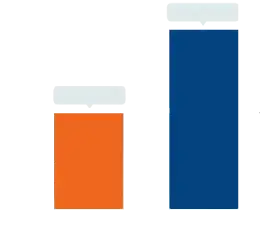
679.99 Million
USD
1,720.06 Million
2025
2033
USD
679.99 Million
USD
1,720.06 Million
2025
2033
 Forecast Period Forecast Period |
2026 –2033 |
 Market Size (Base Year) Market Size (Base Year) |
USD 679.99 Million |
 Market Size (Forecast Year) Market Size (Forecast Year) |
USD 1,720.06 Million |
 CAGR CAGR |
% |
| Major Markets Players |
|
Soil Monitoring Market Size
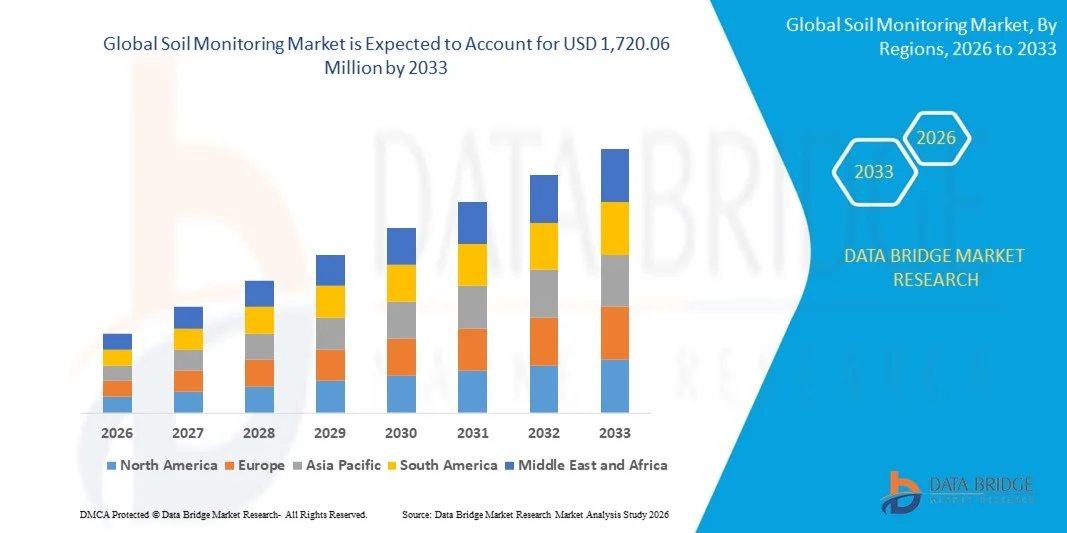
- The global soil monitoring market size was valued at USD 679.99 million in 2025 and is expected to reach USD 1,720.06 million by 2033, at a CAGR of 12.30% during the forecast period
- The market growth is largely fuelled by the increasing adoption of precision agriculture, rising demand for sustainable farming practices, and advancements in soil sensing technologies
Soil Monitoring Market Analysis
- Growing need for real-time soil data to optimize crop yield, improve resource efficiency, and reduce environmental impact is driving market adoption
- Technological innovations in IoT-enabled sensors, wireless monitoring systems, and AI-driven analytics are enhancing soil monitoring capabilities
- North America dominated the soil monitoring market with the largest revenue share of 38.50% in 2025, driven by the increasing adoption of precision agriculture, government initiatives promoting sustainable farming, and growing awareness of soil health management
- Asia-Pacific region is expected to witness the highest growth rate in the global soil monitoring market, driven by increasing investment in smart agriculture, rising food demand, technological advancements, and government initiatives supporting digital farming solutions
- The hardware segment held the largest market revenue share in 2025, driven by the increasing adoption of sensors and IoT-enabled devices for real-time soil data collection. Hardware solutions, including soil moisture sensors, nutrient analyzers, and pH meters, provide accurate and timely information, enabling precision farming and efficient resource management
Report Scope and Soil Monitoring Market Segmentation
|
Attributes |
Soil Monitoring Key Market Insights |
|
Segments Covered |
|
|
Countries Covered |
North America
Europe
Asia-Pacific
Middle East and Africa
South America
|
|
Key Market Players |
|
|
Market Opportunities |
|
|
Value Added Data Infosets |
In addition to the insights on market scenarios such as market value, growth rate, segmentation, geographical coverage, and major players, the market reports curated by the Data Bridge Market Research also include in-depth expert analysis, geographically represented company-wise production and capacity, network layouts of distributors and partners, detailed and updated price trend analysis and deficit analysis of supply chain and demand. |
Soil Monitoring Market Trends
Rising Adoption of Data-Driven Farming and Sustainable Practices
- Increasing emphasis on precision agriculture and smart farming is shaping the soil monitoring market, as farmers and agribusinesses adopt tools that provide real-time soil insights for improved crop management. Advanced soil sensors and IoT-enabled platforms help monitor moisture, nutrients, and pH levels to enhance yield and sustainability. These systems also support remote monitoring, enabling timely decisions and optimized resource use across large farms
- Demand for environmentally friendly farming practices is driving interest in soil monitoring solutions that optimize water use and minimize chemical inputs. Farmers are leveraging analytics platforms to implement targeted irrigation and fertilization, reducing runoff and conserving soil health. These solutions also contribute to regulatory compliance and sustainable certification for crops
- Governments and agritech companies are promoting soil health initiatives and digital agriculture solutions, influencing purchasing decisions and creating new market opportunities. Policy support, subsidies, and pilot projects in precision agriculture are encouraging farmers to invest in soil monitoring technologies. This trend is fostering collaborations between technology providers and agricultural research organizations
- For instance, in 2024, John Deere in the U.S. and Trimble in the Netherlands expanded their soil monitoring product lines to include smart sensors and analytics platforms. These solutions support sustainable crop management and precision farming adoption across commercial farms and agricultural service providers. They also integrate with farm management software to offer predictive insights for better yield planning
- The trend toward connected and automated soil monitoring systems is expected to continue, encouraging technology providers to innovate and enhance solution interoperability and functionality. Solutions with AI-driven analytics, cloud-based data storage, and wireless sensor networks are being increasingly adopted, helping farmers improve productivity and reduce operational risks
Soil Monitoring Market Dynamics
Driver
Growing Need for Enhanced Crop Productivity and Efficient Resource Management
- The rising demand for higher crop yields and efficient use of water, fertilizers, and nutrients is a major driver for the soil monitoring market. Farmers are deploying sensors and data analytics platforms to optimize soil conditions, reduce wastage, and increase profitability. These technologies allow precision targeting of resources, minimizing costs while maximizing output and soil health
- Expanding applications in agriculture, horticulture, and research are promoting market growth, as soil monitoring helps improve crop quality and soil fertility while supporting sustainability goals. Real-time data collection and predictive analytics enable farmers to detect nutrient deficiencies and moisture irregularities before they impact yield. The solutions are also being used in crop trials and research to develop climate-resilient varieties
- Integration of AI and machine learning in soil monitoring platforms enables predictive analytics for better decision-making in irrigation, fertilization, and crop rotation. Farmers can forecast crop growth trends, identify potential stress factors, and implement corrective measures proactively. This reduces operational risks and contributes to long-term farm productivity and sustainability
- For example, in 2023, Trimble in the Netherlands and AG Leader in the U.S. reported increased adoption of soil monitoring solutions to improve resource efficiency and operational performance in large-scale farms. Both companies emphasized integration with farm management systems and analytics dashboards for optimized decision-making. Their platforms also support remote access, allowing farm managers to monitor multiple sites efficiently
- Continued emphasis on maximizing productivity and reducing environmental impact will keep driving adoption of soil monitoring solutions globally. Governments and private organizations are investing in awareness campaigns, precision agriculture training, and smart farming initiatives, further boosting demand for soil monitoring technologies
Restraint/Challenge
High Cost and Limited Awareness Among Small-Scale Farmers
- The relatively high cost of soil monitoring systems compared to conventional farming methods remains a challenge, limiting adoption among smallholder farmers. Initial investment in sensors, connectivity, and analytics platforms can be prohibitive. Maintenance and calibration requirements further increase operational costs, particularly in regions with limited technical support
- Awareness of the functional benefits of soil monitoring is uneven, especially in developing regions where traditional practices dominate, slowing market penetration. Many farmers are unfamiliar with data-driven decision-making and may hesitate to adopt new technologies. Lack of training and localized support services exacerbates this adoption barrier
- Infrastructure and connectivity gaps affect the effectiveness of IoT-enabled soil monitoring solutions. Reliable internet, power supply, and sensor maintenance are critical for consistent data collection and analysis. Rural farms with limited digital infrastructure may face difficulties deploying these systems effectively, affecting the return on investment
- For instance, in 2024, small-scale farms in India and Southeast Asia reported limited adoption due to high costs, maintenance needs, and insufficient understanding of soil monitoring benefits. In addition, lack of integration with existing farm management practices limited operational efficiency. These factors slowed the growth of soil monitoring adoption in emerging markets
- Addressing these challenges will require cost-effective solutions, targeted awareness programs, and partnerships with government agencies, cooperatives, and technology providers to expand adoption. Training, financing options, and localized support services can help smallholder farmers leverage soil monitoring benefits effectively. Affordable and user-friendly solutions will be critical for widespread market penetration
Soil Monitoring Market Scope
The market is segmented on the basis of offering, system type, and application.
- By Offering
On the basis of offering, the soil monitoring market is segmented into hardware, software, and services. The hardware segment held the largest market revenue share in 2025, driven by the increasing adoption of sensors and IoT-enabled devices for real-time soil data collection. Hardware solutions, including soil moisture sensors, nutrient analyzers, and pH meters, provide accurate and timely information, enabling precision farming and efficient resource management.
The software segment is expected to witness the fastest growth rate from 2026 to 2033, driven by advanced analytics, data visualization, and cloud-based monitoring platforms. Software solutions allow users to interpret soil data, forecast crop performance, and make informed decisions, making them essential for modern agricultural practices and sustainable land management.
- By System Type
On the basis of system type, the market is segmented into sensing and imagery systems, ground-based monitoring systems, and others. Sensing and imagery systems held the largest share in 2025 due to the increasing use of satellite and drone-based technologies for large-scale soil health assessment. These systems offer extensive coverage, high-resolution data, and integration with GIS platforms, facilitating precision agriculture and environmental monitoring.
Ground-based monitoring systems are expected to grow rapidly from 2026 to 2033, supported by the rising demand for localized and high-accuracy soil measurements. These systems are widely used in farms, research institutes, and horticultural applications where precise soil parameters are critical for optimizing yield and quality.
- By Application
On the basis of application, the soil monitoring market is segmented into agricultural and non-agricultural. The agricultural segment dominated the market in 2025, driven by the increasing adoption of precision farming techniques and government initiatives promoting sustainable agriculture. Soil monitoring helps optimize irrigation, nutrient management, and crop planning, enhancing productivity and reducing environmental impact.
The non-agricultural segment is expected to witness significant growth during the forecast period, fueled by urban landscaping, construction, and environmental monitoring activities. Soil monitoring in non-agricultural applications ensures soil stability, contamination assessment, and sustainable land use practices.
Soil Monitoring Market Regional Analysis
- North America dominated the soil monitoring market with the largest revenue share of 38.50% in 2025, driven by the increasing adoption of precision agriculture, government initiatives promoting sustainable farming, and growing awareness of soil health management
- Farmers and agribusinesses in the region highly value the accuracy, real-time data insights, and integration capabilities offered by soil monitoring systems, enabling optimized irrigation, nutrient management, and crop planning
- This widespread adoption is further supported by advanced agricultural infrastructure, high investment in smart farming technologies, and a focus on maximizing yield and efficiency, establishing soil monitoring solutions as essential tools for modern agriculture
U.S. Soil Monitoring Market Insight
The U.S. soil monitoring market captured the largest revenue share in 2025 within North America, fueled by the rapid implementation of IoT-enabled sensors and data-driven farm management solutions. Farmers are increasingly prioritizing sustainable and efficient farming practices through continuous soil health monitoring. The rising adoption of cloud-based analytics platforms, coupled with precision agriculture techniques, further drives the market. Moreover, integration with automated irrigation systems and crop management software is significantly contributing to market expansion.
Europe Soil Monitoring Market Insight
The Europe soil monitoring market is expected to witness the fastest growth rate from 2026 to 2033, primarily driven by stringent environmental regulations and the increasing need for sustainable agriculture. The rise in organic farming, coupled with government subsidies and grants for smart farming technologies, is fostering the adoption of soil monitoring systems. European farmers are also drawn to the efficiency, resource optimization, and environmental benefits these systems provide. The market is expanding across crop farming, horticulture, and research applications, with soil monitoring being incorporated in both new and existing agricultural setups.
U.K. Soil Monitoring Market Insight
The U.K. soil monitoring market is expected to witness the fastest growth rate from 2026 to 2033, driven by the growing emphasis on precision agriculture and sustainable land management practices. In addition, concerns regarding soil degradation, nutrient depletion, and climate variability are encouraging adoption among farmers and agricultural consultants. The U.K.’s support for agri-tech innovation and digital farming platforms is expected to continue stimulating market growth.
Germany Soil Monitoring Market Insight
The Germany soil monitoring market is expected to witness the fastest growth rate from 2026 to 2033, fueled by increasing awareness of soil health, precision agriculture adoption, and technological advancements in sensing and analytics systems. Germany’s strong agricultural research infrastructure, combined with its focus on sustainability and innovation, promotes the use of soil monitoring systems across farms, research institutes, and industrial applications. Integration with automated farm management systems is also becoming more prevalent, supporting environmentally conscious and data-driven farming.
Asia-Pacific Soil Monitoring Market Insight
The Asia-Pacific soil monitoring market is expected to witness the fastest growth rate from 2026 to 2033, driven by increasing adoption of smart farming technologies, rising food demand, and government initiatives supporting sustainable agriculture in countries such as China, India, and Japan. The region’s growing focus on digital agriculture, coupled with advancements in sensor technologies and cost-effective solutions, is driving the adoption of soil monitoring systems. Moreover, APAC’s large agricultural base and increasing investment in precision farming technologies are expanding accessibility to both large-scale and smallholder farmers.
Japan Soil Monitoring Market Insight
The Japan soil monitoring market is expected to witness the fastest growth rate from 2026 to 2033 due to the country’s high-tech farming practices, focus on crop yield optimization, and demand for efficient land use. Japanese farmers are increasingly adopting IoT-enabled soil sensors and automated monitoring systems to ensure soil quality and resource-efficient farming. Integration with smart irrigation and crop management solutions is fueling growth, while government initiatives and research programs further support the market.
China Soil Monitoring Market Insight
The China soil monitoring market accounted for the largest revenue share in Asia-Pacific in 2025, attributed to rapid urbanization, government support for smart agriculture, and high adoption of precision farming technologies. China’s large agricultural sector and growing awareness of soil degradation and nutrient management are driving demand for soil monitoring systems. The push toward smart farms, availability of affordable sensor-based solutions, and strong domestic manufacturing capabilities are key factors propelling market growth in China
Soil Monitoring Market Share
The Soil Monitoring industry is primarily led by well-established companies, including:
- Stevens Water Monitoring Systems Inc. (U.S.)
- SGS SA (Switzerland)
- METER Group, Inc. (U.S.)
- Element Materials Technology (U.K.)
- The Toro Company (U.S.)
- Campbell Scientific, Inc. (U.S.)
- Sentek Technologies (Australia)
- Spectrum Technologies (U.S.)
- Irrometer Company, Inc. (U.S.)
- CropX Inc. (U.S.)
- Acclima, Inc. (U.S.)
- AquaCheck (U.K.)
- Caipos GmbH (Germany)
- Manx Technology Group (U.K.)
- Delta-T Devices Ltd. (U.K.)
- IMKO Micromodultechnik GmbH (Germany)
- Vegetronix (U.S.)
- AquaSpy (U.S.)
- Soil Scout Oy (Finland)
- E.S.I. Environmental Sensors, Inc. (U.S.)
Latest Developments in Global Soil Monitoring Market
- In February 2025, The Toro Company announced a partnership with TerraRad to develop the Spatial Adjust soil moisture monitoring software. The solution integrates with the Toro Lynx Central Control platform, enabling automated irrigation schedule adjustments based on real-time soil data. This innovation improves water efficiency, enhances turf and crop health, and strengthens Toro’s position in the precision irrigation market
- In January 2025, Lindsay Corporation acquired a 49.9% stake in Pessl Instruments to enhance its precision irrigation offerings. The integration of Pessl’s METOS soil monitoring systems with Lindsay’s FieldNET platform allows farmers to make data-driven irrigation decisions, boosting crop yields and operational efficiency
- In November 2024, EarthOptics secured USD 24 million in Series B funding to expand its soil digitization services. The investment will enable the company to strengthen its market presence and accelerate the deployment of advanced soil monitoring solutions for agricultural and environmental applications
- In May 2024, Stevens Water Monitoring Systems, Inc. acquired Dyacon’s weather instrument products, expanding its portfolio in soil analysis, agriculture, and environmental monitoring. This acquisition enhances Stevens’ capabilities in meteorology and precision soil monitoring, supporting early warning and data-driven farming solutions
- In April 2024, AGCO Corporation and Trimble completed a joint venture to establish PTx Trimble, combining soil monitoring systems with autonomous farm machinery. The venture enables farms to implement integrated, data-driven platforms for scalable and efficient precision agriculture
- In February 2024, CropX Technologies partnered with Syngenta to improve sustainability and yield performance for seed suppliers in the American Midwest. By collecting real-time soil and crop data via sensors and farm equipment, the solution provides actionable insights and analytics, enhancing farm productivity and resource efficiency
SKU-
Get online access to the report on the World's First Market Intelligence Cloud

- Interactive Data Analysis Dashboard
- Company Analysis Dashboard for high growth potential opportunities
- Research Analyst Access for customization & queries
- Competitor Analysis with Interactive dashboard
- Latest News, Updates & Trend analysis
- Harness the Power of Benchmark Analysis for Comprehensive Competitor Tracking
Global Soil Monitoring Market, Supply Chain Analysis and Ecosystem Framework
To support market growth and help clients navigate the impact of geopolitical shifts, DBMR has integrated in-depth supply chain analysis into its Global Soil Monitoring Market research reports. This addition empowers clients to respond effectively to global changes affecting their industries. The supply chain analysis section includes detailed insights such as Global Soil Monitoring Market consumption and production by country, price trend analysis, the impact of tariffs and geopolitical developments, and import and export trends by country and HSN code. It also highlights major suppliers with data on production capacity and company profiles, as well as key importers and exporters. In addition to research, DBMR offers specialized supply chain consulting services backed by over a decade of experience, providing solutions like supplier discovery, supplier risk assessment, price trend analysis, impact evaluation of inflation and trade route changes, and comprehensive market trend analysis.
Research Methodology
Data collection and base year analysis are done using data collection modules with large sample sizes. The stage includes obtaining market information or related data through various sources and strategies. It includes examining and planning all the data acquired from the past in advance. It likewise envelops the examination of information inconsistencies seen across different information sources. The market data is analysed and estimated using market statistical and coherent models. Also, market share analysis and key trend analysis are the major success factors in the market report. To know more, please request an analyst call or drop down your inquiry.
The key research methodology used by DBMR research team is data triangulation which involves data mining, analysis of the impact of data variables on the market and primary (industry expert) validation. Data models include Vendor Positioning Grid, Market Time Line Analysis, Market Overview and Guide, Company Positioning Grid, Patent Analysis, Pricing Analysis, Company Market Share Analysis, Standards of Measurement, Global versus Regional and Vendor Share Analysis. To know more about the research methodology, drop in an inquiry to speak to our industry experts.
Customization Available
Data Bridge Market Research is a leader in advanced formative research. We take pride in servicing our existing and new customers with data and analysis that match and suits their goal. The report can be customized to include price trend analysis of target brands understanding the market for additional countries (ask for the list of countries), clinical trial results data, literature review, refurbished market and product base analysis. Market analysis of target competitors can be analyzed from technology-based analysis to market portfolio strategies. We can add as many competitors that you require data about in the format and data style you are looking for. Our team of analysts can also provide you data in crude raw excel files pivot tables (Fact book) or can assist you in creating presentations from the data sets available in the report.