




Global Soil Treatment Market
Market Size in USD Billion

 USD
28.30 Billion
USD
52.95 Billion
2025
2033
USD
28.30 Billion
USD
52.95 Billion
2025
2033
 Forecast Period Forecast Period |
2026 - 2033 |
 Market Size (Base Year) Market Size (Base Year) |
USD 28.30 Billion |
 Market Size (Forecast Year) Market Size (Forecast Year) |
USD 52.95 Billion |
 CAGR CAGR |
% |
| Major Markets Players |
|
Soil Treatment Market Overview
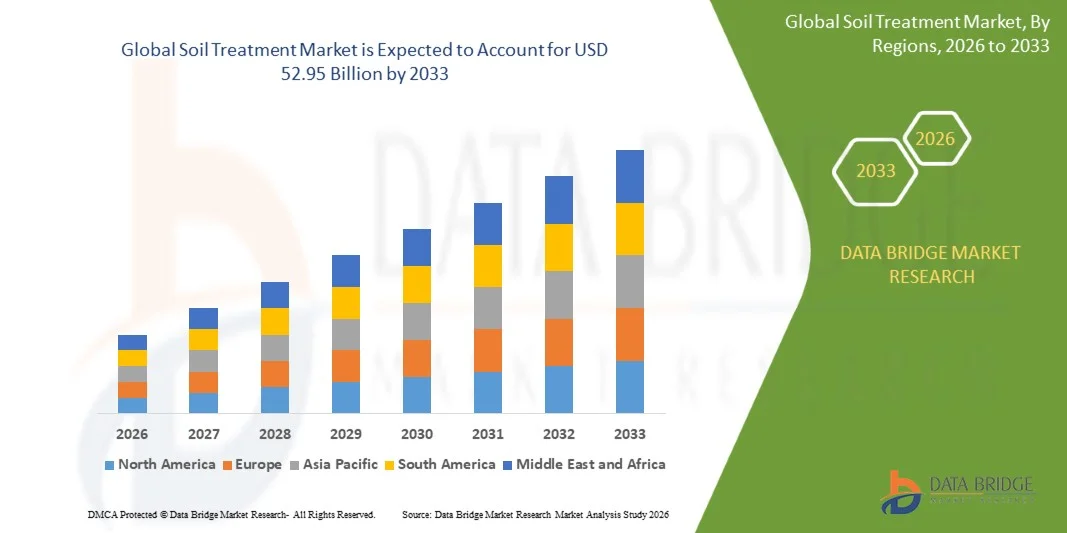
As per Data Bridge Market Research analysis the global soil treatment market was valued at USD 28.30 billion in 2025 and is projected to reach USD 52.95 billion by 2033, growing at a CAGR of 8.15% from 2026 to 2033. The market is experiencing steady growth driven by rising concerns regarding soil degradation, increasing adoption of sustainable agricultural practices, growing demand for soil fertility improvement solutions, and expanding applications of advanced soil remediation technologies.
The increasing impact of intensive farming, nutrient depletion, soil contamination, and climate-related challenges is encouraging farmers, agricultural organizations, and governments to adopt effective soil treatment solutions. Organic amendments, biological treatments, pH adjusters, and integrated soil management practices are gaining traction as sustainable alternatives to conventional approaches, helping improve soil health, enhance crop productivity, and support long-term agricultural sustainability. Furthermore, rising investments in regenerative agriculture, precision farming, and contaminated land restoration are creating new growth opportunities for soil treatment technologies across agricultural, forestry, and environmental applications.
Market Size & Forecast
- Global Market Value (2025): USD 28.30 Billion
- Expected Market Value (2033): USD 52.95 Billion
- Forecast CAGR (2026–2033): 8.15%
- Leading Region in 2025: North America
- Fastest Growing Region: Asia-Pacific
Key Market Trends & Insights
- North America accounted for a significant share of the global soil treatment market approximately 40.5% in 2025, supported by increasing adoption of sustainable agricultural practices, advanced soil management technologies, and growing awareness regarding soil health improvement.
- Asia-Pacific soil treatment market is expected to witness the fastest growth rate from 2026 to 2033 holding approximately 20.5% of the global share, supported by rising agricultural production, increasing food demand, rapid population growth, and growing awareness regarding soil health management.
- Organic amendments held the dominated position in 2025, driven by the increasing adoption of sustainable agriculture practices, rising preference for natural soil enrichment solutions, and growing demand for improving soil structure, moisture retention, and nutrient availability. The widespread utilization of compost, manure, biochar, and microbial-based soil conditioners across agricultural applications continues to support segment expansion.
- The pH adjusters segment is projected to register the fastest growth during the forecast period of 2026 to 2033, driven by increasing concerns related to acidic and saline soil degradation, expansion of precision agriculture practices, and rising awareness regarding optimal soil pH management. The growing adoption of lime-based and gypsum-based treatments to enhance nutrient absorption and improve crop productivity is expected to accelerate segment growth.
- Biochemical technology accounted for the largest market share in 2025, supported by increasing adoption of microbial soil treatment products, biological fertilizers, and environmentally sustainable agricultural practices. Rising regulatory focus on reducing chemical dependency and improving long-term soil health is further contributing to the adoption of biochemical solutions.
- The thermal segment is anticipated to witness the fastest growth from 2026 to 2033 owing to increasing demand for chemical-free soil sterilization methods, greenhouse cultivation, and high-value crop production. Advancements in thermal treatment technologies, including steam-based soil disinfection, are gaining traction due to their ability to control soil pathogens while minimizing environmental impact.
Report Scope and Soil Treatment Market Segmentation
|
Attributes |
Soil Treatment Key Market Insights |
|
Segments Covered |
|
|
Countries Covered |
North America
Europe
Asia-Pacific
Middle East and Africa
South America
|
|
Key Market Players |
|
|
Market Opportunities |
|
|
Value Added Data Infosets |
In addition to the insights on market scenarios such as market value, growth rate, segmentation, geographical coverage, and major players, the market reports curated by the Data Bridge Market Research also include import export analysis, production capacity overview, production consumption analysis, price trend analysis, climate change scenario, supply chain analysis, value chain analysis, raw material/consumables overview, vendor selection criteria, PESTLE Analysis, Porter Analysis, and regulatory framework. |
Soil Treatment Market Trends
Trend: Growth In Sustainable Soil Health Management And Advanced Biological Soil Treatment Solutions
Increasing demand for sustainable agriculture, regenerative farming, and soil restoration practices is accelerating the adoption of advanced soil treatment solutions across agricultural, environmental, and land restoration sectors. Conventional farming practices involving excessive chemical inputs and intensive cultivation are contributing to soil degradation, nutrient imbalance, and reduced soil biodiversity, encouraging the adoption of organic amendments, biological treatments, and integrated soil management approaches.
Modern agriculture is increasingly focusing on improving soil fertility, microbial activity, carbon retention, and water management through advanced soil treatment solutions. For instance, the Food and Agriculture Organization (FAO) established the Global Soil Partnership to promote sustainable soil management, improve soil governance, and support global initiatives related to soil fertility, soil pollution, soil salinity, and soil conservation. This initiative is encouraging governments and agricultural organizations worldwide to invest in soil health improvement programs.
The growing adoption of precision agriculture and soil monitoring technologies is further increasing demand for targeted soil treatment solutions capable of addressing specific soil challenges, including nutrient deficiencies, acidity, salinity, and contamination. For instance, the U.S. Department of Agriculture’s Natural Resources Conservation Service (USDA NRCS) promotes soil health practices such as reduced tillage, cover crops, and improved nutrient management to enhance soil productivity and long-term agricultural sustainability.
In addition, soil remediation activities are gaining importance due to increasing industrial land restoration projects and environmental regulations. For instance, the U.S. Environmental Protection Agency (EPA) manages contaminated land cleanup activities through programs such as Superfund, which focuses on assessing and remediating hazardous sites to restore land usability and protect communities.
Key Market Driver: Rising Adoption Of Sustainable Agriculture And Soil Fertility Improvement Practices
Agricultural productivity worldwide is increasingly dependent on maintaining healthy soil conditions, improving nutrient efficiency, and preventing degradation caused by intensive farming practices. Soil erosion, nutrient depletion, declining organic matter, and climate-related challenges are increasing demand for soil treatment solutions that enhance soil quality and support long-term crop productivity.
Farmers are increasingly adopting organic amendments, microbial treatments, and integrated soil management solutions to improve soil structure, nutrient availability, and water retention capacity. For instance, USDA NRCS provides financial and technical assistance programs that encourage farmers to implement soil health practices, including cover cropping, conservation tillage, and nutrient management strategies to improve soil quality and agricultural resilience.
Similarly, international organizations are promoting sustainable soil management practices to address global food security challenges. For instance, FAO’s Global Soil Partnership works with governments, research institutions, and agricultural stakeholders to improve soil information systems, soil fertility management, and sustainable land-use practices worldwide.
Key Market Restraint/Challenge: High Treatment Costs And Limited Awareness Among Farmers
Despite increasing adoption of soil treatment solutions, high implementation costs, limited technical knowledge, and insufficient soil testing infrastructure remain key challenges, especially among small and medium-scale farmers. Advanced biological treatments, precision soil management systems, and remediation technologies often require higher initial investment compared with conventional agricultural practices.
In developing regions, limited access to agricultural advisory services and soil analysis facilities restricts the adoption of advanced soil treatment products. Farmers often rely on traditional practices due to cost concerns and lack of awareness regarding long-term soil productivity benefits.
Complex contaminated soil restoration projects also require significant investment, technical expertise, and regulatory compliance. For instance, the U.S. EPA’s Superfund program highlights that contaminated site remediation involves detailed assessment, cleanup planning, and long-term monitoring activities, increasing project complexity and costs.
Key Market Opportunity: Expansion Of Regenerative Agriculture And Soil Remediation Activities
Growing adoption of regenerative agriculture, climate-smart farming, and land restoration initiatives is creating significant opportunities for soil treatment market expansion. Farmers are increasingly seeking solutions that improve soil organic matter, enhance microbial activity, increase water retention, and support sustainable crop production.
For instance, USDA conservation programs support agricultural producers in adopting soil health practices designed to improve soil quality, water management, and ecosystem resilience. These initiatives are increasing awareness and adoption of sustainable soil treatment methods across farming communities.
Increasing industrialization and urban development are also creating demand for soil remediation technologies to restore contaminated lands. For instance, EPA’s contaminated site cleanup programs address hazardous land restoration through assessment, remediation, and monitoring activities, supporting demand for soil remediation solutions.
The combination of regenerative agriculture initiatives, government-supported soil health programs, and increasing environmental restoration activities is expected to create new growth opportunities for soil treatment providers across North America, Europe, and Asia-Pacific.
Soil Treatment Market Scope
The market is segmented on the basis of type, technology, application, function, crop type, soil treatment method, application type, soil condition, and functional use.
- By Type
On the basis of type, the global soil treatment market is segmented into pH adjusters, organic amendments, and soil protection. Organic amendments held the dominated position in 2025, driven by the increasing adoption of sustainable agriculture practices, rising preference for natural soil enrichment solutions, and growing demand for improving soil structure, moisture retention, and nutrient availability. The widespread utilization of compost, manure, biochar, and microbial-based soil conditioners across agricultural applications continues to support segment expansion.
The pH adjusters segment is projected to register the fastest growth during the forecast period of 2026 to 2033, driven by increasing concerns related to acidic and saline soil degradation, expansion of precision agriculture practices, and rising awareness regarding optimal soil pH management. The growing adoption of lime-based and gypsum-based treatments to enhance nutrient absorption and improve crop productivity is expected to accelerate segment growth.
- By Technology
On the basis of technology, the market is segmented into biochemical, physiochemical, and thermal. Biochemical technology accounted for the largest market share in 2025, supported by increasing adoption of microbial soil treatment products, biological fertilizers, and environmentally sustainable agricultural practices. Rising regulatory focus on reducing chemical dependency and improving long-term soil health is further contributing to the adoption of biochemical solutions.
The thermal segment is anticipated to witness the fastest growth from 2026 to 2033 owing to increasing demand for chemical-free soil sterilization methods, greenhouse cultivation, and high-value crop production. Advancements in thermal treatment technologies, including steam-based soil disinfection, are gaining traction due to their ability to control soil pathogens while minimizing environmental impact.
- By Application
On the basis of application, the market is segmented into weed control, pest control, and others. Weed control held the dominated position in 2025, primarily due to extensive adoption of soil-applied herbicides for pre-emergence weed management and increasing implementation of conservation farming practices. Growing challenges associated with weed resistance and the need for efficient crop protection solutions continue to support demand for advanced weed control treatments.
The pest control segment is projected to witness the fastest growth from 2026 to 2033, driven by increasing occurrences of soil-borne pests, rising adoption of integrated pest management strategies, and growing emphasis on minimizing crop losses. Increasing demand for biological pest control solutions and targeted soil treatments is expected to create new growth opportunities for this segment.
- By Function
On the basis of function, the market is segmented into fungicide, herbicide, insecticide, molluscicide, and nematicide. The herbicide segment held the largest market revenue share of approximately 73.5% in 2024, driven by its widespread application in controlling weed seeds before crop emergence and improving crop yield efficiency. Increasing adoption of no-till and minimum-till farming practices, along with rising demand for effective weed management solutions, continues to strengthen segment growth.
The herbicide segment is projected to witness significant growth from 2026 to 2033, supported by increasing adoption of precision farming technologies, rising concerns regarding weed resistance, and growing demand for cost-effective pre-emergent weed control solutions. Manufacturers are focusing on developing advanced herbicide formulations with improved efficiency and reduced environmental impact.
- By Crop Type
On the basis of crop type, the market is segmented into grains and cereals, fruits and vegetables, pulses and oilseeds, commercial crops, and turf and ornamentals. The grains and cereals segment held the largest market revenue share of approximately 45.5% in 2024, driven by extensive cultivation of wheat, rice, corn, barley, and oats worldwide. Increasing demand for food production, rising crop protection requirements, and the need to maintain soil fertility are supporting the adoption of soil treatment solutions in this segment.
The commercial crops segment is projected to witness the fastest growth from 2026 to 2033, supported by increasing cultivation of cotton, sugarcane, plantation crops, and other high-value agricultural products. Growing investments in improving crop quality, enhancing productivity, and reducing soil degradation are encouraging farmers to adopt advanced soil treatment technologies.
- By Soil Treatment Method
On the basis of soil treatment method, the market is segmented into biological treatment, chemical treatment, physical treatment, and integrated soil treatment. Chemical treatment dominated the market in 2025 owing to its widespread use for controlling weeds, pests, and soil-borne diseases across large-scale agricultural operations. The effectiveness, availability, and established usage of chemical soil treatment products continue to support market penetration.
The biological treatment segment is expected to witness the fastest growth during 2026 to 2033, driven by increasing demand for sustainable farming practices, regulatory support for biological products, and rising adoption of microbial-based soil improvement solutions. Growing awareness regarding soil biodiversity and long-term agricultural sustainability is further accelerating the shift toward biological treatment methods.
- By Application Type
On the basis of application type, the market is segmented into agricultural land, non-agricultural land, and forestry land. Agricultural land accounted for the largest market share in 2025 due to increasing global food demand, expansion of cultivated areas, and widespread utilization of soil treatment products to improve productivity and crop protection. Rising adoption of precision agriculture and sustainable farming practices continues to drive demand in agricultural applications.
The forestry land segment is projected to witness the fastest growth from 2026 to 2033, driven by increasing reforestation initiatives, forest ecosystem restoration programs, and growing focus on sustainable land management. Government and environmental organizations are increasingly investing in restoring degraded forest soils, supporting segment expansion.
- By Soil Condition
On the basis of soil condition, the market is segmented into contaminated soil, saline soil, acidic soil, and compacted soil. Acidic soil represented the dominant segment in 2025, supported by widespread occurrence of acidic agricultural soils and increasing adoption of pH adjustment solutions to improve nutrient availability and crop performance. Growing awareness about maintaining balanced soil conditions is encouraging farmers to implement corrective soil treatment measures.
The contaminated soil segment is projected to witness the fastest growth from 2026 to 2033 owing to increasing soil remediation projects, industrial land restoration activities, and stricter environmental regulations related to land contamination. Rising investments in sustainable remediation technologies and restoration of degraded land are expected to create significant opportunities for market growth.
- By Functional Use
On the basis of functional use, the market is segmented into soil remediation, soil fertility improvement, and soil stabilization. Soil fertility improvement accounted for the largest market share in 2025, driven by increasing emphasis on enhancing nutrient availability, improving soil structure, and supporting sustainable agricultural productivity. Growing adoption of organic amendments, fertilizers, and soil conditioners is strengthening demand for fertility improvement solutions.
The soil remediation segment is projected to witness the fastest growth from 2026 to 2033, driven by increasing investments in contaminated land restoration, stricter environmental regulations, and expanding industrial site rehabilitation activities. Rising focus on restoring soil quality and improving land usability is expected to accelerate adoption of remediation technologies.
Soil Treatment Market Regional Analysis
North America Soil Treatment Market Insight
North America accounted for a significant share of the global soil treatment market approximately 40.5% in 2025, supported by increasing adoption of sustainable agricultural practices, advanced soil management technologies, and growing awareness regarding soil health improvement. Farmers and agricultural enterprises across the region are increasingly utilizing soil treatment solutions, including organic amendments, biological treatments, and soil conditioners, to enhance crop productivity and maintain long-term soil fertility. The presence of advanced agricultural infrastructure, strong adoption of precision farming technologies, and government initiatives promoting sustainable land management are further supporting market expansion across the region.
U.S. Soil Treatment Market Insight
The U.S. soil treatment market captured the largest revenue share in North America in 2025, driven by extensive agricultural production, increasing focus on soil fertility enhancement, and rising adoption of sustainable farming practices. The country’s large-scale cultivation of grains, cereals, fruits, vegetables, and commercial crops is generating strong demand for soil treatment products to improve nutrient availability, manage soil degradation, and enhance crop yields. Furthermore, government-supported soil health programs, including conservation initiatives promoting cover crops, reduced tillage, and improved nutrient management, are contributing to the growing adoption of advanced soil treatment solutions.
Europe Soil Treatment Market Insight
The Europe soil treatment market is expected to witness the fastest growth rate from 2026 to 2033 accounting for around 30% of the global market share, primarily driven by increasing regulatory focus on sustainable agriculture, soil protection, and reduction of chemical dependency. European countries are increasingly adopting biological soil treatments, organic amendments, and integrated soil management practices to improve soil quality and support environmentally responsible farming. The rising emphasis on regenerative agriculture, carbon reduction initiatives, and restoration of degraded agricultural land is further encouraging the adoption of advanced soil treatment technologies across residential, agricultural, and environmental applications.
U.K. Soil Treatment Market Insight
The U.K. soil treatment market is expected to witness strong growth from 2026 to 2033, driven by increasing focus on sustainable farming practices, soil conservation, and improving agricultural productivity. The growing adoption of organic amendments, biological soil treatments, and precision agriculture solutions is supporting market development across the country. In addition, rising awareness regarding soil degradation, nutrient management, and environmental sustainability is encouraging farmers and land managers to implement advanced soil treatment methods to improve soil health and maintain long-term agricultural productivity.
Germany Soil Treatment Market Insight
The Germany soil treatment market is expected to witness significant growth from 2026 to 2033, fueled by increasing investments in sustainable agriculture, environmental protection, and advanced farming technologies. Germany’s strong focus on reducing chemical inputs and improving soil biodiversity is driving demand for biological soil treatments, organic amendments, and precision-based soil management solutions. Furthermore, the country’s emphasis on climate-smart agriculture, sustainable land use, and restoration of degraded soils is supporting the adoption of innovative soil treatment technologies across agricultural and environmental sectors.
Asia-Pacific Soil Treatment Market Insight
The Asia-Pacific soil treatment market is expected to witness the fastest growth rate from 2026 to 2033 holding approximately 20.5% of the global share, supported by rising agricultural production, increasing food demand, rapid population growth, and growing awareness regarding soil health management. Countries such as China, India, and Japan are increasingly adopting soil treatment solutions to improve crop productivity, manage soil degradation, and enhance agricultural sustainability. The region’s expanding agricultural sector, government initiatives supporting modern farming practices, and rising adoption of biological and organic soil treatment products are driving market growth. In addition, increasing investments in precision agriculture and sustainable farming technologies are creating new opportunities for soil treatment providers across APAC.
Japan Soil Treatment Market Insight
The Japan soil treatment market is expected to witness steady growth from 2026 to 2033, driven by increasing adoption of advanced agricultural technologies, sustainable farming practices, and solutions for improving soil productivity. Japan’s limited agricultural land availability and emphasis on maximizing crop yields are encouraging farmers to adopt soil fertility improvement solutions, biological treatments, and precision soil management practices. Furthermore, growing interest in environmentally friendly agriculture, reduced chemical usage, and advanced soil monitoring technologies is supporting the adoption of innovative soil treatment solutions in both agricultural and horticultural applications.
China Soil Treatment Market Insight
The China soil treatment market accounted for a significant revenue share in Asia-Pacific in 2025, attributed to the country’s large agricultural base, increasing focus on food security, and rising concerns regarding soil degradation and contamination. China is witnessing growing demand for soil remediation, fertility improvement, and soil stabilization solutions due to intensive farming practices, industrial development, and the need to restore degraded agricultural land. Government initiatives promoting sustainable agriculture, improved soil quality management, and modernization of farming practices are further accelerating the adoption of advanced soil treatment technologies across agricultural and environmental sectors.
Soil Treatment Market Share
The Soil Treatment industry is primarily led by well-established companies, including:
- BASF SE (Germany)
- ADAMA Ltd. (Israel)
- Bayer AG (Germany)
- Corteva Agriscience (U.S.)
- UPL Limited (India)
- Solvay (Belgium)
- AMVAC Chemical Corporation (U.S.)
- Rallis India Limited (India)
- Soil Technologies Corp. (U.S.)
- OHP Inc. (U.S.)
- Agro Phos India Limited (India)
- SWAROOP AGROCHEMICAL INDUSTRIES (India)
- Element Solutions Inc. (U.S.)
- Sardar Bio Chem (India)
- Kanseho Soil Treatment Srl (Italy)
Latest Developments in Soil Treatment Market
- In January 2023, Bayer AG announced a strategic collaboration with Oerth Bio to advance next-generation crop protection technology. Through this partnership, both companies focused on utilizing Oerth Bio’s PROTAC protein degradation technology to develop more sustainable and precise crop protection solutions. The collaboration aimed to create effective products with improved environmental profiles and support Bayer’s strategy of developing innovative agricultural technologies. This development is expected to accelerate the adoption of advanced biological crop protection solutions and strengthen sustainability trends in the agriculture industry.
- In December 2022, ADAMA Ltd. completed the acquisition agreement for AgriNova New Zealand Ltd. (Grochem New Zealand), expanding its crop protection portfolio and strengthening its presence in the New Zealand agricultural market. The acquisition enabled ADAMA to enter complementary segments, including biological products, plant nutrition, and plant growth regulators, while improving support for horticulture growers. This development enhanced ADAMA’s regional capabilities and supported its global strategy of expanding sustainable agricultural solutions.
- In 2018, ADAMA Ltd. inaugurated its new global research and development center at Neot Hovav, Israel, to enhance its innovation capabilities in crop protection solutions. The facility supports research activities across fungicides, herbicides, pesticides, active ingredients, and product development processes. This investment strengthened ADAMA’s R&D infrastructure, enabling faster development of advanced agricultural solutions and improving its competitiveness in the global crop protection market.
SKU-

- Interactive Data Analysis Dashboard
- Company Analysis Dashboard for high growth potential opportunities
- Research Analyst Access for customization & queries
- Competitor Analysis with Interactive dashboard
- Latest News, Updates & Trend analysis
- Harness the Power of Benchmark Analysis for Comprehensive Competitor Tracking
Data collection and base year analysis are done using data collection modules with large sample sizes. The stage includes obtaining market information or related data through various sources and strategies. It includes examining and planning all the data acquired from the past in advance. It likewise envelops the examination of information inconsistencies seen across different information sources. The market data is analysed and estimated using market statistical and coherent models. Also, market share analysis and key trend analysis are the major success factors in the market report. To know more, please request an analyst call or drop down your inquiry.
The key research methodology used by DBMR research team is data triangulation which involves data mining, analysis of the impact of data variables on the market and primary (industry expert) validation. Data models include Vendor Positioning Grid, Market Time Line Analysis, Market Overview and Guide, Company Positioning Grid, Patent Analysis, Pricing Analysis, Company Market Share Analysis, Standards of Measurement, Global versus Regional and Vendor Share Analysis. To know more about the research methodology, drop in an inquiry to speak to our industry experts.
Data Bridge Market Research is a leader in advanced formative research. We take pride in servicing our existing and new customers with data and analysis that match and suits their goal. The report can be customized to include price trend analysis of target brands understanding the market for additional countries (ask for the list of countries), clinical trial results data, literature review, refurbished market and product base analysis. Market analysis of target competitors can be analyzed from technology-based analysis to market portfolio strategies. We can add as many competitors that you require data about in the format and data style you are looking for. Our team of analysts can also provide you data in crude raw excel files pivot tables (Fact book) or can assist you in creating presentations from the data sets available in the report.












