


Soluble Dietary Fiber Market Overview
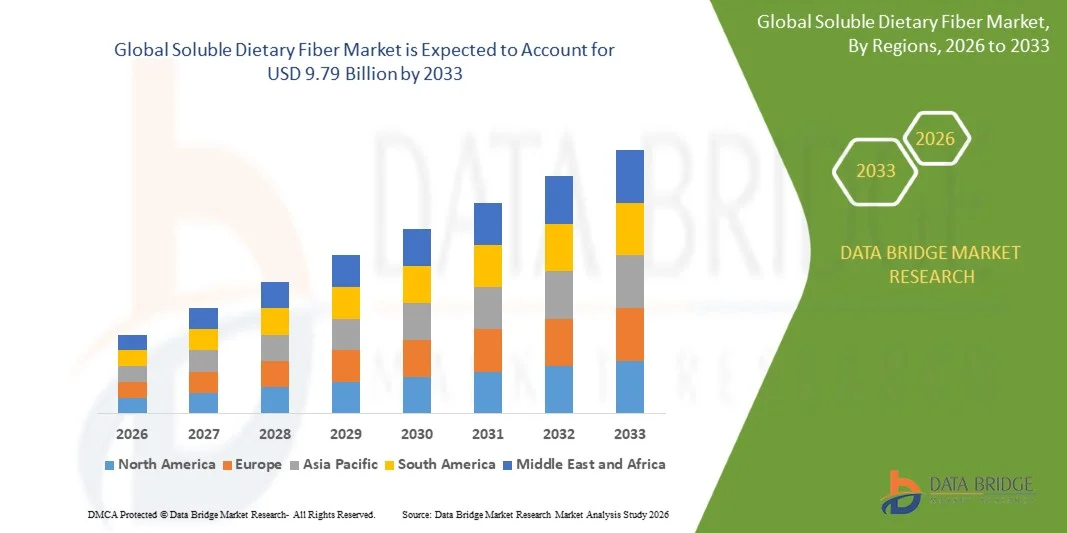
As per Data Bridge Market Research analysis, the soluble dietary fiber market was valued at USD 4.74 billion in 2025 and is projected to reach USD 9.79 billion by 2033, growing at a CAGR of 9.50% from 2026 to 2033. The market is experiencing consistent growth driven by increasing consumer demand for functional food ingredients, rising awareness regarding digestive health, and expanding applications of soluble fibers in functional foods, beverages, dietary supplements, and nutraceutical products.
The growing focus on preventive healthcare, gut health, and metabolic wellness, combined with rising demand for clean-label and plant-based ingredients, is encouraging food and beverage manufacturers to incorporate soluble dietary fibers such as inulin, pectin, beta-glucan, and resistant starch into product formulations. The increasing adoption of soluble fibers in bakery products, dairy alternatives, functional beverages, and nutritional supplements is further supporting market expansion by providing consumers with health benefits associated with improved digestion, cholesterol management, and overall wellness.
Market Size & Forecast
- Global Market Value (2025): USD 4.74 Billion
- Expected Market Value (2033): USD 9.79 Billion
- Forecast CAGR (2026–2033): 9.50%
- Leading Region in 2025: North America
- Fastest Growing Region: Asia-Pacific
Key Market Trends & Insights
- North America dominated the soluble dietary fiber market with the largest revenue share of 38.5% in 2025, supported by increasing consumer awareness regarding digestive health, rising demand for functional foods, and strong adoption of dietary fiber-enriched products across food, beverage, and nutraceutical applications
- The fruits & vegetables segment led the market with a 45.5% share in 2025, driven by increasing demand for naturally derived fiber ingredients from sources such as chicory root, citrus fruits, apples, and vegetables
- Asia-Pacific is expected to be the fastest-growing region in the soluble dietary fiber market, expanding at a CAGR of 15.7% during the forecast period, fueled by rising health consciousness, increasing disposable income, growing demand for functional food products, in emerging economies such as China and India
- Cereals & grains are the fastest-growing source type, projected to register a CAGR of 15.0%, reflecting the surge in utilization of cereal-based soluble fibers such as beta-glucan and resistant starch in functional food applications
- The inulin segment dominated the type category with a 42.9% revenue share in 2025, led by its extensive application as a prebiotic ingredient in functional foods, beverages, and dietary supplements
- Functional food & beverages accounted for 68.6% of the market, preferred by increasing incorporation of soluble fibers into cereals, bakery products, dairy products, beverages, and nutritional food
- The pharmaceuticals segment is the fastest-growing application category, with a CAGR of 15.8%, driven by increasing utilization of soluble dietary fibers in nutraceuticals, digestive health supplements, and therapeutic formulations
Report Scope and Soluble Dietary Fiber Market Segmentation
|
Attributes |
Soluble Dietary Fiber Key Market Insights |
|
Segments Covered |
|
|
Countries Covered |
North America
Europe
Asia-Pacific
Middle East and Africa
South America
|
|
Key Market Players |
|
|
Market Opportunities |
|
|
Value Added Data Infosets |
In addition to the insights on market scenarios such as market value, growth rate, segmentation, geographical coverage, and major players, the market reports curated by the Data Bridge Market Research also include in-depth expert analysis, pricing analysis, brand share analysis, consumer survey, demography analysis, supply chain analysis, value chain analysis, raw material/consumables overview, vendor selection criteria, PESTLE Analysis, Porter Analysis, and regulatory framework. |
Soluble Dietary Fiber Market Trends
Trend: Rising Demand for Functional Foods and Gut Health Ingredients
Consumers are increasingly adopting soluble dietary fibers as functional ingredients to support digestive health, weight management, and metabolic wellness. Food and beverage manufacturers are incorporating fibers such as inulin, pectin, beta-glucan, and resistant starch into cereals, dairy alternatives, beverages, bakery products, and nutritional supplements to meet growing demand for health-focused formulations. The rising popularity of prebiotic ingredients and clean-label products is further accelerating innovation in fiber-enriched foods, while advancements in ingredient processing are enabling improved taste, texture, and functionality in consumer products. For instance, in May 2024, Tate & Lyle announced the opening of expanded production capacity for its PROMITOR Soluble Fibres facility in Boleráz, Slovakia, following a USD 28.5 million investment to increase soluble dietary fiber production capacity and meet growing global demand for fiber-enriched food and beverage products.
The increasing consumer focus on gut health, preventive nutrition, and functional food solutions is strengthening demand for soluble dietary fibers across global food and beverage applications.
Soluble Dietary Fiber Market Dynamics
Key Market Driver: Growing Awareness of Digestive Health and Preventive Nutrition
The rising awareness regarding the health benefits of soluble dietary fibers is driving market growth, as consumers increasingly seek ingredients that support gut microbiome balance, cholesterol management, blood glucose regulation, and overall wellness. Healthcare professionals and nutrition-focused organizations are promoting higher dietary fiber intake, encouraging manufacturers to develop fiber-fortified products across multiple categories. The expanding adoption of nutraceuticals, dietary supplements, and functional beverages is further increasing the utilization of soluble fibers as consumers shift toward preventive healthcare approaches and healthier lifestyles. For instance, in March 2023, the U.S. Food and Drug Administration (FDA) updated its authorized health claim references for soluble fiber, confirming that beta-glucan soluble fiber from whole oats and barley can be associated with a reduced risk of coronary heart disease when consumed as part of a diet low in saturated fat and cholesterol.
Growing scientific recognition of soluble fiber benefits and increasing consumer preference for preventive health solutions are major factors accelerating market expansion.
Key Restraint/Challenge: High Cost of Fiber Extraction and Product Formulation
A significant challenge in the soluble dietary fiber market is the high cost associated with extraction, purification, and processing of advanced fiber ingredients. Manufacturers require specialized technologies to maintain functional properties, improve solubility, and ensure compatibility with different food formulations. In addition, challenges related to taste modification, texture optimization, and regulatory compliance can increase production costs, limiting adoption among small and medium-sized food manufacturers. The availability of alternative low-cost ingredients and fluctuations in raw material prices further create challenges for maintaining competitive pricing across global markets. For instance, in August 2024, researchers published a study in the Journal of Food Science evaluating 23 functional dietary fiber ingredients and highlighted that fiber functionality depends on physicochemical properties such as solubility, water absorption, and structural characteristics, which influence their performance in food product development and formulation.
Although soluble dietary fibers offer significant health benefits, production complexity, formulation challenges, and cost pressures remain key barriers affecting wider adoption.
Key Market Opportunity: Expansion of Plant-Based and Personalized Nutrition Applications
The increasing demand for plant-based foods and personalized nutrition solutions presents a significant opportunity for soluble dietary fiber manufacturers. Companies are developing innovative fiber-based ingredients that support customized nutrition, functional beverages, and targeted health applications such as digestive wellness, weight management, and metabolic health. The growing preference for natural, sustainable, and clean-label ingredients is encouraging manufacturers to utilize plant-derived soluble fibers from sources such as chicory root, fruits, vegetables, and cereals. Emerging markets with rising health awareness and expanding functional food industries provide additional opportunities for market growth. For instance, in March 2025, Icon Foods introduced FibRefine 3.0 and FibRefine 3.5 functional fiber blends, combining soluble tapioca fiber, chicory root inulin, polydextrose, and organic gum acacia to help food and beverage manufacturers increase fiber content, improve digestive tolerance, and develop clean-label formulations.
Increasing demand for plant-based nutrition, clean-label products, and personalized wellness solutions is expected to create new growth opportunities for soluble dietary fiber applications worldwide.
Soluble Dietary Fiber Market Scope
The soluble dietary fiber market is segmented on the basis of source, type, and application.
- By Source
On the basis of source, the soluble dietary fiber market is segmented into fruits & vegetables, nuts & seeds, and cereals & grains. The fruits & vegetables segment dominated the soluble dietary fiber market with a revenue share of 45.5% in 2025, owing to increasing demand for naturally derived fiber ingredients from sources such as chicory root, citrus fruits, apples, and vegetables. These sources are widely preferred due to their clean-label positioning, nutritional benefits, and compatibility with functional food formulations. Fruit- and vegetable-derived soluble fibers such as pectin and inulin are extensively used in beverages, bakery products, dairy alternatives, and dietary supplements. Rising consumer preference for plant-based and minimally processed ingredients is further supporting segment growth. Food manufacturers are increasingly incorporating these fibers to improve texture, enhance nutritional value, and support digestive health claims. Growing awareness regarding natural prebiotic ingredients is also strengthening adoption across global markets. The segment continues to benefit from the expansion of functional foods and wellness-oriented product innovation.
The cereals & grains segment is projected to register the fastest growth during the forecast period, expanding at a CAGR of 15.0%, driven by increasing utilization of cereal-based soluble fibers such as beta-glucan and resistant starch in functional food applications. Rising consumer awareness regarding heart health, blood glucose management, and digestive wellness is encouraging demand for oat, barley, and grain-derived fibers. Manufacturers are increasingly incorporating cereal-based fibers into breakfast cereals, nutrition bars, beverages, and bakery products. The growing popularity of whole-grain and high-fiber diets is further accelerating adoption. Increasing research supporting the health benefits of beta-glucan from oats and barley is encouraging product development. Expansion of functional nutrition categories and rising demand for fortified foods are expected to create new growth opportunities for cereal-derived soluble fibers.
- By Type
On the basis of type, the soluble dietary fiber market is segmented into inulin, pectin, polydextrose, beta-glucan, and others. The inulin segment dominated the soluble dietary fiber market with a revenue share of 42.9% in 2025, supported by its extensive application as a prebiotic ingredient in functional foods, beverages, and dietary supplements. Inulin is widely used due to its ability to promote beneficial gut bacteria and improve digestive health. It is commonly extracted from chicory root and is increasingly adopted as a natural fiber ingredient in clean-label formulations. Food manufacturers utilize inulin as a fat and sugar replacer while maintaining product texture and nutritional quality. Growing consumer interest in microbiome health and preventive nutrition is significantly increasing demand for inulin-based products. The ingredient is also gaining popularity in dairy alternatives, bakery products, and nutritional supplements. Strong application versatility and increasing demand for prebiotic ingredients continue to support the dominance of the inulin segment.
The beta-glucan segment is expected to witness the fastest growth during the forecast period, growing at a CAGR of 16.2%, driven by increasing scientific recognition of its health benefits related to cholesterol management, cardiovascular health, and immune support. Beta-glucan derived from oats and barley is increasingly incorporated into functional foods, beverages, and nutraceutical products. Growing awareness of heart-health benefits among consumers is encouraging manufacturers to develop beta-glucan-enriched products. Regulatory approvals and health claims associated with beta-glucan are further supporting market expansion. Rising demand for natural ingredients with clinically supported benefits is accelerating adoption across food and supplement categories. Increasing investment in functional nutrition products is expected to create significant growth opportunities for beta-glucan-based soluble fibers.
- By Application
On the basis of application, the soluble dietary fiber market is segmented into functional food & beverages, animal feed, pharmaceuticals, and others. The functional food & beverages segment dominated the soluble dietary fiber market with a revenue share of 68.6% in 2025, driven by increasing incorporation of soluble fibers into cereals, bakery products, dairy products, beverages, and nutritional foods. Growing consumer awareness regarding digestive health, weight management, and preventive wellness is significantly increasing demand for fiber-enriched products. Manufacturers are focusing on developing functional foods with added prebiotic and nutritional benefits to meet changing consumer preferences. Soluble fibers improve product functionality by enhancing texture, stability, and nutritional value. The rising popularity of clean-label, plant-based, and fortified food products is further supporting segment growth. Increasing innovation in functional beverages, including fiber-enriched drinks and wellness beverages, is expanding application opportunities. The segment remains the largest contributor due to broad consumer acceptance and extensive product integration.
The pharmaceuticals segment is projected to register the fastest growth during the forecast period, expanding at a CAGR of 15.8%, supported by increasing utilization of soluble dietary fibers in nutraceuticals, digestive health supplements, and therapeutic formulations. Soluble fibers are gaining importance due to their role in improving gastrointestinal health, supporting cholesterol management, and regulating blood glucose levels. Growing consumer preference for preventive healthcare and self-care products is increasing demand for fiber-based supplements. Pharmaceutical and nutraceutical companies are investing in advanced formulations that combine soluble fibers with probiotics and other functional ingredients. Increasing clinical research on gut microbiome health is further strengthening pharmaceutical applications. Rising healthcare expenditure and growing awareness of dietary interventions for chronic disease management are expected to accelerate segment growth.
Soluble Dietary Fiber Market Regional Analysis
North America dominated the soluble dietary fiber market with the largest revenue share of 38.5% in 2025, supported by increasing consumer awareness regarding digestive health, rising demand for functional foods, and strong adoption of dietary fiber-enriched products across food, beverage, and nutraceutical applications. The region also benefits from the presence of established food ingredient manufacturers, advanced research capabilities, and growing investments in clean-label and plant-based nutrition solutions. Increasing demand for prebiotic ingredients, fiber-fortified products, and personalized nutrition solutions is accelerating market development. Growing focus on preventive healthcare, gut microbiome health, and healthier dietary patterns continues to strengthen North America's leadership position in the global soluble dietary fiber market.
U.S. Soluble Dietary Fiber Market Insight
The U.S. soluble dietary fiber market is witnessing strong growth due to increasing consumer demand for functional foods, digestive health products, and fiber-enriched dietary supplements. The country’s mature food and beverage industry, along with rising adoption of prebiotic ingredients such as inulin, beta-glucan, and resistant starch, is driving demand across functional nutrition applications. In addition, growing awareness regarding the health benefits of dietary fiber, including cholesterol management and gut microbiome support, is accelerating product innovation among food manufacturers. In May 2021, the U.S. Food and Drug Administration (FDA) updated its guidance on dietary fiber, recognizing certain isolated and synthetic non-digestible carbohydrates as dietary fibers when they demonstrate beneficial physiological effects, supporting innovation in fiber-enriched food formulations.
Europe Soluble Dietary Fiber Market Insight
The Europe soluble dietary fiber market remains a major contributor to global revenue, driven by strong demand for clean-label ingredients, plant-based nutrition, and functional food products. The widespread adoption of prebiotic fibers in beverages, dairy alternatives, bakery products, and nutraceutical formulations is supporting market expansion across the region. Increasing investments in sustainable food ingredients and growing consumer focus on digestive wellness continue to enhance the adoption of soluble dietary fibers throughout Europe. In November 2021, BENEO announced a multi-million investment program to expand its prebiotic chicory root fiber production capacity at its facilities in Oreye, Belgium, and Pemuco, Chile. The investment was expected to increase global chicory root fiber production capacity by more than 40% to meet rising demand for Orafti Inulin and Oligofructose used in fiber-enriched food and beverage applications.
U.K. Soluble Dietary Fiber Market Insight
The U.K. soluble dietary fiber market is experiencing steady growth, supported by increasing consumer interest in gut health, functional nutrition, and healthier food alternatives. Rising demand for fiber-enriched cereals, beverages, supplements, and plant-based products is encouraging manufacturers to develop innovative soluble fiber formulations. Furthermore, growing awareness of dietary recommendations and the importance of adequate fiber intake is improving adoption across consumer food categories. The British Nutrition Foundation highlighted the importance of increasing dietary fiber intake through foods such as whole grains, fruits, vegetables, and fiber-rich products to support digestive health.
Germany Soluble Dietary Fiber Market Insight
The Germany soluble dietary fiber market is expanding steadily due to the country’s strong food processing industry, advanced ingredient innovation capabilities, and increasing adoption of functional food solutions. Food manufacturers and ingredient suppliers are increasingly incorporating soluble fibers into bakery products, beverages, dairy alternatives, and nutritional products to meet rising consumer demand for health-oriented formulations. Continuous advancements in prebiotic ingredients, sustainable food technologies, and microbiome-focused nutrition are further driving market growth in Germany. In October 2025, Döhler and FGF Trapani announced a strategic joint venture to expand citrus fiber solutions for the food and beverage industry, providing natural fiber ingredients that support fiber enrichment, clean-label formulations, and improved texture in functional food applications.
Asia-Pacific Soluble Dietary Fiber Market Insight
The Asia-Pacific soluble dietary fiber market is expected to witness rapid growth, driven by increasing health awareness, expanding functional food industries, and rising demand for digestive health products across countries such as China, India, and Japan. Growing urbanization, changing dietary patterns, and increasing adoption of preventive healthcare solutions are supporting regional market expansion. In addition, the growing presence of food ingredient manufacturers and rising investments in nutrition-focused product development are accelerating soluble fiber adoption across commercial and consumer applications. China’s National Health Commission continued promoting dietary fiber intake awareness through national nutrition guidelines emphasizing increased consumption of whole grains, vegetables, and fiber-rich foods.
Japan Soluble Dietary Fiber Market Insight
The Japan soluble dietary fiber market is witnessing consistent growth due to rising demand for functional foods, aging population needs, and increasing consumer focus on digestive and metabolic health. Food manufacturers are increasingly developing fiber-fortified beverages, supplements, and functional foods containing soluble fibers such as resistant dextrin and beta-glucan. Moreover, Japan’s established functional food sector and regulatory framework for Foods with Function Claims (FFC) are supporting market expansion. Japan’s Consumer Affairs Agency continued operating the Foods with Function Claims (FFC) system, allowing companies to register products with scientifically supported health functions, including products containing dietary fibers that target digestive health and other wellness benefits.
China Soluble Dietary Fiber Market Insight
The China soluble dietary fiber market is growing rapidly, driven by increasing consumer awareness regarding gut health, rising demand for functional foods, and expanding applications of soluble fibers in beverages, supplements, and nutritional products. Growing investments in food innovation, increasing middle-class health awareness, and government initiatives promoting healthier diets are significantly boosting market demand. In addition, rapid expansion of the functional beverage and nutraceutical sectors is positioning China as one of the fastest-growing markets for soluble dietary fibers globally. Chinese Nutrition Society released the Dietary Guidelines for Chinese Residents (2022), recommending a balanced diet with increased consumption of vegetables, fruits, whole grains, and other fiber-rich foods, supporting greater awareness and demand for dietary fiber-based nutrition products in China.
Soluble Dietary Fiber Market Share
The soluble dietary fiber industry is primarily led by well-established companies, including:
- BENEO (Germany)
- Tate & Lyle PLC (U.K.)
- ADM (U.S.)
- International Flavors & Fragrances Inc. (U.S.)
- Ingredion (U.S.)
- Cargill, Incorporated (U.S.)
- Kerry Group plc (Ireland)
- Roquette Frères (France)
- DuPont. (U.S.)
- Archer Daniels Midland Company (U.S.)
- COSUCRA (Belgium)
- Sensus (Netherlands)
- Nexira (France)
- Taiyo Kagaku Co., Ltd. (Japan)
- Matsutani Chemical Industry Co., Ltd. (Japan)
- Fiberstar, Inc. (U.S.)
- Herbafood Ingredients GmbH (Germany)
- AIDP, Inc. (U.S.)
- Shandong Longlive Bio-technology Co., Ltd. (China)
Latest Developments in Soluble Dietary Fiber Market
- In September 2025, ADM announced that its Fibersol soluble prebiotic fiber received approval from Australia’s Therapeutic Goods Administration (TGA) for use as an active ingredient in biologicals, listed medicines, and prescription medicines. The regulatory approval expanded Fibersol applications beyond conventional food and beverage products into health-focused formulations, supporting growing demand for scientifically supported soluble dietary fiber solutions. This development highlights increasing adoption of soluble fibers in functional nutrition, dietary supplements, and wellness-oriented products
- In September 2025, BENEO announced that its chicory root fiber ingredient Orafti Inulin received the first-ever Thai FDA approval for an exclusive prebiotic health claim. The approval was based on scientific evaluation and strengthened the use of soluble dietary fiber ingredients in products targeting digestive health benefits. The development supports increasing demand for prebiotic fibers in functional foods and supplements across emerging Asian markets
- In June 2025, ITOCHU Corporation announced the acquisition of exclusive domestic marketing rights for INULIA water-soluble dietary fiber in Japan from Sensus B.V., strengthening its dietary fiber business portfolio. The partnership focuses on expanding applications of inulin, a chicory root-derived soluble dietary fiber used in food and beverage products to improve fiber content and support digestive health. The move reflects increasing demand for functional ingredients and growing consumer awareness regarding soluble fiber intake in Japan
- In December 2023, Glucose Health, Inc. launched its FIBER UP prebiotic soluble fiber drink mix products on Amazon, expanding consumer access to convenient soluble fiber supplementation. The product line was developed to provide soluble fiber through flavored drink formats, supporting increasing demand for easy-to-use digestive health and metabolic wellness solutions. The launch highlights the growing adoption of soluble fiber ingredients beyond traditional food categories into functional nutrition products
- In November 2021, BENEO announced a multi-million investment program to expand its prebiotic chicory root fiber production capacity at facilities in Oreye, Belgium, and Pemuco, Chile. The investment included more than USD 34.2 million in the first phase and aimed to increase global chicory root fiber production capacity by more than 40% to meet rising demand for Orafti Inulin and Oligofructose. The expansion supported the growing use of soluble dietary fibers in functional foods, beverages, and nutrition products focused on digestive health

- Interactive Data Analysis Dashboard
- Company Analysis Dashboard for high growth potential opportunities
- Research Analyst Access for customization & queries
- Competitor Analysis with Interactive dashboard
- Latest News, Updates & Trend analysis
- Harness the Power of Benchmark Analysis for Comprehensive Competitor Tracking
Global Soluble Dietary Fibers Market, Supply Chain Analysis and Ecosystem Framework
To support market growth and help clients navigate the impact of geopolitical shifts, DBMR has integrated in-depth supply chain analysis into its Global Soluble Dietary Fibers Market research reports. This addition empowers clients to respond effectively to global changes affecting their industries. The supply chain analysis section includes detailed insights such as Global Soluble Dietary Fibers Market consumption and production by country, price trend analysis, the impact of tariffs and geopolitical developments, and import and export trends by country and HSN code. It also highlights major suppliers with data on production capacity and company profiles, as well as key importers and exporters. In addition to research, DBMR offers specialized supply chain consulting services backed by over a decade of experience, providing solutions like supplier discovery, supplier risk assessment, price trend analysis, impact evaluation of inflation and trade route changes, and comprehensive market trend analysis.
Data collection and base year analysis are done using data collection modules with large sample sizes. The stage includes obtaining market information or related data through various sources and strategies. It includes examining and planning all the data acquired from the past in advance. It likewise envelops the examination of information inconsistencies seen across different information sources. The market data is analysed and estimated using market statistical and coherent models. Also, market share analysis and key trend analysis are the major success factors in the market report. To know more, please request an analyst call or drop down your inquiry.
The key research methodology used by DBMR research team is data triangulation which involves data mining, analysis of the impact of data variables on the market and primary (industry expert) validation. Data models include Vendor Positioning Grid, Market Time Line Analysis, Market Overview and Guide, Company Positioning Grid, Patent Analysis, Pricing Analysis, Company Market Share Analysis, Standards of Measurement, Global versus Regional and Vendor Share Analysis. To know more about the research methodology, drop in an inquiry to speak to our industry experts.
Data Bridge Market Research is a leader in advanced formative research. We take pride in servicing our existing and new customers with data and analysis that match and suits their goal. The report can be customized to include price trend analysis of target brands understanding the market for additional countries (ask for the list of countries), clinical trial results data, literature review, refurbished market and product base analysis. Market analysis of target competitors can be analyzed from technology-based analysis to market portfolio strategies. We can add as many competitors that you require data about in the format and data style you are looking for. Our team of analysts can also provide you data in crude raw excel files pivot tables (Fact book) or can assist you in creating presentations from the data sets available in the report.













