


Global Space Situational Awareness Market
Market Size in USD Billion
CAGR :
% 
 USD
1.49 Billion
USD
2.12 Billion
2025
2033
USD
1.49 Billion
USD
2.12 Billion
2025
2033
 Forecast Period Forecast Period |
2026 –2033 |
 Market Size (Base Year) Market Size (Base Year) |
USD 1.49 Billion |
 Market Size (Forecast Year) Market Size (Forecast Year) |
USD 2.12 Billion |
 CAGR CAGR |
% |
| Major Markets Players |
|
Space Situational Awareness Market Size
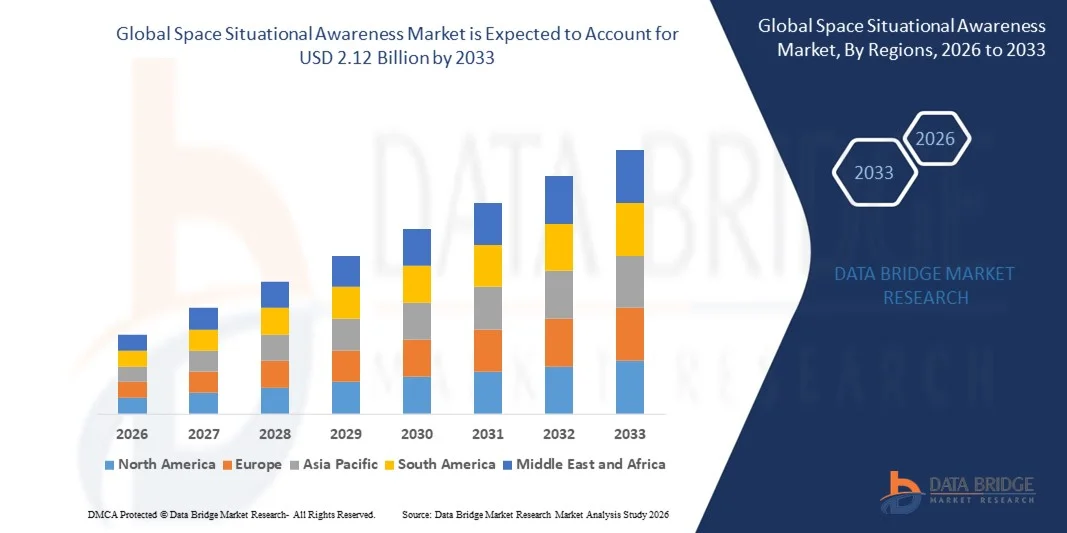
- The global space situational awareness market size was valued at USD 1.49 billion in 2025 and is expected to reach USD 2.12 billion by 2033, at a CAGR of 4.50% during the forecast period
- The market growth is largely fuelled by the rising number of satellite launches, increasing concerns over space debris, and the growing need for real-time tracking and monitoring of space objects
- Expanding commercial space activities and the rapid deployment of mega-constellations for communication and Earth observation are further accelerating demand for advanced SSA solutions
Space Situational Awareness Market Analysis
- The market is witnessing steady growth due to the integration of artificial intelligence, data analytics, and sensor fusion technologies into space monitoring systems, enhancing detection accuracy and predictive capabilities
- Growing collaboration between government space agencies and private space companies, along with advancements in radar and optical tracking infrastructure, is supporting innovation and competitive dynamics across the global space situational awareness market
- North America dominated the space situational awareness market with the largest revenue share in 2025, driven by substantial investments in space defense programs, advanced surveillance infrastructure, and increasing satellite deployments
- Asia-Pacific region is expected to witness the highest growth rate in the global space situational awareness market, driven by rising defense budgets, rapid expansion of satellite constellations, and increasing government emphasis on space sustainability and security. Countries such as China, India, Japan, and South Korea are actively investing in advanced monitoring systems to enhance regional space domain awareness capabilities
- The Services segment held the largest market revenue share in 2025 driven by the increasing demand for real-time monitoring, collision avoidance support, and data analytics services provided to satellite operators and defense agencies. Service providers offer continuous tracking, risk assessment, and regulatory compliance support, making them essential for both government and commercial missions
Report Scope and Space Situational Awareness Market Segmentation
|
Attributes |
Space Situational Awareness Key Market Insights |
|
Segments Covered |
|
|
Countries Covered |
North America
Europe
Asia-Pacific
Middle East and Africa
South America
|
|
Key Market Players |
|
|
Market Opportunities |
|
|
Value Added Data Infosets |
In addition to the market insights such as market value, growth rate, market segments, geographical coverage, market players, and market scenario, the market report curated by the Data Bridge Market Research team includes in-depth expert analysis, import/export analysis, pricing analysis, production consumption analysis, and pestle analysis. |
Space Situational Awareness Market Trends
Rising Deployment Of Satellites And Growing Concern Over Space Debris
- The increasing number of satellite launches for communication, navigation, Earth observation, and defense applications is significantly shaping the global space situational awareness market. Governments and private space companies are investing in advanced tracking and monitoring systems to ensure operational safety and collision avoidance. Space situational awareness solutions enhance real-time detection, tracking, and characterization of space objects, supporting mission continuity and asset protection
- Growing concerns regarding space debris and congestion in low Earth orbit are accelerating demand for predictive analytics and collision avoidance technologies. As mega-constellations expand, the risk of orbital collisions increases, encouraging regulatory authorities and satellite operators to adopt advanced SSA platforms. This trend is strengthening investments in radar, optical sensors, and data integration systems for improved orbital monitoring
- Increasing collaboration between government space agencies and commercial operators is influencing innovation and technology development. Public-private partnerships are facilitating the deployment of next-generation ground-based and space-based surveillance networks. These collaborations are improving data sharing, enhancing situational awareness capabilities, and supporting standardized space traffic management frameworks
- For instance, in 2024, NASA in the U.S. and European Space Agency in Europe expanded space debris tracking initiatives and strengthened partnerships with private satellite operators. These initiatives focused on enhancing collision avoidance services and integrating AI-driven analytics into monitoring platforms. The developments improved operational transparency and reinforced long-term sustainability in space activities
- While adoption of SSA solutions is expanding, sustained market growth depends on continuous technological advancement, data accuracy, and regulatory harmonization. Stakeholders are focusing on scalable infrastructure, improved sensor precision, and cost-effective deployment models to ensure comprehensive coverage and reliable space traffic coordination
Space Situational Awareness Market Dynamics
Driver
Increasing Focus On Space Security And Asset Protection
- Rising geopolitical tensions and the strategic importance of space-based assets are major drivers for the space situational awareness market. Governments are prioritizing the protection of satellites used for defense communication, surveillance, and navigation. Investment in advanced SSA systems strengthens national security capabilities and ensures resilience against potential threats
- Expanding commercial space operations are further influencing market growth. Private sector participation in satellite deployment and deep-space missions requires accurate monitoring and risk mitigation solutions. SSA platforms provide early warning systems, enhance mission planning, and reduce operational uncertainties for commercial operators
- Defense agencies and space organizations are actively promoting advanced surveillance networks through research programs and international collaborations. These initiatives are supported by increased funding allocations and policy frameworks aimed at maintaining safe and sustainable space operations. Integration of AI and big data analytics is also enhancing predictive modeling and response capabilities
- For instance, in 2023, U.S. Space Force expanded contracts for advanced space domain awareness capabilities, while ISRO strengthened indigenous tracking infrastructure. These initiatives improved national monitoring capacity and stimulated demand for innovative SSA technologies, reinforcing competitive dynamics in the global market
- Although increasing security concerns support growth, long-term expansion depends on interoperability standards, cross-border data sharing, and sustainable funding mechanisms. Continuous investment in R&D and collaborative governance models will be critical to maintaining operational efficiency and global coordination
Restraint/Challenge
High Infrastructure Costs And Data Integration Complexities
- The high cost associated with deploying and maintaining advanced radar systems, optical telescopes, and data processing centers remains a significant challenge for the space situational awareness market. Infrastructure development requires substantial capital investment and long-term maintenance commitments, limiting participation for smaller operators
- Data integration and interoperability issues also hinder market growth, as SSA systems must consolidate information from multiple sensors and international databases. Variations in technical standards and data-sharing protocols can restrict seamless coordination and reduce operational efficiency
- Limited regulatory harmonization across countries creates additional barriers, particularly in the development of unified space traffic management frameworks. Differences in national policies and security concerns may restrict transparent data exchange, affecting comprehensive situational awareness
- For instance, in 2024, satellite operators collaborating with Japan Aerospace Exploration Agency and regional tracking networks reported challenges in aligning data formats and compliance requirements. These complexities increased operational costs and delayed implementation timelines, impacting service scalability
- Addressing these challenges will require standardized global frameworks, cost-optimized infrastructure models, and enhanced cooperation among public and private stakeholders. Investment in automation, cloud-based analytics, and shared monitoring platforms will be essential to unlock the full growth potential of the global space situational awareness market
Space Situational Awareness Market Scope
The market is segmented on the basis of offering, object, end user, and capacity.
- By Offering
On the basis of offering, the global space situational awareness market is segmented into Services and Software. The Services segment held the largest market revenue share in 2025 driven by the increasing demand for real-time monitoring, collision avoidance support, and data analytics services provided to satellite operators and defense agencies. Service providers offer continuous tracking, risk assessment, and regulatory compliance support, making them essential for both government and commercial missions.
The Software segment is expected to witness the fastest growth rate from 2026 to 2033, driven by rising adoption of advanced analytics platforms, AI-enabled prediction tools, and cloud-based SSA solutions. Software platforms enable automated data processing, visualization, and decision-making support, enhancing operational efficiency and scalability for satellite operators.
- By Object
On the basis of object, the market is segmented into Mission-Related Debris and Rocket Bodies, Fragmentation Debris, Functional Spacecraft, and Non-Functional Spacecraft. The Fragmentation Debris segment held the largest market revenue share in 2025 due to the growing accumulation of small debris particles in orbit and the high risk they pose to operational satellites. Continuous monitoring of fragmentation debris is critical for collision avoidance and long-term orbital sustainability.
The Functional Spacecraft segment is expected to witness the fastest growth rate from 2026 to 2033, driven by the rapid deployment of commercial satellite constellations and increasing reliance on space-based services. Rising satellite launches are intensifying the need for accurate tracking and identification capabilities.
- By End User
On the basis of end user, the market is segmented into Government and Military and Commercial. The Government and Military segment held the largest market revenue share in 2025 driven by national security priorities, defense modernization programs, and investments in space domain awareness infrastructure. Governments are focusing on strengthening monitoring capabilities to protect strategic space assets and ensure operational superiority.
The Commercial segment is expected to witness the fastest growth rate from 2026 to 2033, supported by expanding private sector participation in satellite deployment, Earth observation, and communication services. Commercial operators increasingly rely on SSA solutions to minimize operational risks and ensure compliance with evolving regulatory standards.
- By Capacity
On the basis of capacity, the market is segmented into Detect, Track, and Identify (D/T/ID), Threat Warning and Assessment, and Characterization. The Detect, Track, and Identify (D/T/ID) segment held the largest market revenue share in 2025 driven by the fundamental requirement to continuously monitor and catalog space objects across multiple orbits. Advanced radar and optical systems are widely deployed to enhance detection accuracy and coverage.
The Threat Warning and Assessment segment is expected to witness the fastest growth rate from 2026 to 2033, driven by increasing concerns over collision risks and potential hostile activities in space. Advanced predictive analytics and early warning systems are supporting proactive decision-making and strengthening overall space security frameworks.
Space Situational Awareness Market Regional Analysis
- North America dominated the space situational awareness market with the largest revenue share in 2025, driven by substantial investments in space defense programs, advanced surveillance infrastructure, and increasing satellite deployments
- Government agencies and defense organizations in the region highly prioritize real-time tracking, collision avoidance, and space domain awareness capabilities to safeguard critical space assets
- This widespread adoption is further supported by strong presence of leading aerospace and defense companies, well-established ground-based radar networks, and continuous modernization initiatives, establishing space situational awareness systems as a strategic necessity for both military and commercial operators
U.S. Space Situational Awareness Market Insight
The U.S. space situational awareness market captured the largest revenue share in 2025 within North America, fueled by robust defense expenditure and expansion of national space security initiatives. The country is actively investing in next-generation tracking systems, advanced radar capabilities, and AI-driven analytics platforms to enhance orbital monitoring. The growing role of the U.S. Space Force in strengthening space domain awareness further propels the market. Moreover, increasing collaboration between government agencies and private satellite operators significantly contributes to sustained market expansion.
Europe Space Situational Awareness Market Insight
The Europe space situational awareness market is expected to witness the fastest growth rate from 2026 to 2033, primarily driven by rising investments in space security and sustainable space operations. Increasing satellite launches and regulatory focus on space debris mitigation are fostering adoption of advanced monitoring systems. European nations are emphasizing collaborative frameworks for space traffic management and cross-border data sharing. The region is experiencing notable growth across defense and commercial applications, supported by initiatives led by the European Space Agency.
U.K. Space Situational Awareness Market Insight
The U.K. space situational awareness market is expected to witness the fastest growth rate from 2026 to 2033, driven by growing national security priorities and expansion of domestic space programs. The country is investing in advanced surveillance infrastructure and strengthening partnerships with allied nations to enhance monitoring capabilities. Rising commercial satellite activities and innovation in space analytics platforms are further stimulating market development. The U.K.’s focus on resilient space operations continues to create opportunities for technology providers.
Germany Space Situational Awareness Market Insight
The Germany space situational awareness market is expected to witness the fastest growth rate from 2026 to 2033, fueled by increasing emphasis on secure satellite communication and defense modernization. Germany’s strong engineering capabilities and commitment to space sustainability support the deployment of advanced radar and optical tracking systems. Collaboration with European partners and integration of AI-driven analytics are becoming increasingly prevalent. The focus on precision monitoring and compliance with international standards aligns with national strategic priorities.
Asia-Pacific Space Situational Awareness Market Insight
The Asia-Pacific space situational awareness market is expected to witness the fastest growth rate from 2026 to 2033, driven by rising satellite launches, expanding defense budgets, and rapid advancement of indigenous space programs in countries such as China, Japan, and India. Governments in the region are prioritizing space security and investing in ground-based and space-based monitoring infrastructure. Increasing commercial space participation and digital transformation initiatives are further accelerating adoption of SSA solutions.
Japan Space Situational Awareness Market Insight
The Japan space situational awareness market is expected to witness the fastest growth rate from 2026 to 2033 due to strong technological capabilities and growing focus on national space security. The country is enhancing its orbital monitoring systems and strengthening partnerships with international agencies to ensure sustainable space operations. Increasing deployment of commercial and research satellites is fueling demand for accurate tracking and predictive analytics solutions. Japan’s emphasis on innovation and long-term space sustainability continues to support market growth.
China Space Situational Awareness Market Insight
The China space situational awareness market accounted for the largest market revenue share in Asia Pacific in 2025, attributed to rapid expansion of satellite constellations and significant government investment in space infrastructure. China is actively developing advanced radar and optical surveillance networks to strengthen its space domain awareness capabilities. The push toward space station development, deep-space missions, and national security initiatives is accelerating SSA adoption. Strong domestic manufacturing capabilities and strategic long-term planning are key factors propelling the market in China.
Space Situational Awareness Market Share
The Space Situational Awareness industry is primarily led by well-established companies, including:
- Vision Engineering Ltd (U.K.)
- ExoAnalytic Solutions (U.S.)
- Schafer Industries (U.S.)
- etamax space GmbH (Germany)
- Kratos Defense & Security Solutions, Inc. (U.S.)
- Analytical Graphics, Inc (U.S.)
- Lockheed Martin Corporation (U.S.)
- Sky and Space Global Ltd (Australia)
- NorthStar Earth & Space Inc. (Canada)
- Polaris Alpha (U.S.)
- Solers (U.S.)
- L3 Applied Defense Solutions (U.S.)
- Elecnor Deimos (Spain)
- SpaceNav (U.S.)
- GMV (Spain)
- Harris (U.S.)
- GlobVision Inc. (U.S.)
Latest Developments in Global Space Situational Awareness Market
- In April 2024, L3Harris Technologies, Inc., contract award, secured the fifth option year of the MOSSAIC initiative valued at approximately USD 187 million from the U.S. Space Force. The program supports maintenance and enhancement of critical space situational awareness infrastructure to strengthen space domain monitoring capabilities. This development reinforces long-term defense partnerships and drives sustained demand for advanced SSA solutions in the U.S. market
- In January 2024, Rocket Lab, satellite launch, successfully deployed four SSA satellites for NorthStar Earth & Space Inc. and Spire Global using its Electron rocket. The mission placed satellites into a 530 km circular orbit to enhance real-time monitoring of space objects. This launch strengthens commercial SSA capabilities and accelerates growth in private sector participation within the global SSA market
- In August 2023, EnduroSat AD and Vyoma GmbH, strategic partnership, collaborated on Europe’s first commercial SSA constellation mission. The initiative involves deploying optical telescopes on microsatellites to provide near real-time tracking and data services. This partnership enhances Europe’s independent SSA capabilities and expands commercial service offerings, supporting competitive dynamics in the regional market
- In September 2021, Kratos Defense & Security Solutions, Inc., government funding, secured USD 2.8 million from the U.S. Department of Defense to prototype a system delivering rapid access to space-related situational awareness data. The solution supports the Unified Data Library through virtualized infrastructure and cloud-based integration. This advancement strengthens digital transformation in defense space operations and promotes innovation in data-driven SSA platforms
- In August 2021, Telespazio UK, service contract, was awarded a contract by the European Space Agency to operate science mission centers at the European Space Astronomy Centre. The contract supports astronomy and heliophysics missions, enhancing operational efficiency and mission data management. This development reinforces Europe’s SSA and space research ecosystem, supporting sustained investment in advanced monitoring and analysis capabilities
SKU-
Get online access to the report on the World's First Market Intelligence Cloud

- Interactive Data Analysis Dashboard
- Company Analysis Dashboard for high growth potential opportunities
- Research Analyst Access for customization & queries
- Competitor Analysis with Interactive dashboard
- Latest News, Updates & Trend analysis
- Harness the Power of Benchmark Analysis for Comprehensive Competitor Tracking
Research Methodology
Data collection and base year analysis are done using data collection modules with large sample sizes. The stage includes obtaining market information or related data through various sources and strategies. It includes examining and planning all the data acquired from the past in advance. It likewise envelops the examination of information inconsistencies seen across different information sources. The market data is analysed and estimated using market statistical and coherent models. Also, market share analysis and key trend analysis are the major success factors in the market report. To know more, please request an analyst call or drop down your inquiry.
The key research methodology used by DBMR research team is data triangulation which involves data mining, analysis of the impact of data variables on the market and primary (industry expert) validation. Data models include Vendor Positioning Grid, Market Time Line Analysis, Market Overview and Guide, Company Positioning Grid, Patent Analysis, Pricing Analysis, Company Market Share Analysis, Standards of Measurement, Global versus Regional and Vendor Share Analysis. To know more about the research methodology, drop in an inquiry to speak to our industry experts.
Customization Available
Data Bridge Market Research is a leader in advanced formative research. We take pride in servicing our existing and new customers with data and analysis that match and suits their goal. The report can be customized to include price trend analysis of target brands understanding the market for additional countries (ask for the list of countries), clinical trial results data, literature review, refurbished market and product base analysis. Market analysis of target competitors can be analyzed from technology-based analysis to market portfolio strategies. We can add as many competitors that you require data about in the format and data style you are looking for. Our team of analysts can also provide you data in crude raw excel files pivot tables (Fact book) or can assist you in creating presentations from the data sets available in the report.












