




Global Specimen Containers Market
Market Size in USD Billion
CAGR :
% 
 USD
2.30 Billion
USD
3.39 Billion
2025
2033
USD
2.30 Billion
USD
3.39 Billion
2025
2033
 Forecast Period Forecast Period |
2026 –2033 |
 Market Size (Base Year) Market Size (Base Year) |
USD 2.30 Billion |
 Market Size (Forecast Year) Market Size (Forecast Year) |
USD 3.39 Billion |
 CAGR CAGR |
% |
| Major Markets Players |
|
Specimen Containers Market Size
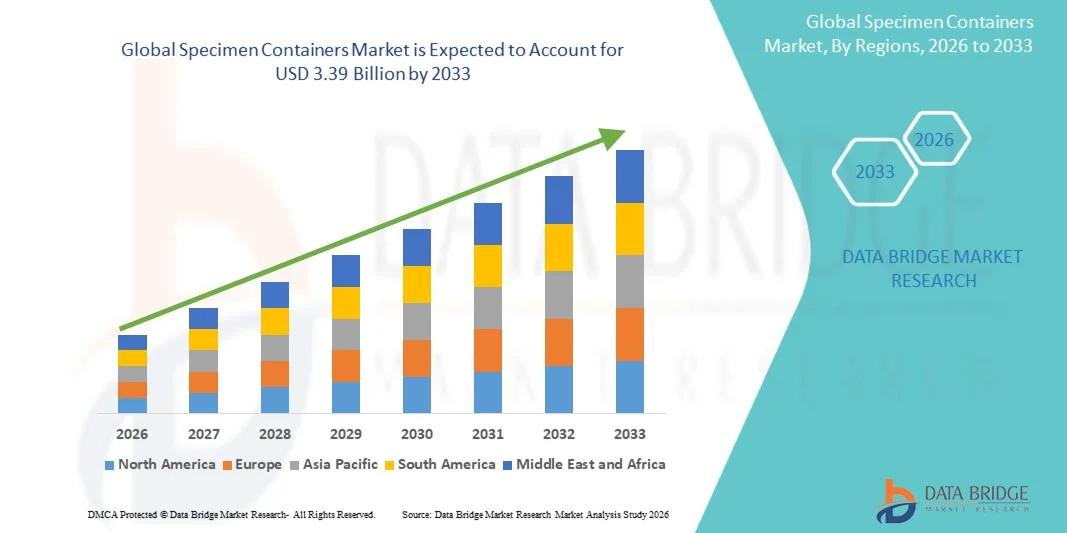
- The global specimen containers market size was valued at USD 2.30 billion in 2025and is expected to reach USD 3.39 billion by 2033, at a CAGR of 5.00% during the forecast period
- The market growth is primarily driven by the rising demand for accurate diagnostic testing, increasing laboratory automation, and the expanding burden of infectious and chronic diseases, which is boosting sample collection and handling needs across healthcare systems
- Furthermore, growing emphasis on infection control, stringent regulatory standards for specimen integrity, and the rapid expansion of hospitals, diagnostic laboratories, and biobanking facilities are reinforcing the adoption of high-quality specimen containers, thereby accelerating overall market growth
Specimen Containers Market Analysis
- Specimen containers, used for the secure collection, storage, and transportation of biological samples such as urine, blood, and tissue, are critical components in clinical diagnostics, laboratories, and research settings due to their ability to maintain sample integrity and prevent contamination throughout the testing process
- The market growth is primarily driven by the increasing volume of diagnostic testing, rising prevalence of infectious and chronic diseases, and expanding healthcare infrastructure, along with growing demand for accurate, safe, and standardized sample handling solutions across healthcare systems
- North America dominated the specimen containers market with the largest revenue share of 39.8% in 2025, supported by advanced healthcare infrastructure, high diagnostic testing rates, strong laboratory networks, and widespread adoption of standardized specimen collection practices in hospitals and diagnostic centers
- Asia-Pacific is expected to be the fastest growing region in the specimen containers market during the forecast period due to improving healthcare access, rising patient population, increasing investments in diagnostic laboratories, and expanding awareness of early disease detection
- Collection Cups segment dominated the specimen containers market with a market share of 42.3% in 2025, driven by their extensive use in routine urine and sample collection procedures, ease of handling, cost-effectiveness, and widespread adoption across hospitals, clinics, and diagnostic laboratories
Report Scope and Specimen Containers Market Segmentation
|
Attributes |
Specimen Containers Key Market Insights |
|
Segments Covered |
|
|
Countries Covered |
North America · U.S. · Canada · Mexico Europe · Germany · France · U.K. · Netherlands · Switzerland · Belgium · Russia · Italy · Spain · Turkey · Rest of Europe Asia-Pacific · China · Japan · India · South Korea · Singapore · Malaysia · Australia · Thailand · Indonesia · Philippines · Rest of Asia-Pacific Middle East and Africa · Saudi Arabia · U.A.E. · South Africa · Egypt · Israel · Rest of Middle East and Africa South America · Brazil · Argentina · Rest of South America |
|
Key Market Players |
|
|
Market Opportunities |
· Growing adoption of biobanking and precision medicine initiatives · Increasing shift toward decentralized and home-based diagnostic testing |
|
Value Added Data Infosets |
In addition to the insights on market scenarios such as market value, growth rate, segmentation, geographical coverage, and major players, the market reports curated by the Data Bridge Market Research also include in-depth expert analysis, patient epidemiology, pipeline analysis, pricing analysis, and regulatory framework |
Specimen Containers Market Trends
“Rising Adoption of Standardized and Traceable Sample Collection Systems”
- A significant and accelerating trend in the global specimen containers market is the increasing adoption of standardized, barcoded, and traceable sample collection systems across hospitals and diagnostic laboratories, improving accuracy and reducing sample mix-up errors in clinical workflows
- For instance, BD (Becton, Dickinson and Company) specimen containers integrated with barcoding systems are widely used in hospital laboratories to ensure precise patient sample identification and tracking throughout the diagnostic process
- Digital integration in specimen containers enables features such as automated labeling, sample tracking in laboratory information systems (LIS), and improved traceability, reducing manual errors and enhancing laboratory efficiency in high-volume testing environments
- Furthermore, the integration of specimen collection systems with laboratory automation platforms allows centralized monitoring of sample status, improving workflow management and enabling faster diagnostic turnaround times across healthcare facilities
- Increasing demand for contamination-free and pre-sterilized disposable specimen containers is also emerging as a key trend, as healthcare providers prioritize infection control and single-use safety standards in diagnostic environments
- This trend toward smarter, standardized, and digitally connected specimen handling systems is reshaping laboratory expectations for diagnostic accuracy and efficiency. Consequently, companies such as Sarstedt are developing advanced leak-proof and pre-labeled containers designed for seamless laboratory integration and compliance with testing protocols
- The demand for standardized and traceable specimen containers is growing rapidly across hospitals and diagnostic laboratories, as healthcare providers increasingly prioritize accuracy, compliance, and operational efficiency in diagnostic testing
Specimen Containers Market Dynamics
Driver
“Growing Demand Due to Rising Diagnostic Testing and Disease Burden”
- The increasing prevalence of infectious diseases, chronic conditions, and preventive health screening programs, coupled with the rising volume of diagnostic testing globally, is a significant driver for the heightened demand for specimen containers
- For instance, in April 2025, Thermo Fisher Scientific expanded its diagnostic sample handling portfolio to support high-throughput laboratory testing, reflecting growing demand for reliable specimen collection and storage solutions in clinical diagnostics
- As healthcare systems focus more on early disease detection and routine health monitoring, specimen containers offer essential functionality such as contamination prevention, secure transport, and preservation of sample integrity for accurate diagnostic results
- Furthermore, the expansion of hospital networks, diagnostic laboratories, and point-of-care testing facilities is making specimen containers a fundamental requirement in both centralized and decentralized healthcare settings
- Rising adoption of home-based diagnostic testing and telehealth-enabled sample collection services is further driving demand for easy-to-use, leak-proof specimen containers designed for self-collection and safe courier transport
- Increasing government investment in public health screening programs and infectious disease surveillance is also accelerating large-scale procurement of standardized specimen collection solutions across healthcare systems
- The convenience of safe sample collection, compatibility with automated laboratory systems, and availability in multiple formats such as vials, cups, and jars are key factors propelling adoption across healthcare and research sectors. The trend toward expanding laboratory infrastructure further supports market growth
Restraint/Challenge
“Regulatory Compliance Complexity and Risk of Sample Contamination”
- Concerns surrounding strict regulatory compliance requirements for medical-grade materials and the risk of sample contamination during collection, storage, and transport pose a significant challenge to broader market penetration
- For instance, regulatory standards such as ISO guidelines for medical specimen handling require manufacturers to ensure high levels of sterility, chemical resistance, and leak-proof performance, increasing production complexity and compliance burden
- Addressing these regulatory challenges through strict quality control, validated manufacturing processes, and adherence to global healthcare standards is crucial for maintaining product reliability and clinical acceptance. Companies such as Greiner Bio-One emphasize certified manufacturing practices to ensure compliance and product safety in clinical use
- In addition, the risk of improper handling, temperature sensitivity of samples, and contamination during transportation can impact diagnostic accuracy, creating concerns among healthcare providers regarding sample reliability
- Increasing variability in regulatory requirements across different countries also creates barriers for global manufacturers, leading to delays in product approvals and higher compliance costs
- While advanced materials and improved container designs are being introduced, compliance costs and operational risks can still limit adoption, especially in cost-sensitive healthcare systems and smaller diagnostic laboratories
Specimen Containers Market Scope
The market is segmented on the basis of raw material, product, color, and type of neck.
- By Raw Material
On the basis of raw material, the specimen containers market is segmented into HDPE, PP, PVC, and others. The PP (Polypropylene) segment dominated the market with the largest revenue share of 46.5% in 2025, driven by its superior chemical resistance, high clarity, and strong compatibility with a wide range of laboratory reagents used in diagnostic testing. PP containers are widely preferred in hospitals and diagnostic laboratories because they maintain sample integrity during transport and storage without reacting with biological fluids. Their ability to withstand autoclaving and sterilization processes makes them highly suitable for reusable and sterile applications. In addition, PP’s lightweight nature and cost efficiency support its large-scale adoption across both developed and emerging healthcare systems. Its strong leak-proof design and adaptability for various sample types further strengthen its dominant position in routine diagnostics.
The HDPE (High-Density Polyethylene) segment is expected to witness the fastest growth rate of 19.8% from 2026 to 2033, driven by its excellent impact resistance and growing use in large-scale diagnostic and public health testing programs. HDPE containers are increasingly preferred in high-volume laboratories due to their durability and reduced risk of breakage during transportation. The material’s strong resistance to moisture and chemicals makes it suitable for long-term storage of biological samples. Rising demand for cost-effective and disposable specimen collection solutions in infectious disease screening is also accelerating adoption. Furthermore, expanding healthcare infrastructure in emerging economies is boosting demand for HDPE-based specimen containers.
- By Product
On the basis of product, the specimen containers market is segmented into collection cups, graduated bottles, airtight containers, jars, vials, and others. The Collection Cups segment dominated the market with the largest revenue share of 42.3% in 2025, driven by their extensive usage in routine urine sample collection and general diagnostic testing procedures. These containers are widely used in hospitals and laboratories due to their simple design, ease of handling, and cost-effectiveness. Collection cups are typically available in sterile, leak-proof formats, ensuring safe sample transport and minimizing contamination risks. Their compatibility with both manual and automated laboratory workflows further enhances their adoption. In addition, increasing outpatient testing and routine health screening programs significantly support their market dominance.
The Vials segment is expected to witness the fastest growth rate of 20.4% from 2026 to 2033, driven by rising demand in advanced diagnostics, biobanking, and molecular testing applications. Vials provide superior sealing and preservation capabilities, making them ideal for blood, serum, and genetic material storage. Their compact design supports efficient storage in laboratory freezers and automated systems. Increasing focus on precision medicine and genomic research is significantly boosting vial usage in research laboratories. Furthermore, growing pharmaceutical and clinical research activities are accelerating demand for high-quality specimen vials.
- By Colors
On the basis of colors, the specimen containers market is segmented into clear, translucent, and opaque. The Clear segment dominated the market with the largest revenue share of 52.7% in 2025, driven by its ability to provide direct visual inspection of sample condition, volume, and possible contamination without opening the container. Clear containers are widely used in routine diagnostic workflows where quick assessment is essential for laboratory efficiency. Their transparency supports accurate sample identification and reduces handling errors in high-throughput laboratories. In addition, clear containers are versatile and compatible with most standard testing procedures across healthcare facilities. Their widespread availability and low cost further strengthen their dominance in clinical applications.
The Opaque segment is expected to witness the fastest growth rate of 18.9% from 2026 to 2033, driven by increasing demand for protection of light-sensitive biological samples such as hormones, enzymes, and certain pharmaceutical compounds. Opaque containers help maintain sample stability by blocking UV and visible light exposure during storage and transport. This feature is particularly important in advanced diagnostic and research applications where sample degradation must be minimized. Rising adoption in specialized laboratories and pharmaceutical testing is further supporting growth. In addition, increasing use in controlled diagnostic environments is boosting demand for opaque specimen containers.
- By Type of Neck
On the basis of type of neck, the specimen containers market is segmented into narrow mouth, wide mouth, and pour spout. The Wide Mouth segment dominated the market with the largest revenue share of 48.3% in 2025, driven by its ease of sample collection, especially for urine and solid or semi-solid biological samples. Wide mouth containers reduce spillage risks and improve usability in both clinical and patient-operated collection settings. They are highly preferred in hospitals and diagnostic centers due to their convenient design and faster sample handling capability. Their compatibility with manual and automated processing systems further supports widespread adoption. In addition, increasing outpatient diagnostics and routine testing procedures strengthen their dominant position.
The Pour Spout segment is expected to witness the fastest growth rate of 21.1% from 2026 to 2033, driven by rising demand for controlled and contamination-free sample transfer in laboratory environments. Pour spout designs enable precise pouring of liquids without spillage, improving laboratory efficiency and accuracy. These containers are increasingly used in high-throughput diagnostic systems where automation and precision handling are essential. Their design reduces cross-contamination risk during sample processing, making them suitable for sensitive diagnostic applications. Furthermore, growing adoption in advanced clinical laboratories and research facilities is accelerating their demand globally.
Specimen Containers Market Regional Analysis
- North America dominated the specimen containers market with the largest revenue share of 39.8% in 2025, supported by advanced healthcare infrastructure, high diagnostic testing rates, strong laboratory networks, and widespread adoption of standardized specimen collection practices in hospitals and diagnostic centers
- Healthcare providers in the region highly value the reliability, contamination-free design, and standardized compliance features offered by specimen containers, which ensure accurate sample collection and safe transport across complex diagnostic workflows
- This widespread adoption is further supported by high healthcare expenditure, early adoption of advanced diagnostic technologies, and strict regulatory standards for laboratory practices, establishing specimen containers as a critical component in clinical diagnostics and research applications
U.S. Specimen Containers Market Insight
The United States specimen containers market captured the largest revenue share within North America in 2025, driven by the country’s highly advanced diagnostic infrastructure and extensive network of hospitals, clinical laboratories, and research institutions. Strong demand for routine and specialized diagnostic testing, including infectious disease screening and chronic disease monitoring, is significantly boosting the use of specimen containers. In addition, the country’s emphasis on laboratory automation, digital health integration, and strict regulatory standards for sample handling is reinforcing the adoption of high-quality, standardized containers. The presence of major diagnostic companies and continuous innovation in healthcare consumables further strengthens market growth across the U.S.
Europe Specimen Containers Market Insight
Europe specimen containers market is projected to expand at a substantial CAGR throughout the forecast period, primarily driven by stringent healthcare regulations, increasing demand for standardized diagnostic procedures, and rising focus on infection control and patient safety. The increase in aging population, coupled with rising prevalence of chronic diseases, is fostering demand for frequent diagnostic testing and reliable specimen collection solutions across hospitals and laboratories in the region. European healthcare systems are also emphasizing sustainability and high-quality medical consumables, leading to growing adoption of certified, leak-proof, and eco-conscious specimen container solutions across both public and private healthcare facilities.
U.K. Specimen Containers Market Insight
U.K. specimen containers market is anticipated to grow at a noteworthy CAGR during the forecast period, driven by increasing diagnostic testing volumes, strong healthcare infrastructure, and rising focus on early disease detection programs. Concerns regarding healthcare-associated infections and the need for safe sample handling are encouraging hospitals and diagnostic centers to adopt high-quality, standardized specimen containers. In addition, expansion of private diagnostic laboratories and increasing investment in healthcare digitization are supporting efficient sample tracking and improving laboratory workflow efficiency in the country.
Germany Specimen Containers Market Insight
Germany specimen containers market is expected to expand at a considerable CAGR during the forecast period, fueled by strong emphasis on healthcare innovation, strict regulatory compliance, and high demand for precision diagnostics. The country’s advanced laboratory infrastructure and focus on quality-driven healthcare services are promoting the use of durable, contamination-resistant specimen containers across diagnostic and research applications. Furthermore, Germany’s growing biotechnology and pharmaceutical research sector is significantly increasing demand for specialized specimen storage and transport solutions.
Asia-Pacific Specimen Containers Market Insight
Asia-Pacific specimen containers market is poised to grow at the fastest CAGR of 23% during the forecast period of 2026 to 2033, driven by rapid urbanization, increasing healthcare access, and rising diagnostic testing demand in countries such as China, India, and Japan. The region’s growing focus on early disease detection, coupled with expanding hospital networks and laboratory infrastructure, is significantly boosting adoption of cost-effective specimen collection solutions. In addition, the presence of large-scale manufacturing hubs for medical consumables is improving affordability and availability, expanding the use of specimen containers across both urban and rural healthcare systems.
Japan Specimen Containers Market Insight
Japan specimen containers market is gaining momentum due to its advanced healthcare system, aging population, and strong emphasis on precision diagnostics and laboratory efficiency. The country’s high demand for accurate and contamination-free diagnostic testing is driving adoption of high-quality, standardized specimen containers in hospitals and research institutions. Furthermore, integration of laboratory automation and digital tracking systems is enhancing sample management efficiency, supporting market growth in both clinical and research applications.
India Specimen Containers Market Insight
India specimen containers market accounted for the largest market revenue share in Asia-Pacific in 2025, attributed to rapid urbanization, expanding healthcare infrastructure, and increasing awareness of diagnostic testing and preventive healthcare. The rising prevalence of infectious and lifestyle diseases is driving strong demand for routine diagnostic testing, significantly boosting the use of specimen collection containers across healthcare facilities. In addition, government healthcare initiatives and growth of private diagnostic chains, along with availability of affordable medical consumables, are further accelerating market expansion in the country.
Specimen Containers Market Share
The Specimen Containers industry is primarily led by well-established companies, including:
- Thermo Fisher Scientific Inc. (U.S.)
- BD (U.S.)
- Greiner Bio-One International GmbH (Austria)
- Sarstedt AG & Co. KG (Germany)
- Cardinal Health (U.S.)
- Medline Industries, LP (U.S.)
- Avantor, Inc. (U.S.)
- Bio-Rad Laboratories, Inc. (U.S.)
- Corning Incorporated (U.S.)
- Eppendorf SE (Germany)
- Merck KGaA (Germany)
- Terumo Corporation (Japan)
- QIAGEN (Germany)
- Simport Scientific Inc. (Canada)
- Globe Scientific Inc. (U.S.)
- Heathrow Scientific LLC (U.S.)
- DWK Life Sciences GmbH (Germany)
- CML Biotech (P) Ltd. (India)
- FL Medical S.r.l. (Italy)
- Kartell S.p.A. (Italy)
What are the Recent Developments in Global Specimen Containers Market?
- In September 2025, Becton Dickinson (BD) introduced new innovations in specimen collection and handling systems designed to improve sample integrity and reduce pre-analytical errors in clinical laboratories. The development focuses on safer blood and biological sample collection with enhanced contamination control and workflow efficiency
- In April 2024, Greiner Bio-One, a leading provider of laboratory consumables, expanded its Mediscan sterilization facility in Kremsmünster, Austria to increase production capacity for sterile medical products, including specimen containers and diagnostic sample collection systems. The expansion was aimed at strengthening supply reliability for contamination-free and high-quality laboratory consumables across global healthcare markets
- In March 2024, Sarstedt AG & Co. KG launched new-generation specimen container solutions featuring improved leak-proof sealing technology and ergonomic design for healthcare professionals. The new product line is designed to enhance safety, reduce contamination risk, and improve handling efficiency in laboratory workflows. These innovations also support compatibility with automated laboratory systems used in high-throughput diagnostic testing
- In January 2024, Greiner Bio-One International GmbH expanded its manufacturing capacity for single-use specimen containers and laboratory consumables in response to rising global demand. The expansion aims to ensure consistent supply of sterile and contamination-free sample collection products used in diagnostics and clinical testing
- In December 2021, Thermo Fisher Scientific acquired PPD Inc., a global clinical research organization, to expand its capabilities in laboratory services and clinical trial support. This acquisition strengthens Thermo Fisher’s integrated diagnostic and research ecosystem, indirectly increasing demand for specimen collection, storage, and transport solutions. The development enhances end-to-end capabilities in clinical diagnostics, from sample collection to analysis
SKU-
Get online access to the report on the World's First Market Intelligence Cloud

- Interactive Data Analysis Dashboard
- Company Analysis Dashboard for high growth potential opportunities
- Research Analyst Access for customization & queries
- Competitor Analysis with Interactive dashboard
- Latest News, Updates & Trend analysis
- Harness the Power of Benchmark Analysis for Comprehensive Competitor Tracking
Research Methodology
Data collection and base year analysis are done using data collection modules with large sample sizes. The stage includes obtaining market information or related data through various sources and strategies. It includes examining and planning all the data acquired from the past in advance. It likewise envelops the examination of information inconsistencies seen across different information sources. The market data is analysed and estimated using market statistical and coherent models. Also, market share analysis and key trend analysis are the major success factors in the market report. To know more, please request an analyst call or drop down your inquiry.
The key research methodology used by DBMR research team is data triangulation which involves data mining, analysis of the impact of data variables on the market and primary (industry expert) validation. Data models include Vendor Positioning Grid, Market Time Line Analysis, Market Overview and Guide, Company Positioning Grid, Patent Analysis, Pricing Analysis, Company Market Share Analysis, Standards of Measurement, Global versus Regional and Vendor Share Analysis. To know more about the research methodology, drop in an inquiry to speak to our industry experts.
Customization Available
Data Bridge Market Research is a leader in advanced formative research. We take pride in servicing our existing and new customers with data and analysis that match and suits their goal. The report can be customized to include price trend analysis of target brands understanding the market for additional countries (ask for the list of countries), clinical trial results data, literature review, refurbished market and product base analysis. Market analysis of target competitors can be analyzed from technology-based analysis to market portfolio strategies. We can add as many competitors that you require data about in the format and data style you are looking for. Our team of analysts can also provide you data in crude raw excel files pivot tables (Fact book) or can assist you in creating presentations from the data sets available in the report.












