Global Spintronics Market
Market Size in USD Million
CAGR :
% 
 USD
730.94 Million
USD
1,096.49 Million
2025
2033
USD
730.94 Million
USD
1,096.49 Million
2025
2033
 Forecast Period Forecast Period |
2026 –2033 |
 Market Size (Base Year) Market Size (Base Year) |
USD 730.94 Million |
 Market Size (Forecast Year) Market Size (Forecast Year) |
USD 1,096.49 Million |
 CAGR CAGR |
% |
| Major Markets Players |
|
Spintronics Market Size
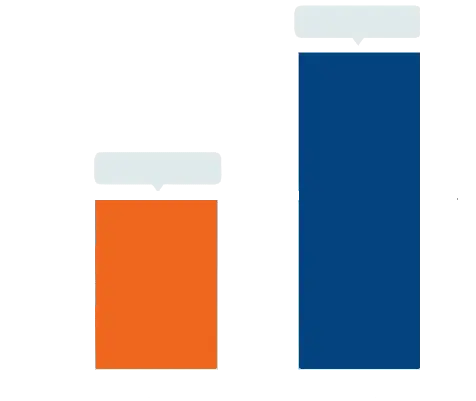
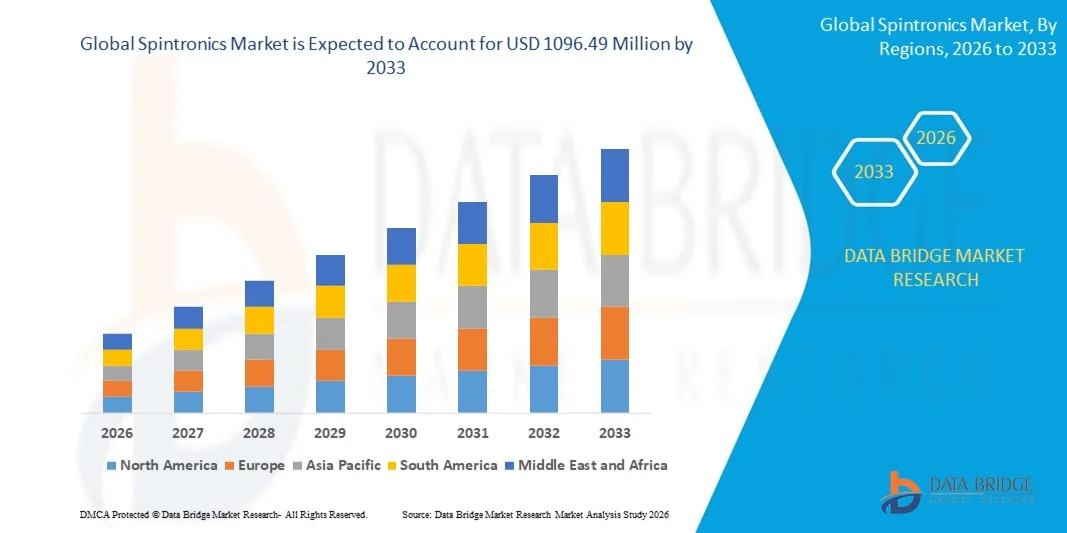
- The global spintronics market size was valued at USD 730.94 million in 2025 and is expected to reach USD 1096.49 million by 2033, at a CAGR of 5.20% during the forecast period
- The market growth is largely fueled by increasing adoption of advanced memory technologies and rapid progress in semiconductor research, driving wider integration of spintronics across data storage, computing, and sensing applications
- Furthermore, rising demand for energy-efficient, high-speed, and non-volatile components in sectors such as consumer electronics, automotive, and data centers is accelerating commercialization of spintronic devices, thereby significantly boosting overall market growth
Spintronics Market Analysis
- Spintronics, which leverages electron spin in addition to charge for information processing and storage, is becoming a critical technology for next-generation memory, logic, and sensing solutions due to its low power consumption, high endurance, and superior performance
- The escalating demand for spintronic technologies is primarily driven by limitations of conventional CMOS scaling, increasing need for high-density memory such as MRAM, and growing investments in emerging areas such as artificial intelligence, high-performance computing, and quantum technologies
- North America dominated the spintronics market with a share of around 45% in 2025, due to strong investments in advanced electronics, data storage technologies, and semiconductor R&D
- Asia-Pacific is expected to be the fastest growing region in the spintronics market during the forecast period due to rapid expansion of the electronics manufacturing sector and increasing investments in semiconductor fabrication
- Semiconductor based spintronics segment dominated the market with a market share of 45.5% in 2025, due to its strong compatibility with existing semiconductor manufacturing processes and its critical role in advanced memory and logic applications. These devices enable efficient spin manipulation and integration into CMOS architectures, which accelerates adoption across data storage and computing applications
Report Scope and Spintronics Market Segmentation
|
Attributes |
Spintronics Key Market Insights |
|
Segments Covered |
|
|
Countries Covered |
North America
Europe
Asia-Pacific
Middle East and Africa
South America
|
|
Key Market Players |
|
|
Market Opportunities |
|
|
Value Added Data Infosets |
In addition to the insights on market scenarios such as market value, growth rate, segmentation, geographical coverage, and major players, the market reports curated by the Data Bridge Market Research also include in-depth expert analysis, geographically represented company-wise production and capacity, network layouts of distributors and partners, detailed and updated price trend analysis and deficit analysis of supply chain and demand. |
Spintronics Market Trends
Integration of Spintronics in Advanced Memory and Computing Systems
- A prominent trend in the spintronics market is the growing integration of spin-based technologies into advanced memory and computing architectures, driven by the need for faster processing speeds, non-volatility, and reduced power consumption. Spintronics is increasingly viewed as a viable solution to overcome the physical and performance limitations of conventional charge-based semiconductor technologies
- For instance, IBM has been actively advancing spintronic research for next-generation memory and logic devices, focusing on scalable MRAM and spin-based computing concepts that support high-speed and energy-efficient data processing. These developments are reinforcing the role of spintronics as a foundational technology for future computing platforms
- The adoption of spintronic MRAM in embedded systems is expanding as manufacturers seek memory solutions that combine high endurance with instant-on capabilities. This trend is positioning spintronics as a critical enabler for applications requiring reliable performance under continuous operation and harsh environments
- Advanced computing domains such as artificial intelligence and high-performance computing are increasingly incorporating spintronic elements to enhance data throughput and reduce latency. The ability of spintronics to support parallel processing and low-power operation is strengthening its relevance in data-intensive workloads
- Research institutions and semiconductor companies are accelerating efforts to integrate spintronics with CMOS architectures, enabling smoother commercialization pathways. This convergence is shaping a long-term shift toward hybrid computing systems that leverage both charge and spin for improved efficiency
- Overall, the increasing integration of spintronics into memory and computing systems is reinforcing its strategic importance across the semiconductor industry. This trend supports the transition toward faster, more efficient, and scalable electronic architectures
Spintronics Market Dynamics
Driver
Rising Demand for Energy-Efficient Non-Volatile Memory
- The rising demand for energy-efficient non-volatile memory solutions is a key driver for the spintronics market, as industries seek alternatives to conventional memory technologies that consume more power and face scaling limitations. Spintronic memories such as MRAM offer high speed, durability, and data retention without continuous power supply
- For instance, Everspin Technologies is commercializing STT-MRAM products that are widely adopted in industrial, data center, and enterprise storage applications. These solutions address growing requirements for reliable memory with low power consumption and high endurance
- The expansion of data centers and cloud infrastructure is increasing demand for memory technologies that reduce energy usage while maintaining performance. Spintronic memory helps operators improve energy efficiency and operational stability in high-density computing environments
- Automotive and industrial sectors are also driving demand for non-volatile memory capable of operating under extreme conditions. Spintronics-based memory supports these requirements by offering robust performance across wide temperature ranges
- The continued growth of connected devices and intelligent systems is amplifying the need for instant-on and low-latency memory solutions. This sustained demand is reinforcing spintronics as a critical driver of innovation in next-generation memory technologies
Restraint/Challenge
High Manufacturing Complexity and Cost
- The spintronics market faces challenges related to high manufacturing complexity and elevated production costs, as fabricating spin-based devices requires advanced materials, precise layer deposition, and sophisticated process control. These requirements increase technical barriers and capital expenditure for manufacturers
- For instance, companies such as Intel Corporation and IBM rely on highly specialized fabrication processes to develop spintronic components compatible with advanced semiconductor nodes. Maintaining precision at nanoscale dimensions adds to production difficulty and cost intensity
- The integration of magnetic materials with standard semiconductor processes introduces additional complexity in terms of yield management and process stability. These challenges can slow large-scale commercialization and limit cost competitiveness
- Strict quality control and reliability testing are necessary to ensure consistent performance of spintronic devices, particularly for automotive and industrial applications. These extended validation cycles further increase development timelines and operational expenses
- As a result, manufacturers face ongoing pressure to optimize fabrication techniques and reduce costs while maintaining performance standards. This challenge continues to act as a restraint on rapid scaling and widespread adoption of spintronics technologies
Spintronics Market Scope
The market is segmented on the basis of device type, application, and end user.
- By Device Type
On the basis of device type, the spintronics market is segmented into semiconductor based spintronics, metallic based spintronics, and alloy based spintronics. The semiconductor based spintronics segment dominated the market with the largest share of 45.5% in 2025, supported by its strong compatibility with existing semiconductor manufacturing processes and its critical role in advanced memory and logic applications. These devices enable efficient spin manipulation and integration into CMOS architectures, which accelerates adoption across data storage and computing applications. Ongoing investments in next-generation MRAM and logic devices further reinforce the dominance of semiconductor based spintronics.
The metallic based spintronics segment is expected to register the fastest growth from 2026 to 2033, driven by its superior spin transport properties and high thermal stability. Metallic materials support faster switching speeds and improved durability, making them suitable for emerging high-performance and energy-efficient spintronic devices. Rising research focus on spin valves and magnetic tunnel junctions continues to expand their commercial potential.
- By Application
On the basis of application, the spintronics market is segmented into magnetic sensors, hard disks and MRAMs, electric vehicles, quantum computing, RF and microwave devices, and others. The hard disks and MRAMs segment accounted for the largest market share in 2025 due to widespread deployment of spintronic components in data storage technologies. MRAM adoption is increasing as it offers non-volatility, high endurance, and faster read–write operations compared to conventional memory technologies. Strong demand from data centers and enterprise storage solutions further sustains this segment’s leadership.
The quantum computing segment is projected to witness the fastest growth during the forecast period, supported by rising investments in quantum research and the need for stable spin-based qubits. Spintronics enables precise control of electron spin states, which is essential for scalable quantum architectures. Expanding collaboration between research institutions and technology companies is accelerating commercialization prospects in this segment.
- By End User
On the basis of end user, the spintronics market is segmented into automotive, industrial, consumer electronics, healthcare, and IT and telecom. The consumer electronics segment dominated the market in 2025, driven by high adoption of spintronic sensors and memory components in smartphones, wearables, and computing devices. Demand for compact, low-power, and high-performance components continues to push integration of spintronics across mass-market electronics. Continuous product innovation and shorter replacement cycles further strengthen this segment’s position.
The automotive segment is anticipated to grow at the fastest rate from 2026 to 2033, fueled by increasing integration of advanced sensing, memory, and power-efficient electronics in electric and autonomous vehicles. Spintronic sensors support precise position, speed, and current sensing, which is essential for vehicle safety and control systems. Rising focus on vehicle electrification and intelligent mobility solutions is expected to sustain rapid growth in this end-user segment.
Spintronics Market Regional Analysis
- North America dominated the spintronics market with the largest revenue share of around 45% in 2025, driven by strong investments in advanced electronics, data storage technologies, and semiconductor R&D
- The region benefits from early adoption of emerging memory technologies such as MRAM, supported by the presence of leading technology companies and well-established research ecosystems
- High defense spending, growing demand for high-performance computing, and rapid commercialization of spintronics-based components continue to strengthen market leadership across both industrial and commercial applications
U.S. Spintronics Market Insight
The U.S. spintronics market accounted for the largest revenue share within North America in 2025, supported by robust funding for semiconductor innovation and quantum research. Strong collaboration between universities, government laboratories, and private enterprises accelerates technology development. Increasing deployment of spintronic sensors, memory devices, and logic components in data centers and automotive electronics further propels market growth.
Europe Spintronics Market Insight
The Europe spintronics market is projected to expand at a healthy CAGR during the forecast period, driven by rising focus on energy-efficient electronics and advanced manufacturing. Supportive government initiatives promoting next-generation semiconductor technologies are encouraging wider adoption. Growth is further supported by increasing demand from automotive electronics, industrial automation, and research-driven quantum applications.
U.K. Spintronics Market Insight
The U.K. spintronics market is expected to grow at a notable CAGR, supported by strong academic research capabilities and increasing commercialization of advanced electronic materials. Rising investments in quantum computing and next-generation memory technologies are key growth drivers. The country’s emphasis on innovation and digital infrastructure continues to foster market expansion.
Germany Spintronics Market Insight
The Germany spintronics market is anticipated to witness steady growth, fueled by the country’s strong automotive and industrial electronics base. Demand for precise magnetic sensors and energy-efficient memory solutions is increasing across electric vehicles and automation systems. Germany’s focus on advanced engineering and sustainable technologies supports broader adoption of spintronics solutions.
Asia-Pacific Spintronics Market Insight
The Asia-Pacific spintronics market is expected to grow at the fastest CAGR from 2026 to 2033, driven by rapid expansion of the electronics manufacturing sector and increasing investments in semiconductor fabrication. Rising demand for data storage, consumer electronics, and electric vehicles supports market growth. Government-backed initiatives promoting domestic semiconductor production further enhance regional momentum.
Japan Spintronics Market Insight
The Japan spintronics market is gaining traction due to strong expertise in materials science and advanced electronics. High adoption of spintronic components in sensors, memory devices, and next-generation computing systems drives demand. Continuous innovation and focus on miniaturization and performance efficiency support sustained market growth.
China Spintronics Market Insight
The China spintronics market accounted for the largest revenue share within Asia-Pacific in 2025, driven by massive semiconductor manufacturing capacity and rapid technological adoption. Strong government support for domestic chip development and increasing demand for advanced memory and sensor technologies accelerate growth. Expanding applications across consumer electronics, automotive, and industrial sectors continue to propel the market in China.
Spintronics Market Share
The spintronics industry is primarily led by well-established companies, including:
- NVE Corporation (U.S.)
- IBM (U.S.)
- Synopsys, Inc. (U.S.)
- Crocus Technology (U.S.)
- Intel Corporation (U.S.)
- Everspin Technologies, Inc. (U.S.)
- Avalanche Technology (U.S.)
- Infineon Technologies AG (Germany)
- Samsung Electronics Co., Ltd. (South Korea)
- TDK Corporation (Japan)
- SK hynix Inc. (South Korea)
- Micron Technology, Inc. (U.S.)
Latest Developments in Global Spintronics Market
- In July 2025, Renesas Electronics Corporation launched the RA8P1 MCU Group built on TSMC’s 22nm ultra-low leakage process, marking a significant advancement for the spintronics market through the integration of embedded MRAM. This development strengthens the role of spintronic memory in AI, ML, and real-time analytics by delivering ultra-high performance with low power consumption, accelerating adoption of MRAM in next-generation intelligent edge and embedded systems
- In April 2025, TDK demonstrated the world’s first spin photo detector capable of achieving data transmission speeds ten times faster than conventional semiconductor photo detectors. This breakthrough significantly expands the application potential of spintronics in high-speed optical data processing, particularly for AI and data-intensive computing, reinforcing spintronics as a key enabler of future ultra-fast communication technologies
- In July 2024, Avalanche Technology introduced its Space Grade-E discrete MRAM product family to address rising demand from the aerospace and defense sectors. This launch highlights the growing reliance on spintronic MRAM for mission-critical applications requiring high reliability, radiation tolerance, and long-term data retention, thereby strengthening spintronics penetration in high-value, defense-oriented markets
- In October 2023, Everspin Technologies expanded its industrial STT-MRAM portfolio with the EMxxLX family, adding higher density, smaller package sizes, and extended temperature tolerance. This expansion enhances the commercial viability of spintronics-based memory in harsh industrial environments, supporting broader adoption across automation, energy, and embedded industrial systems
- In January 2023, NVE Corporation launched one of the most sensitive magnetometer ICs alongside new ultra-miniature isolated DC-to-DC converters. These innovations reinforce the importance of spintronics in precision sensing and power-efficient electronics, expanding its market impact across industrial, medical, and instrumentation applications where high sensitivity and compact design are critical
SKU-
Get online access to the report on the World's First Market Intelligence Cloud

- Interactive Data Analysis Dashboard
- Company Analysis Dashboard for high growth potential opportunities
- Research Analyst Access for customization & queries
- Competitor Analysis with Interactive dashboard
- Latest News, Updates & Trend analysis
- Harness the Power of Benchmark Analysis for Comprehensive Competitor Tracking
Global Spintronics Market, Supply Chain Analysis and Ecosystem Framework
To support market growth and help clients navigate the impact of geopolitical shifts, DBMR has integrated in-depth supply chain analysis into its Global Spintronics Market research reports. This addition empowers clients to respond effectively to global changes affecting their industries. The supply chain analysis section includes detailed insights such as Global Spintronics Market consumption and production by country, price trend analysis, the impact of tariffs and geopolitical developments, and import and export trends by country and HSN code. It also highlights major suppliers with data on production capacity and company profiles, as well as key importers and exporters. In addition to research, DBMR offers specialized supply chain consulting services backed by over a decade of experience, providing solutions like supplier discovery, supplier risk assessment, price trend analysis, impact evaluation of inflation and trade route changes, and comprehensive market trend analysis.
Research Methodology
Data collection and base year analysis are done using data collection modules with large sample sizes. The stage includes obtaining market information or related data through various sources and strategies. It includes examining and planning all the data acquired from the past in advance. It likewise envelops the examination of information inconsistencies seen across different information sources. The market data is analysed and estimated using market statistical and coherent models. Also, market share analysis and key trend analysis are the major success factors in the market report. To know more, please request an analyst call or drop down your inquiry.
The key research methodology used by DBMR research team is data triangulation which involves data mining, analysis of the impact of data variables on the market and primary (industry expert) validation. Data models include Vendor Positioning Grid, Market Time Line Analysis, Market Overview and Guide, Company Positioning Grid, Patent Analysis, Pricing Analysis, Company Market Share Analysis, Standards of Measurement, Global versus Regional and Vendor Share Analysis. To know more about the research methodology, drop in an inquiry to speak to our industry experts.
Customization Available
Data Bridge Market Research is a leader in advanced formative research. We take pride in servicing our existing and new customers with data and analysis that match and suits their goal. The report can be customized to include price trend analysis of target brands understanding the market for additional countries (ask for the list of countries), clinical trial results data, literature review, refurbished market and product base analysis. Market analysis of target competitors can be analyzed from technology-based analysis to market portfolio strategies. We can add as many competitors that you require data about in the format and data style you are looking for. Our team of analysts can also provide you data in crude raw excel files pivot tables (Fact book) or can assist you in creating presentations from the data sets available in the report.