What is the Sports Equipment Market Size and Growth Rate?
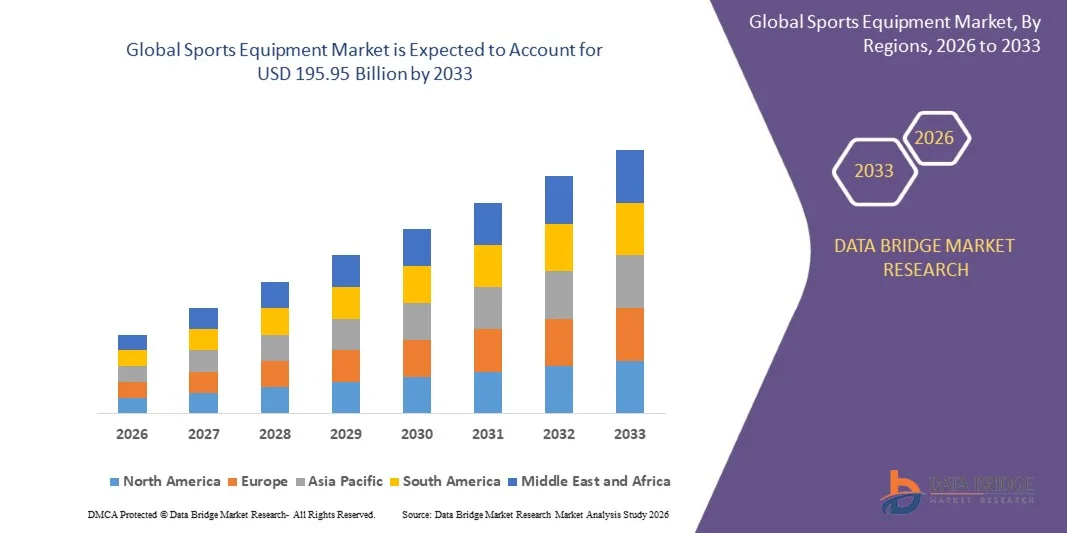
- As per Data Bridge Market Research analysis, the sports equipment market was valued at USD 141.00 billion in 2025 and is projected to reach USD 195.95 billion by 2033, growing at a CAGR of 4.20% from 2026 to 2033.
- The market is experiencing consistent growth driven by rising participation in sports and fitness activities, increasing health consciousness, growing popularity of recreational and professional sports, and continuous advancements in sports equipment materials and design.
- The increasing emphasis on physical fitness and active lifestyles, combined with rising investments in sports infrastructure and organized sporting events, is encouraging consumers, athletes, schools, and sports organizations to invest in advanced equipment. Lightweight materials, ergonomic designs, and performance-enhancing technologies are improving safety, durability, and user experience, supporting the adoption of innovative sports equipment across recreational, amateur, and professional applications.
Market Size & Forecast
- Global Market Value (2025): USD 141.00 Billion
- Expected Market Value (2033): USD 195.95 Billion
- Forecast CAGR (2026–2033): 4.20%
- Leading Region in 2025: North America
- Fastest Growing Region: Asia Pacific
What are the Major Takeaways of the Sports Equipment Market?
- North America dominated the global sports equipment market with the largest revenue share of 31.4% in 2025, supported by high sports participation, strong consumer spending on fitness products, and the presence of established sports equipment manufacturers
- Asia-Pacific is expected to be the fastest-growing region at a CAGR of 8.4% from 2026 to 2033, fueled by rising disposable incomes, increasing participation in organized sports, expanding fitness awareness, and growing investments in sports infrastructure across China, India, and Japan.
- The ball sports segment led the market with a 35% share in 2025, driven by widespread participation in football, basketball, volleyball, cricket, and tennis.
- Extreme sports are the fastest-growing type, projected to register a CAGR of 6.5%, reflecting the surge in adventure recreation, action sports, and outdoor sporting activities.
- The hardware segment dominated the component category with a 85% revenue share in 2025, led by strong demand for physical sports equipment and athletic training accessories across professional, recreational, and household applications.
- Ball games accounted for 30% of the market share in 2025, preferred by widespread participation in football, basketball, cricket, baseball, and other popular sports.
- The fitness/strength equipment segment is the fastest-growing product category, with a CAGR of 7.5%, driven by rising health consciousness and increasing participation in strength training and resistance-based exercise.
Report Scope and Sports Equipment Market Segmentation
|
Attributes |
Sports Equipment Key Market Insights |
|
Segments Covered |
|
|
Countries Covered |
North America
Europe
Asia-Pacific
Middle East and Africa
South America
|
|
Key Market Players |
|
|
Market Opportunities |
|
|
Value Added Data Infosets |
In addition to the insights on market scenarios such as market value, growth rate, segmentation, geographical coverage, and major players, the market reports curated by the Data Bridge Market Research also include in-depth expert analysis, pricing analysis, brand share analysis, consumer survey, demography analysis, supply chain analysis, value chain analysis, raw material/consumables overview, vendor selection criteria, PESTLE Analysis, Porter Analysis, and regulatory framework. |
What is the Key Trend in the Sports Equipment Market?
- Sports equipment manufacturers are increasingly adopting advanced materials, smart technologies, and ergonomic designs to improve athletic performance, enhance product durability, and deliver more personalized sporting experiences.
- For instance, in January 2024, Wilson Sporting Goods introduced its new Airless Gen1 basketball prototype, developed using 3D printing technology to create a unique lattice structure that reimagines traditional basketball design.
- Smart sensors and connected technologies are enabling athletes to monitor performance metrics, analyze movement patterns, and improve training outcomes through data-driven feedback.
- Sports equipment companies are also exploring recycled materials and sustainable manufacturing processes to reduce environmental impact while maintaining equipment quality and performance.
- For instance, in July 2023, Adidas announced the launch of its Made To Be Remade circularity initiative for selected products, supporting the company's broader efforts to improve material circularity and product reuse
- As athletes and recreational consumers increasingly prioritize performance, personalization, and sustainability, sports equipment manufacturers are expected to expand innovation in connected products, lightweight materials, and environmentally conscious designs, strengthening the market's long-term growth prospects.
What are the Key Drivers of the Sports Equipment Market?
- The rising participation in sports, fitness activities, and recreational exercise has significantly increased demand for sports equipment across professional, educational, and household settings.
- For instance, in April 2024, the Sports & Fitness Industry Association (SFIA) reported that U.S. sporting goods, fitness, and related recreation product sales grew 4.2% in 2023, reaching USD 121.66 billion, reflecting sustained consumer demand.
- Governments, schools, sports clubs, and private organizations are investing in sports facilities and training infrastructure, increasing procurement of balls, rackets, protective gear, gym equipment, and specialized athletic products.
- For instance, in August 2024, India's Ministry of Youth Affairs and Sports reported that 343 sports infrastructure projects had been sanctioned under various initiatives, supporting the development of sports facilities and associated equipment requirements.
- With growing sports participation and continued investment in sporting infrastructure, demand for durable, affordable, and performance-oriented equipment is expected to increase across recreational and professional applications, supporting long-term market expansion.
What Factors are Challenging the Growth of the Sports Equipment Market?
- Sports equipment manufacturers face significant production costs due to fluctuations in raw material prices, specialized manufacturing requirements, quality certifications, and investments in advanced production technologies.
- For instance, in May 2026, the Sports & Fitness Industry Association (SFIA) reported that rising tariffs, supply-chain constraints, and cost pressures were creating challenges for the U.S. sporting goods industry, affecting manufacturers' operating conditions and consumers' access to sports products.
- These cost pressures can limit affordability, reduce profit margins, and restrict the ability of smaller manufacturers to compete with established international brands.
- High production expenses and supply-chain constraints continue to challenge sports equipment manufacturers, particularly small and medium-sized enterprises operating in price-sensitive markets.
- For instance, in July 2022, the World Federation of the Sporting Goods Industry (WFSGI) highlighted that rising transportation and raw material costs were squeezing manufacturers' margins. Container freight rates had increased by as much as sevenfold compared with pre-pandemic levels, while metal prices rose 88% and rubber prices increased 32%, demonstrating the impact of supply-chain disruptions on sports equipment production costs.
- These barriers can limit investment in product innovation, restrict export competitiveness, and slow the adoption of advanced manufacturing processes despite increasing global demand for sports equipment.
How is the Sports Equipment Market Segmented?
The sports equipment market is segmented on the basis of type, components, products, end-user, and distribution channel.
- By Type
On the basis of type, the sports equipment market is segmented into racing sports, ball sports, water sports, extreme sports, and others. The ball sports segment dominated the market with an estimated share of 35% in 2025, owing to widespread participation in football, basketball, volleyball, cricket, and tennis. Ball sports equipment is extensively purchased by schools, sports clubs, professional teams, and individual consumers. Increasing participation in organized sporting events and grassroots sports programs supports consistent demand for balls, nets, goalposts, and related accessories. The popularity of team sports across developed and emerging economies further strengthens this segment. Frequent equipment replacement and the availability of products across multiple price ranges also support sales.
The extreme sports segment is expected to experience strong growth, registering an estimated CAGR of 6.5% from 2026 to 2033, supported by increasing interest in adventure recreation, action sports, and outdoor sporting activities. Growing participation in skateboarding, mountain biking, climbing, and snowboarding is encouraging demand for specialized equipment. Improvements in protective gear, lightweight materials, and equipment durability are helping enhance safety and performance. Social media exposure and international sporting competitions are also increasing the visibility of extreme sports. Rising adventure tourism and the development of dedicated skateparks, climbing centers, and outdoor recreation facilities create additional demand. Manufacturers are increasingly developing sport-specific products for beginner and professional users.
- By Components
On the basis of components, the sports equipment market is segmented into hardware and software. The hardware segment dominated the market with an estimated share of 85% in 2025, as it includes the physical products used in sporting and fitness activities, such as balls, rackets, protective equipment, exercise machines, footwear, and training accessories. Demand is supported by widespread participation in recreational, amateur, and professional sports. Schools, gyms, sports clubs, and individual consumers regularly purchase hardware for training, competition, and physical conditioning. Product durability, material quality, comfort, and safety remain important purchasing considerations. Innovations in carbon fiber, lightweight alloys, and impact-resistant materials are improving equipment performance.
The software segment is expected to register the fastest growth, at an estimated CAGR of 9.0% from 2026 to 2033, as sports equipment increasingly incorporates digital technologies and connected training capabilities. Software supports performance monitoring, workout tracking, motion analysis, and personalized training recommendations. Integration with smart fitness equipment and wearable devices allows users to monitor progress and adjust training routines. Professional athletes and sports organizations increasingly use digital analytics to evaluate technique and improve performance. Mobile applications and cloud-based platforms also create opportunities for remote coaching and connected fitness services. Improvements in artificial intelligence and sensor integration are expanding the capabilities of sports technology products.
- By Products
On the basis of products, the sports equipment market is segmented into ball over net games, ball games, fitness/strength equipment, athletic training equipment, protective equipment, footwear, and others. The ball games segment dominated the market with an estimated share of 30% in 2025, supported by widespread participation in football, basketball, cricket, baseball, and other popular sports. Demand is generated by professional athletes, schools, sports academies, recreational players, and community sports organizations. Frequent replacement of balls and related accessories supports recurring purchases. The availability of equipment across affordable, mid-range, and premium price categories broadens the consumer base. Professional leagues and international sporting tournaments further encourage participation and equipment purchases.
The fitness/strength equipment segment is expected to witness strong growth, registering an estimated CAGR of 7.5% from 2026 to 2033, driven by rising health consciousness and increasing participation in strength training and resistance-based exercise. Growing gym memberships and home workout adoption are encouraging purchases of dumbbells, barbells, weight benches, resistance machines, and functional training accessories. Consumers are increasingly prioritizing physical fitness, muscle development, and preventive wellness. Commercial gyms, hotels, corporate wellness centers, and residential fitness spaces are expanding their equipment requirements. Compact and multifunctional products are gaining popularity among consumers with limited workout space. Technological improvements in connected fitness machines and adjustable equipment are further enhancing user convenience.
- By End-User
On the basis of end-user, the sports equipment market is segmented into commercial and household. The commercial segment dominated the market with an estimated share of 60% in 2025, supported by purchases from gyms, fitness centers, schools, sports clubs, stadiums, hotels, and professional training facilities. These organizations require durable equipment that can withstand frequent use and intensive training sessions. Growing investments in sports infrastructure and organized sporting programs are increasing institutional procurement. Professional teams and academies also invest in specialized equipment to improve athlete performance and training quality. Regular maintenance and replacement requirements generate recurring demand.
The household segment is expected to register strong growth, at an estimated CAGR of 6.8% from 2026 to 2033, as consumers increasingly invest in personal fitness and recreational sports equipment. Greater awareness of physical wellness and convenience is encouraging home-based exercise and individual sports participation. Consumers are purchasing dumbbells, yoga accessories, exercise bikes, resistance bands, balls, and other compact fitness products for home use. Flexible work arrangements and limited access to nearby fitness facilities can further encourage home workouts. E-commerce platforms make it easier to compare products, review specifications, and purchase equipment for personal use. Increasing availability of space-efficient and affordable products is broadening adoption.
- By Distribution Channel
On the basis of distribution channel, the sports equipment market is segmented into online, specialty and sports shops, and department and discount stores. The specialty and sports shops segment dominated the market with an estimated share of 45% in 2025, supported by its wide selection of sport-specific products and personalized purchasing assistance. These stores allow consumers to inspect equipment, compare product quality, and evaluate fit and comfort before buying. Specialist staff can provide guidance on sizing, safety features, material selection, and equipment suitability. Professional athletes and sports enthusiasts often prefer specialist retailers for technical products. Brand-focused displays and product demonstrations further improve the shopping experience.
The online distribution channel is expected to experience strong growth, registering an estimated CAGR of 8.0% from 2026 to 2033, driven by increasing e-commerce adoption and consumer preference for convenient shopping. Digital platforms provide access to extensive product catalogs, multiple brands, customer reviews, and price comparisons. Home delivery and convenient return policies make online purchasing attractive for bulky and specialized equipment. Direct-to-consumer websites allow manufacturers to introduce new products and reach customers beyond traditional retail markets. Digital advertising and personalized recommendations also help retailers target sports enthusiasts and fitness consumers. Improved payment systems and logistics networks are supporting online sales across emerging economies.
Which Region Holds the Largest Share of the Sports Equipment Market?
- North America dominated the global sports equipment market with the largest revenue share of 31.4% in 2025, supported by high sports participation, strong consumer spending on fitness products, and the presence of established sports equipment manufacturers
- The region also benefits from well-developed sports infrastructure, widespread gym memberships, strong professional sports leagues, and growing adoption of technologically advanced fitness equipment. Increasing investments in recreational facilities, school sports programs, and performance-oriented athletic products continue to strengthen North America’s position in the global sports equipment market.
U.S. Sports Equipment Market Insight
The U.S. sports equipment market is witnessing strong growth due to rising participation in sports and fitness activities, increasing consumer spending on athletic products, and expanding investments in sports infrastructure. The country’s mature professional sports ecosystem, along with growing adoption of smart fitness equipment and performance-oriented sporting goods, is driving demand across commercial, recreational, and household applications. In addition, increasing emphasis on physical wellness, youth sports participation, and advanced athletic training is accelerating demand for innovative sports equipment across the country.
Asia-Pacific Sports Equipment Market Insight
The Asia-Pacific sports equipment market is expected to witness rapid growth, driven by increasing disposable incomes, expanding urban populations, and rising participation in organized sports across countries such as China, India, and Japan. Growing awareness regarding physical fitness, rising investments in sports infrastructure, and increasing demand for affordable and technologically advanced equipment are supporting regional market expansion. Additionally, the growing popularity of international sporting events, fitness centers, and grassroots sports programs is accelerating equipment adoption across recreational and professional applications.
Japan Sports Equipment Market Insight
The Japan sports equipment market is witnessing consistent growth due to rising participation in recreational sports, increasing health consciousness, and continued investments in athletic training infrastructure. Sports clubs, educational institutions, professional athletes, and individual consumers are increasingly purchasing specialized equipment for performance improvement and physical conditioning. Moreover, growing integration of smart fitness technologies, lightweight materials, and ergonomic product designs, along with the country's established sporting culture, is further contributing to market growth.
China Sports Equipment Market Insight
The China sports equipment market is growing rapidly, driven by increasing participation in fitness activities, expanding sports infrastructure, and rising government emphasis on public health and sports development. Growing demand for fitness equipment, athletic footwear, protective gear, and sport-specific products across commercial and household applications is significantly boosting market demand. In addition, rising investments in sports facilities, increasing popularity of professional sporting events, and the expansion of domestic sportswear and equipment manufacturers are positioning China as a major growth market for sports equipment globally.
U.K. Sports Equipment Market Insight
The U.K. sports equipment market is experiencing steady growth, supported by rising participation in recreational sports, expanding fitness activities, and sustained demand for specialized athletic products. Increasing investments in sports clubs, educational facilities, and commercial fitness centers are contributing to market growth. Furthermore, growing consumer interest in home workouts, sustainable equipment materials, and digitally connected fitness products is improving product innovation and expanding purchasing opportunities, positioning the U.K. as an important market for sports equipment.
Germany Sports Equipment Market Insight
The Germany sports equipment market is expanding steadily due to the country's established sporting culture, strong manufacturing capabilities, and increasing consumer interest in fitness and outdoor recreation. Sports clubs, fitness centers, educational institutions, and individual consumers are increasingly purchasing equipment for athletic training, recreational activities, and professional competition. Continuous advancements in lightweight materials, sustainable product design, and smart fitness technologies, along with growing investments in sports facilities and community programs, are further driving market growth in Germany.
Which are the Top Companies in Sports Equipment Market?
The sports equipment industry is primarily led by well-established companies, including:
- adidas AG (Germany)
- Nike, Inc. (U.S.)
- PUMA SE (Germany)
- Under Armour, Inc. (U.S.)
- ASICS Corporation (Japan)
- Mizuno Corporation (Japan)
- YONEX Co., Ltd. (Japan)
- Wilson Sporting Goods Co. (U.S.)
- Amer Sports, Inc. (U.S.)
- Decathlon SE (France)
- New Balance Athletics, Inc. (U.S.)
- Skechers U.S.A., Inc. (U.S.)
- Callaway Golf Company (U.S.)
- Acushnet Holdings Corp. (U.S.)
- Taylor Made Golf Company, Inc. (U.S.)
- STIGA Sports AB (Sweden)
- HEAD Sport GmbH (Austria)
- Franklin Sports, Inc. (U.S.)
- Bauer Hockey, LLC (U.S.)
- Thule Group AB (Sweden)
What are Latest Developments in Sports Equipment Market?
- In November 2025, India’s Ministry of Skill Development and Entrepreneurship launched SportEdge Meerut, an initiative designed to strengthen sports manufacturing, innovation, and entrepreneurship. Developed in collaboration with industry and skills-development organizations, the initiative aims to improve workforce capabilities and support Meerut’s development as a major sports goods manufacturing hub. This development highlights efforts to strengthen domestic manufacturing capabilities and improve the competitiveness of India’s sports equipment industry.
- In June 2025, PUMA unveiled the official Premier League match ball for the 2025/26 season, introducing new football equipment for use across professional matches. The launch formed part of PUMA’s partnership with the Premier League and was supported by a campaign celebrating football participation at both professional and recreational levels. This development highlights continued innovation in ball design and the importance of major sporting partnerships in promoting sports equipment globally.
- In April 2025, Bridgestone Golf announced the launch of its new ELECTRON junior golf ball, developed in partnership with First Tee to make golf more accessible and enjoyable for young players. The ball was designed to help junior golfers launch shots more easily and incorporates messaging inspired by First Tee’s youth-development programs. The product was made available through DICK’S Sporting Goods and Golf Galaxy, highlighting manufacturers’ focus on specialized sports equipment for younger consumers.
- In January 2024, Babolat launched the fourth generation of its Pure Strike tennis racquet range, incorporating technologies designed to improve control, feel, and precision for attacking players. The updated collection featured NF²-TECH, which uses natural flax fibers to help filter vibrations, and Frame String Interaction Control, designed to optimize the interaction between the frame and strings. The launch demonstrated continued product innovation in performance-oriented racquet sports equipment.
- In February 2023, Wilson Sporting Goods introduced its first 3D-printed Airless Prototype Basketball during the NBA All-Star Slam Dunk Contest. Developed through Wilson Labs and technology partners, the prototype featured a lattice structure designed to eliminate the need for inflation while maintaining basketball-like playing characteristics. The innovation showcased the potential of additive manufacturing to transform traditional sports equipment design and opened new possibilities for material engineering and product development.
- Interactive Data Analysis Dashboard
- Company Analysis Dashboard for high growth potential opportunities
- Research Analyst Access for customization & queries
- Competitor Analysis with Interactive dashboard
- Latest News, Updates & Trend analysis
- Harness the Power of Benchmark Analysis for Comprehensive Competitor Tracking
Data collection and base year analysis are done using data collection modules with large sample sizes. The stage includes obtaining market information or related data through various sources and strategies. It includes examining and planning all the data acquired from the past in advance. It likewise envelops the examination of information inconsistencies seen across different information sources. The market data is analysed and estimated using market statistical and coherent models. Also, market share analysis and key trend analysis are the major success factors in the market report. To know more, please request an analyst call or drop down your inquiry.
The key research methodology used by DBMR research team is data triangulation which involves data mining, analysis of the impact of data variables on the market and primary (industry expert) validation. Data models include Vendor Positioning Grid, Market Time Line Analysis, Market Overview and Guide, Company Positioning Grid, Patent Analysis, Pricing Analysis, Company Market Share Analysis, Standards of Measurement, Global versus Regional and Vendor Share Analysis. To know more about the research methodology, drop in an inquiry to speak to our industry experts.
Data Bridge Market Research is a leader in advanced formative research. We take pride in servicing our existing and new customers with data and analysis that match and suits their goal. The report can be customized to include price trend analysis of target brands understanding the market for additional countries (ask for the list of countries), clinical trial results data, literature review, refurbished market and product base analysis. Market analysis of target competitors can be analyzed from technology-based analysis to market portfolio strategies. We can add as many competitors that you require data about in the format and data style you are looking for. Our team of analysts can also provide you data in crude raw excel files pivot tables (Fact book) or can assist you in creating presentations from the data sets available in the report.