


Global Standalone Ultrasonic Cleaning Market
Market Size in USD Billion
CAGR :
% 
 USD
1.50 Billion
USD
2.25 Billion
2025
2033
USD
1.50 Billion
USD
2.25 Billion
2025
2033
 Forecast Period Forecast Period |
2026 –2033 |
 Market Size (Base Year) Market Size (Base Year) |
USD 1.50 Billion |
 Market Size (Forecast Year) Market Size (Forecast Year) |
USD 2.25 Billion |
 CAGR CAGR |
% |
| Major Markets Players |
|
Standalone Ultrasonic Cleaning Market Overview
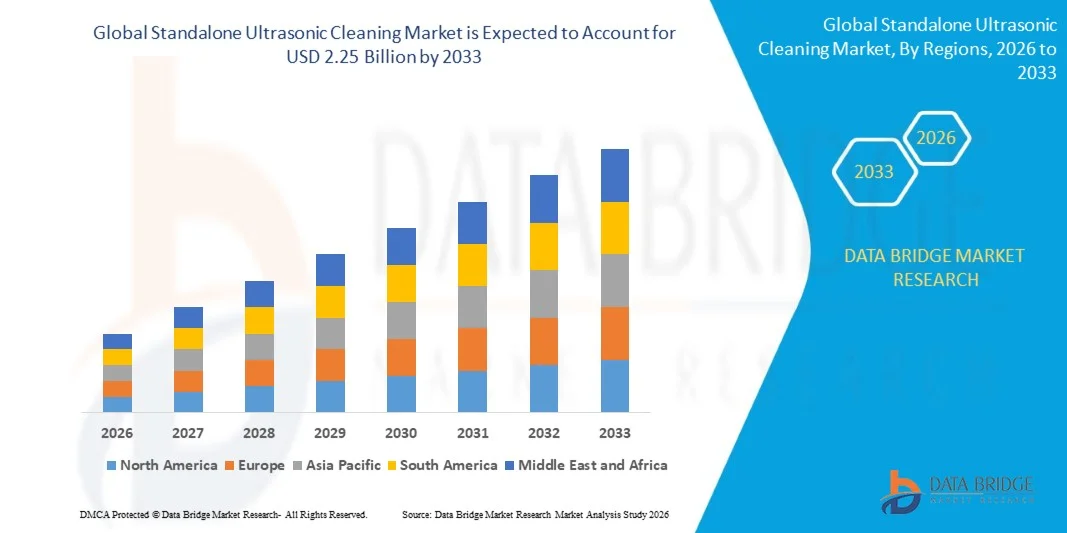
The Standalone Ultrasonic Cleaning Market was valued at USD 1.50 billion in 2025 and is projected to reach USD 2.25 billion by 2033, growing at a CAGR of 5.25% from 2026 to 2033. The market is witnessing steady expansion driven by increasing demand for high-precision cleaning solutions across healthcare, electronics, automotive, and industrial manufacturing sectors, along with growing emphasis on contamination-free and non-abrasive cleaning processes.
The rising adoption of ultrasonic cleaning systems in medical device sterilization, semiconductor manufacturing, and precision engineering is significantly boosting market growth. Additionally, strict hygiene regulations in healthcare and pharmaceutical industries, coupled with the need for efficient cleaning of complex components with intricate geometries, is accelerating the shift toward standalone ultrasonic cleaning systems. Technological advancements such as automated frequency control, multi-frequency cleaning tanks, and energy-efficient designs are further enhancing performance, reliability, and operational efficiency across end-use industries.
Key Market Trends & Insights
- North America dominated the Standalone Ultrasonic Cleaning Market with the largest revenue share of 36.28% in 2025, supported by strong presence of advanced healthcare manufacturing, aerospace industries, and high adoption of precision cleaning technologies.
- The 250–500 W segment led the market with a 34.6% share in 2025, driven by its widespread use in laboratories, medical instrument cleaning, and small-scale industrial applications where moderate cleaning intensity and energy efficiency are required.
- Asia-Pacific is expected to be the fastest-growing region at a CAGR of 7.0% from 2026 to 2033, fueled by rapid industrialization, expanding electronics production, and increasing healthcare investments in China, India, and Japan.
- 1000–2000 W are the fastest-growing power output type, projected to register a CAGR of 6.2%, reflecting the surge in demand for high-intensity cleaning in industrial manufacturing, aerospace maintenance, and automotive component refurbishment.
- The 10–50 L segment dominated the capacity category with a 38.91% revenue share in 2025, led by its extensive usage in hospitals, laboratories, dental clinics, and small manufacturing units requiring moderate batch cleaning.
- Medical and Healthcare accounted for 37.8% of the market, preferred by stringent sterilization requirements for surgical instruments, dental tools, and reusable medical devices.
- The electrical and electronics segment is the fastest-growing vertical category, with a CAGR of 6.6%, driven by rising demand for precision cleaning of semiconductors, printed circuit boards, and microelectronic components.
Market Size & Forecast
- Global Market Value (2025): USD 1.50 Billion
- Expected Market Value (2033): USD 2.25 Billion
- Forecast CAGR (2026–2033): 5.25%
- Leading Region in 2025: North America
- Fastest Growing Region: Asia Pacific
Report Scope and Standalone Ultrasonic Cleaning Market Segmentation
|
Attributes |
Standalone Ultrasonic Cleaning Key Market Insights |
|
Segments Covered |
|
|
Countries Covered |
North America · U.S. · Canada · Mexico Europe · Germany · France · U.K. · Netherlands · Switzerland · Belgium · Russia · Italy · Spain · Turkey · Rest of Europe Asia-Pacific · China · Japan · India · South Korea · Singapore · Malaysia · Australia · Thailand · Indonesia · Philippines · Rest of Asia-Pacific Middle East and Africa · Saudi Arabia · U.A.E. · South Africa · Egypt · Israel · Rest of Middle East and Africa South America · Brazil · Argentina · Rest of South America |
|
Key Market Players |
· Elma Schmidbauer GmbH (Germany) · Branson Ultrasonics Corporation (U.S.) · Crest Ultrasonics Corporation (U.S.) · Kemet International Limited (U.K.) · Hielscher Ultrasonics GmbH (Germany) · SharperTek (U.S.) · Blue Wave Ultrasonics (U.S.) · Omegasonics (U.S.) · Mettler Electronics Corp. (U.S.) · GT Sonic (China) · Skymen Cleaning Equipment Shenzhen Co., Ltd. (China) · BANDELIN electronic GmbH & Co. KG (Germany) · Karl Suss (Germany) · IP Clean Tech (Japan) · Kaijo Corporation (Japan) · Mirae Ultrasonics Co., Ltd. (South Korea) · Daihan Scientific Co., Ltd. (South Korea) · Sonics & Materials, Inc. (U.S.) · Cleaning Technologies Group (U.S.) · Sonicor Inc. (U.S.) |
|
Market Opportunities |
· Increasing use of compact standalone ultrasonic cleaners in decentralized laboratories and point-of-care diagnostic centers · Growing replacement demand in healthcare facilities for automated sterilization systems · Expansion of ultrasonic cleaning adoption in semiconductor wafer fabrication as chip geometries shrink |
|
Value Added Data Infosets |
In addition to the insights on market scenarios such as market value, growth rate, segmentation, geographical coverage, and major players, the market reports curated by the Data Bridge Market Research also include in-depth expert analysis, geographically represented company-wise production and capacity, network layouts of distributors and partners, detailed and updated price trend analysis and deficit analysis of supply chain and demand. |
Standalone Ultrasonic Cleaning Market Trends
Trend: Rising Adoption in Precision Manufacturing & Healthcare Cleaning
Standalone ultrasonic cleaning systems are increasingly being used for high-precision cleaning of medical instruments, electronic components, and aerospace parts, driven by demand for contamination-free surfaces and non-abrasive cleaning methods. The integration of automated frequency tuning and multi-stage cleaning cycles is improving efficiency and consistency across industrial applications. Growing replacement of manual and solvent-based cleaning processes with ultrasonic technology is further enhancing operational safety, reducing chemical usage, and improving cleaning accuracy in sensitive manufacturing environments, while IoT-enabled monitoring is enabling better process control and maintenance tracking. for instance, advanced surgical instrument reprocessing units and semiconductor wafer cleaning lines are widely adopting standalone ultrasonic systems.
Standalone Ultrasonic Cleaning Market Dynamics
Key Market Driver: Expanding Demand from Healthcare and Electronics Industries
The increasing demand for sterile medical instruments and contamination-free electronic components is driving strong adoption of standalone ultrasonic cleaning systems across healthcare, pharmaceutical, and semiconductor sectors. Rising production of minimally invasive surgical tools and compact electronic devices is further amplifying the need for precise and non-damaging cleaning technologies that can reach complex geometries. Strict regulatory standards for hygiene and quality control are also compelling manufacturers to integrate ultrasonic cleaning into production and maintenance workflows, improving reliability and compliance while reducing manual cleaning dependency. for instance, hospitals and PCB manufacturing facilities are increasingly deploying ultrasonic cleaning units for routine sterilization and precision cleaning operations.
Key Restraint/Challenge: High Equipment Cost and Maintenance Complexity
A major restraint in the standalone ultrasonic cleaning market is the relatively high initial investment required for advanced systems equipped with multi-frequency transducers, heating controls, and automated cleaning features. Small and medium-sized enterprises often face challenges in justifying the cost due to limited cleaning volume requirements and budget constraints. Additionally, maintenance of transducers, cleaning solutions, and system calibration increases operational expenses over time, affecting adoption in price-sensitive markets. for instance, small dental clinics and local manufacturing workshops often delay upgrading from manual cleaning methods due to cost barriers and maintenance requirements
Key Market Opportunity: Integration of Smart Monitoring and Eco-Friendly Cleaning Systems
The integration of smart sensors, IoT-based monitoring, and eco-friendly cleaning solutions presents a significant growth opportunity for standalone ultrasonic cleaning systems across industries. Advanced systems capable of real-time monitoring of cleaning efficiency, fluid condition, and energy consumption are gaining traction in regulated industries such as healthcare and aerospace. The shift toward solvent-free and water-based cleaning processes is further supporting sustainable manufacturing initiatives and reducing environmental impact. for instance, pharmaceutical production units and precision electronics manufacturers are increasingly adopting smart ultrasonic cleaners with automated process optimization capabilities.
Standalone Ultrasonic Cleaning Market Scope
The standalone ultrasonic cleaning market is segmented on the basis of power output, capacity, and vertical.
- By Power Output
On the basis of power output, the Standalone Ultrasonic Cleaning Market is segmented into up to 250 W, 250–500 W, 500–1000 W, 1000–2000 W, 2000–5000 W, 5000–10000 W, and more than 10000 W. The 250–500 W segment dominated the market with a 34.6% share in 2025, owing to its widespread use in laboratories, medical instrument cleaning, and small-scale industrial applications where moderate cleaning intensity and energy efficiency are required. These systems offer an optimal balance between cleaning performance and operational cost, making them highly preferred in healthcare and precision manufacturing environments. Their compact design and ease of integration into existing workflows further support adoption. They are also widely used in dental clinics and research facilities for routine sterilization tasks. Increasing demand for standardized cleaning in regulated industries is reinforcing segment dominance. The segment continues to benefit from low maintenance requirements and broad application suitability across multiple end-use sectors. for instance, hospital sterilization units and electronics repair workshops extensively use 250–500 W ultrasonic cleaners.
The 1000–2000 W segment is expected to register the fastest growth at a CAGR of 6.2% from 2026 to 2033, driven by rising demand for high-intensity cleaning in industrial manufacturing, aerospace maintenance, and automotive component refurbishment. These systems provide deeper cleaning penetration for complex and heavily contaminated parts, improving efficiency in large-scale operations. Increasing automation in production lines is accelerating integration of high-power ultrasonic systems. Their ability to handle bulk cleaning tasks reduces operational downtime and improves throughput. Growing adoption in semiconductor and precision engineering industries is further boosting demand. Advancements in energy-efficient transducer technology are also making high-power systems more viable. for instance, aerospace maintenance facilities and automotive remanufacturing plants are increasingly deploying 1000–2000 W systems for heavy-duty cleaning applications.
- By Capacity
On the basis of capacity, the Standalone Ultrasonic Cleaning Market is segmented into up to 5 L, 10–50 L capacity, 50–100 L capacity, 100–150 L capacity, 150–200 L capacity, 200–250 L capacity, 250–300 L, and more than 300 L. The 10–50 L capacity segment dominated the market with a 38.9% share in 2025, due to its extensive usage in hospitals, laboratories, dental clinics, and small manufacturing units requiring moderate batch cleaning. These systems offer flexibility in handling multiple instruments simultaneously while maintaining cleaning precision. Their compact footprint makes them suitable for space-constrained environments. They are also preferred for routine sterilization and maintenance cleaning tasks across healthcare and electronics sectors. Ease of operation and cost-effectiveness further enhance adoption. The segment benefits from strong demand in both developed and emerging healthcare infrastructure. for instance, diagnostic laboratories and dental clinics widely use 10–50 L ultrasonic cleaning tanks for daily instrument sterilization.
The 100–150 L capacity segment is expected to witness the fastest growth at a CAGR of 6.4% from 2026 to 2033, driven by increasing demand for medium-scale industrial cleaning applications in automotive, aerospace, and electronics manufacturing. These systems support higher batch processing, improving productivity and operational efficiency. Rising adoption in precision engineering and component refurbishment is further fueling demand. Manufacturers are increasingly integrating these systems into automated production workflows. Growing focus on reducing manual cleaning time and improving consistency is accelerating adoption. Expanding industrial production capacity in Asia-Pacific is also supporting growth. for instance, automotive component manufacturers and aerospace MRO facilities are increasingly deploying 100–150 L systems for batch cleaning of precision parts.
- By Vertical
On the basis of vertical, the Standalone Ultrasonic Cleaning Market is segmented into medical and healthcare, automotive, food and beverage, metal and machinery, electrical and electronics, jewellery and gems, optics, aerospace, pharmaceuticals, and others. The medical and healthcare segment dominated the market with a 37.8% share in 2025, driven by stringent sterilization requirements for surgical instruments, dental tools, and reusable medical devices. Ultrasonic cleaning is widely adopted due to its ability to remove microscopic contaminants without damaging delicate instruments. Increasing surgical procedures and rising infection control standards are further strengthening demand. Hospitals and diagnostic centers rely heavily on these systems for routine cleaning workflows. Regulatory compliance requirements are also driving consistent adoption. Continuous expansion of healthcare infrastructure globally supports long-term segment dominance. for instance, hospitals and surgical centers routinely use ultrasonic cleaners for sterilizing endoscopic and orthopedic instruments.
The electrical and electronics segment is expected to register the fastest growth at a CAGR of 6.6% from 2026 to 2033, driven by rising demand for precision cleaning of semiconductors, printed circuit boards, and microelectronic components. As device miniaturization increases, contamination control becomes critical for performance and reliability. Ultrasonic cleaning ensures removal of flux residues, dust, and microscopic particles without damaging sensitive components. Expanding semiconductor manufacturing and consumer electronics production is further accelerating adoption. Increasing automation in electronics assembly lines is boosting integration of inline cleaning systems. Strong growth in 5G, IoT, and advanced computing devices is also contributing to demand. for instance, semiconductor fabs and PCB assembly plants increasingly rely on ultrasonic cleaning systems for precision contamination removal.
Standalone Ultrasonic Cleaning Market Regional Analysis
North America dominated the Standalone Ultrasonic Cleaning Market with the largest revenue share of 36.28% in 2025, supported by strong presence of advanced healthcare manufacturing, aerospace industries, and high adoption of precision cleaning technologies. The region also benefits from strict hygiene and sterilization regulations, widespread use of medical devices, and high penetration of automated cleaning systems across hospitals, laboratories, and industrial facilities. Increasing investment in semiconductor manufacturing, medical device production, and R&D activities continues to strengthen North America’s leadership position in the global market.
U.S. Standalone Ultrasonic Cleaning Market Insight
The U.S. standalone ultrasonic cleaning market is witnessing strong growth due to rising demand from advanced healthcare infrastructure, semiconductor manufacturing, and aerospace maintenance sectors. The country’s well-established medical device industry, combined with strict sterilization and contamination control standards, is driving widespread adoption of ultrasonic cleaning systems. Increasing investment in precision manufacturing and laboratory automation is further supporting market expansion across industrial and research applications. In addition, growing focus on reducing chemical-based cleaning processes and improving operational efficiency is accelerating technology adoption across end-use industries.
Europe Standalone Ultrasonic Cleaning Market Insight
The Europe standalone ultrasonic cleaning market remains a key contributor to global revenue, driven by strong regulatory frameworks, high adoption in healthcare sterilization, and advanced industrial manufacturing capabilities. The region benefits from well-developed automotive, aerospace, and precision engineering sectors that rely heavily on contamination-free cleaning processes. Increasing emphasis on sustainability and reduced chemical usage is further promoting ultrasonic cleaning adoption. Additionally, continuous technological advancements in automated and energy-efficient systems are strengthening market penetration across industrial and laboratory applications.
U.K. Standalone Ultrasonic Cleaning Market Insight
The U.K. standalone ultrasonic cleaning market is experiencing steady growth, supported by rising adoption in healthcare facilities, dental clinics, and precision engineering industries. Increasing demand for cost-effective and efficient sterilization solutions is driving the use of ultrasonic cleaning systems across medical and laboratory environments. Growing investment in research and biotechnology sectors is further supporting market expansion. Moreover, integration of smart monitoring features and compact system designs is enhancing operational efficiency and boosting adoption in small and medium-sized facilities.
Germany Standalone Ultrasonic Cleaning Market Insight
The Germany standalone ultrasonic cleaning market is expanding steadily due to the country’s strong industrial manufacturing base, advanced automotive sector, and high precision engineering capabilities. Automotive OEMs, aerospace manufacturers, and medical device producers are increasingly adopting ultrasonic cleaning systems for high-accuracy component cleaning. Strong focus on quality standards and engineering excellence is further driving market demand. Additionally, growing integration of automated and energy-efficient cleaning technologies is enhancing productivity and reducing operational downtime across industries.
Asia-Pacific Standalone Ultrasonic Cleaning Market Insight
The Asia-Pacific standalone ultrasonic cleaning market is expected to witness rapid growth, driven by expanding electronics manufacturing, rising healthcare investments, and strong industrialization across China, India, and Japan. Increasing demand for precision cleaning in semiconductor production and medical device sterilization is significantly boosting regional adoption. Growing awareness of contamination control and process automation is further supporting market expansion. Additionally, cost-effective manufacturing capabilities and rising exports of electronic and industrial components are accelerating demand for ultrasonic cleaning systems.
Japan Standalone Ultrasonic Cleaning Market Insight
The Japan standalone ultrasonic cleaning market is witnessing consistent growth due to strong demand from electronics, automotive, and healthcare sectors. The country’s advanced manufacturing ecosystem emphasizes high precision and contamination-free production, driving widespread adoption of ultrasonic cleaning systems. Increasing use in semiconductor fabrication and medical device sterilization is further strengthening market demand. Moreover, continuous technological innovation in compact and high-efficiency cleaning systems is supporting adoption across industrial and laboratory applications.
China Standalone Ultrasonic Cleaning Market Insight
The China standalone ultrasonic cleaning market is growing rapidly, driven by large-scale electronics production, expanding healthcare infrastructure, and strong industrial manufacturing growth. Rising demand for precision cleaning in semiconductor, automotive, and machinery sectors is significantly boosting adoption. Government support for advanced manufacturing and medical technology development is further accelerating market expansion. Additionally, increasing focus on automation, cost efficiency, and quality control is positioning China as one of the fastest-growing markets for standalone ultrasonic cleaning systems globally.
Standalone Ultrasonic Cleaning Market Share
The standalone ultrasonic cleaning industry is primarily led by well-established companies, including:
- Elma Schmidbauer GmbH (Germany)
- Branson Ultrasonics Corporation (U.S.)
- Crest Ultrasonics Corporation (U.S.)
- Kemet International Limited (U.K.)
- Hielscher Ultrasonics GmbH (Germany)
- SharperTek (U.S.)
- Blue Wave Ultrasonics (U.S.)
- Omegasonics (U.S.)
- Mettler Electronics Corp. (U.S.)
- GT Sonic (China)
- Skymen Cleaning Equipment Shenzhen Co., Ltd. (China)
- BANDELIN electronic GmbH & Co. KG (Germany)
- Karl Suss (Germany)
- IP Clean Tech (Japan)
- Kaijo Corporation (Japan)
- Mirae Ultrasonics Co., Ltd. (South Korea)
- Daihan Scientific Co., Ltd. (South Korea)
- Sonics & Materials, Inc. (U.S.)
- Cleaning Technologies Group (U.S.)
- Sonicor Inc. (U.S.)
Latest Developments in Standalone Ultrasonic Cleaning Market
- In October 2025, industry developments highlighted a strong shift toward eco-friendly ultrasonic cleaning solutions, with companies such as Crest Ultrasonics and Omegasonics focusing on chemical-free and energy-efficient systems driven by sustainability regulations and environmental compliance pressures, accelerating replacement of solvent-based cleaning methods; for instance, manufacturers in electronics and healthcare sectors are transitioning to biodegradable and water-based ultrasonic cleaning processes
- In March 2025, Crest Ultrasonics showcased advanced ultrasonic cleaning technologies at IMTOS 2025, highlighting improved cavitation efficiency and industrial-scale cleaning capabilities tailored for automotive and precision engineering applications, reflecting growing demand for high-performance standalone cleaning systems in emerging industrial markets; for instance, manufacturers demonstrated integration of ultrasonic cleaning in production and maintenance workflows
- In November 2024, Branson Ultrasonics (Emerson Electric) announced advancements in its ultrasonic cleaning portfolio, focusing on automated and high-precision cleaning systems designed for medical, aerospace, and electronics applications, with improved integration into smart manufacturing and Industry 4.0 environments, enabling higher consistency and reduced manual intervention in industrial cleaning workflows; for instance, automated ultrasonic cleaning lines are increasingly being integrated into precision component manufacturing facilities
- In August 2024, Crest Ultrasonics introduced eco-friendly and solvent-free ultrasonic cleaning systems aimed at reducing chemical usage while improving cleaning efficiency, supporting the shift toward sustainable manufacturing practices in healthcare and industrial sectors, particularly where contamination control is critical; for instance, medical device and aerospace manufacturers are increasingly adopting water-based ultrasonic cleaning tanks for safer and compliant operations
- In June 2023, the ultrasonic cleaning industry witnessed steady expansion driven by rising adoption across healthcare, automotive, and electronics manufacturing, with key players such as Branson Ultrasonics and Crest Ultrasonics enhancing automation, precision, and cleaning efficiency in their systems, supporting broader industrial integration of ultrasonic cleaning technologies; for instance, electronics assembly and PCB manufacturing facilities increasingly deployed ultrasonic cleaning units for high-precision component
SKU-
Get online access to the report on the World's First Market Intelligence Cloud

- Interactive Data Analysis Dashboard
- Company Analysis Dashboard for high growth potential opportunities
- Research Analyst Access for customization & queries
- Competitor Analysis with Interactive dashboard
- Latest News, Updates & Trend analysis
- Harness the Power of Benchmark Analysis for Comprehensive Competitor Tracking
Global Standalone Ultrasonic Cleaning Market, Supply Chain Analysis and Ecosystem Framework
To support market growth and help clients navigate the impact of geopolitical shifts, DBMR has integrated in-depth supply chain analysis into its Global Standalone Ultrasonic Cleaning Market research reports. This addition empowers clients to respond effectively to global changes affecting their industries. The supply chain analysis section includes detailed insights such as Global Standalone Ultrasonic Cleaning Market consumption and production by country, price trend analysis, the impact of tariffs and geopolitical developments, and import and export trends by country and HSN code. It also highlights major suppliers with data on production capacity and company profiles, as well as key importers and exporters. In addition to research, DBMR offers specialized supply chain consulting services backed by over a decade of experience, providing solutions like supplier discovery, supplier risk assessment, price trend analysis, impact evaluation of inflation and trade route changes, and comprehensive market trend analysis.
Research Methodology
Data collection and base year analysis are done using data collection modules with large sample sizes. The stage includes obtaining market information or related data through various sources and strategies. It includes examining and planning all the data acquired from the past in advance. It likewise envelops the examination of information inconsistencies seen across different information sources. The market data is analysed and estimated using market statistical and coherent models. Also, market share analysis and key trend analysis are the major success factors in the market report. To know more, please request an analyst call or drop down your inquiry.
The key research methodology used by DBMR research team is data triangulation which involves data mining, analysis of the impact of data variables on the market and primary (industry expert) validation. Data models include Vendor Positioning Grid, Market Time Line Analysis, Market Overview and Guide, Company Positioning Grid, Patent Analysis, Pricing Analysis, Company Market Share Analysis, Standards of Measurement, Global versus Regional and Vendor Share Analysis. To know more about the research methodology, drop in an inquiry to speak to our industry experts.
Customization Available
Data Bridge Market Research is a leader in advanced formative research. We take pride in servicing our existing and new customers with data and analysis that match and suits their goal. The report can be customized to include price trend analysis of target brands understanding the market for additional countries (ask for the list of countries), clinical trial results data, literature review, refurbished market and product base analysis. Market analysis of target competitors can be analyzed from technology-based analysis to market portfolio strategies. We can add as many competitors that you require data about in the format and data style you are looking for. Our team of analysts can also provide you data in crude raw excel files pivot tables (Fact book) or can assist you in creating presentations from the data sets available in the report.












