




Global Stress Testing Solutions Market
Market Size in USD Billion
CAGR :
% 
 USD
14.64 Billion
USD
70.44 Billion
2025
2033
USD
14.64 Billion
USD
70.44 Billion
2025
2033
 Forecast Period Forecast Period |
2026 - 2033 |
 Market Size (Base Year) Market Size (Base Year) |
USD 14.64 Billion |
 Market Size (Forecast Year) Market Size (Forecast Year) |
USD 70.44 Billion |
 CAGR CAGR |
% |
| Major Markets Players |
|
Stress Testing Solutions Market Overview
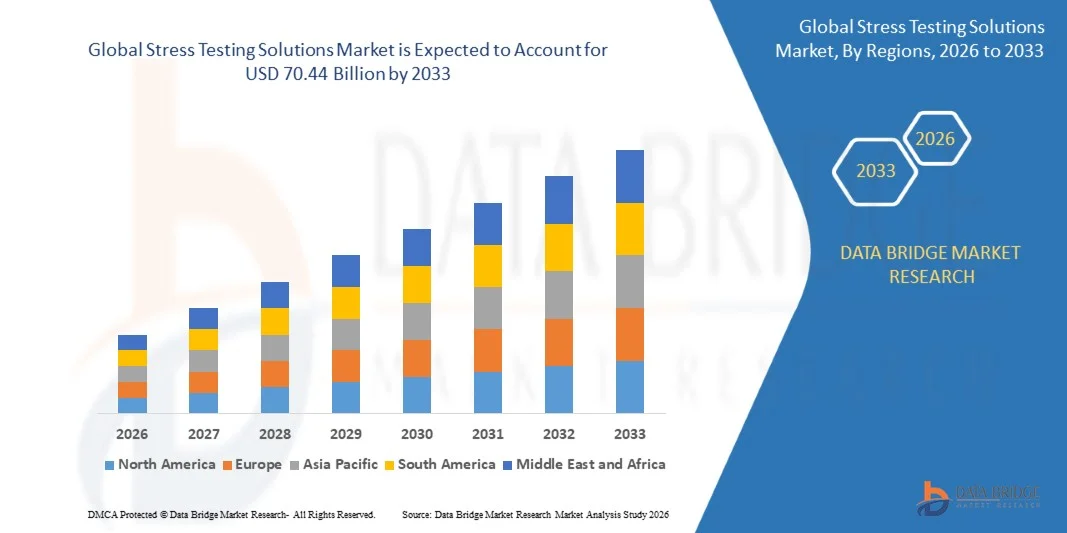
The Stress Testing Solutions Market was valued at USD 14.64 billion in 2025 and is projected to reach USD 70.44 billion by 2033, growing at a CAGR of 21.70% from 2026 to 2033. The market is witnessing rapid expansion driven by increasing regulatory requirements for financial risk assessment, rising complexity in global financial systems, and growing adoption of advanced analytics and AI-based modeling tools across banking, insurance, and fintech sectors.
The increasing frequency of economic uncertainties, including interest rate fluctuations, geopolitical risks, and market volatility, is compelling financial institutions to adopt robust stress testing frameworks to ensure capital adequacy and regulatory compliance. In addition, stricter guidelines from regulatory bodies such as the Basel Committee and central banks are accelerating the integration of automated, scenario-based stress testing solutions to improve risk forecasting accuracy and strengthen overall financial system stability.
Key Market Trends & Insights
- North America dominated the stress testing solutions market with the largest revenue share of approximately 38.6% in 2025, supported by strict regulatory frameworks such as CCAR and Federal Reserve stress testing mandates, early adoption of advanced risk analytics technologies, and strong presence of major financial institutions and fintech ecosystems.
- Asia-Pacific is expected to be the fastest-growing region, recording a CAGR of 23.2% from 2026 to 2033. Growth is driven by rapid expansion of digital banking services, increasing regulatory reforms in emerging economies, rising fintech penetration, and growing demand for advanced financial risk management systems across banking and insurance sectors.
- The Application Testing segment held the largest market revenue share of approximately 57% in 2025 driven by rising demand for real time financial risk assessment, regulatory compliance validation, and AI based scenario modeling across banking and insurance institutions. Application testing solutions are widely used to evaluate credit risk, liquidity risk, and market volatility exposure under extreme economic conditions. Increasing adoption of cloud based analytics platforms and automated stress testing frameworks is further strengthening segment dominance across large financial enterprises.
- The Product Testing segment is projected to register the fastest growth at a CAGR of 23.4% from 2026 to 2033, driven by increasing deployment of advanced software solutions, fintech platforms, and trading systems requiring rigorous validation under simulated financial stress conditions. Rising complexity of digital financial ecosystems and integration of AI driven trading applications is further accelerating demand for robust product level stress testing solutions across global markets.
- The Banking, Financial Services, and Insurance (BFSI) segment held the largest market revenue share of approximately 62% in 2025 driven by stringent regulatory requirements, capital adequacy norms, and increasing need for financial risk mitigation. BFSI institutions extensively use stress testing solutions for portfolio risk analysis, liquidity planning, and compliance reporting under Basel III and IFRS frameworks.
- The IT and Telecom segment is projected to register the fastest growth at a CAGR of 24.1% from 2026 to 2033, driven by increasing adoption of cloud based financial platforms, digital payment ecosystems, and cybersecurity risk assessment systems. Rapid expansion of fintech infrastructure and real time transaction processing systems is further boosting demand for stress testing solutions across technology driven financial environments.
Market Size & Forecast
- Global Market Value (2025): USD 14.64 Billion
- Expected Market Value (2033): USD 70.44 Billion
- Forecast CAGR (2026–2033): 21.70%
- Leading Region in 2025: North America
- Fastest Growing Region: Asia-Pacific
Report Scope and Stress Testing Solutions Market Segmentation
|
Attributes |
Stress Testing Solutions Key Market Insights |
|
Segments Covered |
|
|
Countries Covered |
North America
Europe
Asia-Pacific
Middle East and Africa
South America
|
|
Key Market Players |
• Micro Focus (U.K.) |
|
Market Opportunities |
|
|
Value Added Data Infosets |
In addition to the market insights such as market value, growth rate, market segments, geographical coverage, market players, and market scenario, the market report curated by the Data Bridge Market Research team includes in-depth expert analysis, import/export analysis, pricing analysis, production consumption analysis, and pestle analysis. |
Stress Testing Solutions Market Trends
Trend: Growth In AI Driven Scenario Modeling And Real Time Financial Risk Simulation
Increasing demand for advanced, data driven, and regulatory compliant stress testing solutions across banking, insurance, and capital markets sectors. Traditional risk assessment methods are increasingly unable to handle the complexity and speed of modern financial systems, driving adoption of AI based and cloud enabled stress testing platforms that improve predictive accuracy and scenario flexibility.
In modern banking institutions, financial organizations are integrating stress testing solutions, For instance for credit risk analysis and liquidity forecasting, to evaluate capital adequacy under extreme but plausible market conditions while improving compliance with Basel III and IFRS 9 frameworks. In insurance companies, these platforms are being used to simulate catastrophe risk and asset liability mismatches, improving underwriting accuracy and solvency management. In addition, capital market firms are increasingly deploying real time stress testing tools to monitor portfolio risk exposure during high volatility trading sessions, reducing potential drawdowns and systemic risk impact.
The rapid expansion of digital banking and fintech ecosystems is also increasing demand for scalable cloud based stress testing platforms capable of processing large volumes of transactional and market data in real time. In addition, regulatory authorities such as the Federal Reserve in the U.S. and the European Banking Authority are strengthening mandatory stress testing requirements, driving widespread adoption across Tier 1 and Tier 2 financial institutions. Industry implementation in 2025 across major European banks demonstrated improved risk forecasting accuracy of nearly 20–30% after integrating AI powered scenario based stress testing systems into their core risk management frameworks.
Stress Testing Solutions Market Dynamics
Key Market Driver: Rising Regulatory Compliance And Financial Risk Management Requirements
Financial institutions globally are under increasing pressure to maintain capital adequacy, ensure liquidity resilience, and comply with evolving regulatory frameworks, driving strong adoption of advanced stress testing solutions. Growing market volatility, geopolitical uncertainty, and interest rate fluctuations are further increasing the need for predictive risk assessment tools capable of simulating extreme financial scenarios.
Banks and insurance companies are increasingly deploying automated stress testing platforms, For instance in credit portfolio evaluation and balance sheet risk analysis, to meet regulatory requirements imposed by Basel Committee guidelines and central bank mandates. Large financial institutions in North America and Europe have reported up to 25% improvement in risk identification efficiency after implementing integrated stress testing frameworks, enhancing decision making and capital planning accuracy under uncertain market conditions.
Key Restraint/Challenge: High Implementation Complexity And Data Integration Limitations
Despite strong adoption potential, stress testing solutions face challenges related to complex system integration, high deployment costs, and dependence on large volumes of high quality financial data. Legacy banking infrastructure often lacks compatibility with modern analytics platforms, creating integration bottlenecks and increasing implementation timelines.
In addition, smaller financial institutions face affordability constraints due to the high cost of advanced AI driven stress testing platforms and skilled data science resources required for operation. Data inconsistency across multiple financial systems further limits model accuracy and reduces reliability of scenario based forecasting. Industry studies indicate that integration and maintenance costs can account for nearly 30–40% of total stress testing solution deployment expenses in large banking networks, limiting adoption in cost sensitive institutions.
Key Market Opportunity: Expansion Of Cloud Based And AI Powered Risk Analytics Platforms
The increasing shift toward digital banking, fintech expansion, and real time financial monitoring is creating significant opportunities for cloud based and AI enabled stress testing solutions. These platforms offer scalability, faster processing capabilities, and enhanced predictive analytics compared to traditional on premise systems, making them highly suitable for modern financial ecosystems.
Financial institutions are increasingly adopting cloud native stress testing systems, For instance in enterprise risk management and regulatory reporting, to improve operational efficiency and reduce compliance reporting time. In 2025, several Asia Pacific banks integrating AI driven stress testing platforms reported up to 35% faster scenario generation and improved capital allocation efficiency, highlighting strong potential for widespread adoption across global financial markets.
Stress Testing Solutions Market Scope
The market is segmented on the basis of product and end-users.
• By Product
On the basis of product, the Stress Testing Solutions Market is segmented into Application Testing and Product Testing. The Application Testing segment held the largest market revenue share of approximately 57% in 2025 driven by rising demand for real time financial risk assessment, regulatory compliance validation, and AI based scenario modeling across banking and insurance institutions. Application testing solutions are widely used to evaluate credit risk, liquidity risk, and market volatility exposure under extreme economic conditions. Increasing adoption of cloud based analytics platforms and automated stress testing frameworks is further strengthening segment dominance across large financial enterprises.
The Product Testing segment is projected to register the fastest growth at a CAGR of 23.4% from 2026 to 2033, driven by increasing deployment of advanced software solutions, fintech platforms, and trading systems requiring rigorous validation under simulated financial stress conditions. Rising complexity of digital financial ecosystems and integration of AI driven trading applications is further accelerating demand for robust product level stress testing solutions across global markets.
• By End-Users
On the basis of end-users, the market is segmented into Banking, Financial Services, and Insurance (BFSI), IT and Telecom, Lifesciences and Healthcare, Manufacturing, Energy and Utilities, Retail, Consumer Goods, Logistics, and Others. The Banking, Financial Services, and Insurance (BFSI) segment held the largest market revenue share of approximately 62% in 2025 driven by stringent regulatory requirements, capital adequacy norms, and increasing need for financial risk mitigation. BFSI institutions extensively use stress testing solutions for portfolio risk analysis, liquidity planning, and compliance reporting under Basel III and IFRS frameworks.
The IT and Telecom segment is projected to register the fastest growth at a CAGR of 24.1% from 2026 to 2033, driven by increasing adoption of cloud based financial platforms, digital payment ecosystems, and cybersecurity risk assessment systems. Rapid expansion of fintech infrastructure and real time transaction processing systems is further boosting demand for stress testing solutions across technology driven financial environments.
Stress Testing Solutions Market Regional Analysis
North America Stress Testing Solutions Market Insight
North America dominated the stress testing solutions market with the largest revenue share of approximately 38.6% in 2025, supported by strong regulatory enforcement, advanced financial infrastructure, and early adoption of AI driven risk analytics platforms. The region benefits from stringent stress testing requirements imposed by regulatory bodies such as the Federal Reserve and Office of the Comptroller of the Currency, driving widespread implementation across banking and insurance institutions. High concentration of global financial institutions and rapid digital transformation in risk management systems are further strengthening regional market dominance.
U.S. Stress Testing Solutions Market Insight
The U.S. stress testing solutions market captured the largest revenue share in 2025 within North America, driven by mandatory regulatory stress testing programs, increasing adoption of cloud based financial analytics, and rising demand for real time risk assessment tools. Large banks and insurance companies are heavily investing in advanced AI powered stress testing platforms to comply with Basel III and CCAR requirements. In addition, growing fintech expansion and increasing integration of predictive analytics into financial decision making are significantly boosting market growth across the country.
Europe Stress Testing Solutions Market Insight
The Europe stress testing solutions market is expected to witness the fastest growth rate from 2026 to 2033, primarily driven by strict regulatory frameworks imposed by the European Banking Authority and increasing focus on financial stability across banking systems. Rising adoption of digital banking platforms and advanced risk management technologies is accelerating demand for automated stress testing solutions. The region is also witnessing strong growth in scenario based modeling tools used for capital adequacy assessment and liquidity risk management across financial institutions.
U.K. Stress Testing Solutions Market Insight
The U.K. stress testing solutions market is expected to witness strong growth from 2026 to 2033, driven by increasing regulatory scrutiny from the Prudential Regulation Authority and growing emphasis on financial resilience post economic uncertainties. Banks and financial institutions are increasingly adopting AI based stress testing systems to enhance forecasting accuracy and regulatory reporting efficiency. In addition, the expansion of digital banking services and fintech innovation hubs in London is further supporting market expansion across risk analytics and compliance solutions.
Germany Stress Testing Solutions Market Insight
The Germany stress testing solutions market is expected to witness steady growth from 2026 to 2033, fueled by strong banking sector stability requirements and increasing digital transformation in financial risk management systems. German financial institutions are focusing on advanced analytics platforms to improve stress scenario modeling and capital planning accuracy. The integration of cloud based compliance tools and rising adoption of automated risk assessment systems are further accelerating market growth across banking and insurance sectors.
Asia-Pacific Stress Testing Solutions Market Insight
The Asia-Pacific stress testing solutions market is expected to witness the fastest growth rate from 2026 to 2033, supported by rapid expansion of banking networks, rising fintech adoption, and increasing regulatory reforms across emerging economies such as China, India, and Japan. Growing awareness of financial risk management and increasing digitalization of financial services are driving strong adoption of advanced stress testing platforms. In addition, rising foreign investments and expansion of cross border banking activities are further boosting demand for scalable risk analytics solutions in the region.
Japan Stress Testing Solutions Market Insight
The Japan stress testing solutions market is expected to witness steady growth from 2026 to 2033 due to increasing focus on financial stability, technological modernization of banking systems, and rising adoption of AI based risk modeling tools. Japanese financial institutions are integrating advanced stress testing frameworks to improve portfolio risk assessment and regulatory compliance efficiency. In addition, growing digital transformation in banking operations and increased exposure to global financial markets are supporting market expansion across risk management applications.
China Stress Testing Solutions Market Insight
The China stress testing solutions market accounted for the largest market revenue share in Asia-Pacific in 2025, attributed to rapid expansion of the banking sector, strong regulatory oversight, and increasing adoption of digital financial infrastructure. Chinese financial institutions are increasingly implementing advanced stress testing systems to manage credit risk, market volatility, and liquidity challenges. In addition, government driven financial reforms, expansion of fintech ecosystems, and rising adoption of AI powered analytics platforms are further accelerating market growth across the country.
Stress Testing Solutions Market Share
The Stress Testing Solutions industry is primarily led by well-established companies, including:
• Micro Focus (U.K.)
• Cigniti Technologies Limited (India)
• Accenture (Ireland)
• Capgemini (France)
• IBM (U.S.)
• Wipro Limited (India)
• Akamai Technologies (U.S.)
• Progress Software Corporation (U.S.)
• RadView Software Ltd. (Israel)
• Performance Lab (U.S.)
• Oracle (U.S.)
• Infosys Limited (India)
• Hewlett Packard Enterprise Development LP (U.S.)
• SAS Institute Inc. (U.S.)
• Invensis Technologies Pvt Ltd (India)
• Sun Technologies (U.S.)
• Tata Consultancy Services Limited (India)
• Cognizant (U.S.)
• Broadcom (U.S.)
SKU-
Get online access to the report on the World's First Market Intelligence Cloud

- Interactive Data Analysis Dashboard
- Company Analysis Dashboard for high growth potential opportunities
- Research Analyst Access for customization & queries
- Competitor Analysis with Interactive dashboard
- Latest News, Updates & Trend analysis
- Harness the Power of Benchmark Analysis for Comprehensive Competitor Tracking
Research Methodology
Data collection and base year analysis are done using data collection modules with large sample sizes. The stage includes obtaining market information or related data through various sources and strategies. It includes examining and planning all the data acquired from the past in advance. It likewise envelops the examination of information inconsistencies seen across different information sources. The market data is analysed and estimated using market statistical and coherent models. Also, market share analysis and key trend analysis are the major success factors in the market report. To know more, please request an analyst call or drop down your inquiry.
The key research methodology used by DBMR research team is data triangulation which involves data mining, analysis of the impact of data variables on the market and primary (industry expert) validation. Data models include Vendor Positioning Grid, Market Time Line Analysis, Market Overview and Guide, Company Positioning Grid, Patent Analysis, Pricing Analysis, Company Market Share Analysis, Standards of Measurement, Global versus Regional and Vendor Share Analysis. To know more about the research methodology, drop in an inquiry to speak to our industry experts.
Customization Available
Data Bridge Market Research is a leader in advanced formative research. We take pride in servicing our existing and new customers with data and analysis that match and suits their goal. The report can be customized to include price trend analysis of target brands understanding the market for additional countries (ask for the list of countries), clinical trial results data, literature review, refurbished market and product base analysis. Market analysis of target competitors can be analyzed from technology-based analysis to market portfolio strategies. We can add as many competitors that you require data about in the format and data style you are looking for. Our team of analysts can also provide you data in crude raw excel files pivot tables (Fact book) or can assist you in creating presentations from the data sets available in the report.












