


Global Submarine Cable System Market
Market Size in USD Billion
CAGR :
% 
 USD
33.05 Billion
USD
59.39 Billion
2025
2033
USD
33.05 Billion
USD
59.39 Billion
2025
2033
 Forecast Period Forecast Period |
2026 –2033 |
 Market Size (Base Year) Market Size (Base Year) |
USD 33.05 Billion |
 Market Size (Forecast Year) Market Size (Forecast Year) |
USD 59.39 Billion |
 CAGR CAGR |
% |
| Major Markets Players |
|
Submarine Cable System Market Size
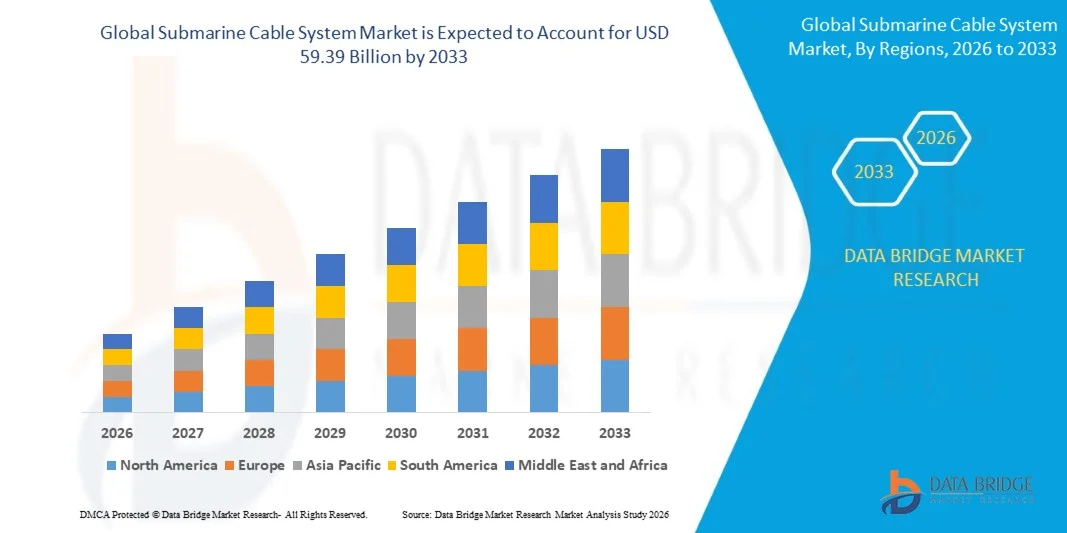
- The global submarine cable system market size was valued at USD 33.05 billion in 2025 and is expected to reach USD 59.39 billion by 2033, at a CAGR of 7.60% during the forecast period
- The market growth is largely fueled by the rapid expansion of offshore wind energy projects, rising inter-country power interconnection initiatives, and increasing global demand for high-capacity data transmission networks. Growing investments in subsea infrastructure are strengthening both energy and communication connectivity across continents
- Furthermore, rising demand for reliable, low-latency global internet connectivity, increasing digital transformation, and the surge in cloud computing, AI workloads, and hyperscale data centers are significantly accelerating the deployment of submarine cable systems, thereby boosting overall market expansion
Submarine Cable System Market Analysis
- Submarine cable systems are high-capacity underwater transmission networks used for transferring electricity and data across oceans, enabling long-distance power exchange and global internet connectivity. These systems form the backbone of international communication and cross-border energy infrastructure, ensuring stable and efficient transmission
- The escalating demand for submarine cable systems is primarily driven by the expansion of offshore renewable energy projects, increasing global data traffic, and rising investments in strengthening international power grids and digital communication networks
- Asia-Pacific dominated the submarine cable system market with a share of 39.1% in 2025, due to rapid expansion of offshore wind projects, rising inter-country connectivity demand, and strong investments in digital infrastructure
- North America is expected to be the fastest growing region in the submarine cable system market during the forecast period due to rising offshore wind investments, increasing demand for high-capacity communication networks, and modernization of grid infrastructure
- Wet plant products segment dominated the market with a market share of 68.15% in 2025, due to extensive deployment of subsea cables across offshore wind farms and intercontinental connectivity projects. These components form the core transmission infrastructure under seawater, ensuring reliable high-capacity energy and data transfer. Growing investments in long-distance power transmission networks and subsea communication routes further strengthen demand for wet plant systems
Report Scope and Submarine Cable System Market Segmentation
|
Attributes |
Submarine Cable System Key Market Insights |
|
Segments Covered |
|
|
Countries Covered |
North America
Europe
Asia-Pacific
Middle East and Africa
South America
|
|
Key Market Players |
|
|
Market Opportunities |
|
|
Value Added Data Infosets |
In addition to the insights on market scenarios such as market value, growth rate, segmentation, geographical coverage, and major players, the market reports curated by the Data Bridge Market Research also include in-depth expert analysis, geographically represented company-wise production and capacity, network layouts of distributors and partners, detailed and updated price trend analysis and deficit analysis of supply chain and demand. |
Submarine Cable System Market Trends
“Rising Deployment of Offshore Renewable Energy Integration Networks”
- A significant trend in the submarine cable system market is the increasing deployment of offshore renewable energy integration networks, driven by the rapid expansion of offshore wind farms and cross-border interconnection projects. These systems are becoming essential for transmitting large-scale renewable energy from offshore sites to onshore grids, supporting global decarbonization goals
- For instance, Prysmian Group and Nexans are actively involved in supplying and installing submarine power cables for major offshore wind projects such as the Hornsea offshore wind farm in the U.K. and the DolWin offshore grid connection system in Germany. These deployments highlight the growing reliance on submarine cables for large-scale renewable energy evacuation
- The integration of offshore wind energy with national grids is increasing demand for high-capacity HVDC submarine cable systems capable of transmitting electricity over long distances with minimal losses. This is enabling countries to expand renewable energy capacity without compromising grid stability
- Energy operators are also investing in multi-terminal and hybrid offshore grids that connect multiple wind farms and countries through a single interconnected subsea network. This is improving energy efficiency and enhancing regional power sharing capabilities
- The trend is further strengthened by rising government commitments toward net-zero targets, which are accelerating offshore wind installations and subsea transmission infrastructure development. This is positioning submarine cable systems as a critical backbone for the global energy transition
- Overall, the increasing convergence of offshore wind development and cross-border electricity trading is reshaping global energy infrastructure, making submarine cable systems essential for sustainable power transmission networks
Submarine Cable System Market Dynamics
Driver
“Expansion of Global Data Center and Cloud Connectivity Infrastructure”
- The expansion of global data center and cloud connectivity infrastructure is a major driver of the submarine cable system market, fueled by exponential growth in internet traffic, cloud computing services, and hyperscale data center development. Submarine cables form the backbone of international data transmission, enabling high-speed and low-latency global connectivity
- For instance, Meta and Google have invested in large-scale submarine cable projects such as the 2Africa and Equiano systems to enhance global cloud and digital service connectivity. These projects demonstrate how technology giants are directly driving demand for high-capacity subsea communication networks
- The increasing reliance on cloud-based platforms for enterprise operations, streaming services, and digital applications is significantly boosting the need for resilient and high-bandwidth subsea communication infrastructure. This ensures uninterrupted global data flow across continents
- Hyperscale data centers operated by companies such as Amazon Web Services and Microsoft Azure are further accelerating demand for redundant and high-capacity submarine cable routes. These systems support continuous data exchange and improve network resilience across regions
- Overall, the continuous expansion of global digital infrastructure is reinforcing the need for advanced submarine cable systems, making them essential for supporting the next generation of cloud-driven economies
Restraint/Challenge
“High Installation and Maintenance Complexity in Deep-Sea Environments”
- The submarine cable system market faces significant challenges due to the high installation and maintenance complexity associated with deep-sea environments, where extreme water depth, seabed conditions, and environmental risks make deployment technically demanding and costly
- For instance, SubCom and NEC Corporation utilize specialized cable-laying vessels and remotely operated underwater vehicles (ROVs) to install and maintain submarine cables such as the SEA-ME-WE and Asia-America Gateway systems. These operations require advanced engineering precision and high operational expenditure
- Cable installation involves complex marine route surveys, seabed mapping, and careful routing to avoid underwater hazards such as tectonic zones, fishing areas, and anchor drags. These requirements significantly increase project timelines and execution difficulty
- Maintenance and repair operations are further constrained by harsh underwater conditions, where locating faults and restoring connectivity requires specialized ships and highly skilled technical teams. This increases downtime risks and operational costs for network operators
- Overall, the complexity of deploying and maintaining submarine cable systems in deep ocean environments continues to act as a major restraint, increasing both capital and operational burdens for industry participants
Submarine Cable System Market Scope
The market is segmented on the basis of component, type, configuration, voltage, offering, application, and end users.
• By Component
On the basis of component, the submarine cable system market is segmented into dry plant products and wet plant products. The wet plant products segment dominated the largest market revenue share of 68.15% in 2025, driven by extensive deployment of subsea cables across offshore wind farms and intercontinental connectivity projects. These components form the core transmission infrastructure under seawater, ensuring reliable high-capacity energy and data transfer. Growing investments in long-distance power transmission networks and subsea communication routes further strengthen demand for wet plant systems. The segment continues to expand due to its critical role in enabling large-scale offshore energy integration and global connectivity infrastructure.
The dry plant products segment is anticipated to witness the fastest growth rate from 2026 to 2033, supported by rising development of onshore substations and terminal equipment linked to submarine cable networks. Increasing integration of advanced monitoring systems and power conversion technologies enhances operational efficiency and grid stability. Expansion of landing station infrastructure for offshore wind projects is further accelerating demand for dry plant components. Utility operators are increasingly investing in modernized shore-based facilities to support higher transmission capacities. The segment growth is reinforced by continuous upgrades in onshore power handling and control systems.
• By Type
On the basis of type, the submarine cable system market is segmented into unarmored cable and armored cable. The armored cable segment dominated the largest market revenue share in 2025, driven by its high durability and protection against external damage in shallow water and coastal installations. These cables are widely used in regions with high marine activity where physical protection is critical. Their layered construction ensures resistance against abrasion, fishing activities, and anchoring impacts. The segment remains essential for nearshore and offshore projects requiring enhanced mechanical strength and reliability.
The unarmored cable segment is anticipated to witness the fastest growth rate from 2026 to 2033, fueled by increasing deployment in deep-sea environments where external mechanical risks are relatively low. These cables offer reduced material usage and improved flexibility, making them suitable for long-distance high-capacity transmission routes. Rising demand for cost-efficient HVDC submarine links is further supporting adoption. Offshore energy expansion into deeper waters is accelerating the need for lightweight cable designs. The segment growth is strengthened by technological improvements in deep-sea installation capabilities.
• By Configuration
On the basis of configuration, the submarine cable system market includes submerged plant, beach manhole, shore section, land sections, terminal station, and terminal station equipment. The submerged plant segment dominated the largest market revenue share in 2025, driven by extensive undersea cable deployment across offshore wind farms and intercontinental communication networks. This configuration forms the primary transmission pathway under marine environments, ensuring stable and high-capacity connectivity. Increasing cross-border energy projects further enhances its importance in global infrastructure. The segment remains central to subsea transmission systems due to its large-scale deployment scope.
The terminal station equipment segment is anticipated to witness the fastest growth rate from 2026 to 2033, driven by rising investments in advanced grid interconnection infrastructure. These systems support power conversion, monitoring, and stabilization functions at landing points of submarine cables. Expansion of offshore renewable integration projects is increasing demand for high-performance terminal equipment. Utilities are focusing on enhancing reliability and operational control at connection hubs. The segment growth is supported by modernization of coastal transmission infrastructure and digital control systems.
• By Voltage
On the basis of voltage, the submarine cable system market is segmented into medium voltage, high voltage, and extra high voltage. The extra high voltage segment dominated the largest market revenue share in 2025, driven by its extensive use in long-distance power transmission and offshore wind integration projects. These systems enable efficient bulk power transfer with reduced transmission losses over vast underwater distances. Growing inter-country grid interconnection projects further strengthen demand for extra high voltage solutions. The segment remains essential for large-scale offshore energy transmission networks.
The high voltage segment is anticipated to witness the fastest growth rate from 2026 to 2033, fueled by increasing adoption in regional interconnection and mid-range offshore projects. Rising electrification initiatives and expansion of offshore wind capacity are driving demand for efficient transmission systems. High voltage cables offer a balanced solution between capacity and installation complexity. Utilities are increasingly deploying these systems to enhance grid flexibility and reliability. The segment growth is supported by ongoing infrastructure expansion across emerging energy corridors.
• By Offering
On the basis of offering, the submarine cable system market is segmented into installation and commissioning, maintenance, and upgrade. The installation and commissioning segment dominated the largest market revenue share in 2025, driven by large-scale deployment of offshore wind farms and intercontinental cable projects. These activities involve complex engineering, seabed preparation, and precise cable laying operations. Increasing investments in new subsea infrastructure are further supporting demand for installation services. The segment remains critical due to the high initial setup requirements of submarine cable systems.
The upgrade segment is anticipated to witness the fastest growth rate from 2026 to 2033, driven by the need to enhance existing subsea networks for higher capacity and efficiency. Aging infrastructure is being modernized to support increased power transmission and data traffic demands. Integration of advanced monitoring and control technologies is further accelerating upgrade activities. Utilities and operators are focusing on extending asset lifespan through system enhancements. The segment growth is reinforced by continuous improvements in subsea transmission performance requirements.
• By Application
On the basis of application, the submarine cable system market is segmented into communication cables and power cables. The power cables segment dominated the largest market revenue share in 2025, driven by rising offshore wind power generation and cross-border electricity transmission projects. These cables play a critical role in connecting offshore energy sources to mainland grids. Increasing global demand for renewable energy integration is further strengthening adoption. The segment remains central to large-scale energy transition initiatives.
The communication cables segment is anticipated to witness the fastest growth rate from 2026 to 2033, fueled by rising global internet traffic and expansion of subsea data transmission networks. Increasing deployment of international fiber optic links is supporting high-speed digital connectivity. Growth in cloud computing and data center interconnectivity is further accelerating demand. Telecommunications operators are investing heavily in resilient undersea communication infrastructure. The segment growth is driven by expanding global digital communication requirements.
• By End Users
On the basis of end users, the submarine cable system market is segmented into offshore wind power generation, inter-country and island connection, and offshore oil and gas. The inter-country and island connection segment dominated the largest market revenue share in 2025, driven by rising demand for reliable cross-border electricity exchange and grid stability. These projects enable efficient energy sharing between regions and support national energy security goals. Increasing investments in HVDC interconnectors are further strengthening segment growth. The segment remains a key driver of large-scale submarine cable deployment worldwide.
The offshore wind power generation segment is anticipated to witness the fastest growth rate from 2026 to 2033, driven by rapid expansion of renewable energy capacity in offshore locations. Governments and utilities are heavily investing in wind farms to reduce carbon emissions and enhance energy diversification. Submarine cable systems play a critical role in transmitting generated power to onshore grids. Technological advancements in turbine capacity are further increasing demand for high-capacity transmission systems. The segment growth is reinforced by accelerating global shift toward clean energy infrastructure.
Submarine Cable System Market Regional Analysis
- Asia-Pacific dominated the submarine cable system market with the largest revenue share of 39.1% in 2025, driven by rapid expansion of offshore wind projects, rising inter-country connectivity demand, and strong investments in digital infrastructure
- The region benefits from extensive coastline development and increasing deployment of high-capacity undersea communication networks
- Growing energy transition initiatives and cross-border grid interconnections are further strengthening market expansion. Rising data traffic and offshore renewable integration continue to accelerate large-scale submarine cable installations
China Submarine Cable System Market Insight
China held the largest share in the Asia-Pacific submarine cable system market in 2025, supported by massive investments in offshore wind farms, advanced grid infrastructure, and strong manufacturing capabilities for cable production. The country’s focus on energy security and expansion of ultra-high voltage transmission networks is boosting demand for submarine cable systems. Government-backed infrastructure projects and Belt and Road connectivity initiatives are further enhancing growth. China’s dominance in both power and communication cable deployment reinforces its leading regional position.
India Submarine Cable System Market Insight
India is witnessing the fastest growth in the Asia-Pacific region from 2026 to 2033, driven by increasing offshore renewable energy ambitions, rising internet penetration, and expansion of coastal infrastructure. Government initiatives supporting clean energy and digital connectivity are accelerating submarine cable deployments. Growing demand for inter-island and international connectivity is further supporting market growth. Investments in smart grid systems and coastal energy transmission projects are strengthening India’s role in the regional market.
Europe Submarine Cable System Market Insight
Europe is expanding steadily in the submarine cable system market, supported by strong offshore wind development, cross-border energy integration projects, and advanced communication infrastructure. The region’s focus on decarbonization and renewable energy transition is driving large-scale submarine cable installations. Increasing investments in HVDC interconnectors and digital subsea networks are further supporting growth. Strict regulatory frameworks and emphasis on sustainable infrastructure are shaping market development.
Germany Submarine Cable System Market Insight
Germany’s submarine cable system market is driven by its leadership in offshore wind energy deployment and strong integration of renewable energy into the national grid. The country’s advanced engineering capabilities and investment in North Sea wind farms are boosting demand for high-capacity transmission systems. Expansion of interconnection projects with neighboring countries is further strengthening market growth. Germany’s industrial expertise supports continuous development of efficient submarine cable infrastructure.
U.K. Submarine Cable System Market Insight
The U.K. market is supported by large-scale offshore wind expansion in the North Sea and strong investments in cross-border electricity interconnectors. Post-Brexit energy security priorities and increasing focus on renewable integration are driving submarine cable deployments. The country is actively developing advanced subsea transmission corridors to support decarbonization goals. Rising demand for resilient energy infrastructure continues to strengthen market expansion.
North America Submarine Cable System Market Insight
North America is projected to grow at the fastest CAGR from 2026 to 2033, driven by rising offshore wind investments, increasing demand for high-capacity communication networks, and modernization of grid infrastructure. The region is witnessing strong deployment of submarine cables to support renewable energy integration and cross-border data transmission. Technological advancements and expansion of deep-water energy projects are further accelerating growth. Increasing focus on energy resilience and digital connectivity continues to boost market expansion.
U.S. Submarine Cable System Market Insight
The U.S. accounted for the largest share in North America in 2025, supported by rapid offshore wind development, strong investment in subsea communication infrastructure, and advanced grid modernization initiatives. Growing demand for high-speed data transmission and expansion of coastal renewable energy projects are driving submarine cable deployment. Federal support for clean energy and infrastructure upgrades is further strengthening market growth. Presence of leading technology and energy companies reinforces the country’s dominant position.
Submarine Cable System Market Share
The submarine cable system industry is primarily led by well-established companies, including:
- TE Connectivity (Switzerland)
- NEC Corporation (Japan)
- Saudi Ericsson (Saudi Arabia)
- Prysmian Group (Italy)
- Nexans (France)
- ZTT (China)
- SubCom (U.S.)
- Nokia (Finland)
- HENGTONG GROUP CO. LTD. (China)
- NKT A/S (Denmark)
- Sumitomo Electric Industries Ltd. (Japan)
- Corning Incorporated (U.S.)
- TFKable (Poland)
- Hellenic Cables S.A. (Greece)
- The Okonite Company (U.S.)
- Apar Industries Ltd. (India)
- AFL (U.S.)
- Hexatronic (Sweden)
Latest Developments in Global Submarine Cable System Market
- In March 2025, SoftBank initiated the construction of a next-generation Asia–U.S. subsea cable route designed to deliver multi-terabit trans-Pacific capacity. This development strengthens global data transmission infrastructure by significantly improving bandwidth availability and reducing latency across major digital corridors. It also supports rising cloud computing, AI workloads, and hyperscale data center connectivity demands. The project enhances international digital resilience and reinforces SoftBank’s strategic position in global submarine communication networks
- In February 2025, Nokia completed its acquisition of Infinera, expanding its coherent-optics capabilities for advanced subsea line-terminal equipment. This move strengthens Nokia’s technological leadership in high-capacity optical transmission systems used in submarine cable networks. It enables more efficient upgrade solutions for existing subsea infrastructure, improving data throughput and transmission reliability. The acquisition supports growing global demand for scalable and energy-efficient underwater communication systems
- In February 2025, Meta announced a USD 10 billion Project Waterworth, a 24-pair, 50,000 km global submarine cable system. This initiative significantly enhances Meta’s control over global data traffic and strengthens long-haul intercontinental connectivity. It is expected to improve bandwidth capacity for digital platforms, cloud services, and social media ecosystems. The project reinforces large-scale private investment trends in subsea cable infrastructure and global internet backbone expansion
- In September 2023, SubCom expanded its manufacturing and marine fulfillment capabilities in the U.S. through increased fiber-optic cable production and the addition of advanced assembly operations. The company also acquired two new vessels to enhance cable transportation efficiency and marine route survey capabilities. This expansion improves deployment speed, operational reliability, and project execution capacity for global submarine cable installations. It strengthens SubCom’s position as a leading supplier in the rapidly growing subsea communication infrastructure market
- In April 2023, Sumitomo Electric established a new high-voltage alternating current submarine cable manufacturing facility in Scotland, U.K. This development increases production capacity for offshore wind and power transmission projects across Europe. It reduces supply chain dependency and enhances proximity to key renewable energy markets. The expansion supports the U.K.’s offshore wind ambitions and strengthens Sumitomo Electric’s role in the European submarine power cable industry
SKU-
Get online access to the report on the World's First Market Intelligence Cloud

- Interactive Data Analysis Dashboard
- Company Analysis Dashboard for high growth potential opportunities
- Research Analyst Access for customization & queries
- Competitor Analysis with Interactive dashboard
- Latest News, Updates & Trend analysis
- Harness the Power of Benchmark Analysis for Comprehensive Competitor Tracking
Global Submarine Cable System Market, Supply Chain Analysis and Ecosystem Framework
To support market growth and help clients navigate the impact of geopolitical shifts, DBMR has integrated in-depth supply chain analysis into its Global Submarine Cable System Market research reports. This addition empowers clients to respond effectively to global changes affecting their industries. The supply chain analysis section includes detailed insights such as Global Submarine Cable System Market consumption and production by country, price trend analysis, the impact of tariffs and geopolitical developments, and import and export trends by country and HSN code. It also highlights major suppliers with data on production capacity and company profiles, as well as key importers and exporters. In addition to research, DBMR offers specialized supply chain consulting services backed by over a decade of experience, providing solutions like supplier discovery, supplier risk assessment, price trend analysis, impact evaluation of inflation and trade route changes, and comprehensive market trend analysis.
Research Methodology
Data collection and base year analysis are done using data collection modules with large sample sizes. The stage includes obtaining market information or related data through various sources and strategies. It includes examining and planning all the data acquired from the past in advance. It likewise envelops the examination of information inconsistencies seen across different information sources. The market data is analysed and estimated using market statistical and coherent models. Also, market share analysis and key trend analysis are the major success factors in the market report. To know more, please request an analyst call or drop down your inquiry.
The key research methodology used by DBMR research team is data triangulation which involves data mining, analysis of the impact of data variables on the market and primary (industry expert) validation. Data models include Vendor Positioning Grid, Market Time Line Analysis, Market Overview and Guide, Company Positioning Grid, Patent Analysis, Pricing Analysis, Company Market Share Analysis, Standards of Measurement, Global versus Regional and Vendor Share Analysis. To know more about the research methodology, drop in an inquiry to speak to our industry experts.
Customization Available
Data Bridge Market Research is a leader in advanced formative research. We take pride in servicing our existing and new customers with data and analysis that match and suits their goal. The report can be customized to include price trend analysis of target brands understanding the market for additional countries (ask for the list of countries), clinical trial results data, literature review, refurbished market and product base analysis. Market analysis of target competitors can be analyzed from technology-based analysis to market portfolio strategies. We can add as many competitors that you require data about in the format and data style you are looking for. Our team of analysts can also provide you data in crude raw excel files pivot tables (Fact book) or can assist you in creating presentations from the data sets available in the report.












