Global Supercritical Fluid Chromatography Market
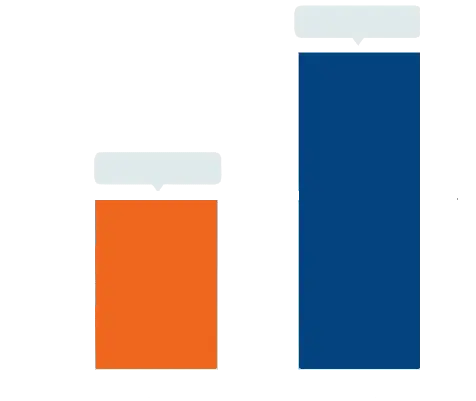
Market Size in USD Billion
CAGR :
% 
 USD
1.63 Billion
USD
2.25 Billion
2025
2033
USD
1.63 Billion
USD
2.25 Billion
2025
2033
 Forecast Period Forecast Period |
2026 –2033 |
 Market Size (Base Year) Market Size (Base Year) |
USD 1.63 Billion |
 Market Size (Forecast Year) Market Size (Forecast Year) |
USD 2.25 Billion |
 CAGR CAGR |
% |
| Major Markets Players |
|
Supercritical Fluid Chromatography Market Size
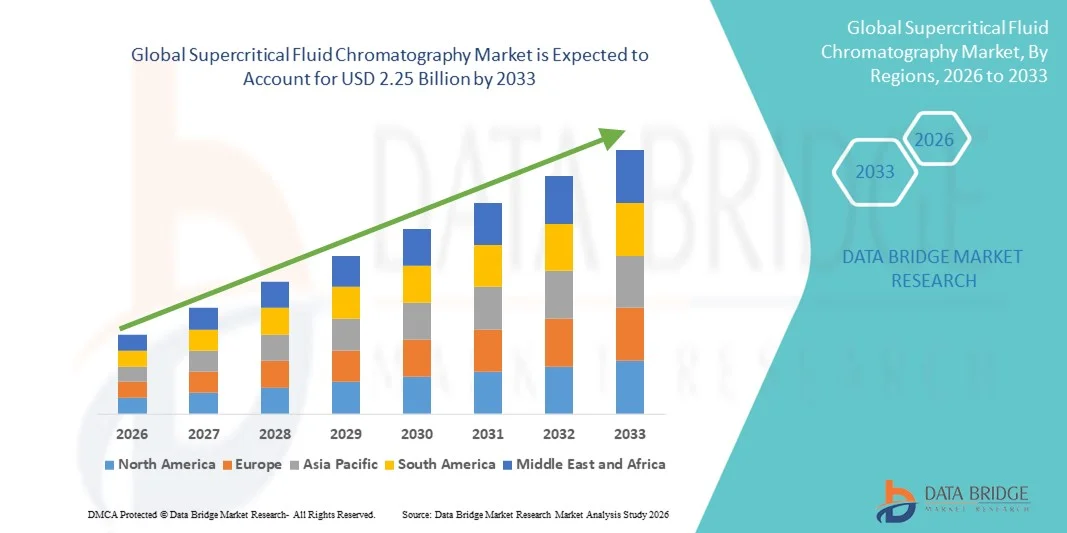
- The global supercritical fluid chromatography market size was valued at USD 1.63 billion in 2025 and is expected to reach USD 2.25 billion by 2033, at a CAGR of 4.12% during the forecast period
- The market growth is primarily driven by the increasing adoption of advanced analytical techniques in pharmaceutical, biotechnology, and academic research, supported by rising demand for faster, more efficient, and environmentally sustainable separation technologies
- Furthermore, growing emphasis on high-throughput analysis, improved chiral separations, and reduced solvent consumption is positioning supercritical fluid chromatography as a preferred alternative to conventional liquid chromatography. These combined factors are accelerating the adoption of SFC systems, thereby significantly enhancing the market’s overall growth trajectory
Supercritical Fluid Chromatography Market Analysis
- Supercritical fluid chromatography, enabling rapid and high-efficiency separation of complex compounds, is increasingly adopted across chemical, food, and biomedical laboratories due to its high resolution, reduced solvent usage, and compatibility with both analytical and preparative applications
- The growing demand for supercritical fluid chromatography systems is primarily driven by the rising adoption of advanced analytical techniques, increasing focus on sustainable and green chromatography solutions, and expanding use in chemical and biomedical analysis
- North America dominated the supercritical fluid chromatography market with the largest revenue share of 39.6% in 2025, driven by advanced research infrastructure, early adoption of chromatography technologies, and the strong presence of leading analytical instrumentation manufacturers, with the U.S. contributing the majority of regional demand
- Asia-Pacific is expected to be the fastest growing region in the supercritical fluid chromatography market during the forecast period supported by expanding analytical laboratories, growing pharmaceutical and chemical manufacturing, and increasing R&D investments across emerging economies
- The analytical segment dominated the supercritical fluid chromatography market with a market share of 46.8% in 2025, attributed to its widespread application in routine chemical analysis, method development, and quality control across diverse end-use industries
Report Scope and Supercritical Fluid Chromatography Market Segmentation
|
Attributes |
Supercritical Fluid Chromatography Key Market Insights |
|
Segments Covered |
|
|
Countries Covered |
North America
Europe
Asia-Pacific
Middle East and Africa
South America
|
|
Key Market Players |
|
|
Market Opportunities |
|
|
Value Added Data Infosets |
In addition to the insights on market scenarios such as market value, growth rate, segmentation, geographical coverage, and major players, the market reports curated by the Data Bridge Market Research also include in-depth expert analysis, patient epidemiology, pipeline analysis, pricing analysis, and regulatory framework |
Supercritical Fluid Chromatography Market Trends
Shift Toward Green and High-Speed Separation Technologies
- A significant and accelerating trend in the global supercritical fluid chromatography market is the growing preference for environmentally sustainable and high-speed separation techniques, driven by increasing regulatory pressure to reduce organic solvent usage and improve laboratory efficiency
- For instance, modern SFC systems introduced by leading analytical instrument manufacturers emphasize reduced CO₂-based mobile phases combined with advanced column technologies to deliver faster run times compared to conventional liquid chromatography
- Advictly, ongoing innovations in SFC instrumentation are enabling enhanced resolution, improved reproducibility, and better performance in complex compound separations, particularly for chiral and nonpolar analytes, making the technology increasingly attractive for routine and advanced analytical workflows
- The integration of automated sample handling, advanced detectors, and hybrid system configurations is further improving analytical throughput and ease of use, allowing laboratories to seamlessly incorporate SFC into existing chromatography platforms
- This trend toward faster, greener, and more versatile chromatography solutions is reshaping laboratory practices, with companies such as Waters and Agilent developing next-generation SFC systems focused on scalability, compliance, and operational efficiency
- The demand for sustainable, high-performance separation technologies is steadily increasing across pharmaceutical, chemical, food, and academic research sectors, reinforcing supercritical fluid chromatography as a strategic alternative to traditional methods
- The growing adoption of hybrid SFC–LC platforms is enabling laboratories to leverage multiple separation techniques within a single workflow, improving operational flexibility and utilization
Supercritical Fluid Chromatography Market Dynamics
Driver
Rising Demand for Efficient and Sustainable Analytical Techniques
- The increasing need for rapid, high-resolution, and environmentally friendly analytical methods across pharmaceutical, chemical, and food industries is a key driver fueling the adoption of supercritical fluid chromatography
- For instance, pharmaceutical companies are expanding the use of SFC in drug development workflows to accelerate chiral separations and impurity profiling while significantly reducing solvent consumption
- As regulatory agencies continue to emphasize method robustness, accuracy, and sustainability, laboratories are increasingly adopting SFC to meet stringent quality and compliance requirements
- Furthermore, the growing volume of analytical testing in drug discovery, quality control, and chemical research is driving demand for techniques that offer faster analysis without compromising precision
- The ability of supercritical fluid chromatography to support both analytical and preparative applications enhances its value proposition, encouraging wider adoption across multiple end-use industries
- The combination of performance efficiency, cost savings from reduced solvent usage, and alignment with green chemistry initiatives is strongly propelling market growth
- Expanding pharmaceutical pipelines and increasing complexity of chemical entities are further driving demand for advanced separation technologies such as SFC
- Rising investments in analytical laboratory infrastructure, particularly in emerging economies, are supporting increased deployment of supercritical fluid chromatography systems
Restraint/Challenge
High System Costs and Technical Complexity
- The relatively high initial investment required for supercritical fluid chromatography systems, along with associated maintenance and training costs, presents a notable challenge to widespread market adoption
- For instance, small and mid-sized laboratories may hesitate to adopt SFC due to the capital expenditure involved and the need for specialized expertise to operate and optimize the systems effectively
- The technical complexity of method development in SFC, including pressure optimization and modifier selection, can act as a barrier for laboratories accustomed to conventional liquid chromatography techniques
- In addition, limited awareness and familiarity with SFC among some end users can slow adoption, particularly in emerging markets with constrained analytical infrastructure
- While technological advancements are improving system usability, concerns related to operational complexity and return on investment remain for cost-sensitive users
- Overcoming these challenges through user-friendly system designs, training initiatives, and cost-effective product offerings will be essential for sustaining long-term growth in the supercritical fluid chromatography market
- Limited availability of standardized SFC methods across industries can create validation challenges and slow regulatory acceptance
- Dependence on specialized consumables and columns may increase long-term operating costs, restraining adoption among budget-constrained laboratories
Supercritical Fluid Chromatography Market Scope
The market is segmented on the basis of type, system, product, application, and end user.
- By Type
On the basis of type, the supercritical fluid chromatography market is segmented into pre-packed columns and empty columns. The pre-packed columns segment dominated the market in 2025, driven by its ease of use, consistent performance, and reduced method development time. Laboratories prefer pre-packed columns as they ensure reproducibility and reliability, which are critical for regulated environments such as pharmaceutical and food testing labs. Pre-packed columns minimize variability between analyses and reduce the need for in-house packing expertise. In addition, manufacturers provide a wide range of stationary phases tailored for specific applications, further strengthening adoption. Their compatibility with modern SFC systems supports seamless workflow integration and reduces setup errors.
The empty columns segment is expected to witness the fastest growth during the forecast period, fueled by increasing demand for customized separations. Advanced research laboratories and specialized analytical facilities favor empty columns for flexibility in packing specific stationary phases. This enables optimization for niche applications such as complex chiral separations and preparative-scale purification. Growing research activity and innovation-driven laboratories are key contributors to this growth. Furthermore, empty columns allow experimentation with new stationary phases, which supports method development in cutting-edge research.
- By System
On the basis of system, the market is segmented into analytical, hybrid, semi-preparative, and preparative systems. The analytical system segment dominated the market in 2025 with a market share of 46.8%, owing to its widespread use in routine chemical analysis, quality control, and method development. Analytical SFC systems offer high throughput, excellent resolution, and reduced solvent consumption, making them suitable for daily laboratory operations. Their compact design and compatibility with detectors such as mass spectrometry further enhance adoption. Regulatory compliance requirements also favor analytical systems due to their precision and reproducibility. Analytical systems are widely used across pharmaceutical, chemical, and food laboratories for standard testing and method validation.
The hybrid system segment is anticipated to witness the fastest growth during the forecast period, driven by its ability to combine liquid chromatography and supercritical fluid chromatography within a single platform. Hybrid systems provide operational flexibility and allow laboratories to handle a broader range of compounds. This versatility reduces capital investment by eliminating the need for multiple standalone systems. Increasing demand for multifunctional analytical platforms is accelerating adoption. Hybrid systems are particularly attractive to research institutions requiring high adaptability and integration with existing workflows.
- By Product
On the basis of product, the market is segmented into instruments, kits, reagents, and consumables. The instruments segment held the largest market share in 2025, supported by continuous technological advancements and replacement demand for advanced SFC systems. Instruments represent high-value purchases and are essential for establishing SFC capabilities within laboratories. Increasing adoption of automated and high-performance systems further strengthens this segment. Instrument upgrades to support hybrid and preparative applications also contribute to dominance. Instruments also provide scalability for increasing laboratory workloads and complex analytical tasks. Manufacturers often bundle service contracts with instruments, increasing their attractiveness to end users.
The kits, reagents, and consumables segment is projected to grow at the fastest rate during the forecast period, driven by recurring demand from routine analytical operations. As installed bases of SFC instruments expand globally, consumption of columns, reagents, and consumables increases steadily. This segment benefits from repeat purchases and long-term laboratory usage. Growing emphasis on method optimization and application-specific consumables further supports growth. Consumables also include specialty modifiers and solvents required for chiral separations. This steady demand ensures recurring revenue for manufacturers and distributors.
- By Application
On the basis of application, the market is segmented into chemical analysis, food product analysis, biomedical analysis, and others. The chemical analysis segment dominated the market in 2025, attributed to extensive use of SFC in separation, identification, and purity analysis of complex chemical compounds. Chemical laboratories favor SFC for its speed, efficiency, and reduced solvent requirements. Its effectiveness in handling nonpolar and chiral compounds makes it a preferred analytical technique. Increasing chemical research and industrial testing activities support sustained dominance. The segment also benefits from regulatory mandates requiring precise chemical characterization. In addition, SFC enables rapid high-throughput testing, enhancing laboratory productivity.
The biomedical analysis segment is expected to be the fastest growing during the forecast period, driven by rising pharmaceutical and biotechnology research. SFC is increasingly utilized for drug discovery, impurity profiling, and chiral drug analysis. The growing complexity of biomedical compounds and need for precise analytical methods are fueling adoption. Expanding healthcare R&D investments further contribute to rapid growth. Biomedical research often demands minimal solvent usage and rapid separation, both addressed by SFC. Academic and hospital laboratories are adopting SFC to accelerate therapeutic development workflows.
- By End User
On the basis of end user, the market is segmented into food and beverage industry, hospitals/clinics, nutraceutical companies, environmental agencies, pharmaceutical and biotechnology industry, cosmetic industry, government laboratories, and research institutes. The pharmaceutical and biotechnology industry segment dominated the market in 2025, supported by extensive use of SFC in drug development, quality control, and regulatory testing. The industry benefits from SFC’s ability to deliver high-resolution separations with lower solvent consumption. Increasing pharmaceutical pipelines and stringent quality standards reinforce dominance. SFC is widely used in both analytical and preparative workflows within this sector. Large-scale pharmaceutical companies prioritize SFC to improve throughput and reduce environmental impact. The demand for high-precision analytical techniques also drives sustained adoption in biotech research.
The research institutes segment is anticipated to witness the fastest growth during the forecast period, driven by rising academic and government-funded research activities. Research institutes increasingly adopt SFC for advanced analytical studies and method innovation. Growing collaboration between academia and industry further supports system installations. Continuous focus on analytical advancements positions research institutes as a key growth contributor. The flexibility of SFC systems allows experimentation with new stationary phases and hybrid methods. In addition, research funding initiatives in emerging economies accelerate adoption of modern analytical platforms.
Supercritical Fluid Chromatography Market Regional Analysis
- North America dominated the supercritical fluid chromatography market with the largest revenue share of 39.6% in 2025, driven by advanced research infrastructure, early adoption of chromatography technologies, and the strong presence of leading analytical instrumentation manufacturers, with the U.S. contributing the majority of regional demand
- Laboratories in the region extensively utilize SFC for pharmaceutical quality control, method development, and chemical analysis due to its high efficiency, reproducibility, and reduced solvent consumption compared to conventional chromatography techniques
- The widespread adoption is further supported by significant R&D investments, a large base of academic and industrial research institutions, and regulatory emphasis on robust, validated analytical methods, making SFC a preferred choice for analytical and preparative workflows
U.S. Supercritical Fluid Chromatography Market Insight
The U.S. supercritical fluid chromatography market captured the largest revenue share of 82% in North America in 2025, driven by strong pharmaceutical, biotechnology, and chemical research activities. Laboratories increasingly rely on SFC for high-throughput analysis, chiral separations, and impurity profiling. The growing emphasis on environmentally sustainable analytical methods, coupled with regulatory requirements for precise and reproducible testing, further propels adoption. Advanced automated and hybrid SFC systems are being integrated into both industrial and academic labs. In addition, the presence of leading instrument manufacturers and a technologically inclined research ecosystem supports continuous market growth. The increasing use of SFC in method development, quality control, and preparative applications positions the U.S. as the regional market leader.
Europe Supercritical Fluid Chromatography Market Insight
The Europe supercritical fluid chromatography market is projected to expand at a substantial CAGR during the forecast period, driven by stringent regulatory frameworks, the growing pharmaceutical manufacturing base, and increasing adoption of green analytical technologies. Laboratories in Germany, France, and Switzerland prioritize high-resolution, reproducible separation methods for complex chemical and chiral compounds. The rise in research and development initiatives, coupled with the growing demand for environmentally sustainable processes, is fostering market growth. SFC adoption is increasing across both industrial and academic laboratories for chemical analysis, drug development, and quality control. Europe’s emphasis on innovation and compliance strengthens the preference for SFC over conventional techniques. Rising collaborations between research institutions and pharmaceutical companies further accelerate the market.
U.K. Supercritical Fluid Chromatography Market Insight
The U.K. supercritical fluid chromatography market is anticipated to grow at a noteworthy CAGR during the forecast period, supported by expanding pharmaceutical R&D, advanced analytical laboratories, and growing awareness of sustainable analytical methods. Adoption is particularly strong in chemical, pharmaceutical, and academic research applications. Increasing demand for chiral separations and high-throughput analytical methods is encouraging laboratories to integrate SFC systems. The presence of a robust regulatory environment ensures preference for validated, precise, and reproducible separation technologies. Furthermore, the integration of SFC with mass spectrometry and hybrid platforms is gaining traction. The U.K.’s focus on innovation, research collaborations, and green analytical techniques underpins sustained market growth.
Germany Supercritical Fluid Chromatography Market Insight
The Germany supercritical fluid chromatography market is expected to expand at a considerable CAGR during the forecast period, fueled by the country’s advanced pharmaceutical, chemical, and research infrastructure. High demand for precise, reproducible, and sustainable analytical methods is driving adoption. Laboratories prioritize SFC for chiral separations, impurity profiling, and quality control in compliance with strict regulatory standards. Germany’s emphasis on technological innovation and environmental sustainability supports the integration of green analytical methods such as SFC. Academic and industrial research institutions are increasingly adopting SFC for both analytical and preparative applications. In addition, the preference for hybrid and automated systems is contributing to steady market growth.
Asia-Pacific Supercritical Fluid Chromatography Market Insight
The Asia-Pacific supercritical fluid chromatography market is poised to grow at the fastest CAGR of 25% during 2026–2033, driven by rapid expansion of pharmaceutical, biotechnology, and chemical industries. Increasing R&D investments, technological advancements, and government initiatives promoting green and advanced analytical laboratories are key growth drivers. Countries such as China, Japan, and India are seeing rising adoption of SFC in quality control, method development, and drug discovery workflows. The expanding manufacturing base for analytical instruments and components enhances affordability and accessibility. Furthermore, the growing focus on high-throughput and sustainable analysis solutions is encouraging widespread adoption across research and industrial labs.
Japan Supercritical Fluid Chromatography Market Insight
The Japan supercritical fluid chromatography market is gaining momentum due to the country’s advanced pharmaceutical and chemical research ecosystem, strong focus on analytical innovation, and adoption of green technologies. SFC systems are increasingly used in quality control, chiral separations, and drug development applications. The integration of SFC with mass spectrometry and hybrid platforms enhances analytical capabilities. Laboratories are also adopting automated systems to improve efficiency and reproducibility. Japan’s aging population and increasing healthcare R&D are driving demand for reliable and efficient analytical workflows. The emphasis on sustainability and regulatory compliance further supports market expansion in the region.
India Supercritical Fluid Chromatography Market Insight
The India supercritical fluid chromatography market accounted for the largest market revenue share in Asia-Pacific in 2025, driven by rapid industrialization, expansion of pharmaceutical and chemical research, and increasing adoption of advanced analytical instruments. India is emerging as a hub for analytical research and method development, supported by both academic and industrial laboratories. The growing focus on green analytical chemistry and high-throughput separations is enhancing demand for SFC systems. Domestic manufacturing and availability of affordable SFC instruments further propel market growth. Increasing R&D investments, government initiatives for laboratory modernization, and rising demand from pharmaceutical, biotechnology, and chemical industries continue to support the market. SFC adoption is also rising in academic research for chiral and complex compound analysis.
Supercritical Fluid Chromatography Market Share
The Supercritical Fluid Chromatography industry is primarily led by well-established companies, including:
- Waters Corporation (U.S.)
- Agilent Technologies, Inc. (U.S.)
- Thermo Fisher Scientific Inc. (U.S.)
- Shimadzu Corporation (Japan)
- JASCO Corporation (Japan)
- Novasep Holding S.A.S. (France)
- Thar Process Inc. (U.S.)
- Supercritical Fluid Technologies, Inc. (U.S.)
- Selerity Technologies, Inc. (U.S.)
- Knauer Wissenschaftliche Geräte GmbH (Germany)
- Phenomenex Inc. (U.S.)
- Restek Corporation (U.S.)
- YMC Co., Ltd. (Japan)
- LEWA GmbH (Germany)
- Sepiatec GmbH (Germany)
- Fluitron Inc. (U.S.)
- Bruker Corporation (U.S.)
- Aurora SFC Systems (U.S.)
- Trajan Scientific and Medical (Australia)
- Applied Separations (U.S.)
What are the Recent Developments in Global Supercritical Fluid Chromatography Market?
- In October 2025, the SFC Europe 2025 conference the 19th International Conference on Packed Column Supercritical Fluid Chromatography was scheduled in Basel, Switzerland, highlighting advances in environmental, food, and pharmaceutical applications of SFC and facilitating global researcher exchange on technique improvements
- In May 2025, Shimadzu Asia Pacific announced a strategic partnership with Core Separations to deliver end‑to‑end supercritical fluid chromatography (SFC) and supercritical fluid extraction (SFE) solutions in Southeast Asia and South Asia (excluding India), enabling unified workflows from lab‑scale research to full‑scale production for food, nutraceutical, and natural products industries
- In April 2025, LCGC International previewed sustainability‑focused SFC adoption in environmental and food analysis, noting SFC’s growing role in trace‑level contaminant screening and ultra‑trace identification beyond traditional life‑science applications
- In January 2025, an analytical instrumentation company announced a strategic partnership with a contract research organisation to develop integrated SFC workflows, aimed at expanding green chromatography applications covering lipidomics and environmental analysis, thereby accelerating adoption of SFC in emerging analytical fields
- In March 2024, Agilent and Aurora SFC Fusion A5 announced the combined Agilent 1200 Series Analytical SFC System, offering a significant sensitivity improvement and ultrafast separations for trace chiral and impurity analysis, making SFC more accessible for pharmaceutical research laboratories
- In February 2024, analytical communities reported renewed attention to SFC’s sustainable, cost‑effective capabilities, with companies such as Shimadzu showcasing fully automated SFC/SFE systems that reduce solvent usage dramatically while improving chiral and achiral separations in routine workflows
SKU-
Get online access to the report on the World's First Market Intelligence Cloud

- Interactive Data Analysis Dashboard
- Company Analysis Dashboard for high growth potential opportunities
- Research Analyst Access for customization & queries
- Competitor Analysis with Interactive dashboard
- Latest News, Updates & Trend analysis
- Harness the Power of Benchmark Analysis for Comprehensive Competitor Tracking
Research Methodology
Data collection and base year analysis are done using data collection modules with large sample sizes. The stage includes obtaining market information or related data through various sources and strategies. It includes examining and planning all the data acquired from the past in advance. It likewise envelops the examination of information inconsistencies seen across different information sources. The market data is analysed and estimated using market statistical and coherent models. Also, market share analysis and key trend analysis are the major success factors in the market report. To know more, please request an analyst call or drop down your inquiry.
The key research methodology used by DBMR research team is data triangulation which involves data mining, analysis of the impact of data variables on the market and primary (industry expert) validation. Data models include Vendor Positioning Grid, Market Time Line Analysis, Market Overview and Guide, Company Positioning Grid, Patent Analysis, Pricing Analysis, Company Market Share Analysis, Standards of Measurement, Global versus Regional and Vendor Share Analysis. To know more about the research methodology, drop in an inquiry to speak to our industry experts.
Customization Available
Data Bridge Market Research is a leader in advanced formative research. We take pride in servicing our existing and new customers with data and analysis that match and suits their goal. The report can be customized to include price trend analysis of target brands understanding the market for additional countries (ask for the list of countries), clinical trial results data, literature review, refurbished market and product base analysis. Market analysis of target competitors can be analyzed from technology-based analysis to market portfolio strategies. We can add as many competitors that you require data about in the format and data style you are looking for. Our team of analysts can also provide you data in crude raw excel files pivot tables (Fact book) or can assist you in creating presentations from the data sets available in the report.