Global Surgery Medical Bandage Market
Market Size in USD Billion
CAGR :
% 
 USD
6.81 Billion
USD
11.71 Billion
2025
2033
USD
6.81 Billion
USD
11.71 Billion
2025
2033
 Forecast Period Forecast Period |
2026 –2033 |
 Market Size (Base Year) Market Size (Base Year) |
USD 6.81 Billion |
 Market Size (Forecast Year) Market Size (Forecast Year) |
USD 11.71 Billion |
 CAGR CAGR |
% |
| Major Markets Players |
|
Surgery Medical Bandage Market Size
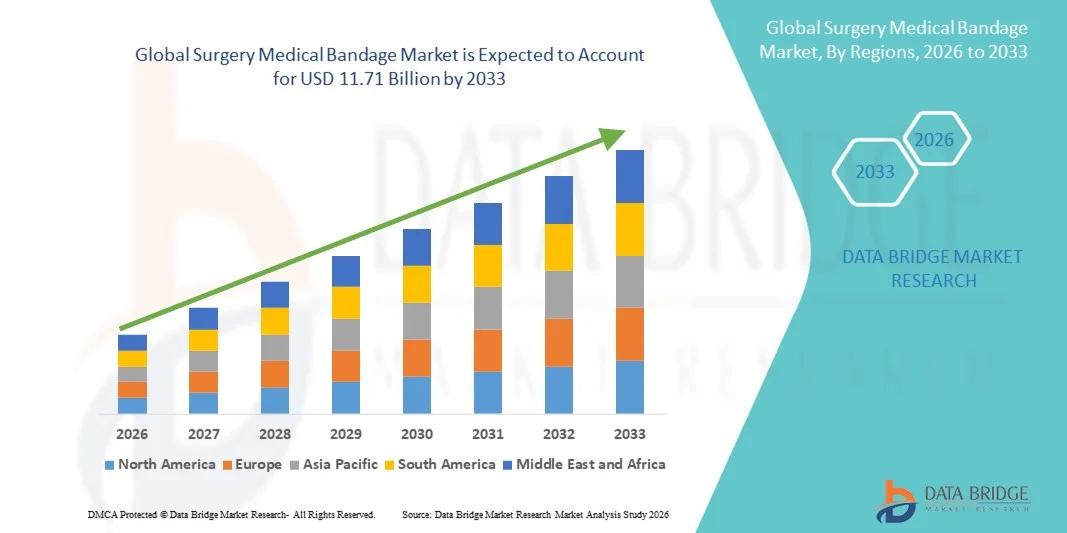
- The global surgery medical bandage market size was valued at USD 6.81 billion in 2025 and is expected to reach USD 11.71 billion by 2033, at a CAGR of 7.02% during the forecast period
- The market growth is largely fueled by the increasing number of surgical procedures worldwide, rising incidence of chronic wounds, and growing demand for advanced wound care solutions in hospitals and surgical centers. Technological advancements in medical bandages, such as antimicrobial coatings, hydrocolloids, and absorbent materials, are further driving adoption in both clinical and outpatient settings
- Furthermore, increasing emphasis on patient safety, faster wound healing, and infection prevention is establishing surgical medical bandages as a critical component of modern surgical care. These converging factors are accelerating the uptake of surgery medical bandage solutions, thereby significantly boosting overall industry growth
Surgery Medical Bandage Market Analysis
- Surgery medical bandages are essential wound care products used to protect surgical incisions, control bleeding, and promote healing across hospitals, ambulatory surgical centers, and specialty clinics. Their growing importance is driven by the rising volume of surgical procedures, increasing prevalence of chronic wounds, and greater adoption of advanced post-operative care practices in both inpatient and outpatient settings
- The escalating demand for surgery medical bandages is primarily fueled by the growing geriatric population, increasing incidence of trauma and surgical interventions, and heightened awareness regarding infection prevention and faster wound healing. In addition, continuous innovations in materials—such as antimicrobial, absorbent, and breathable bandages—are strengthening market adoption
- North America dominated the surgery medical bandage market with the largest revenue share of approximately 38.7% in 2025, supported by advanced healthcare infrastructure, high surgical procedure volumes, favorable reimbursement policies, and strong presence of leading wound care product manufacturers. The U.S. accounted for the majority share due to widespread use of advanced surgical dressings and post-operative wound management solutions
- Asia-Pacific is expected to be the fastest-growing region in the surgery medical bandage market during the forecast period, registering a CAGR driven by rising healthcare expenditure, increasing number of surgeries, expanding hospital networks, and growing awareness of advanced wound care products in countries such as China, India, and Japan
- The elastic bandage rolls segment dominated the largest market revenue share of 38.9% in 2025, driven by their widespread use in surgical procedures, post-operative care, and injury management
Report Scope and Surgery Medical Bandage Market Segmentation
|
Attributes |
Surgery Medical Bandage Key Market Insights |
|
Segments Covered |
|
|
Countries Covered |
North America
Europe
Asia-Pacific
Middle East and Africa
South America
|
|
Key Market Players |
|
|
Market Opportunities |
|
|
Value Added Data Infosets |
In addition to the insights on market scenarios such as market value, growth rate, segmentation, geographical coverage, and major players, the market reports curated by the Data Bridge Market Research also include in-depth expert analysis, patient epidemiology, pipeline analysis, pricing analysis, and regulatory framework. |
Surgery Medical Bandage Market Trends
Increasing Adoption of Advanced and Specialized Surgical Bandages
- A significant and accelerating trend in the global surgery medical bandage market is the growing adoption of advanced and specialized surgical bandages designed to improve wound healing outcomes and reduce post-operative complications. Healthcare providers are increasingly shifting toward bandages that offer enhanced absorption, breathability, and protection against infection
- For instance, Smith+Nephew has expanded its portfolio of advanced surgical dressings, including antimicrobial and foam-based bandages, which are widely used in post-surgical wound care to manage exudate and reduce infection risks. Such products are gaining popularity across hospitals and surgical centers
- The increasing number of surgical procedures worldwide, including orthopedic, cardiovascular, and general surgeries, is driving demand for high-performance medical bandages that support faster recovery and improved patient comfort
- In addition, innovations in material science, such as the use of hydrocolloid, alginate, and silicone-based materials, are improving the flexibility and effectiveness of surgical bandages, making them suitable for a wide range of wound types and anatomical locations
- This trend toward more effective and patient-friendly surgical bandages is reshaping expectations in post-operative care, encouraging manufacturers to focus on product differentiation, clinical efficacy, and compliance with healthcare standards
Surgery Medical Bandage Market Dynamics
Driver
Rising Surgical Volume and Increasing Focus on Post-Operative Care
- The growing global volume of surgical interventions, driven by an aging population and the rising prevalence of chronic diseases, is a key driver for the surgery medical bandage market. Surgical procedures require reliable bandaging solutions to protect wounds and support healing
- For instance, the increasing number of orthopedic and cardiovascular surgeries performed annually in major hospitals has led to higher consumption of sterile surgical bandages for wound protection and recovery management. This trend is particularly evident in developed healthcare systems
- Moreover, heightened awareness regarding post-operative infection prevention is prompting healthcare providers to adopt high-quality surgical bandages that offer antimicrobial protection and moisture balance
- The expansion of hospital infrastructure, ambulatory surgical centers, and outpatient clinics—especially in emerging economies—is further contributing to increased demand for surgical medical bandages
- The growing emphasis on reducing hospital stays and promoting faster patient recovery is also encouraging the use of advanced surgical bandages that support effective wound healing and patient mobility
Restraint/Challenge
Cost Constraints and Limited Access to Advanced Bandage Solutions
- The relatively higher cost of advanced surgical bandages, compared to traditional gauze-based products, poses a significant challenge, particularly for cost-sensitive healthcare systems and smaller medical facilities
- For instance, many public hospitals in developing regions continue to rely on conventional surgical bandages due to budget limitations, despite the availability of advanced wound care products. This limits the adoption of newer technologies
- In addition, variability in reimbursement policies across regions can affect purchasing decisions, slowing the uptake of premium surgical bandage products in certain markets
- Limited awareness and training regarding the proper use of specialized surgical bandages can also hinder their effective adoption, especially in under-resourced healthcare settings
- Addressing these challenges through cost-effective product development, improved healthcare funding, professional training, and broader access to advanced wound care solutions will be essential for sustaining growth in the surgery medical bandage market globally
Surgery Medical Bandage Market Scope
The market is segmented on the basis of product, application, and end-use.
- By Product
On the basis of product, the Global Surgery Medical Bandage market is segmented into Muslin Bandage Rolls, Elastic Bandage Rolls, Triangular Bandages, Orthopedic Bandages, Elastic Plaster Bandages, and Other Bandages. The elastic bandage rolls segment dominated the largest market revenue share of 38.9% in 2025, driven by their widespread use in surgical procedures, post-operative care, and injury management. Elastic bandage rolls provide effective compression, support, and flexibility, making them suitable for a wide range of clinical applications. Hospitals and clinics frequently use these bandages to manage swelling, stabilize joints, and secure wound dressings. Their ability to conform to body contours improves patient comfort and healing outcomes. Rising incidences of surgeries, trauma cases, and sports injuries have significantly increased demand. Additionally, the availability of breathable and skin-friendly materials enhances adoption. Cost-effectiveness and ease of application further contribute to high usage volumes. Elastic bandage rolls are also preferred in outpatient and home care settings. Strong distribution networks and bulk procurement by healthcare facilities support revenue dominance. The segment benefits from consistent demand across both developed and emerging regions. Increasing awareness of proper wound care practices further sustains growth. These factors collectively reinforce the leading position of elastic bandage rolls in the global market.
The orthopedic bandages segment is expected to witness the fastest CAGR of 9.8% from 2026 to 2033, fueled by the rising prevalence of musculoskeletal disorders and orthopedic surgeries. Increasing cases of fractures, ligament injuries, and joint disorders drive demand for specialized orthopedic support solutions. Aging populations globally contribute to higher incidences of bone-related conditions, accelerating segment growth. Orthopedic bandages are increasingly used in rehabilitation and post-surgical recovery to provide stability and controlled compression. Technological advancements in material science, such as lightweight and high-durability fabrics, improve patient compliance. Expanding sports participation and physical activities further increase injury-related demand. Growing adoption in ambulatory surgery centers and physiotherapy clinics supports rapid growth. Additionally, rising awareness about early injury management boosts utilization. Increased availability through retail and online channels enhances accessibility. Healthcare professionals increasingly recommend orthopedic bandages for long-term support. Emerging markets with improving healthcare infrastructure present new opportunities. These factors position orthopedic bandages as the fastest-growing product segment.
- By Application
On the basis of application, the Global Surgery Medical Bandage market is segmented into Surgical Wound, Traumatic Wound, Ulcer, Sports Injury, Burn Injury, and Other Injuries. The surgical wound segment accounted for the largest market revenue share of 41.6% in 2025, driven by the growing number of surgical procedures performed globally. Medical bandages are essential for post-operative wound protection, infection prevention, and accelerated healing. Hospitals extensively use sterile and absorbent bandages to manage incisions and surgical sites. Rising prevalence of chronic diseases has increased the volume of elective and emergency surgeries, supporting demand. Advancements in surgical techniques also necessitate specialized wound care solutions. Surgical wound management requires frequent dressing changes, increasing product consumption. The availability of advanced bandages with antimicrobial properties further strengthens adoption. Increasing emphasis on reducing post-surgical complications boosts bandage usage. Strong clinical guidelines mandate proper wound dressing protocols. Expansion of hospital infrastructure globally supports sustained demand. Growing patient awareness regarding post-operative care enhances compliance. These factors collectively drive dominance of the surgical wound application segment.
The sports injury segment is projected to grow at the fastest CAGR of 10.6% from 2026 to 2033, driven by rising participation in sports and physical fitness activities. Increasing awareness about immediate injury management has boosted the use of medical bandages in sports settings. Elastic and compression bandages are widely used for sprains, strains, and ligament injuries. Growth of professional sports leagues and fitness culture further accelerates demand. Sports medicine clinics increasingly stock specialized bandages for injury prevention and recovery. Rising youth participation in athletics also contributes to higher injury rates. Improved access to sports healthcare services supports segment growth. Innovations in breathable and flexible bandage materials enhance athlete comfort. Increased recommendations from physiotherapists drive usage. Retail availability of sports bandages boosts consumer adoption. Emerging economies show growing interest in organized sports. These factors collectively make sports injury the fastest-growing application segment.
- By End-Use
On the basis of end-use, the Global Surgery Medical Bandage market is segmented into Hospitals, Ambulatory Surgery Centers, Clinics, Retail, and Others. The hospitals segment dominated the market with a revenue share of 56.8% in 2025, driven by high patient admissions and a large volume of surgical and trauma cases. Hospitals are primary centers for wound management, post-operative care, and emergency treatment. Continuous availability of skilled healthcare professionals ensures consistent use of medical bandages. Hospitals maintain strict infection control protocols, requiring frequent bandage replacement. Increasing number of inpatient and outpatient surgeries supports high consumption levels. Bulk procurement agreements further strengthen hospital dominance. Adoption of advanced wound care products enhances usage rates. Expansion of multispecialty hospitals globally boosts demand. Government investments in public healthcare infrastructure contribute to growth. Hospitals also manage severe burn and trauma cases requiring intensive bandaging. High procedural frequency ensures recurring demand. These factors collectively establish hospitals as the leading end-use segment.
The ambulatory surgery centers segment is expected to register the fastest CAGR of 11.1% from 2026 to 2033, driven by the growing shift toward outpatient surgical procedures. ASCs offer cost-effective and efficient surgical care, increasing patient preference. Rising adoption of minimally invasive surgeries supports demand for post-procedure wound care bandages. Faster patient turnover increases the need for disposable medical supplies. ASCs increasingly focus on infection prevention, boosting bandage usage. Technological advancements allow complex surgeries in outpatient settings. Expansion of ASCs in urban and semi-urban regions fuels growth. Growing insurance coverage for outpatient procedures supports adoption. Improved patient convenience accelerates procedural volumes. Increasing partnerships with healthcare providers expand service offerings. Retail-linked supply chains enhance product availability. These factors collectively drive rapid growth of the ambulatory surgery centers segment.
Surgery Medical Bandage Market Regional Analysis
- North America dominated the surgery medical bandage market, accounting for approximately 38.7% of the global revenue share in 2025
- The region’s leadership is supported by advanced healthcare infrastructure, a high volume of surgical procedures, favorable reimbursement policies, and the strong presence of leading wound care and medical bandage manufacturers
- Increasing adoption of advanced surgical dressings and post-operative wound management solutions across hospitals and surgical centers continues to drive market growth
U.S. Surgery Medical Bandage Market Insight
The U.S. surgery medical bandage market accounted for the majority share within North America in 2025, driven by widespread use of advanced surgical bandages in hospitals and ambulatory surgical centers. High surgical procedure volumes, rising prevalence of chronic wounds, and strong demand for effective post-operative care solutions significantly support market expansion. Additionally, the availability of innovative wound care products and well-established reimbursement frameworks further contribute to sustained demand.
Europe Surgery Medical Bandage Market Insight
The Europe surgery medical bandage market is projected to expand at a substantial CAGR during the forecast period, supported by increasing surgical volumes, growing geriatric population, and rising awareness of infection prevention and wound management. Strong regulatory standards and increasing healthcare expenditure across countries such as Germany, the U.K., and France are encouraging the adoption of advanced surgical bandages in both inpatient and outpatient settings.
U.K. Surgery Medical Bandage Market Insight
The U.K. surgery medical bandage market is anticipated to grow at a noteworthy CAGR during the forecast period, driven by rising demand for surgical interventions, expanding hospital infrastructure, and increased focus on post-surgical wound care. Government initiatives to improve patient outcomes and reduce hospital-acquired infections further support the adoption of high-quality surgical bandages.
Germany Surgery Medical Bandage Market Insight
The Germany surgery medical bandage market is expected to expand at a considerable CAGR, fueled by a well-developed healthcare system, high surgical procedure rates, and strong emphasis on advanced wound care management. The country’s focus on quality healthcare delivery and technological innovation promotes steady demand for surgical bandages across hospitals and specialized clinics.
Asia-Pacific Surgery Medical Bandage Market Insight
The Asia-Pacific surgery medical bandage market region is expected to be the fastest-growing market for surgery medical bandages during the forecast period, registering a strong CAGR. Growth is driven by rising healthcare expenditure, increasing number of surgical procedures, expanding hospital networks, and growing awareness of advanced wound care products. Countries such as China, India, and Japan are witnessing significant demand due to improving access to surgical care and expanding healthcare infrastructure.
Japan Surgery Medical Bandage Market Insight
The Japan surgery medical bandage market is gaining steady momentum due to its aging population, high surgical procedure volume, and strong focus on post-operative care. Increasing demand for advanced wound management solutions in hospitals and long-term care facilities continues to support market growth.
China Surgery Medical Bandage Market Insight
China surgery medical bandage market accounted for the largest market revenue share in the Asia-Pacific region in 2025, driven by rapid expansion of healthcare infrastructure, rising surgical volumes, and increasing adoption of modern wound care products. Growing government investment in healthcare and expanding hospital networks further propel demand for surgery medical bandages across the country.
Surgery Medical Bandage Market Share
The Surgery Medical Bandage industry is primarily led by well-established companies, including:
• Johnson & Johnson (U.S.)
• Medtronic (Ireland)
• Smith & Nephew plc (U.K.)
• Mölnlycke Health Care AB (Sweden)
• ConvaTec Group plc (U.K.)
• B. Braun S.E. (Germany)
• Cardinal Health, Inc. (U.S.)
• Coloplast Group (Denmark)
• Paul Hartmann AG (Germany)
• Derma Sciences, Inc. (U.S.)
• Dynarex Corporation (U.S.)
• Beiersdorf AG (Germany)
• Medline Industries, LP (U.S.)
• BSN Medical (Germany)
• Integra LifeSciences (U.S.)
• Winner Medical Co., Ltd. (China)
• Essity AB (Sweden)
• DeRoyal Industries, Inc. (U.S.)
Latest Developments in Global Surgery Medical Bandage Market
- In October 2023, DuPont launched a new higher-adhesion, low-cyclic silicone soft skin adhesive product called DuPont Liveo MG 7-9960, designed for advanced wound care dressings and to improve the adhesion of medical bandages and related surgical dressings for extended wear while minimizing skin damage during removal. This innovation was introduced to enhance the performance of surgical dressings and related bandage applications across healthcare settings
- In April 2023, 3M Health Care received the first-ever FDA clearance for its 3M Veraflo Cleanse Choice Complete Dressing and 3M V.A.C. Veraflo Cleanse Choice Dressing, part of the 3M Veraflo Therapy system. These advanced dressings are intended to remove infectious materials and non-viable tissue via hydromechanical cleaning, supporting improved wound healing environments and reducing the frequency of surgical debridement procedures—a meaningful advancement for surgical wound bandage applications
- In October 2024, Johnson & Johnson (via acquisition) strengthened its position in the surgical and medical bandage market by integrating Derma Sciences’ portfolio of innovative dressings, including “smart” bandages capable of monitoring wound conditions. This strategic move broadened its footprint in both hospital and home-care wound management, highlighting a trend toward intelligent bandage solutions with enhanced functionality
- In October 2024, Mölnlycke Health Care AB unveiled Mepitel Smart, a sensor-enabled surgical bandage designed to monitor wound parameters such as temperature, moisture, and pH, and transmit this data to clinicians to optimize postoperative care and reduce infection risk. This launch marked a significant step toward smart wound bandage technology in clinical practice
SKU-
Get online access to the report on the World's First Market Intelligence Cloud

- Interactive Data Analysis Dashboard
- Company Analysis Dashboard for high growth potential opportunities
- Research Analyst Access for customization & queries
- Competitor Analysis with Interactive dashboard
- Latest News, Updates & Trend analysis
- Harness the Power of Benchmark Analysis for Comprehensive Competitor Tracking
Research Methodology
Data collection and base year analysis are done using data collection modules with large sample sizes. The stage includes obtaining market information or related data through various sources and strategies. It includes examining and planning all the data acquired from the past in advance. It likewise envelops the examination of information inconsistencies seen across different information sources. The market data is analysed and estimated using market statistical and coherent models. Also, market share analysis and key trend analysis are the major success factors in the market report. To know more, please request an analyst call or drop down your inquiry.
The key research methodology used by DBMR research team is data triangulation which involves data mining, analysis of the impact of data variables on the market and primary (industry expert) validation. Data models include Vendor Positioning Grid, Market Time Line Analysis, Market Overview and Guide, Company Positioning Grid, Patent Analysis, Pricing Analysis, Company Market Share Analysis, Standards of Measurement, Global versus Regional and Vendor Share Analysis. To know more about the research methodology, drop in an inquiry to speak to our industry experts.
Customization Available
Data Bridge Market Research is a leader in advanced formative research. We take pride in servicing our existing and new customers with data and analysis that match and suits their goal. The report can be customized to include price trend analysis of target brands understanding the market for additional countries (ask for the list of countries), clinical trial results data, literature review, refurbished market and product base analysis. Market analysis of target competitors can be analyzed from technology-based analysis to market portfolio strategies. We can add as many competitors that you require data about in the format and data style you are looking for. Our team of analysts can also provide you data in crude raw excel files pivot tables (Fact book) or can assist you in creating presentations from the data sets available in the report.