

Global Synthetic Spider Silk Market
Market Size in USD Billion
CAGR :
% 
 USD
3.46 Billion
USD
10.58 Billion
2025
2033
USD
3.46 Billion
USD
10.58 Billion
2025
2033
 Forecast Period Forecast Period |
2026 –2033 |
 Market Size (Base Year) Market Size (Base Year) |
USD 3.46 Billion |
 Market Size (Forecast Year) Market Size (Forecast Year) |
USD 10.58 Billion |
 CAGR CAGR |
% |
| Major Markets Players |
|
Synthetic Spider Silk Market Size
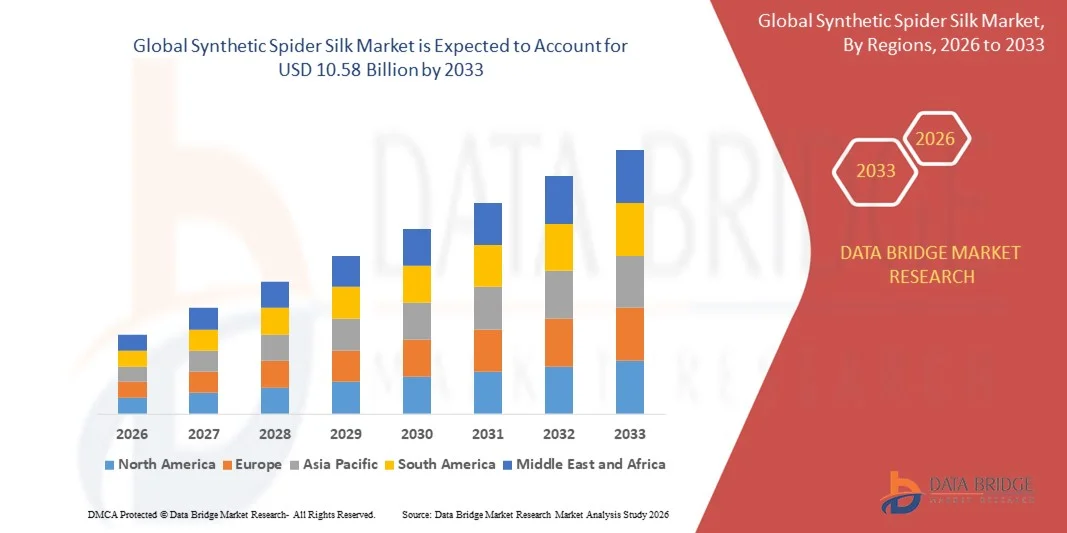
- The global synthetic spider silk market size was valued at USD 3.46 billion in 2025 and is expected to reach USD 10.58 billion by 2033, at a CAGR of 15% during the forecast period
- The market growth is largely fueled by rapid advancements in biotechnology and genetic engineering, enabling the efficient production of high-performance synthetic spider silk with enhanced strength, elasticity, and consistency across industrial scales
- Furthermore, rising demand for sustainable, lightweight, and high-strength materials across textile, healthcare, automotive, and defense sectors is positioning synthetic spider silk as a viable alternative to conventional synthetic fibers. These converging factors are accelerating the adoption of bio-engineered spider silk solutions, thereby significantly boosting overall market growth
Synthetic Spider Silk Market Analysis
- Synthetic spider silk, produced through bioengineering and fermentation-based processes, is emerging as a critical advanced material due to its exceptional mechanical properties, biocompatibility, and biodegradability across multiple high-value applications
- The increasing demand for synthetic spider silk is primarily driven by sustainability-focused material innovation, expanding use in medical devices and regenerative medicine, and growing interest from performance textile and defense industries seeking durable yet lightweight materials
- Asia-Pacific dominated the synthetic spider silk market with a share of 47.01% in 2025, due to rapid advancements in biotechnology, expanding textile manufacturing capabilities, and increasing investments in bio-based and sustainable materials
- North America is expected to be the fastest growing region in the synthetic spider silk market during the forecast period due to strong biotechnology innovation, high R&D spending, and early adoption of advanced biomaterials
- Genetically modified yeast fermentation segment dominated the market with a market share of 45.5% in 2025, due to its scalability, consistent protein yield, and suitability for industrial-scale production. Yeast-based fermentation enables precise control over spider silk protein synthesis, ensuring uniform quality and reduced batch variability. Manufacturers favor this method due to its compatibility with existing bioreactor infrastructure and lower contamination risks. The process also supports cost optimization over time, making it attractive for commercial textile and composite applications. In addition, yeast fermentation allows easier regulatory compliance compared to transgenic animal-based methods, strengthening its dominance in the market
Report Scope and Synthetic Spider Silk Market Segmentation
|
Attributes |
Synthetic Spider Silk Key Market Insights |
|
Segments Covered |
|
|
Countries Covered |
North America
Europe
Asia-Pacific
Middle East and Africa
South America
|
|
Key Market Players |
|
|
Market Opportunities |
|
|
Value Added Data Infosets |
In addition to the insights on market scenarios such as market value, growth rate, segmentation, geographical coverage, and major players, the market reports curated by the Data Bridge Market Research also include import export analysis, production capacity overview, production consumption analysis, price trend analysis, climate change scenario, supply chain analysis, value chain analysis, raw material/consumables overview, vendor selection criteria, PESTLE Analysis, Porter Analysis, and regulatory framework. |
Synthetic Spider Silk Market Trends
Rising Adoption of Bio-Engineered and Sustainable High-Performance Fibers
- A significant trend in the synthetic spider silk market is the rising adoption of bio-engineered and sustainable high-performance fibers, driven by growing demand for materials that combine superior strength, elasticity, and environmental compatibility. Industries are increasingly shifting away from petroleum-based synthetic fibers toward biofabricated alternatives that support sustainability goals while maintaining advanced mechanical performance
- For instance, Bolt Threads has actively developed and promoted engineered spider silk materials for apparel and performance textiles, demonstrating the commercial viability of bio-based fibers in premium markets. These developments are strengthening confidence among manufacturers and brands seeking sustainable material innovations
- The textile industry is increasingly integrating synthetic spider silk to produce lightweight, durable, and flexible fabrics that align with circular economy principles. This trend is supporting broader adoption in technical and high-end textile segments where performance and sustainability are equally critical
- Healthcare applications are also contributing to this trend, as bio-engineered spider silk is being explored for sutures, tissue scaffolds, and wound care products due to its biocompatibility and biodegradability. This is expanding the material’s relevance beyond conventional textile uses
- Research institutions and biotechnology firms are accelerating innovation in spider silk protein engineering to enhance fiber consistency and scalability. These advancements are reinforcing market momentum and supporting long-term adoption across multiple industries
- Overall, the growing preference for sustainable, bio-engineered high-performance fibers is reinforcing synthetic spider silk as a strategic material, supporting its transition from niche research applications to broader commercial deployment
Synthetic Spider Silk Market Dynamics
Driver
Advancements in Genetic Engineering and Fermentation Technologies
- Advancements in genetic engineering and fermentation technologies are a primary driver of growth in the synthetic spider silk market, as they enable precise replication and optimization of spider silk proteins at industrial scale. Improvements in gene editing, protein expression, and fermentation control are enhancing yield consistency and material performance. These technological developments are making synthetic spider silk more commercially viable across diverse applications
- For instance, Kraig Biocraft Laboratories, Inc. has advanced its genetic research by increasing the size and complexity of spider silk gene inserts, directly improving fiber strength and functional properties. Such progress is accelerating product differentiation and expanding potential end-use markets
- Fermentation-based production methods using genetically modified organisms are allowing manufacturers to achieve scalable and repeatable output while maintaining quality standards. This is particularly important for meeting growing demand from textile and biomedical industries
- Biotechnology firms are also benefiting from improved bioreactor designs and downstream processing techniques that reduce inefficiencies and support larger batch production. These advancements are lowering technical barriers to commercialization
- Collectively, ongoing progress in genetic engineering and fermentation technologies is reinforcing production scalability and performance reliability, positioning synthetic spider silk for sustained market growth
Restraint/Challenge
High Production Costs and Scaling Complexity
- The synthetic spider silk market faces notable challenges related to high production costs and the complexity of scaling biofabrication processes. Manufacturing spider silk proteins requires advanced genetic engineering, controlled fermentation environments, and sophisticated purification processes, all of which increase operational expenses. These factors limit cost competitiveness compared to conventional synthetic fibers
- For instance, AMSilk GmbH relies on highly controlled fermentation and protein purification systems to produce medical-grade spider silk materials, which demand significant capital investment and specialized expertise. Such requirements elevate production costs and restrict rapid capacity expansion
- Maintaining consistent quality at scale remains challenging, as minor variations in biological processes can impact fiber performance and yield. This increases the need for rigorous monitoring and quality control systems
- The reliance on specialized infrastructure and skilled scientific talent further adds to production complexity and operational costs. Smaller players may face difficulties entering the market due to these high entry barriers
- Scaling from pilot production to mass commercialization while preserving material properties continues to be a key constraint for manufacturers. Overall, high production costs and scaling challenges place pressure on companies to balance innovation, cost efficiency, and commercial feasibility, shaping the pace of market expansion
Synthetic Spider Silk Market Scope
The market is segmented on the basis of product type and application.
- By Product Type
On the basis of product type, the synthetic spider silk market is segmented into genetically modified yeast fermentation, genetically modified silkworm, and genetically modified E. coli fermentation. The genetically modified yeast fermentation segment dominated the market with the largest revenue share of 45.5% in 2025, driven by its scalability, consistent protein yield, and suitability for industrial-scale production. Yeast-based fermentation enables precise control over spider silk protein synthesis, ensuring uniform quality and reduced batch variability. Manufacturers favor this method due to its compatibility with existing bioreactor infrastructure and lower contamination risks. The process also supports cost optimization over time, making it attractive for commercial textile and composite applications. In addition, yeast fermentation allows easier regulatory compliance compared to transgenic animal-based methods, strengthening its dominance in the market.
The genetically modified silkworm segment is anticipated to witness the fastest growth rate during the forecast period, supported by its ability to produce spider silk fibers with mechanical properties closer to natural spider silk. This method integrates spider silk genes into silkworms, enabling direct fiber spinning without extensive downstream processing. Growing interest from high-performance textile and defense material developers is accelerating adoption. The approach also offers potential reductions in energy-intensive processing steps compared to fermentation-based routes. Advancements in genetic engineering and breeding efficiency are further improving yield consistency. As a result, genetically modified silkworms are gaining traction for premium and specialized end-use applications.
- By Application
On the basis of application, the synthetic spider silk market is segmented into automotive, textile, healthcare, defense, and others. The textile segment accounted for the largest market revenue share in 2025, driven by rising demand for lightweight, high-strength, and sustainable fibers. Synthetic spider silk offers superior tensile strength, elasticity, and biodegradability compared to conventional synthetic fibers, making it highly attractive for next-generation apparel and technical textiles. Fashion and performance wear brands are increasingly exploring spider silk to meet sustainability goals without compromising durability. The material’s softness and breathability further enhance its suitability for premium textile products. Continuous innovation in fiber spinning and weaving techniques is reinforcing the segment’s leading position.
The healthcare segment is expected to register the fastest growth over the forecast period, fueled by expanding use in sutures, tissue engineering, and regenerative medicine. Synthetic spider silk exhibits excellent biocompatibility and controlled biodegradability, making it suitable for implants and wound care products. Researchers are increasingly adopting spider silk scaffolds for cell growth due to their structural stability and minimal immune response. Rising investments in advanced biomaterials and medical biotechnology are accelerating commercialization. The ability to tailor protein structure for specific medical functions further enhances its adoption. Consequently, healthcare applications are emerging as the most rapidly expanding area for synthetic spider silk.
Synthetic Spider Silk Market Regional Analysis
- Asia-Pacific dominated the synthetic spider silk market with the largest revenue share of 47.01% in 2025, driven by rapid advancements in biotechnology, expanding textile manufacturing capabilities, and increasing investments in bio-based and sustainable materials
- The region’s strong fermentation infrastructure, cost-efficient production environment, and growing adoption of high-performance fibers across textile, automotive, and healthcare sectors are accelerating market expansion
- Supportive government initiatives for bioengineering, availability of skilled researchers, and rising demand for sustainable alternatives to conventional synthetic fibers are contributing to increased consumption of synthetic spider silk
China Synthetic Spider Silk Market Insight
China held the largest share in the Asia-Pacific synthetic spider silk market in 2025, supported by its strong biotechnology ecosystem, large-scale textile manufacturing base, and significant investments in advanced materials research. The country’s focus on sustainable industrial development, combined with its ability to scale fermentation and biofabrication processes, is driving commercial adoption. Growing demand from high-performance textiles, medical materials, and defense-related applications further supports market growth.
India Synthetic Spider Silk Market Insight
India is witnessing the fastest growth in the Asia-Pacific region, fueled by expanding biotechnology research, rising investments in sustainable textiles, and growing collaboration between academic institutions and startups. Government support for bio-based manufacturing and innovation-driven programs is strengthening domestic capabilities. Increasing interest from healthcare and advanced textile manufacturers is further accelerating market expansion.
Europe Synthetic Spider Silk Market Insight
The Europe synthetic spider silk market is expanding steadily, supported by strong emphasis on sustainability, advanced biomaterials research, and strict environmental regulations encouraging bio-based alternatives. The region’s well-established R&D infrastructure and growing demand for high-performance fibers in healthcare and automotive applications are key growth drivers. Continuous innovation in biofabrication technologies is further enhancing regional market development.
Germany Synthetic Spider Silk Market Insight
Germany’s synthetic spider silk market is driven by its leadership in advanced materials engineering, strong biotechnology research landscape, and close collaboration between industry and academic institutions. The country’s focus on precision manufacturing and sustainable material solutions is boosting adoption across automotive, medical, and industrial textile applications. Robust funding for research and innovation continues to support market growth.
U.K. Synthetic Spider Silk Market Insight
The U.K. market is supported by a strong life sciences sector, active research in biomimetic materials, and increasing investments in sustainable manufacturing technologies. Academic-industry partnerships and startup-driven innovation are accelerating the development of synthetic spider silk applications. Demand is particularly growing in healthcare, defense, and specialty textile segments.
North America Synthetic Spider Silk Market Insight
North America is projected to grow at the fastest CAGR from 2026 to 2033, driven by strong biotechnology innovation, high R&D spending, and early adoption of advanced biomaterials. Growing demand from medical devices, tissue engineering, and defense applications is supporting market expansion. The region’s focus on commercialization of bioengineered materials further enhances growth prospects.
U.S. Synthetic Spider Silk Market Insight
The U.S. accounted for the largest share in the North America market in 2025, underpinned by its advanced biotechnology infrastructure, strong presence of research-driven companies, and significant funding for biomaterials innovation. The country’s leadership in medical research, defense applications, and sustainable material development is accelerating adoption. Well-established commercialization pathways and strong investor interest continue to reinforce the U.S.’s leading position.
Synthetic Spider Silk Market Share
The synthetic spider silk industry is primarily led by well-established companies, including:
- Kraig Biocraft Laboratories, Inc. (U.S.)
- AMSilk GmbH (Germany)
- Bolt Threads (U.S.)
- Spiber Inc. (Japan)
- Hellenic Silk Company (Greece)
- CHAMUNDI TEXTILES (SILK MILLS) LTD. (India)
- Anhui Silk (China)
- ChinaTing Group Holdings Ltd. (China)
- Ongetta srl unipersonale (Italy)
- Seevix (U.S.)
- Zhejiang Jiaxin Silk Co., Ltd. (China)
- Sichuan Nanchong Liuhe (Group) Co., Ltd. (China)
- ShengKun Silk Manufacturing Co., Ltd. (China)
- China Zhongsi Group Co., Ltd. (China)
- Spiber Technologies (Japan)
Latest Developments in Global Synthetic Spider Silk Market
- In April 2025, Kraig Biocraft Laboratories, Inc. strengthened its commercial positioning in the synthetic spider silk market by securing four registered trademarks for its SpydaSilk brand, reinforcing brand protection and supporting its strategy to enter premium apparel segments. This development enhances market visibility, builds consumer trust, and supports long-term revenue generation through branded spider silk products
- In February 2025, Kraig Biocraft Laboratories, Inc. achieved a major breakthrough in its genetic research program by increasing the size and complexity of its spider silk gene insert package, directly improving material strength and performance characteristics. This advancement accelerates product differentiation and supports broader adoption of synthetic spider silk in high-performance textile and defense applications
- In June 2024, biomedical start-up PrintyMed announced plans to begin exporting artificial spider silk products, signaling the transition from research-scale development to international commercialization. This move expands global market reach and highlights growing demand for spider silk in biomedical and regenerative medicine applications
- In March 2024, AMSilk GmbH expanded its focus on industrial-scale production of biofabricated spider silk proteins to meet rising demand from medical and technical textile manufacturers. This development supports market growth by improving production consistency, enabling wider application adoption, and strengthening Europe’s role in advanced biomaterials
- In January 2024, Bolt Threads advanced the commercialization of its engineered spider silk materials through expanded collaborations with apparel and performance material partners. This progress accelerates market penetration by validating spider silk’s scalability and reinforcing its potential as a sustainable alternative to conventional synthetic fibers
SKU-
Get online access to the report on the World's First Market Intelligence Cloud

- Interactive Data Analysis Dashboard
- Company Analysis Dashboard for high growth potential opportunities
- Research Analyst Access for customization & queries
- Competitor Analysis with Interactive dashboard
- Latest News, Updates & Trend analysis
- Harness the Power of Benchmark Analysis for Comprehensive Competitor Tracking
Global Synthetic Spider Silk Market, Supply Chain Analysis and Ecosystem Framework
To support market growth and help clients navigate the impact of geopolitical shifts, DBMR has integrated in-depth supply chain analysis into its Global Synthetic Spider Silk Market research reports. This addition empowers clients to respond effectively to global changes affecting their industries. The supply chain analysis section includes detailed insights such as Global Synthetic Spider Silk Market consumption and production by country, price trend analysis, the impact of tariffs and geopolitical developments, and import and export trends by country and HSN code. It also highlights major suppliers with data on production capacity and company profiles, as well as key importers and exporters. In addition to research, DBMR offers specialized supply chain consulting services backed by over a decade of experience, providing solutions like supplier discovery, supplier risk assessment, price trend analysis, impact evaluation of inflation and trade route changes, and comprehensive market trend analysis.
Research Methodology
Data collection and base year analysis are done using data collection modules with large sample sizes. The stage includes obtaining market information or related data through various sources and strategies. It includes examining and planning all the data acquired from the past in advance. It likewise envelops the examination of information inconsistencies seen across different information sources. The market data is analysed and estimated using market statistical and coherent models. Also, market share analysis and key trend analysis are the major success factors in the market report. To know more, please request an analyst call or drop down your inquiry.
The key research methodology used by DBMR research team is data triangulation which involves data mining, analysis of the impact of data variables on the market and primary (industry expert) validation. Data models include Vendor Positioning Grid, Market Time Line Analysis, Market Overview and Guide, Company Positioning Grid, Patent Analysis, Pricing Analysis, Company Market Share Analysis, Standards of Measurement, Global versus Regional and Vendor Share Analysis. To know more about the research methodology, drop in an inquiry to speak to our industry experts.
Customization Available
Data Bridge Market Research is a leader in advanced formative research. We take pride in servicing our existing and new customers with data and analysis that match and suits their goal. The report can be customized to include price trend analysis of target brands understanding the market for additional countries (ask for the list of countries), clinical trial results data, literature review, refurbished market and product base analysis. Market analysis of target competitors can be analyzed from technology-based analysis to market portfolio strategies. We can add as many competitors that you require data about in the format and data style you are looking for. Our team of analysts can also provide you data in crude raw excel files pivot tables (Fact book) or can assist you in creating presentations from the data sets available in the report.