




Global Telecom Mounting Hardware Market
Market Size in USD Billion
CAGR :
% 
 USD
21.46 Billion
USD
52.39 Billion
2025
2033
USD
21.46 Billion
USD
52.39 Billion
2025
2033
 Forecast Period Forecast Period |
2026 –2033 |
 Market Size (Base Year) Market Size (Base Year) |
USD 21.46 Billion |
 Market Size (Forecast Year) Market Size (Forecast Year) |
USD 52.39 Billion |
 CAGR CAGR |
% |
| Major Markets Players |
|
Telecom Mounting Hardware Market Size
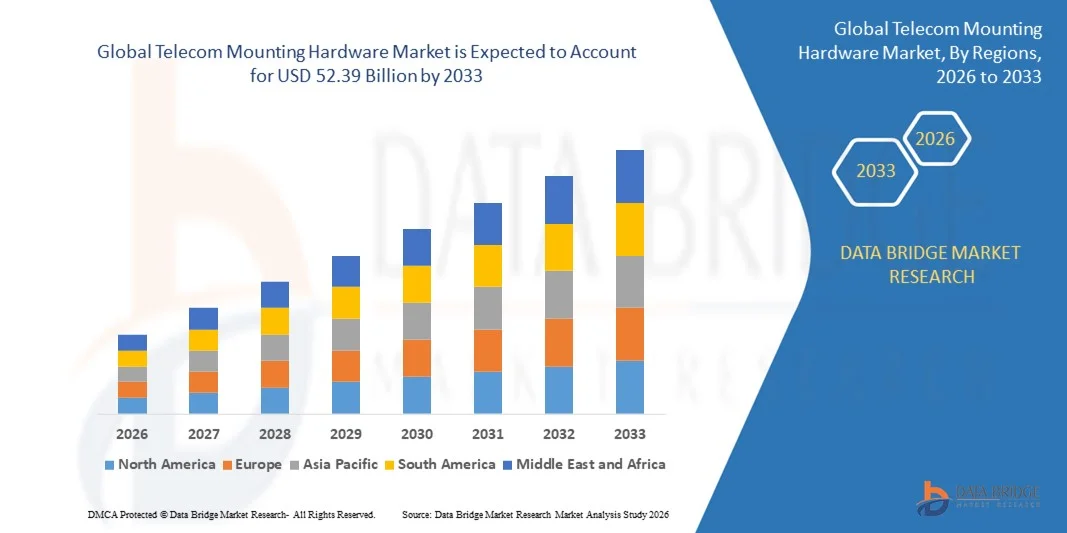
- The global telecom mounting hardware market size was valued at USD 21.46 billion in 2025 and is expected to reach USD 52.39 billion by 2033, at a CAGR of 11.80% during the forecast period
- The market growth is largely fueled by the rapid expansion of telecom networks, 5G deployment, and the increasing need for reliable, secure, and organized mounting solutions to support critical network infrastructure in both enterprise and service provider environments
- Furthermore, rising investments in data centers, fiber-optic networks, and smart city projects are driving demand for modular, scalable, and efficient mounting hardware. These converging factors are accelerating the adoption of telecom mounting solutions, thereby significantly boosting the industry’s growth
Telecom Mounting Hardware Market Analysis
- Telecom mounting hardware, including racks, cabinets, poles, towers, and wall/ceiling mounts, is increasingly vital for the structured installation, protection, and management of network equipment in both commercial and telecom service environments due to its role in ensuring operational efficiency, equipment safety, and organized cabling
- The escalating demand for telecom mounting hardware is primarily fueled by the growth of 5G networks, expanding fiber-optic infrastructure, and increasing requirements for modular and interoperable solutions that simplify installation, maintenance, and upgrades across large-scale telecom and enterprise networks
- North America dominated the telecom mounting hardware market with a share of 37.5% in 2025, due to rapid expansion of telecom infrastructure, data centers, and 5G deployments
- Asia-Pacific is expected to be the fastest growing region in the telecom mounting hardware market during the forecast period due to rapid 5G expansion, increasing data center investments, and government initiatives promoting smart infrastructure in countries such as China, Japan, and India
- Cabinets segment dominated the market with a market share of 41.8% in 2025, due to its critical role in housing telecom equipment and ensuring organized network management. Cabinets provide physical protection, efficient airflow, and security for sensitive networking devices, making them a preferred choice for telecom operators. The market sees strong demand for cabinets due to their compatibility with both indoor and outdoor deployments and their adaptability to various rack and mounting standards
Report Scope and Telecom Mounting Hardware Market Segmentation
|
Attributes |
Telecom Mounting Hardware Key Market Insights |
|
Segments Covered |
|
|
Countries Covered |
North America
Europe
Asia-Pacific
Middle East and Africa
South America
|
|
Key Market Players |
|
|
Market Opportunities |
|
|
Value Added Data Infosets |
In addition to the market insights such as market value, growth rate, market segments, geographical coverage, market players, and market scenario, the market report curated by the Data Bridge Market Research team includes in-depth expert analysis, import/export analysis, pricing analysis, production consumption analysis, and pestle analysis. |
Telecom Mounting Hardware Market Trends
Increasing Adoption of Modular and Scalable Mounting Solutions
- A key trend in the telecom mounting hardware market is the rising adoption of modular and scalable solutions that support flexible installation and rapid deployment across diverse telecom infrastructures. These solutions are enabling telecom operators and tower management companies to streamline equipment integration, reduce installation time, and accommodate future network expansions efficiently
- For instance, CommScope and RFS offer modular mounting systems for base stations and rooftop installations, allowing operators to easily adjust antenna configurations and integrate new hardware without extensive structural modifications. Such solutions enhance operational flexibility and support network densification initiatives
- The deployment of 5G networks is accelerating the need for mounting hardware capable of supporting compact and high-capacity antennas while ensuring structural stability. This trend is driving manufacturers to innovate lightweight and corrosion-resistant materials that meet stringent performance requirements
- Mounting hardware is increasingly being designed for multi-band and multi-operator installations, where a single support structure accommodates multiple service providers’ equipment. This capability is optimizing space utilization and lowering the overall cost of network rollouts
- Industries focusing on urban and rural telecom expansion are investing in advanced mounting solutions to meet the increasing demand for reliable coverage. These hardware systems are critical for supporting small cells, macro towers, and fiber-optic nodes under varied environmental conditions
- The market is witnessing stronger growth in smart and pre-engineered mounting systems that reduce on-site labor requirements and simplify maintenance activities. This rising preference is reinforcing the overall adoption of flexible, efficient, and future-proof telecom infrastructure
Telecom Mounting Hardware Market Dynamics
Driver
Rapid Expansion of 5G Networks and Fiber-Optic Infrastructure
- The rapid rollout of 5G networks and fiber-optic systems is a primary driver for the telecom mounting hardware market, as these networks require robust and scalable support structures for antennas, nodes, and equipment cabinets. Proper mounting solutions are critical for maintaining signal quality, structural integrity, and ease of maintenance across urban and rural deployments
- For instance, Huawei and Ericsson supply mounting hardware that supports high-density 5G base stations, enabling operators to scale network capacity efficiently and ensure uninterrupted service delivery. These solutions facilitate faster network expansion while reducing downtime during equipment upgrades
- The surge in global data consumption and the demand for ultra-low latency services are increasing the need for precise and secure mounting installations. This trend is prompting telecom companies to invest in hardware that supports optimal alignment and minimizes interference
- Expansion of fiber-optic infrastructure requires durable mounting solutions for repeaters, junction boxes, and distribution nodes. These systems are designed to withstand environmental stressors while ensuring consistent network performance
- The increasing adoption of IoT, smart city applications, and high-speed broadband is reinforcing the need for reliable mounting infrastructure. Robust hardware ensures uninterrupted network operation, supporting the broader digital transformation agenda for telecom providers
Restraint/Challenge
High Initial Investment and Complex Regulatory Compliance
- The telecom mounting hardware market faces challenges due to the high capital investment required for advanced, modular, and corrosion-resistant systems, which can constrain adoption, particularly in emerging regions. The cost includes design, materials, installation, and compliance with safety and structural standards
- For instance, companies such as RFS implement rigorous structural testing and regulatory certifications for their mounting solutions to meet international standards, which adds to upfront costs and extends deployment timelines. These compliance requirements can limit rapid expansion in cost-sensitive markets
- Navigating complex municipal, environmental, and safety regulations can delay hardware installation, requiring additional planning and administrative resources. This complexity is more pronounced for urban and high-rise deployments where multiple authorities may be involved
- The market is further challenged by the need for highly skilled labor to install and maintain sophisticated mounting systems. Workforce shortages and specialized training requirements increase operational costs and can slow deployment schedules
- Maintaining a balance between cost efficiency and compliance with structural, safety, and environmental standards remains critical. These constraints collectively impact the speed of network rollout and require telecom operators to strategically plan investments in mounting hardware while adhering to regulatory obligations
Telecom Mounting Hardware Market Scope
The market is segmented on the basis of product type, mounting application, and industry verticals.
- By Product Type
On the basis of product type, the Telecom Mounting Hardware market is segmented into cables, cabinets, routers, and others. The cabinets segment dominated the market with the largest market revenue share of 41.8% in 2025, driven by its critical role in housing telecom equipment and ensuring organized network management. Cabinets provide physical protection, efficient airflow, and security for sensitive networking devices, making them a preferred choice for telecom operators. The market sees strong demand for cabinets due to their compatibility with both indoor and outdoor deployments and their adaptability to various rack and mounting standards. Telecom operators often prioritize cabinet installations for high-density networking environments, ensuring operational efficiency and simplified maintenance.
The routers segment is anticipated to witness the fastest growth rate of 19.5% from 2026 to 2033, fueled by increasing deployment of advanced networking infrastructure in data centers, 5G networks, and enterprise environments. Routers integrated with mounting hardware provide streamlined installation, better cable management, and enhanced accessibility for monitoring and maintenance. The rising demand for scalable and modular network solutions also contributes to the rapid adoption of mounted routers. Businesses and service providers are increasingly leveraging router-mounted setups for optimized space utilization and network reliability in dynamic operational environments.
- By Mounting Application
On the basis of mounting application, the market is segmented into on-wall mounting, in-ceiling mounting, pole mounting, tower mounting, and other platform-specific mounting. The on-wall mounting segment dominated the market with the largest revenue share in 2025, driven by its widespread use in offices, telecom exchanges, and small-scale deployments. On-wall mounts offer straightforward installation, easy access for maintenance, and secure positioning of telecom equipment. Their compatibility with various cabinet sizes, routers, and patch panels enhances operational efficiency and reduces downtime. Service providers often choose on-wall mounting for residential and commercial setups due to lower infrastructure modification requirements and cost-effectiveness.
The tower mounting segment is expected to witness the fastest growth rate from 2026 to 2033, fueled by rapid expansion of cellular networks, especially 5G, and the increasing deployment of tower-based infrastructure in urban and rural regions. Tower-mounted hardware ensures optimal signal distribution, space efficiency, and enhanced equipment protection in challenging outdoor conditions. Telecom operators are prioritizing tower-mounted solutions to maximize network coverage while maintaining reliability and reducing operational complexity. Rising investments in tower modernization and upgrades further accelerate the adoption of this mounting application.
- By Industry Verticals
On the basis of industry verticals, the market is segmented into banking, financial services, insurance (BFSI), retail, media and entertainment, defense and aerospace, education, and others. The BFSI vertical dominated the market with the largest revenue share in 2025, driven by stringent security requirements, robust network infrastructure needs, and the growing adoption of digital banking and payment platforms. Telecom mounting hardware in BFSI ensures organized cabling, secure installation of routers and switches, and seamless connectivity for critical financial operations. The vertical also benefits from dedicated IT infrastructure investments, regulatory compliance mandates, and a focus on minimizing downtime for mission-critical networks.
The defense and aerospace vertical is anticipated to witness the fastest growth rate from 2026 to 2033, fueled by the increasing modernization of communication infrastructure, rising defense spending, and adoption of secure and resilient telecom networks. Mounting hardware in this vertical supports complex and high-performance equipment deployments, including tactical communications, radar systems, and command-and-control networks. The growing need for reliable, durable, and adaptable mounting solutions in harsh and remote environments contributes to rapid market expansion. Defense agencies and aerospace companies are prioritizing scalable mounting solutions to enhance operational efficiency and maintain network reliability in dynamic conditions.
Telecom Mounting Hardware Market Regional Analysis
- North America dominated the telecom mounting hardware market with the largest revenue share of 37.5% in 2025, driven by rapid expansion of telecom infrastructure, data centers, and 5G deployments
- Telecom operators and enterprises in the region prioritize organized mounting solutions that ensure secure installation, efficient cable management, and minimal network downtime
- High adoption of advanced networking technologies, increasing focus on infrastructure modernization, and supportive government policies are further strengthening demand for mounting hardware across the region
U.S. Telecom Mounting Hardware Market Insight
The U.S. market captured the largest revenue share in North America in 2025, fueled by large-scale 5G rollouts, cloud networking expansions, and growing investments in data centers. Enterprises and telecom operators are increasingly emphasizing robust, modular mounting solutions for racks, cabinets, and routers to optimize space and maintain network reliability. The demand for tower and pole-mounted hardware is also rising due to the need for widespread cellular coverage. In addition, government initiatives promoting smart city infrastructure and next-generation telecom networks are accelerating adoption across commercial, defense, and educational sectors.
Europe Telecom Mounting Hardware Market Insight
The Europe market is projected to expand at a substantial CAGR during the forecast period, driven by extensive digitalization of telecom infrastructure, increasing urbanization, and stringent regulatory standards for equipment safety and network reliability. Telecom operators are deploying modular and scalable mounting solutions to support high-density equipment in data centers and office networks. The adoption of integrated solutions that streamline installation, maintenance, and cable management is further boosting market growth. Countries such as Germany, France, and Italy are witnessing growth across both enterprise and telecom network applications.
U.K. Telecom Mounting Hardware Market Insight
The U.K. market is anticipated to grow at a noteworthy CAGR, fueled by increasing demand for advanced telecom infrastructure in enterprises, financial institutions, and government facilities. Rising investments in 5G and fiber networks are driving the need for high-quality mounting hardware to support routers, cabinets, and patch panels. The U.K.’s well-established IT and telecom ecosystem, coupled with growing awareness of network reliability and uptime, is boosting market adoption. In addition, the integration of mounting solutions with energy-efficient and modular designs is supporting sustainable deployment strategies.
Germany Telecom Mounting Hardware Market Insight
The Germany market is expected to expand at a considerable CAGR during the forecast period, driven by its strong focus on industrial digitization, smart city initiatives, and infrastructure modernization. Telecom operators and enterprises are increasingly prioritizing cabinet, pole, and tower-mounted solutions to ensure secure equipment installation and optimized network performance. Germany’s emphasis on high-quality, durable, and technologically advanced solutions is encouraging the adoption of modular and scalable mounting hardware. Integration with monitoring systems and advanced cable management solutions is enhancing operational efficiency across residential, commercial, and industrial networks.
Asia-Pacific Telecom Mounting Hardware Market Insight
The Asia-Pacific market is poised to grow at the fastest CAGR during 2026–2033, driven by rapid 5G expansion, increasing data center investments, and government initiatives promoting smart infrastructure in countries such as China, Japan, and India. The region’s growing telecom subscriber base, urbanization, and digitalization efforts are significantly fueling demand for mounting solutions. Rising industrialization and modernization of network infrastructure are also accelerating adoption. Moreover, the availability of cost-effective, locally manufactured mounting hardware is making deployment accessible to a wider range of enterprises and service providers.
Japan Telecom Mounting Hardware Market Insight
The Japan market is witnessing steady growth due to high technology adoption, extensive 5G rollouts, and increasing demand for reliable telecom infrastructure. Telecom operators and enterprises focus on mounting solutions that ensure compact installation, enhanced airflow, and optimized equipment accessibility. Integration with IoT-enabled monitoring systems and smart network management platforms is driving adoption. Japan’s emphasis on space-efficient and high-durability solutions supports both urban and industrial telecom infrastructure projects.
China Telecom Mounting Hardware Market Insight
The China market accounted for the largest revenue share in Asia-Pacific in 2025, fueled by rapid urbanization, large-scale telecom network expansion, and domestic manufacturing of mounting hardware. The country’s push toward smart city projects and next-generation networks is boosting demand for pole, tower, and cabinet-mounted solutions. Cost-effective local manufacturing, combined with high adoption of 5G and fiber optic networks, is facilitating faster deployment. Telecom operators prioritize mounting hardware that ensures efficient cable management, secure equipment housing, and modular scalability to accommodate future network growth.
Telecom Mounting Hardware Market Share
The telecom mounting hardware industry is primarily led by well-established companies, including:
- Sabre Industries (U.S.)
- Trylon (U.S.)
- Kenwood Telecom Corp (U.S.)
- MALICO INC. (U.S.)
- Talley Inc. (U.S.)
- Infinite Electronics International, Inc. (U.S.)
- Arkivator Telecom (Sweden)
- Kendall Howard (U.S.)
- Legrand North America, LLC. (U.S.)
- Rackmount.IT (U.S.)
- Tata Communications (India)
- Tongding Group Co., Ltd. (China)
- TPC Wire & Cable Corp (U.S.)
- CommScope (U.S.)
- Belden Inc. (U.S.)
- Finolex Cables Ltd. (India)
- Futong Group (China)
Latest Developments in Global Telecom Mounting Hardware Market
- In February 2026, Valmont Telecom and ConcealFab introduced a new side enclosure portfolio engineered for RF-transparent, pole-mounted outdoor cabinets. These solutions significantly accelerate the deployment of 5G small cells, fiber networks, and private LTE/5G systems, reducing the complexity and time required for installations. The enclosures are designed to meet stringent municipal design and aesthetic standards while ensuring robust protection and efficient airflow for equipment. This development is likely to improve network densification in urban and suburban areas, reduce field labor costs, and enhance the operational efficiency of telecom operators deploying high-density network infrastructure
- In December 2025, NEC, through the Telecom Infra Project, announced broader deployment support for its Phoenix open transponder hardware design, which enables interoperability between multiple vendor solutions. This initiative allows telecom operators to adopt modular, scalable mounting solutions that are compatible with a wider range of equipment, thereby reducing integration challenges and operational downtime. The development is expected to accelerate adoption of open networking standards, enhance flexibility in network design, and strengthen NEC’s position as an innovator in next-generation telecom infrastructure
- In September 2025, Commscope Holding Company, Inc. unveiled a new line of eco-friendly mounting solutions designed to meet the rising demand for sustainable telecom infrastructure. The products are manufactured using environmentally responsible processes and materials while maintaining high durability and performance standards. This initiative positions Commscope as a leader in sustainable telecom practices, attracting environmentally conscious clients and partners. It also encourages broader industry adoption of green infrastructure, potentially influencing future design standards and regulations for mounting hardware globally
- In August 2025, SBA Communications Corporation announced a strategic partnership with a leading technology firm to develop next-generation mounting solutions integrated with advanced AI capabilities. The AI-enabled systems are expected to optimize installation processes, monitor structural health, and improve predictive maintenance of mounted equipment. By streamlining operations, reducing installation times, and lowering operational costs, this development positions SBA as a frontrunner in intelligent mounting solutions, enhancing customer satisfaction and offering a competitive edge in a rapidly evolving market
- In July 2025, Huawei Technologies Co., Ltd. expanded its manufacturing capabilities in Europe, aiming to localize production and reduce lead times for its mounting hardware. This strategic move enhances supply chain reliability, allows faster response to European market demands, and reduces logistical challenges. Huawei’s strengthened local presence supports faster deployment of telecom infrastructure projects, improves service levels for operators, and helps the company maintain competitiveness against other global mounting hardware providers, particularly in the high-growth European 5G market
SKU-
Get online access to the report on the World's First Market Intelligence Cloud

- Interactive Data Analysis Dashboard
- Company Analysis Dashboard for high growth potential opportunities
- Research Analyst Access for customization & queries
- Competitor Analysis with Interactive dashboard
- Latest News, Updates & Trend analysis
- Harness the Power of Benchmark Analysis for Comprehensive Competitor Tracking
Research Methodology
Data collection and base year analysis are done using data collection modules with large sample sizes. The stage includes obtaining market information or related data through various sources and strategies. It includes examining and planning all the data acquired from the past in advance. It likewise envelops the examination of information inconsistencies seen across different information sources. The market data is analysed and estimated using market statistical and coherent models. Also, market share analysis and key trend analysis are the major success factors in the market report. To know more, please request an analyst call or drop down your inquiry.
The key research methodology used by DBMR research team is data triangulation which involves data mining, analysis of the impact of data variables on the market and primary (industry expert) validation. Data models include Vendor Positioning Grid, Market Time Line Analysis, Market Overview and Guide, Company Positioning Grid, Patent Analysis, Pricing Analysis, Company Market Share Analysis, Standards of Measurement, Global versus Regional and Vendor Share Analysis. To know more about the research methodology, drop in an inquiry to speak to our industry experts.
Customization Available
Data Bridge Market Research is a leader in advanced formative research. We take pride in servicing our existing and new customers with data and analysis that match and suits their goal. The report can be customized to include price trend analysis of target brands understanding the market for additional countries (ask for the list of countries), clinical trial results data, literature review, refurbished market and product base analysis. Market analysis of target competitors can be analyzed from technology-based analysis to market portfolio strategies. We can add as many competitors that you require data about in the format and data style you are looking for. Our team of analysts can also provide you data in crude raw excel files pivot tables (Fact book) or can assist you in creating presentations from the data sets available in the report.












