




Global Textured Soy Protein Market
Market Size in USD Billion
CAGR :
% 
 USD
221.53 Billion
USD
392.17 Billion
2025
2033
USD
221.53 Billion
USD
392.17 Billion
2025
2033
 Forecast Period Forecast Period |
2026 –2033 |
 Market Size (Base Year) Market Size (Base Year) |
USD 221.53 Billion |
 Market Size (Forecast Year) Market Size (Forecast Year) |
USD 392.17 Billion |
 CAGR CAGR |
% |
| Major Markets Players |
|
What is the Global Textured Soy Protein Market Size and Growth Rate?
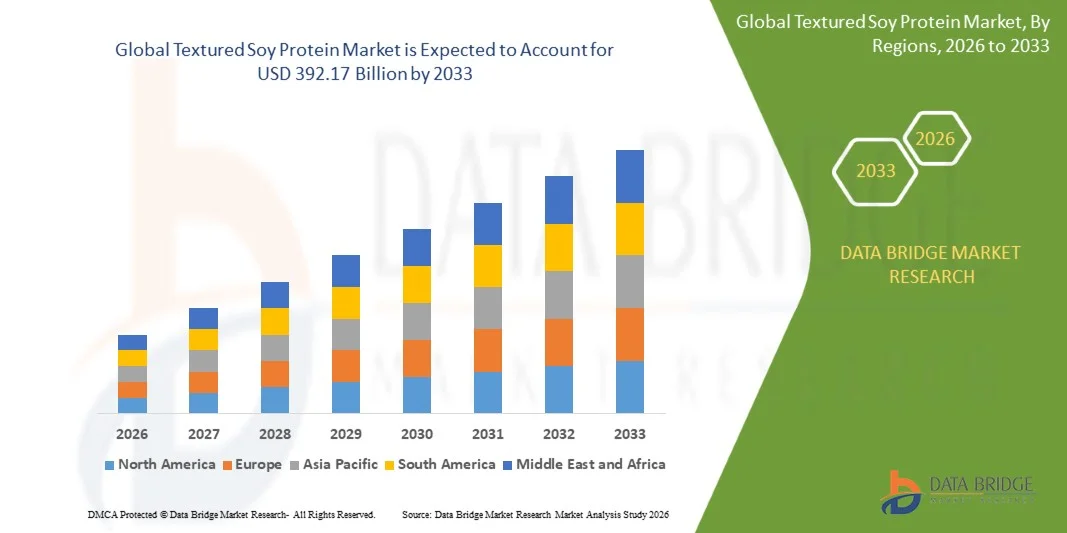
- The global textured soy protein market size was valued at USD 221.53 billion in 2025 and is expected to reach USD 392.17 billion by 2033, at a CAGR of 7.40% during the forecast period
- The market growth is largely fueled by the increased focus on sustainability-driven formulation and innovation. This growth is driven by factors such as increasing demand for meat substitutes in processed food products
What are the Major Takeaways of Textured Soy Protein Market?
- Textured soy protein (TSP) is witnessing robust global demand, fueled by the rising shift toward plant-based diets and the increasing need for sustainable and affordable protein sources. Its growing adoption across food and beverage applications—especially in meat analogs, ready meals, and processed foods—is accelerating market expansion. Health-conscious consumers, flexitarians, and expanding vegan product lines are key factors supporting this growth
- TSP is utilized across various industries, primarily in food and beverage applications as a meat substitute due to its fibrous texture and high protein content. It also finds applications in dietary supplements, animal feed, and personal care products owing to its functional properties such as water absorption, emulsification, and protein fortification. Its low cost, long shelf life, and versatility make it an ideal ingredient in cost-sensitive and nutrition-focused markets
- North America dominated the global textured soy protein market with a revenue share of 48.68% in 2025, fueled by the growing consumer shift toward plant-based diets, increased health awareness, and strong demand for meat alternatives across the U.S. and Canada
- The Asia-Pacific textured soy protein market is projected to grow at the fastest CAGR of around 7.7% from 2026 to 2033, fueled by rising disposable incomes, increasing awareness of plant-based nutrition, and strong demand for affordable protein alternatives
- The textured soy protein isolates (more than 70% protein content) segment accounted for the largest revenue share in 2025 due to its optimal balance of protein content, cost-efficiency, and suitability in various processed food products such as meat substitutes, ready-to-eat meals, and snacks
Report Scope and Textured Soy Protein Market Segmentation
|
Attributes |
Textured Soy Protein Key Market Insights |
|
Segments Covered |
|
|
Countries Covered |
North America
Europe
Asia-Pacific
Middle East and Africa
South America
|
|
Key Market Players |
|
|
Market Opportunities |
|
|
Value Added Data Infosets |
In addition to the insights on market scenarios such as market value, growth rate, segmentation, geographical coverage, and major players, the market reports curated by the Data Bridge Market Research also include in-depth expert analysis, pricing analysis, brand share analysis, consumer survey, demography analysis, supply chain analysis, value chain analysis, raw material/consumables overview, vendor selection criteria, PESTLE Analysis, Porter Analysis, and regulatory framework. |
What is the Key Trend in the Textured Soy Protein Market?
“Rising Adoption of Plant-Based Diets”
- A growing trend in the global textured soy protein (TSP) market is the increased focus on sustainability-driven formulation and innovation. As industries and consumers alike place greater emphasis on environmental responsibility, manufacturers are reformulating products to align with eco-friendly practices without compromising nutritional value or performance. TSP, being a plant-based protein, already holds an advantage due to its significantly lower environmental impact compared to animal-based proteins—requiring less water, land, and generating fewer greenhouse gas emissions
- Leading companies are incorporating sustainable sourcing and processing practices to strengthen their market position. For instance, there is a rise in the use of non-GMO soybeans and organic farming methods to meet the growing demand for clean-label and responsibly produced foods. In addition, the use of byproducts from soy oil extraction in TSP production reflects a move toward circular processing and waste minimization
- Energy-efficient manufacturing technologies are also gaining traction, with producers optimizing drying, extrusion, and packaging processes to reduce energy consumption and emissions. These developments are particularly important for food and beverage companies seeking to improve their sustainability metrics while offering high-protein meat alternatives
- For instance, In July 2024, Nestlé launched Maggi Rindecarne in Chile—a soy-based meat extender blending soy and spices for affordable hybrid meals.
- The demand for environmentally certified ingredients—compliant with global standards such as USDA Organic, EU Organic, and other sustainability certifications—is driving innovation in TSP formulations. As brands across retail, foodservice, and manufacturing sectors seek to enhance their sustainability credentials, textured soy protein is becoming a key ingredient due to its balance of performance, affordability, and eco-friendlines
- This trend is especially prominent in North America and Europe, where regulatory and consumer pressure is prompting reformulation and sourcing shifts across the protein supply chain. As a result, sustainable TSP offerings are emerging as both a competitive advantage and a market necessity, shaping product development strategies for years to come
What are the Key Drivers of Textured Soy Protein Market?
- A key driver in the global textured soy protein (TSP) market is the increasing demand for meat substitutes in processed food products. As consumers continue to prioritize health, sustainability, and ethical food choices, manufacturers are integrating plant-based proteins such as TSP into a wide variety of ready-to-eat and convenience foods. TSP stands out as a cost-effective, versatile, and high-functionality alternative that mimics the texture and sensory attributes of real meat
- Its fibrous structure allows TSP to closely replicate the chew and mouthfeel of meat, making it ideal for products such as sausages, patties, nuggets, canned meals, and frozen entrées. In addition, its excellent moisture retention and flavor absorption qualities enhance the eating experience, making it a preferred ingredient in plant-based meat analogs
- The growing flexitarian demographic—consumers who reduce but do not eliminate meat intake—is also fueling this trend. This group is increasingly looking for convenient, protein-rich processed foods that support their dietary goals. TSP provides manufacturers with a reliable and affordable solution to deliver meat substitutes that meet consumer expectations on taste, nutrition, and texture without increasing production costs
- In February 2024, Quorn partnered with the University of Teesside to explore more sustainable and nutritious plant-based meat technologies, including those incorporating TSP. In October 2024, Nasoya launched Plantspired Plant-Based Chick’n, offering pre-seasoned bites made from soy and textured vegetable proteins with 22 grams of protein per serving
- The increasing use of TSP in processed foods reflects a broader shift in consumer behavior and food innovation. With its affordability, adaptability, and similarity to meat, TSP is becoming a foundational ingredient in the growing market for plant-based meat alternatives
Which Factor is Challenging the Growth of the Textured Soy Protein Market?
- A notable restraint in the global textured soy protein (TSP) market is the allergenic nature of soy, which continues to limit consumer acceptance despite TSP's nutritional and functional benefits. Soy ranks among the top eight food allergens globally, and even minimal exposure can lead to allergic reactions, ranging from mild symptoms to severe anaphylaxis, particularly in infants and young children. This risk discourages many consumers and complicates product development for manufacturers aiming for mass-market appeal
- To mitigate these challenges, food producers are increasingly exploring alternative plant-based proteins such as pea, rice, and chickpea, which are generally considered less allergenic. These alternatives are often positioned as “allergen-free” or “clean-label,” appealing to health-conscious and sensitive consumers while allowing brands to tap into a broader, more inclusive market segment
- Strict regulatory frameworks requiring clear allergen labeling, particularly concerning soy, further influence consumer decisions. Although such transparency enhances food safety, it can also dissuade potential buyers from choosing soy-based products such as TSP due to heightened awareness of allergen risks. This regulatory landscape places soy-derived ingredients at a relative disadvantage compared to more allergen-neutral options
- Despite its affordability, protein content, and sustainability profile, TSP faces a significant hurdle in gaining widespread market penetration due to concerns surrounding soy allergies. Until scientific advancements succeed in reducing the allergenic properties of soy, this limitation is expected to persist and influence product strategy across the industry
- For instance, in November 2024, an article published by Elsevier Inc. highlighted a case of food-dependent exercise-induced anaphylaxis caused by hidden soy ingredients in processed foods, illustrating the difficulties consumers face in detecting allergens. Similarly, in December 2022, the Asthma and Allergy Foundation of America, via Kids with Food Allergies, emphasized the need for complete avoidance of soy in children with allergies, reinforcing the need for alternative ingredients in pediatric nutrition
- Overall, allergen concerns surrounding soy present a considerable restraint to the textured soy protein market, prompting a shift among manufacturers toward hypoallergenic alternatives and driving innovation in allergen-free product development
How is the Textured Soy Protein Market Segmented?
The market is segmented on the basis of type, form, nature, function, and application.
- By Type
On the basis of type, the textured soy protein market is segmented into textured soy protein isolates (more than 70% protein content), textured soy protein concentrates (65–70% protein content), and textured soy protein flour (50–65% protein content). The textured soy protein isolates (more than 70% protein content) segment accounted for the largest revenue share in 2025 due to its optimal balance of protein content, cost-efficiency, and suitability in various processed food products such as meat substitutes, ready-to-eat meals, and snacks. Its ability to absorb flavors and mimic meat-like textures makes it a go-to choice for manufacturers targeting flexitarian and vegetarian consumers.
The textured soy protein isolates (more than 70% protein content) segment is projected to grow at the fastest CAGR from 2026 to 2033, driven by increasing demand for high-protein food formulations in dietary supplements, sports nutrition, and functional foods. Isolates offer superior purity and digestibility, making them ideal for protein-fortified products in health-conscious and athletic demographics.
- By Form
On the basis of form, the market is segmented into dry and liquid. The dry form dominated the global market share in 2025, owing to its long shelf life, easy storage, and convenience in bulk transportation. It is widely preferred by food manufacturers for large-scale formulations of burgers, sausages, and meal extenders.
The liquid form segment is expected to witness the fastest CAGR through 2033, supported by innovations in ready-to-cook and instant food applications. Liquid forms offer quicker preparation, better dispersion in food matrices, and are gaining traction in foodservice and catering sectors.
- By Nature
On the basis of nature, the market is segmented into conventional and organic. The conventional segment held the largest market share in 2025 due to its wide availability, lower production costs, and extensive use in mainstream food processing. Its competitive pricing makes it suitable for both emerging and developed markets.
The organic segment is anticipated to expand at the fastest CAGR from 2026 to 2033, driven by growing consumer preference for clean-label, non-GMO, and sustainably sourced products. Regulatory support and premium positioning in the health food sector are fueling this trend, especially in North America and Europe.
- By Function
On the basis of function, the market is segmented into water & fat absorption, texturizing agent, emulsifier, binding agent, protein fortification, gelling agent, flavoring agent, and others. The Texturizing Agent segment accounted for the highest revenue in 2025, attributed to the essential role of TSP in replicating the fibrous and chewy texture of meat in plant-based alternatives. Its performance in texture retention and flavor binding supports its use in a wide range of processed foods.
The protein fortification segment is projected to grow at the fastest CAGR during the forecast period, fueled by increasing demand for protein-enriched snacks, beverages, and nutritional bars. The ability of TSP to enhance the nutritional profile of food without altering taste or structure makes it highly valuable in the functional food space.
- By Application
On the basis of application, the market is segmented into food & beverages, personal care & cosmetics, dietary supplements, animal feed, pharmaceuticals, and others. The food & beverages segment captured the largest share in 2025, due to the rising demand for plant-based meat analogs, convenience foods, and high-protein meal options. TSP is widely used in burgers, nuggets, sauces, and meal kits due to its affordability and versatility.
The dietary supplements segment is expected to record the fastest CAGR from 2026 to 2033, as consumers increasingly seek plant-based protein alternatives for muscle building, weight management, and wellness. TSP’s high protein concentration and amino acid profile make it a natural fit for protein powders, bars, and functional snacks.
Which Region Holds the Largest Share of the Textured Soy Protein Market?
- North America dominated the global textured soy protein market with a revenue share of 48.68% in 2025, fueled by the growing consumer shift toward plant-based diets, increased health awareness, and strong demand for meat alternatives across the U.S. and Canada
- The region benefits from a well-established food processing industry, widespread availability of soy-based ingredients, and rising vegan and flexitarian populations, all contributing to the expanding adoption of textured soy protein in processed foods, snacks, and dietary supplements
- Furthermore, leading food manufacturers and brands are investing in clean-label, high-protein, and sustainable product innovations, incorporating TSP into a variety of applications such as ready-to-eat meals, frozen foods, and protein-fortified products. Regulatory support for plant-based claims and consumer preference for high-nutrition, allergen-conscious alternatives continue to drive market momentum
U.S. Textured Soy Protein Market Insight
The U.S. textured soy protein market accounted for the largest revenue share of 63.56% in North America in 2025, driven by strong demand for plant-based meat alternatives, growing health consciousness, and the mainstream adoption of flexitarian and vegan diets. The country’s well-developed food processing industry and innovation in meat substitutes have positioned TSP as a go-to ingredient for high-protein, affordable, and clean-label products. The presence of major players focused on soy-based formulations and increasing retail availability of TSP-enhanced foods are supporting robust market growth.
Europe Textured Soy Protein Market Insight
The Europe textured soy protein market is expected to witness solid growth during the forecast period, supported by rising sustainability commitments, expanding vegetarian and vegan populations, and supportive EU food labeling regulations. Countries such as Germany, France, and the Netherlands are fostering rapid adoption of plant-based diets, prompting food manufacturers to incorporate textured soy protein in a wide variety of processed and ready-to-eat foods. In addition, the growing prevalence of lifestyle diseases is accelerating the shift toward protein-rich, meat-free alternatives.
U.K. Textured Soy Protein Market Insight
The U.K. textured soy protein remains a significant player in the European textured soy protein market due to increasing consumer preference for clean-label, high-protein, and sustainable food products. The country’s vibrant plant-based food ecosystem and aggressive innovation in alternative proteins have created a fertile environment for TSP-based applications across ready meals, snacks, and meat substitutes. In addition, consumer awareness around ethical sourcing and carbon reduction is further bolstering the appeal of soy-based proteins.
Germany Textured Soy Protein Market Insight
The Germany textured soy protein market is projected to grow steadily, driven by the nation’s leadership in vegan food innovation, robust retail support, and growing demand for meat analogs. German consumers are particularly responsive to sustainability-focused foods, with many retailers committing to expanded plant-based offerings. Regulatory backing for plant protein claims and investments in food tech are further accelerating the inclusion of TSP in the country’s evolving protein landscape.
Asia-Pacific Textured Soy Protein Market Insight
The Asia-Pacific textured soy protein market is projected to grow at the fastest CAGR of around 7.7% from 2026 to 2033, fueled by rising disposable incomes, increasing awareness of plant-based nutrition, and strong demand for affordable protein alternatives. Countries such as China, India, and Thailand are rapidly incorporating TSP into traditional and modern diets alike, driven by population growth, urbanization, and the need for cost-effective meat substitutes. The presence of large soy processors and favorable government policies promoting food security and sustainability further support market expansion.
South Korea Textured Soy Protein Market Insight
The South Korea textured soy protein market is steadily expanding, anchored by a strong cultural acceptance of soy-based foods, innovations in functional nutrition, and aging population needs. TSP is increasingly being used in health-conscious ready meals, senior nutrition products, and functional food segments. The country’s emphasis on umami flavor and texture fidelity is pushing manufacturers to innovate in soy-based meat substitutes, ensuring wider appeal across generations.
China Textured Soy Protein Market Insight
China accounted for the largest revenue share in the Asia-Pacific textured soy protein market in 2025, driven by rapid urbanization, increasing preference for plant-based diets, and strong domestic soy production capabilities. TSP is widely used in both traditional cuisine and modern meat alternatives, with the food processing industry increasingly turning to cost-effective soy ingredients to meet mass-market demand. Government focus on improving national nutrition and food security is also catalyzing the growth of textured soy protein in both urban and rural consumption trends.
Which are the Top Companies in Textured Soy Protein Market?
The textured soy protein industry is primarily led by well-established companies, including:
- Sun Nutrafoods (India)
- Shandong Yuxin Biotechnology Co., Ltd (China)
- Linyi Shansong Biological Products Co., Ltd. (China)
- Cargill, Incorporated (U.S.)
- ADM (U.S.)
- Fooding Group Limited (China)
- Tianwei Biotechnology Co., Ltd. (China)
- GALPRO SRL (Italy)
- BIOWAY INDUSTRIAL GROUP LTD (China)
- Wilmar International Ltd (Singapore)
- Xi'an Demeter Biotech Co., Ltd. (China)
- Taj Agro International (Taj Pharma Group) (India)
- Shandong Wonderful Biotech Co., Ltd (China)
- Foodchem International Corporation (China)
- Axiom Foods, Inc. (U.S.)
- International Flavors & Fragrances Inc. (U.S.)
- Bunge (U.S.)
- Shreenidhi Oils and Foods Ingredients Pvt. Ltd. (India)
- Soyproteincn (China)
- Eric India Agro and Food Pvt Ltd (India)
- Newseed Chemical Co., Limited (China)
- Solbar Ningbo Protein Technology Co., Ltd (China)
- Dalian JustLong Imp. & Exp. Co., Ltd (China)
What are the Recent Developments in Global Textured Soy Protein Market?
- In September 2022, ADM inaugurated a new extrusion facility in Serbia to bolster the production of non-GMO textured soy proteins. This strategic move aims to meet the escalating demand for meat alternatives in Europe and the Middle East. The facility sources 90% of its soybeans locally, within a 100 km radius, ensuring a sustainable supply chain. Advanced extrusion and texturizing equipment at the plant enable rapid development of plant-based protein products with desirable texture and taste
- In July 2024, Bunge has launched Beleaf PlantBetter in North America, a new plant-based protein line designed to meet growing consumer demand for sustainable and nutritious options. This strategic move enhances Bunge’s product portfolio, strengthens its market position, and aligns with its commitment to innovation and sustainability in the food industry.
- In July 2024, Bunge has launched Beleaf PlantBetter in North America, a new plant-based protein line designed to meet growing consumer demand for sustainable and nutritious options. This strategic move enhances Bunge’s product portfolio, strengthens its market position, and aligns with its commitment to innovation and sustainability in the food industry.
- In May 2024, Foodchem International Corporation participated in the China (Beijing)-Saudi Arabia Agricultural Industry and Sustainable Development Forum, strengthening its role as a key strategic partner in Saudi Arabia’s food and animal nutrition sectors. The company engaged in high-level dialogues with Saudi and Chinese officials to promote sustainable agricultural development and signed cooperation agreements contributing to the forum’s USD 4 billion total. Foodchem emphasized its commitment to supporting Saudi Vision 2030 through advanced nutrition solutions and climate-resilient food technologies
SKU-
Get online access to the report on the World's First Market Intelligence Cloud

- Interactive Data Analysis Dashboard
- Company Analysis Dashboard for high growth potential opportunities
- Research Analyst Access for customization & queries
- Competitor Analysis with Interactive dashboard
- Latest News, Updates & Trend analysis
- Harness the Power of Benchmark Analysis for Comprehensive Competitor Tracking
Global Textured Soy Protein Market, Supply Chain Analysis and Ecosystem Framework
To support market growth and help clients navigate the impact of geopolitical shifts, DBMR has integrated in-depth supply chain analysis into its Global Textured Soy Protein Market research reports. This addition empowers clients to respond effectively to global changes affecting their industries. The supply chain analysis section includes detailed insights such as Global Textured Soy Protein Market consumption and production by country, price trend analysis, the impact of tariffs and geopolitical developments, and import and export trends by country and HSN code. It also highlights major suppliers with data on production capacity and company profiles, as well as key importers and exporters. In addition to research, DBMR offers specialized supply chain consulting services backed by over a decade of experience, providing solutions like supplier discovery, supplier risk assessment, price trend analysis, impact evaluation of inflation and trade route changes, and comprehensive market trend analysis.
Research Methodology
Data collection and base year analysis are done using data collection modules with large sample sizes. The stage includes obtaining market information or related data through various sources and strategies. It includes examining and planning all the data acquired from the past in advance. It likewise envelops the examination of information inconsistencies seen across different information sources. The market data is analysed and estimated using market statistical and coherent models. Also, market share analysis and key trend analysis are the major success factors in the market report. To know more, please request an analyst call or drop down your inquiry.
The key research methodology used by DBMR research team is data triangulation which involves data mining, analysis of the impact of data variables on the market and primary (industry expert) validation. Data models include Vendor Positioning Grid, Market Time Line Analysis, Market Overview and Guide, Company Positioning Grid, Patent Analysis, Pricing Analysis, Company Market Share Analysis, Standards of Measurement, Global versus Regional and Vendor Share Analysis. To know more about the research methodology, drop in an inquiry to speak to our industry experts.
Customization Available
Data Bridge Market Research is a leader in advanced formative research. We take pride in servicing our existing and new customers with data and analysis that match and suits their goal. The report can be customized to include price trend analysis of target brands understanding the market for additional countries (ask for the list of countries), clinical trial results data, literature review, refurbished market and product base analysis. Market analysis of target competitors can be analyzed from technology-based analysis to market portfolio strategies. We can add as many competitors that you require data about in the format and data style you are looking for. Our team of analysts can also provide you data in crude raw excel files pivot tables (Fact book) or can assist you in creating presentations from the data sets available in the report.












