


Third Generation Sequencing Market Analysis and Size
As the world becomes more digitized, so does the legality of the third generation sequencing market. Technological advances and biomedical research were once considered a fringe practise and are now bustling with high-tech firms and scientists alike. With such a wide range of third-generation sequencing applications, it's no surprise that the market for this service has exploded in recent years. This expansion is expected to be driven primarily by rising demand for early disease detection and personalized medicine.
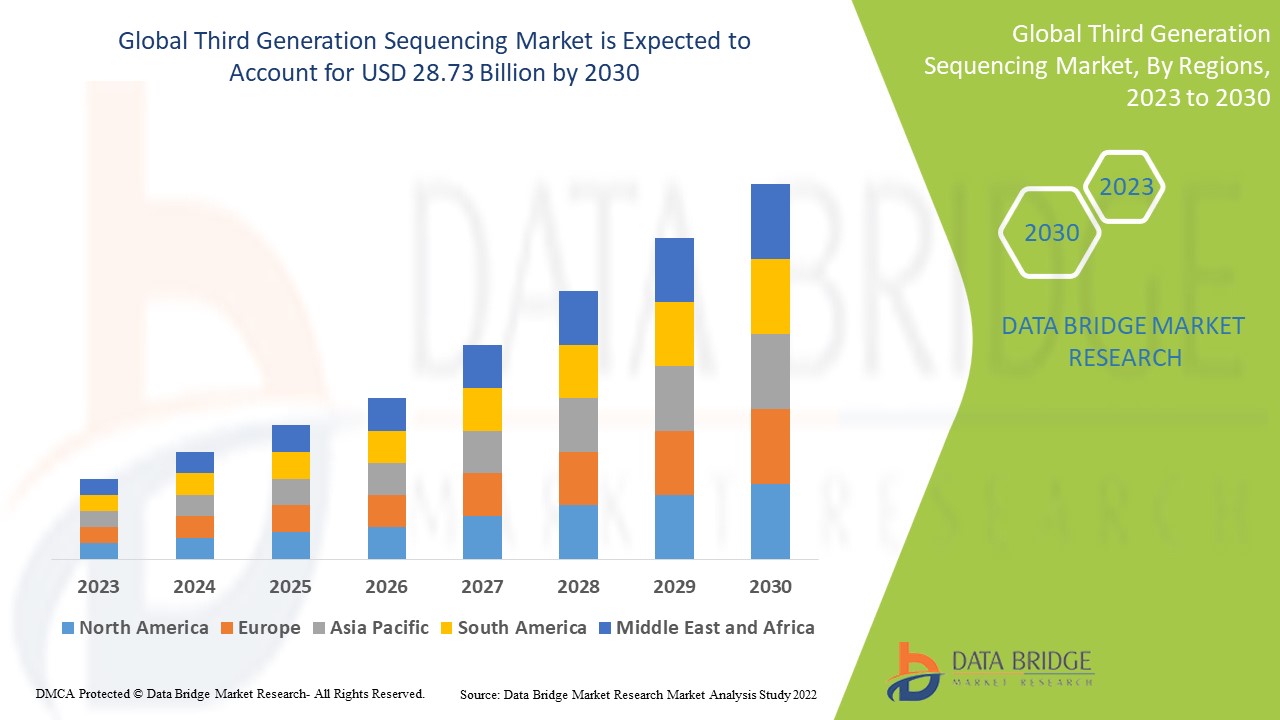
Data Bridge Market Research analyses that the third generation sequencing market which was USD 9.01 billion in 2022, is expected to reach USD 28.73 billion by 2030, at a CAGR of 15.60% during the forecast period 2023 to 2030. In addition to the insights on market scenarios such as market value, growth rate, segmentation, geographical coverage, and major players, the market reports curated by the Data Bridge Market Research also include depth expert analysis, patient epidemiology, pipeline analysis, pricing analysis, and regulatory framework.
Third Generation Sequencing Market Scope and Segmentation
|
Report Metric |
Details |
|
Forecast Period |
2023 to 2030 |
|
Base Year |
2022 |
|
Historic Years |
2021 (Customizable to 2015 - 2020) |
|
Quantitative Units |
Revenue in USD Billion, Volumes in Units, Pricing in USD |
|
Segments Covered |
Type (Single Molecule Real Time (SMRT) DNA Sequencing, Nanopore-based Single-Molecule Analysis Technology, Other), Application (Genome Sequencing, Methylation Studies, Single Nucleotide Polymorphisms (SNP) Detection) |
|
Countries Covered |
U.S., Canada and Mexico in North America, Germany, France, U.K., Netherlands, Switzerland, Belgium, Russia, Italy, Spain, Turkey, Rest of Europe in Europe, China, Japan, India, South Korea, Singapore, Malaysia, Australia, Thailand, Indonesia, Philippines, Rest of Asia-Pacific (APAC) in the Asia-Pacific (APAC), Saudi Arabia, U.A.E, South Africa, Egypt, Israel, Rest of Middle East and Africa (MEA) as a part of Middle East and Africa (MEA), Brazil, Argentina and Rest of South America as part of South America |
|
Market Players Covered |
Agilent Technologies, Inc. (U.S.), Thermo Fisher Scientific, Inc. (U.S.), Illumina, Inc. (U.S.), QIAGEN(Germany), F. Hoffmann-La Roche Ltd. (Switzerland), Oxford Nanopore Technologies Ltd. (U.K.), Macrogen, Inc. (South Korea), Perkin Elmer, Inc. (U.S.), Pacific Biosciences of California, Inc. (U.S.), BGI (China), Bio-Rad Laboratories, Inc. (U.S.), Myriad Genetics (U.S.) |
|
Market Opportunities |
|
Market Definition
The third-generation sequencing (TGS) era of DNA sequencing technology has gained a place in biology as a way to study genomes, transcriptomes, and metagenomes at unprecedented resolution. These technologies use single-molecule sequencing to provide the following benefits: long reads with no amplification, direct detection of epigenetic modifications on native DNA, and direct sequencing through regions of the genome that are inaccessible or difficult to analyze using short-read platforms.
Global Third Generation Sequencing Market Dynamics
Drivers
- Rising applications of Third-generation sequencing
Third-generation sequencing technologies can produce much longer reads than second-generation sequencing technologies. These advantages have significant implications for genomic science as well as general biology research. These technologies are actively being developed, and reductions in high error rates are expected. These all are the certain factors that help the market to grow.
Opportunities
- Technological advances
Certain factors driving market growth include advances in sequencing technology, increased application in clinical diagnosis and drug discovery, and increased R&D investments. DNA sequencing can be used for diagnostics, personalized medicine, biomarkers, forensics, reproductive health, and other purposes. Third generation sequencing technology has enormous potential in cancer diagnostics and therapeutics clinical research and development. Next-generation sequencing (NGS) technology has recently demonstrated its capability as a high-throughput and cost-effective approach to identifying and characterising clinically actionable genetic variants across multiple genes in a single test.
Restraints/Challenges
- Risk associated with sequencing
The easy availability of substitutes, combined with unfavourable government policies and the risk associated with sequencing, are likely to hamper the growth of the third generation sequencing market during the forecast period. The biggest challenge to market growth will be the economy's recession, combined with rising competition among competitors.
This third generation sequencing market report provides details of new recent developments, trade regulations, import-export analysis, production analysis, value chain optimization, market share, impact of domestic and localized market players, analyses opportunities in terms of emerging revenue pockets, changes in market regulations, strategic market growth analysis, market size, category market growths, application niches and dominance, product approvals, product launches, geographic expansions, technological innovations in the market. To gain more info on the third generation sequencing market contact Data Bridge Market Research for an Analyst Brief, our team will help you take an informed market decision to achieve market growth.
Global Third Generation Sequencing Market Scope
The third generation sequencing market is segmented on the basis of type, application,. The growth amongst these segments will help you analyze meagre growth segments in the industries and provide the users with a valuable market overview and market insights to help them make strategic decisions for identifying core market applications.
Type
- Single Molecule Real Time (SMRT) DNA Sequencing
- Nanopore-based Single-Molecule Analysis Technology
- Other
Application
- Genome Sequencing
- Methylation Studies
- Single Nucleotide Polymorphisms (SNP) Detection
Third Generation Sequencing Market Regional Analysis/Insights
The third generation sequencing market is analyzed and market size insights and trends are provided by country, type, application, as referenced above.
The countries covered in the third generation sequencing market report are U.S., Canada and Mexico in North America, Germany, France, U.K., Netherlands, Switzerland, Belgium, Russia, Italy, Spain, Turkey, Rest of Europe in Europe, China, Japan, India, South Korea, Singapore, Malaysia, Australia, Thailand, Indonesia, Philippines, Rest of Asia-Pacific (APAC) in the Asia-Pacific (APAC), Saudi Arabia, U.A.E, South Africa, Egypt, Israel, Rest of Middle East and Africa (MEA) as a part of Middle East and Africa (MEA), Brazil, Argentina and Rest of South America as part of South America.
North America dominates the third generation sequencing market because of the high prevalence of breast cancer patients.
Asia-Pacific is expected to grow at the highest growth rate in the forecast period of 2023 to 2030 owing to the focus of various established market players to expand their presence in this particular region.
The country section of the report also provides individual market impacting factors and changes in regulation in the market domestically that impacts the current and future trends of the market. Data points like down-stream and upstream value chain analysis, technical trends and porter's five forces analysis, case studies are some of the pointers used to forecast the market scenario for individual countries. Also, the presence and availability of global brands and their challenges faced due to large or scarce competition from local and domestic brands, impact of domestic tariffs and trade routes are considered while providing forecast analysis of the country data.
Healthcare Infrastructure Growth Installed base and New Technology Penetration
The third generation sequencing market also provides you with detailed market analysis for every country growth in healthcare expenditure for capital equipment, installed base of different kind of products for third generation sequencing market, impact of technology using life line curves and changes in healthcare regulatory scenarios and their impact on the third generation sequencing market. The data is available for historic period 2011-2021.
Competitive Landscape and Third Generation Sequencing Market Share Analysis
The third generation sequencing market competitive landscape provides details by competitor. Details included are company overview, company financials, revenue generated, market potential, investment in research and development, new market initiatives, global presence, production sites and facilities, production capacities, company strengths and weaknesses, product launch, product width and breadth, application dominance. The above data points provided are only related to the companies' focus related to third generation sequencing market.
Some of the major players operating in the third generation sequencing market are:
- Thermo Fisher Scientific, Inc. (U.S.)
- Illumina, Inc. (U.S.)
- QIAGEN(Germany)
- F. Hoffmann-La Roche Ltd. (Switzerland)
- Oxford Nanopore Technologies Ltd. (U.K.)
- Macrogen, Inc. (South Korea)
- Perkin Elmer, Inc. (U.S.)
- Pacific Biosciences of California, Inc. (U.S.)
- BGI (China)
- Bio-Rad Laboratories, Inc. (U.S.)
- Myriad Genetics (U.S.)
- Agilent Technologies, Inc. (U.S.)

- Interactive Data Analysis Dashboard
- Company Analysis Dashboard for high growth potential opportunities
- Research Analyst Access for customization & queries
- Competitor Analysis with Interactive dashboard
- Latest News, Updates & Trend analysis
- Harness the Power of Benchmark Analysis for Comprehensive Competitor Tracking
Table of Content
1 INTRODUCTION
1.1 OBJECTIVES OF THE STUDY
1.2 MARKET DEFINITION
1.3 OVERVIEW OF GLOBAL THIRD GENERATION SEQUENCING MARKET
1.4 CURRENCY AND PRICING
1.5 LIMITATION
1.6 MARKETS COVERED
2 MARKET SEGMENTATION
2.1 KEY TAKEAWAYS
2.2 ARRIVING AT THE GLOBAL THIRD GENERATION SEQUENCING MARKET SIZE
2.2.1 VENDOR POSITIONING GRID
2.2.2 TECHNOLOGY LIFE LINE CURVE
2.2.3 TRIPOD DATA VALIDATION MODEL
2.2.4 MARKET GUIDE
2.2.5 MULTIVARIATE MODELLING
2.2.6 TOP TO BOTTOM ANALYSIS
2.2.7 CHALLENGE MATRIX
2.2.8 APPLICATION COVERAGE GRID
2.2.9 STANDARDS OF MEASUREMENT
2.2.10 VENDOR SHARE ANALYSIS
2.2.11 EPIDEMIOLOGY BASED MODELLING
2.2.12 DATA POINTS FROM KEY PRIMARY INTERVIEWS
2.2.13 DATA POINTS FROM KEY SECONDARY DATABASES
2.3 GLOBAL THIRD GENERATION SEQUENCING MARKET: RESEARCH SNAPSHOT
2.4 ASSUMPTIONS
3 MARKET OVERVIEW
3.1 DRIVERS
3.2 RESTRAINTS
3.3 OPPORTUNITIES
3.4 CHALLENGES
4 EXECUTIVE SUMMARY
5 PREMIUM INSIGHTS
5.1 PESTEL ANALYSIS
5.2 PORTER’S 5 FORCES MODEL
5.3 STRATEGIC INITIATIVES
6 REGULATORY FRAMEWORK
7 GLOBAL THIRD GENERATION SEQUENCING MARKET, BY PRODUCT
7.1 OVERVIEW
7.2 SEQUENCING INSTRUMENTS
7.2.1 SINGLE-MOLECULE REAL-TIME (SMRT) DEVICES
7.2.1.1. MARKET VLAUE (USD MN)
7.2.1.2. MARKET VOLUME (UNITS)
7.2.1.3. AVERAGE SELLING PRICE (USD)
7.2.2 NANOPORE SEQUENCING DEVICES
7.2.2.1. MARKET VLAUE (USD MN)
7.2.2.2. MARKET VOLUME (UNITS)
7.2.2.3. AVERAGE SELLING PRICE (USD)
7.2.3 OTHERS
7.3 CONSUMABLES
7.3.1 SEQUENCING KIT
7.3.1.1. DNA BASED
7.3.1.1.1. MARKET VLAUE (USD MN)
7.3.1.1.2. MARKET VOLUME (UNITS)
7.3.1.1.3. AVERAGE SELLING PRICE (USD)
7.3.1.2. RNA BASED
7.3.1.2.1. MARKET VLAUE (USD MN)
7.3.1.2.2. MARKET VOLUME (UNITS)
7.3.1.2.3. AVERAGE SELLING PRICE (USD)
7.3.2 LIBRARY PREPARATION KIT
7.3.2.1. MARKET VLAUE (USD MN)
7.3.2.2. MARKET VOLUME (UNITS)
7.3.2.3. AVERAGE SELLING PRICE (USD)
7.3.3 DNA BARCODING KIT
7.3.3.1. BARCODING PRIMER
7.3.3.1.1. MARKET VLAUE (USD MN)
7.3.3.1.2. MARKET VOLUME (UNITS)
7.3.3.1.3. AVERAGE SELLING PRICE (USD)
7.3.3.2. BARCODING ADAPTERS
7.3.3.2.1. MARKET VLAUE (USD MN)
7.3.3.2.2. MARKET VOLUME (UNITS)
7.3.3.2.3. AVERAGE SELLING PRICE (USD)
7.3.3.3. OTHERS
7.3.4 DNA ACCESSORY
7.3.4.1. MIXING PLATES
7.3.4.1.1. MARKET VLAUE (USD MN)
7.3.4.1.2. MARKET VOLUME (UNITS)
7.3.4.1.3. AVERAGE SELLING PRICE (USD)
7.3.4.2. SAMPLE PLATES
7.3.4.2.1. MARKET VLAUE (USD MN)
7.3.4.2.2. MARKET VOLUME (UNITS)
7.3.4.2.3. AVERAGE SELLING PRICE (USD)
7.3.4.3. PIPETTE TIPS
7.3.4.3.1. MARKET VLAUE (USD MN)
7.3.4.3.2. MARKET VOLUME (UNITS)
7.3.4.3.3. AVERAGE SELLING PRICE (USD)
7.3.4.4. TUBE SEPTA
7.3.4.4.1. MARKET VLAUE (USD MN)
7.3.4.4.2. MARKET VOLUME (UNITS)
7.3.4.4.3. AVERAGE SELLING PRICE (USD)
7.3.4.5. OTHERS
7.3.5 BINDING AND CLEANUP KIT
7.3.5.1. INTERNAL CONTROL KITS
7.3.5.1.1. MARKET VLAUE (USD MN)
7.3.5.1.2. MARKET VOLUME (UNITS)
7.3.5.1.3. AVERAGE SELLING PRICE (USD)
7.3.5.2. LOADING CLEAN UP BEAD KIT
7.3.5.2.1. MARKET VLAUE (USD MN)
7.3.5.2.2. MARKET VOLUME (UNITS)
7.3.5.2.3. AVERAGE SELLING PRICE (USD)
7.3.5.3. BINDING BUFFER KIT
7.3.5.3.1. MARKET VLAUE (USD MN)
7.3.5.3.2. MARKET VOLUME (UNITS)
7.3.5.3.3. AVERAGE SELLING PRICE (USD)
7.3.5.4. OTHERS
7.3.6 OTHERS
7.4 SEQUENCING AS SERVICES
7.4.1 MARKET VLAUE (USD MN)
7.4.2 MARKET VOLUME (UNITS)
7.4.3 AVERAGE SELLING PRICE (USD)
7.5 SUPPORTING HARDWARE
7.5.1 MARKET VLAUE (USD MN)
7.5.2 MARKET VOLUME (UNITS)
7.5.3 AVERAGE SELLING PRICE (USD)
8 GLOBAL THIRD GENERATION SEQUENCING MARKET, BY TECHNOLOGY
8.1 OVERVIEW
8.2 SINGLE MOLECULE REAL TIME (SMRT) SEQUENCING (LONG READ)
8.2.1 BY PRODUCT
8.2.1.1. SEQUENCING INSTRUMENTS
8.2.1.2. CONSUMABLES
8.2.1.3. SEQUENCING AS SERVICE
8.2.1.4. SUPPORTIVE HARDWARE
8.2.2 BY USAGE
8.2.2.1. CLINICAL
8.2.2.2. RESEARCH
8.2.3 BY TYPE OF NUCLEOTIDE SEQUENCES
8.2.3.1. RNA
8.2.3.2. DNA
8.3 NANOPORE-BASED SINGLE MOLECULE ANALYSIS TECHNOLOGY (DIRECT LONG READ)
8.3.1 BY PRODUCT
8.3.1.1. SEQUENCING INSTRUMENTS
8.3.1.2. CONSUMABLES
8.3.1.3. SEQUENCING AS SERVICE
8.3.1.4. SUPPORTIVE HARDWARE
8.3.2 BY USAGE
8.3.2.1. CLINICAL
8.3.2.2. RESEARCH
8.3.3 BY TYPE
8.3.3.1. SOLID STATE
8.3.3.2. BIOLOGICAL
8.3.3.3. HYBRID
8.3.4 BY TYPE OF NUCLEOTIDE SEQUENCES
8.3.4.1. RNA
8.3.4.2. DNA
8.4 SINGLE MOLECULE SEQUENCING (SHORT READ)
8.4.1 BY PRODUCT
8.4.1.1. SEQUENCING INSTRUMENTS
8.4.1.2. CONSUMABLES
8.4.1.3. SEQUENCING AS SERVICE
8.4.1.4. SUPPORTIVE HARDWARE
8.4.2 BY USAGE
8.4.2.1. CLINICAL
8.4.2.2. RESEARCH
8.4.3 BY TYPE OF NUCLEOTIDE SEQUENCES
8.4.3.1. RNA
8.4.3.2. DNA
9 GLOBAL THIRD GENERATION SEQUENCING MARKET, BY METHODS
9.1 OVERVIEW
9.2 WHOLE GENOME SEQUENCING
9.3 METAGENOME SEQUENCING
9.4 RNA SEQUENCING
9.5 EPIGENETICS
9.6 TARGETED SEQUENCING
10 GLOBAL THIRD GENERATION SEQUENCING MARKET, BY APPLICATION
10.1 OVERVIEW
10.2 CLINICAL
10.2.1 CLINICAL DIAGNOSTIC
10.2.1.1. RARE DISEASE DIAGNOSIS
10.2.1.2. INFECTIOUS DISEASE DIAGNOSIS
10.2.1.3. CANCER DIAGNOSIS
10.2.1.4. OTHERS
10.2.2 FORENSIC
10.2.3 RETYPEIVE HEALTH
10.2.4 PRENATAL TESTING
10.2.5 OTHERS
10.3 RESEARCH
10.3.1 EPIGENETICS
10.3.1.1. HUMAN AND EUKARYOTE EPIGENETICS
10.3.1.2. MICROBIAL EPIGENETICS
10.3.2 DRUG DISCOVERY
10.3.2.1. ONCLOLOGY
10.3.2.2. RARE DISEASES
10.3.2.3. GENETIC DISORDERS
10.3.2.4. OTHERS
10.3.3 METAGENOMICS
10.3.4 OTHERS
11 GLOBAL THIRD GENERATION SEQUENCING MARKET, BY WORK FLOW
11.1 OVERVIEW
11.2 LIBRARY PREPARATION
11.3 SEQUENCING
11.4 DATA ANALYSIS
11.5 OTHERS
12 GLOBAL THIRD GENERATION SEQUENCING MARKET, BY TYPE OF NUCLEOTIDE SEQUENCES
12.1 OVERVIEW
12.2 DNA
12.3 RNA
13 GLOBAL THIRD GENERATION SEQUENCING MARKET, BY END USER
13.1 OVERVIEW
13.2 HOSPITALS
13.3 ACADEMIC & RESEARCH INSTITUTES
13.4 PHARMACEUTICAL AND BIOTECHNOLOGY COMPANIESS
13.5 CLINICAL AND DIAGNOSTIC LABORATORIES
13.6 OTHERS
14 U.S. DENTAL DEVICES AND CONSUMABLES MARKET, BY DISTRIBUTION CHANNEL
14.1 OVERVIEW
14.2 DIRECT TENDERS
14.3 RETAIL SALES
14.4 OTHERS
15 GLOBAL THIRD GENERATION SEQUENCING MARKET, BY REGION
15.1 GLOBAL THIRD GENERATION SEQUENCING MARKET (ALL SEGMENTATION PROVIDED ABOVE IS REPRESENTED IN THIS CHAPTER BY COUNTRY)
15.2 NORTH AMERICA
15.2.1 U.S.
15.2.1.1. U.S THIRD GENERATION SEQUENCING MARKET, BY PRODUCT
15.2.1.2. U.S THIRD GENERATION SEQUENCING MARKET, BY TECHNOLOGY
15.2.1.3. U.S THIRD GENERATION SEQUENCING MARKET, BY METHODS
15.2.1.4. U.S THIRD GENERATION SEQUENCING MARKET, BY WORKFLOW
15.2.1.5. U.S THIRD GENERATION SEQUENCING MARKET, BY TYPE OF NUCLEOTIDE SEQUENCED
15.2.1.6. U.S THIRD GENERATION SEQUENCING MARKET, BY APPLICATIONS
15.2.1.7. U.S THIRD GENERATION SEQUENCING MARKET, BY END USER
15.2.1.8. U.S THIRD GENERATION SEQUENCING MARKET, BY DISTRIBUTION CHANNELS
15.2.2 CANADA
15.2.3 MEXICO
15.3 EUROPE
15.3.1 GERMANY
15.3.2 FRANCE
15.3.3 U.K.
15.3.4 FINLAND
15.3.5 DENMARK
15.3.6 NORWAY
15.3.7 POLAND
15.3.8 ITALY
15.3.9 SPAIN
15.3.10 RUSSIA
15.3.11 TURKEY
15.3.12 BELGIUM
15.3.13 NETHERLANDS
15.3.14 SWITZERLAND
15.3.15 SWEDEN
15.3.16 REST OF EUROPE
15.4 ASIA-PACIFIC
15.4.1 JAPAN
15.4.2 CHINA
15.4.3 SOUTH KOREA
15.4.4 INDIA
15.4.5 SINGAPORE
15.4.6 THAILAND
15.4.7 INDONESIA
15.4.8 MALAYSIA
15.4.9 PHILIPPINES
15.4.10 AUSTRALIA
15.4.11 NEW ZEALAND
15.4.12 VIETNAM
15.4.13 TAIWAN
15.4.14 REST OF ASIA-PACIFIC
15.4.15
15.5 SOUTH AMERICA
15.5.1 BRZIL
15.5.2 ARGENTINA
15.5.3 REST OF SOUTH AMERICA
15.6 MIDDLE EAST AND AFRICA
15.6.1 SOUTH AFRICA
15.6.2 SAUDI ARABIA
15.6.3 UAE
15.6.4 EGYPT
15.6.5 KUWAIT
15.6.6 OMAN
15.6.7 ISRAEL
15.6.8 BAHRAIN
15.6.9 REST OF MIDDLE EAST AND AFRICA
15.6.10 KEY PRIMARY INSIGHTS: BY MAJOR COUNTRIES
16 GLOBAL THIRD GENERATION SEQUENCING MARKET, SWOT AND DBMR ANALYSIS
17 GLOBAL THIRD GENERATION SEQUENCING MARKET, COMPANY LANDSCAPE
17.1 COMPANY SHARE ANALYSIS: GLOBAL
17.2 COMPANY SHARE ANALYSIS: NORTH AMERICA
17.3 COMPANY SHARE ANALYSIS: EUROPE
17.4 COMPANY SHARE ANALYSIS: ASIA-PACIFIC
17.5 COMPANY SHARE ANALYSIS: MIDDLE EAST AND AFRICA
17.6 COMPANY SHARE ANALYSIS: SOUTH AMERICA
17.7 MERGERS & ACQUISITIONS
17.8 NEW PRODUCT DEVELOPMENT & APPROVALS
17.9 EXPANSIONS
17.1 REGULATORY CHANGES
17.11 PARTNERSHIP AND OTHER STRATEGIC DEVELOPMENTS
18 GLOBAL THIRD GENERATION SEQUENCING MARKET, COMPANY PROFILE
18.1 PACIFIC BIOSCIENCES OF CALIFOENICA INC
18.1.1 COMPANY OVERVIEW
18.1.2 REVENUE ANALYSIS
18.1.3 GEOGRAPHIC PRESENCE
18.1.4 PRODUCT PORTFOLIO
18.1.5 RECENT DEVELOPMENTS
18.2 ILLUMINA
18.2.1 COMPANY OVERVIEW
18.2.2 REVENUE ANALYSIS
18.2.3 GEOGRAPHIC PRESENCE
18.2.4 PRODUCT PORTFOLIO
18.2.5 RECENT DEVELOPMENTS
18.3 OXFORD NANAOPORE TECHNOLOGIES
18.3.1 COMPANY OVERVIEW
18.3.2 REVENUE ANALYSIS
18.3.3 GEOGRAPHIC PRESENCE
18.3.4 PRODUCT PORTFOLIO
18.3.5 RECENT DEVELOPMENTS
18.4 GENXONE S.A
18.4.1 COMPANY OVERVIEW
18.4.2 REVENUE ANALYSIS
18.4.3 GEOGRAPHIC PRESENCE
18.4.4 PRODUCT PORTFOLIO
18.4.5 RECENT DEVELOPMENTS
18.5 F- HOFFMANN LA ROCHE
18.5.1 COMPANY OVERVIEW
18.5.2 REVENUE ANALYSIS
18.5.3 GEOGRAPHIC PRESENCE
18.5.4 PRODUCT PORTFOLIO
18.5.5 RECENT DEVELOPMENTS
18.6 QUANTAPORE
18.6.1 COMPANY OVERVIEW
18.6.2 REVENUE ANALYSIS
18.6.3 GEOGRAPHIC PRESENCE
18.6.4 PRODUCT PORTFOLIO
18.6.5 RECENT DEVELOPMENTS
18.7 FG TECHNOLOGIES
18.7.1 COMPANY OVERVIEW
18.7.2 REVENUE ANALYSIS
18.7.3 GEOGRAPHIC PRESENCE
18.7.4 PRODUCT PORTFOLIO
18.7.5 RECENT DEVELOPMENTS
18.8 BASECLEAR B.V
18.8.1 COMPANY OVERVIEW
18.8.2 REVENUE ANALYSIS
18.8.3 GEOGRAPHIC PRESENCE
18.8.4 PRODUCT PORTFOLIO
18.8.5 RECENT DEVELOPMENTS
18.9 GARVAN INSTITUTE
18.9.1 COMPANY OVERVIEW
18.9.2 REVENUE ANALYSIS
18.9.3 GEOGRAPHIC PRESENCE
18.9.4 PRODUCT PORTFOLIO
18.9.5 RECENT DEVELOPMENTS
18.1 THERMOFISHER SCIENTIFIC INC
18.10.1 COMPANY OVERVIEW
18.10.2 REVENUE ANALYSIS
18.10.3 GEOGRAPHIC PRESENCE
18.10.4 PRODUCT PORTFOLIO
18.10.5 RECENT DEVELOPMENTS
18.11 PERKIN ELMER INC
18.11.1 COMPANY OVERVIEW
18.11.2 REVENUE ANALYSIS
18.11.3 GEOGRAPHIC PRESENCE
18.11.4 PRODUCT PORTFOLIO
18.11.5 RECENT DEVELOPMENTS
18.12 NOVOGENE CORPORATION
18.12.1 COMPANY OVERVIEW
18.12.2 REVENUE ANALYSIS
18.12.3 GEOGRAPHIC PRESENCE
18.12.4 PRODUCT PORTFOLIO
18.12.5 RECENT DEVELOPMENTS
18.13 GENEWIZ INC
18.13.1 COMPANY OVERVIEW
18.13.2 REVENUE ANALYSIS
18.13.3 GEOGRAPHIC PRESENCE
18.13.4 PRODUCT PORTFOLIO
18.13.5 RECENT DEVELOPMENTS
18.14 LEXOGEN GMBH
18.14.1 COMPANY OVERVIEW
18.14.2 REVENUE ANALYSIS
18.14.3 GEOGRAPHIC PRESENCE
18.14.4 PRODUCT PORTFOLIO
18.14.5 RECENT DEVELOPMENTS
18.15 MACROGEN INC
18.15.1 COMPANY OVERVIEW
18.15.2 REVENUE ANALYSIS
18.15.3 GEOGRAPHIC PRESENCE
18.15.4 PRODUCT PORTFOLIO
18.15.5 RECENT DEVELOPMENTS
18.16 PROMEGA CORPORATION
18.16.1 COMPANY OVERVIEW
18.16.2 REVENUE ANALYSIS
18.16.3 GEOGRAPHIC PRESENCE
18.16.4 PRODUCT PORTFOLIO
18.16.5 RECENT DEVELOPMENTS
18.17 DNA TECHNOLOGIES CORE
18.17.1 COMPANY OVERVIEW
18.17.2 REVENUE ANALYSIS
18.17.3 GEOGRAPHIC PRESENCE
18.17.4 PRODUCT PORTFOLIO
18.17.5 RECENT DEVELOPMENTS
18.18 TATAA BIOCENTER
18.18.1 COMPANY OVERVIEW
18.18.2 REVENUE ANALYSIS
18.18.3 GEOGRAPHIC PRESENCE
18.18.4 PRODUCT PORTFOLIO
18.18.5 RECENT DEVELOPMENTS
18.19 UNIVERSAL SEQUENCING TECHNOLOGY
18.19.1 COMPANY OVERVIEW
18.19.2 REVENUE ANALYSIS
18.19.3 GEOGRAPHIC PRESENCE
18.19.4 PRODUCT PORTFOLIO
18.19.5 RECENT DEVELOPMENTS
*NOTE: THE COMPANIES PROFILED IS NOT EXHAUSTIVE LIST AND IS AS PER OUR PREVIOUS CLIENT REQUIREMENT. WE PROFILE MORE THAN 100 COMPANIES IN OUR STUDY AND HENCE THE LIST OF COMPANIES CAN BE MODIFIED OR REPLACED ON REQUEST
19 RELATED REPORTS
20 CONCLUSION
21 QUESTIONNAIRE
22 ABOUT DATA BRIDGE MARKET RESEARCH

Data collection and base year analysis are done using data collection modules with large sample sizes. The stage includes obtaining market information or related data through various sources and strategies. It includes examining and planning all the data acquired from the past in advance. It likewise envelops the examination of information inconsistencies seen across different information sources. The market data is analysed and estimated using market statistical and coherent models. Also, market share analysis and key trend analysis are the major success factors in the market report. To know more, please request an analyst call or drop down your inquiry.
The key research methodology used by DBMR research team is data triangulation which involves data mining, analysis of the impact of data variables on the market and primary (industry expert) validation. Data models include Vendor Positioning Grid, Market Time Line Analysis, Market Overview and Guide, Company Positioning Grid, Patent Analysis, Pricing Analysis, Company Market Share Analysis, Standards of Measurement, Global versus Regional and Vendor Share Analysis. To know more about the research methodology, drop in an inquiry to speak to our industry experts.
Data Bridge Market Research is a leader in advanced formative research. We take pride in servicing our existing and new customers with data and analysis that match and suits their goal. The report can be customized to include price trend analysis of target brands understanding the market for additional countries (ask for the list of countries), clinical trial results data, literature review, refurbished market and product base analysis. Market analysis of target competitors can be analyzed from technology-based analysis to market portfolio strategies. We can add as many competitors that you require data about in the format and data style you are looking for. Our team of analysts can also provide you data in crude raw excel files pivot tables (Fact book) or can assist you in creating presentations from the data sets available in the report.













