


Global Torque Converter Market
Market Size in USD Billion
CAGR :
% 
 USD
3.78 Billion
USD
5.10 Billion
2025
2033
USD
3.78 Billion
USD
5.10 Billion
2025
2033
 Forecast Period Forecast Period |
2026 –2033 |
 Market Size (Base Year) Market Size (Base Year) |
USD 3.78 Billion |
 Market Size (Forecast Year) Market Size (Forecast Year) |
USD 5.10 Billion |
 CAGR CAGR |
% |
| Major Markets Players |
|
Torque Converter Market Size
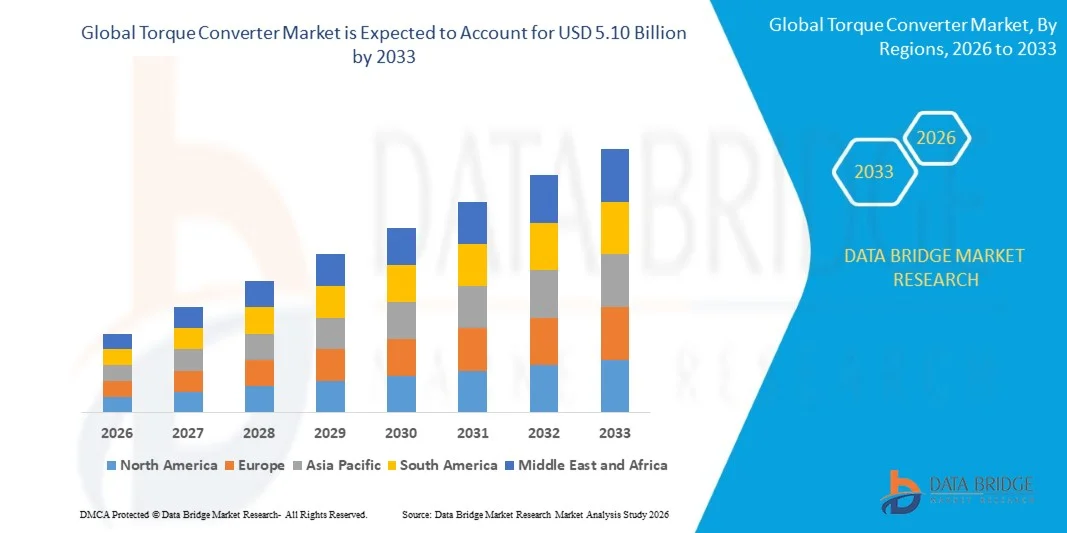
- The global torque converter market size was valued at USD 3.78 billion in 2025 and is expected to reach USD 5.10 billion by 2033, at a CAGR of 3.80% during the forecast period
- The market growth is largely fuelled by the increasing demand for automatic transmission vehicles and improving driving comfort in passenger and commercial vehicles
- Rising vehicle production, particularly in emerging economies, and growing consumer preference for smoother gear shifting and enhanced vehicle performance are supporting market expansion
Torque Converter Market Analysis
- The market is witnessing steady growth due to the rising adoption of automatic and semi-automatic transmission systems in passenger cars and light commercial vehicles across developed and developing economies
- Increasing investments by automotive manufacturers in advanced drivetrain technologies and fuel efficiency improvements are strengthening the demand for high-performance torque converters across various vehicle segments
- North America dominated the torque converter market with the largest revenue share in 2025, driven by the strong presence of automotive manufacturers and the high adoption of automatic transmission vehicles across passenger and commercial vehicle segments
- Asia-Pacific region is expected to witness the highest growth rate in the global torque converter market, driven by rapid urbanization, increasing disposable incomes, expanding automotive production, and growing demand for passenger vehicles equipped with advanced transmission systems
- The automatic transmission segment held the largest market revenue share in 2025 driven by the growing consumer preference for smoother driving experience, improved vehicle comfort, and easier operation in congested urban environments. Automatic transmission systems widely utilize torque converters to ensure efficient torque multiplication and seamless power transfer between the engine and drivetrain
Report Scope and Torque Converter Market Segmentation
|
Attributes |
Torque Converter Key Market Insights |
|
Segments Covered |
|
|
Countries Covered |
North America
Europe
Asia-Pacific
Middle East and Africa
South America
|
|
Key Market Players |
• Infineon Technologies AG (Germany) |
|
Market Opportunities |
• Rising Adoption Of Hybrid And Automatic Transmission Vehicles |
|
Value Added Data Infosets |
In addition to the insights on market scenarios such as market value, growth rate, segmentation, geographical coverage, and major players, the market reports curated by the Data Bridge Market Research also include in-depth expert analysis, geographically represented company-wise production and capacity, network layouts of distributors and partners, detailed and updated price trend analysis and deficit analysis of supply chain and demand. |
Torque Converter Market Trends
“Growing Adoption of Automatic and Hybrid Transmission Systems”
• The increasing demand for automatic transmission vehicles is significantly shaping the torque converter market, as consumers increasingly prefer smoother driving experiences and improved vehicle comfort. Torque converters play a crucial role in enabling seamless power transfer between the engine and transmission, supporting efficient acceleration and improved vehicle performance. This trend is encouraging automotive manufacturers to integrate advanced torque converter technologies into passenger cars and commercial vehicles
• Rising urbanization and increasing traffic congestion have accelerated the adoption of automatic vehicles, particularly in passenger cars and premium vehicle segments. Consumers are prioritizing convenience and ease of driving, which has increased the use of torque converters in modern transmission systems. Automotive manufacturers are also focusing on enhancing transmission efficiency to improve overall vehicle performance and fuel economy
• Advancements in transmission technologies, such as lock-up torque converters and lightweight materials, are influencing purchasing decisions across the automotive industry. These innovations help reduce energy loss, improve fuel efficiency, and enhance driving comfort. As a result, manufacturers are investing in research and development to design more efficient and compact torque converter systems for next-generation vehicles
• For instance, in 2024, ZF Friedrichshafen AG and Aisin Corporation introduced advanced torque converter solutions integrated with automatic and hybrid transmission systems. These technologies were developed to enhance fuel efficiency and driving performance in passenger vehicles, supporting the growing demand for efficient transmission components
• While the demand for torque converters is expanding, sustained market growth depends on continuous technological innovation, cost optimization, and improving compatibility with hybrid and electrified powertrains. Manufacturers are focusing on improving durability, thermal efficiency, and overall system performance to meet evolving automotive industry requirements
Torque Converter Market Dynamics
Driver
“Increasing Demand for Automatic Transmission Vehicles”
• Rising consumer preference for automatic transmission vehicles is a major driver for the torque converter market. Automatic transmissions provide smoother gear transitions, reduced driver effort, and improved comfort compared to manual transmissions. As a result, automakers are increasingly incorporating torque converters into modern vehicle platforms to meet consumer expectations for convenience and driving ease
• Expanding vehicle production globally, particularly in passenger cars and light commercial vehicles, is further influencing market growth. Torque converters help enhance torque multiplication and vehicle acceleration, supporting improved driving performance. The rising demand for premium and mid-range vehicles equipped with automatic transmission systems is also contributing to market expansion
• Automotive manufacturers are actively investing in advanced transmission technologies to improve fuel efficiency and vehicle performance. These initiatives include the development of lightweight torque converters and improved lock-up clutch mechanisms. Such innovations are helping manufacturers meet stringent fuel efficiency standards while maintaining optimal vehicle performance
• For instance, in 2023, BorgWarner Inc. and Valeo expanded their product offerings by introducing advanced torque converter technologies designed for next-generation automatic transmissions. These developments supported improved drivetrain efficiency and strengthened the companies’ presence in the global automotive components market
• Although increasing adoption of automatic transmissions supports market growth, wider expansion depends on continuous innovation, cost-effective manufacturing, and compatibility with emerging vehicle technologies. Investments in advanced materials, improved manufacturing processes, and integration with hybrid drivetrains will be essential to sustain long-term growth in the torque converter market
Restraint/Challenge
“Growing Shift Toward Electric Vehicles Without Conventional Transmissions”
• The increasing adoption of fully electric vehicles represents a major challenge for the torque converter market. Electric vehicles typically use simplified drivetrain systems that do not require conventional torque converters, reducing demand for these components. As EV adoption rises globally, the reliance on traditional transmission systems may gradually decline
• The automotive industry’s transition toward electrification and energy-efficient mobility solutions is influencing transmission technology development. Many electric vehicles use single-speed gear systems, which eliminate the need for torque converters. This shift may limit the growth potential of traditional torque converter technologies in the long term
• Supply chain disruptions and fluctuating raw material costs can also impact market stability. Torque converters require specialized materials and precision manufacturing processes, which can increase production costs. Manufacturers must ensure consistent supply chains and cost-effective production to remain competitive in the evolving automotive industry
• For instance, in 2024, electric vehicle manufacturers such as Tesla and BYD Company Ltd. expanded their EV portfolios featuring simplified drivetrain architectures without conventional torque converters. This development highlighted the growing shift toward alternative powertrain systems in the global automotive market
• Overcoming these challenges will require strategic adaptation by torque converter manufacturers, including the development of advanced hybrid-compatible systems and integration with new transmission technologies. Strengthening innovation, improving production efficiency, and exploring opportunities in hybrid vehicles will be essential for sustaining growth in the evolving mobility landscape
Torque Converter Market Scope
The market is segmented on the basis of transmission type, component, vehicle type, hybrid vehicle type, and end users.
• By Transmission Type
On the basis of transmission type, the torque converter market is segmented into automatic transmission, continuously variable transmission (CVT), and dual-clutch transmission (DCT). The automatic transmission segment held the largest market revenue share in 2025 driven by the growing consumer preference for smoother driving experience, improved vehicle comfort, and easier operation in congested urban environments. Automatic transmission systems widely utilize torque converters to ensure efficient torque multiplication and seamless power transfer between the engine and drivetrain.
The continuously variable transmission (CVT) segment is expected to witness the fastest growth rate from 2026 to 2033, driven by its ability to provide improved fuel efficiency and smoother acceleration. CVT systems are increasingly adopted in passenger vehicles due to their capability to maintain optimal engine performance and enhance overall driving efficiency.
• By Component
On the basis of component, the torque converter market is segmented into clutch plate, damper, impeller, stator, and turbine. The impeller segment accounted for the largest market revenue share in 2025 as it plays a critical role in transmitting engine power to the transmission fluid, initiating torque multiplication. Its essential function in maintaining fluid flow and rotational force makes it a vital component in torque converter systems used in automatic transmissions.
The stator segment is expected to witness the fastest growth rate from 2026 to 2033, driven by its ability to redirect transmission fluid and enhance torque multiplication efficiency. Advancements in stator design and materials are improving durability and transmission performance across modern automotive systems.
• By Vehicle Type
On the basis of vehicle type, the torque converter market is segmented into passenger car and commercial vehicle. The passenger car segment held the largest market revenue share in 2025 driven by the rising demand for automatic transmission vehicles and the increasing adoption of advanced drivetrain technologies in modern passenger vehicles. Growing consumer preference for comfort, convenience, and enhanced driving performance is further supporting the use of torque converters in this segment.
The commercial vehicle segment is expected to witness the fastest growth rate from 2026 to 2033, driven by the increasing need for durable and high-performance transmission systems capable of handling heavy loads and long-distance operations. Torque converters play a crucial role in improving vehicle efficiency and torque delivery in commercial fleets.
• By Hybrid Vehicle Type
On the basis of hybrid vehicle type, the torque converter market is segmented into hybrid electric vehicle (HEV) and plug-in hybrid electric vehicle (PHEV). The hybrid electric vehicle (HEV) segment held the largest market revenue share in 2025 driven by the growing adoption of hybrid powertrains that combine internal combustion engines with electric propulsion systems. Torque converters are widely used in hybrid vehicles to support smooth power delivery and efficient drivetrain performance.
The plug-in hybrid electric vehicle (PHEV) segment is expected to witness significant growth from 2026 to 2033, driven by increasing consumer interest in vehicles offering extended electric driving range along with conventional engine support. The integration of advanced transmission technologies in PHEVs is further contributing to the demand for efficient torque converter systems.
• By End Users
On the basis of end users, the torque converter market is segmented into original equipment manufacturer (OEM) and aftermarket. The original equipment manufacturer (OEM) segment accounted for the largest market revenue share in 2025 driven by increasing automotive production and the growing integration of automatic transmission systems in newly manufactured vehicles. Automakers are continuously collaborating with component manufacturers to develop advanced torque converter technologies that enhance performance and efficiency.
The aftermarket segment is expected to witness the fastest growth rate from 2026 to 2033, driven by the rising demand for replacement components and maintenance services in aging vehicle fleets. Increasing vehicle ownership and longer vehicle lifespans are contributing to the steady demand for torque converter replacements and related automotive services.
Torque Converter Market Regional Analysis
• North America dominated the torque converter market with the largest revenue share in 2025, driven by the strong presence of automotive manufacturers and the high adoption of automatic transmission vehicles across passenger and commercial vehicle segments
• Consumers and fleet operators in the region highly value improved driving comfort, smooth gear shifting, and enhanced vehicle performance offered by torque converter-based transmission systems
• This widespread adoption is further supported by advanced automotive infrastructure, high vehicle ownership rates, and the growing demand for technologically advanced transmission systems in both passenger and commercial vehicles
U.S. Torque Converter Market Insight
The U.S. torque converter market captured the largest revenue share in 2025 within North America, fueled by the increasing production of passenger cars and light commercial vehicles equipped with automatic transmissions. Automotive manufacturers in the country are focusing on improving drivetrain efficiency and driving performance through advanced transmission technologies. In addition, the growing demand for pickup trucks and SUVs with automatic gear systems is further strengthening the market. Continuous investment in automotive innovation and the presence of major component manufacturers are also contributing to market expansion.
Europe Torque Converter Market Insight
The Europe torque converter market is expected to witness the fastest growth rate from 2026 to 2033, primarily driven by increasing vehicle production and the rising demand for fuel-efficient transmission systems. Automotive manufacturers in the region are actively investing in advanced drivetrain technologies to enhance vehicle performance and reduce emissions. Increasing consumer preference for comfortable and efficient driving experiences is also encouraging the adoption of automatic transmission systems in passenger vehicles. Furthermore, the integration of advanced transmission technologies in hybrid vehicles is supporting market growth across the region.
U.K. Torque Converter Market Insight
The U.K. torque converter market is expected to witness the fastest growth rate from 2026 to 2033, driven by increasing demand for vehicles equipped with automatic transmissions and advanced drivetrain systems. Consumers are increasingly prioritizing convenience and smoother driving performance, particularly in urban areas with heavy traffic conditions. In addition, the presence of established automotive manufacturing and component supply chains is supporting the adoption of advanced transmission technologies. Growing interest in hybrid vehicles is also expected to contribute to the demand for torque converter systems in the country.
Germany Torque Converter Market Insight
The Germany torque converter market is expected to witness the fastest growth rate from 2026 to 2033, fueled by the country’s strong automotive manufacturing base and continuous technological innovation in transmission systems. German automotive manufacturers are focusing on improving drivetrain efficiency and vehicle performance through advanced engineering solutions. The increasing integration of automatic transmission systems in premium vehicles is also contributing to market growth. Furthermore, strong research and development activities in automotive components are encouraging the development of high-performance torque converter technologies.
Asia-Pacific Torque Converter Market Insight
The Asia-Pacific torque converter market is expected to witness the fastest growth rate from 2026 to 2033, driven by rapid urbanization, rising vehicle production, and increasing disposable incomes across emerging economies. The region’s expanding automotive industry and growing demand for passenger vehicles with automatic transmission systems are significantly supporting market growth. In addition, the presence of major automotive component manufacturers and cost-efficient production capabilities is strengthening the regional market. Government initiatives supporting automotive manufacturing and technological advancement are also contributing to increased adoption of torque converter systems.
Japan Torque Converter Market Insight
The Japan torque converter market is expected to witness the fastest growth rate from 2026 to 2033 due to the country’s strong automotive engineering capabilities and high adoption of advanced transmission technologies. Japanese automakers are known for integrating efficient and reliable drivetrain components into their vehicles, supporting the demand for high-performance torque converters. The increasing production of hybrid vehicles is also contributing to the adoption of advanced transmission systems. Moreover, the country’s focus on innovation and fuel-efficient vehicle technologies is expected to further drive market growth.
China Torque Converter Market Insight
The China torque converter market accounted for the largest market revenue share in Asia Pacific in 2025, attributed to the country’s large automotive production capacity and expanding passenger vehicle market. China remains one of the largest automotive manufacturing hubs globally, creating strong demand for drivetrain components such as torque converters. The rising middle-class population, increasing urbanization, and growing demand for comfortable driving experiences are supporting the adoption of automatic transmission vehicles. In addition, strong domestic manufacturing capabilities and expanding automotive supply chains are further propelling the market in China.
Torque Converter Market Share
The Torque Converter industry is primarily led by well-established companies, including:
- Infineon Technologies AG (Germany)
- NXP Semiconductors NV (Netherlands)
- Texas Instruments, Inc. (U.S.)
- Toshiba Corp. (Japan)
- Intel Corporation (U.S.)
- Maxim Integrated (U.S.)
- Broadcom Inc. (U.S.)
- Qualcomm Inc. (U.S.)
- Analog Devices, Inc. (U.S.)
- Advanced Micro Devices (U.S.)
- Microchip Technology, Inc. (U.S.)
- Monolithic Power Systems, Inc. (U.S.)
- Samsung Semiconductor, Inc. (South Korea)
- SK Hynix Inc. (South Korea)
- Mediatek Inc. (Taiwan)
- Hitachi Ltd. (Japan)
- Schurter (S) Pte. Ltd. (Singapore)
- Rewell Industrial Co. Ltd. (Taiwan)
- Kyocera Electronics Devices (Japan)
- Watts Electronics Pvt. Ltd. (India)
Latest Developments in Global Torque Converter Market
- In November, 2023, automotive transmission manufacturers, product development and technology advancement, highlighted the importance of torque converters as a critical component in automatic transmission systems that transfer engine power to the drivetrain. The development focused on improving transmission efficiency, enabling smoother acceleration, and allowing vehicles to idle without stalling. Enhanced designs aim to reduce overheating, fluid degradation, and mechanical wear. These improvements are expected to strengthen reliability and fuel efficiency in modern vehicles, supporting broader adoption of automatic transmissions in the global automotive market
- In April, 2021, BMW AG, product integration and transmission upgrade, introduced the ZF 8-speed torque-converter automatic transmission in the M3 Competition, replacing the traditional manual gearbox. The advanced transmission system was designed to deliver smoother gear shifts, improved fuel efficiency, and optimized torque management for high-performance vehicles. Its ability to handle high torque levels while maintaining lightweight construction enhanced vehicle performance and driving comfort. This development reinforced the growing shift toward advanced automatic transmission systems, supporting demand for torque converter technologies across the automotive industry
SKU-
Get online access to the report on the World's First Market Intelligence Cloud

- Interactive Data Analysis Dashboard
- Company Analysis Dashboard for high growth potential opportunities
- Research Analyst Access for customization & queries
- Competitor Analysis with Interactive dashboard
- Latest News, Updates & Trend analysis
- Harness the Power of Benchmark Analysis for Comprehensive Competitor Tracking
Global Torque Converter Market, Supply Chain Analysis and Ecosystem Framework
To support market growth and help clients navigate the impact of geopolitical shifts, DBMR has integrated in-depth supply chain analysis into its Global Torque Converter Market research reports. This addition empowers clients to respond effectively to global changes affecting their industries. The supply chain analysis section includes detailed insights such as Global Torque Converter Market consumption and production by country, price trend analysis, the impact of tariffs and geopolitical developments, and import and export trends by country and HSN code. It also highlights major suppliers with data on production capacity and company profiles, as well as key importers and exporters. In addition to research, DBMR offers specialized supply chain consulting services backed by over a decade of experience, providing solutions like supplier discovery, supplier risk assessment, price trend analysis, impact evaluation of inflation and trade route changes, and comprehensive market trend analysis.
Research Methodology
Data collection and base year analysis are done using data collection modules with large sample sizes. The stage includes obtaining market information or related data through various sources and strategies. It includes examining and planning all the data acquired from the past in advance. It likewise envelops the examination of information inconsistencies seen across different information sources. The market data is analysed and estimated using market statistical and coherent models. Also, market share analysis and key trend analysis are the major success factors in the market report. To know more, please request an analyst call or drop down your inquiry.
The key research methodology used by DBMR research team is data triangulation which involves data mining, analysis of the impact of data variables on the market and primary (industry expert) validation. Data models include Vendor Positioning Grid, Market Time Line Analysis, Market Overview and Guide, Company Positioning Grid, Patent Analysis, Pricing Analysis, Company Market Share Analysis, Standards of Measurement, Global versus Regional and Vendor Share Analysis. To know more about the research methodology, drop in an inquiry to speak to our industry experts.
Customization Available
Data Bridge Market Research is a leader in advanced formative research. We take pride in servicing our existing and new customers with data and analysis that match and suits their goal. The report can be customized to include price trend analysis of target brands understanding the market for additional countries (ask for the list of countries), clinical trial results data, literature review, refurbished market and product base analysis. Market analysis of target competitors can be analyzed from technology-based analysis to market portfolio strategies. We can add as many competitors that you require data about in the format and data style you are looking for. Our team of analysts can also provide you data in crude raw excel files pivot tables (Fact book) or can assist you in creating presentations from the data sets available in the report.












