


Tower Crane Market Size
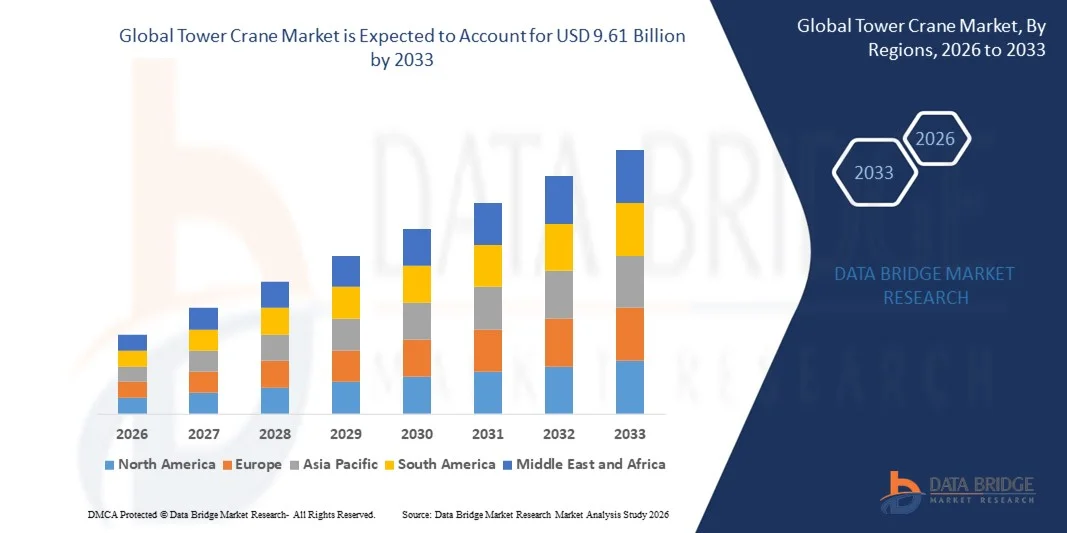
- The global tower crane market size was valued at USD 5.98 billion in 2025 and is expected to reach USD 9.61 billion by 2033, at a CAGR of 6.11% during the forecast period
- The market growth is largely fueled by the increasing demand for high-rise construction, urban infrastructure development, and large-scale industrial projects, driving the adoption of advanced tower cranes with higher lifting capacities, longer jibs, and automated features
- Furthermore, rising contractor and developer preference for efficient, safe, and digitally monitored lifting solutions is establishing modern tower cranes as essential equipment in both commercial and residential construction. These converging factors are accelerating the deployment of advanced crane systems, thereby significantly boosting the industry’s growth
Tower Crane Market Analysis
- Tower cranes, designed for heavy lifting and high-reach operations, are increasingly critical components of modern construction projects due to their ability to handle large loads, operate in confined urban spaces, and integrate with digital construction management systems
- The escalating demand for tower cranes is primarily fueled by rapid urbanization, infrastructure modernization, high-rise residential and commercial construction, and the growing need for operational efficiency, precision, and safety in construction sites
- North America dominated the tower crane market with a share of 40.7% in 2025, due to strong infrastructure development, urbanization, and ongoing construction of commercial and residential high-rise projects
- Asia-Pacific is expected to be the fastest growing region in the tower crane market during the forecast period due to rapid urbanization, government-funded infrastructure projects, and rising construction investments in countries such as China, Japan, and India
- Hammerhead segment dominated the market with a market share of 43.3% in 2025, due to its long-standing reliability in large-scale construction projects and its high load-handling capacity. Hammerhead cranes are preferred for high-rise construction due to their ability to operate in confined urban sites while providing extended horizontal reach
Report Scope and Tower Crane Market Segmentation
|
Attributes |
Tower Crane Key Market Insights |
|
Segments Covered |
|
|
Countries Covered |
North America
Europe
Asia-Pacific
Middle East and Africa
South America
|
|
Key Market Players |
|
|
Market Opportunities |
|
|
Value Added Data Infosets |
In addition to the market insights such as market value, growth rate, market segments, geographical coverage, market players, and market scenario, the market report curated by the Data Bridge Market Research team includes in-depth expert analysis, import/export analysis, pricing analysis, production consumption analysis, and pestle analysis. |
Tower Crane Market Trends
Adoption of Automated, High-Capacity Tower Cranes
- A significant trend in the tower crane market is the increasing adoption of automated, high-capacity cranes that enhance operational efficiency and safety on construction sites. These cranes are being integrated into large-scale infrastructure and urban development projects to handle heavier loads and reduce manual intervention
- For instance, Liebherr and Zoomlion offer automated tower cranes with capacities exceeding 20 tons that are deployed in high-rise and industrial construction projects worldwide. These cranes improve precision in lifting operations and reduce risks associated with human error
- The demand for modular and self-erecting tower cranes is rising as construction companies seek flexible solutions that can be quickly assembled and adapted to various project requirements. This trend supports faster project timelines and operational adaptability in congested urban environments
- Smart crane technologies equipped with sensors, load monitoring systems, and remote control capabilities are gaining traction to enable safer and more efficient construction operations. This is driving the development of connected cranes that can integrate with site management and logistics systems
- The tower crane market is witnessing growth in hybrid cranes that combine electric and hydraulic systems to optimize energy use and reduce emissions. This trend aligns with global construction sustainability initiatives and increasing regulatory focus on environmental standards
- The integration of predictive maintenance and digital monitoring tools is enhancing crane uptime and reducing operational disruptions. This rising incorporation of intelligent systems positions tower cranes as lifting equipment and also as integral elements of modern construction project management
Tower Crane Market Dynamics
Driver
Rising Demand for Efficient and Safe Lifting Solutions
- The increasing scale and complexity of construction projects are driving demand for tower cranes that offer higher load capacities, precision, and safety features. Efficient lifting solutions reduce project delays, lower labor requirements, and improve overall site productivity
- For instance, Manitowoc’s Potain cranes are widely used in large urban and industrial construction projects, providing advanced load monitoring and automation features that ensure safer lifting operations. These cranes help project managers meet tight schedules while adhering to safety regulations
- Urbanization and infrastructure expansion across regions such as Asia-Pacific and the Middle East are fueling investments in tower cranes that can operate efficiently in dense construction environments. High-capacity cranes support vertical construction trends and large-scale industrial projects
- Technological advancements in automation, remote monitoring, and digital integration are making cranes more reliable and easier to manage. These innovations contribute to safer operations and minimize downtime caused by human error or mechanical failure
- Construction companies are increasingly focused on operational efficiency to reduce costs and increase profitability. Tower cranes equipped with advanced control systems and real-time monitoring tools enable optimized lifting schedules and improved resource utilization
Restraint/Challenge
High Investment and Maintenance Costs
- The tower crane market faces challenges due to the substantial capital expenditure required to procure high-capacity and automated cranes. In addition, ongoing maintenance, inspections, and compliance with safety standards contribute to elevated operational costs
- For instance, Liebherr tower cranes require regular service and inspection schedules to maintain optimal performance, which can be expensive for smaller construction firms. These costs can limit the adoption of advanced crane technologies in cost-sensitive projects
- The complexity of assembling, dismantling, and transporting large cranes adds logistical challenges and further increases expenditure. Specialized personnel and equipment are often required to manage these operations efficiently
- Maintenance of automated and sensor-equipped cranes demands skilled technicians and sophisticated diagnostic tools. This dependence on expertise and technology elevates the total cost of ownership and operational planning requirements
- Financial constraints and budget limitations in certain regions slow the replacement of older crane models with newer, more efficient technologies. This challenge continues to influence market adoption rates and impacts the growth trajectory of advanced tower crane solutions
Tower Crane Market Scope
The market is segmented on the basis of product type, design type, lifting capacity, and application.
- By Product Type
On the basis of product type, the tower crane market is segmented into flat top, hammerhead, luffing jib, and self-erecting cranes. The hammerhead segment dominated the market with the largest revenue share of 43.3% in 2025, driven by its long-standing reliability in large-scale construction projects and its high load-handling capacity. Hammerhead cranes are preferred for high-rise construction due to their ability to operate in confined urban sites while providing extended horizontal reach. Their robustness, combined with compatibility with multiple hoisting systems, makes them a favored choice among construction contractors for complex projects. The demand is further strengthened by their ability to integrate with modern construction technologies for precise material handling.
The self-erecting segment is anticipated to witness the fastest growth from 2026 to 2033, fueled by the increasing need for rapid deployment and cost-efficient crane solutions in mid-rise residential and commercial projects. Self-erecting cranes offer easy setup without requiring additional support structures, reducing installation time and labor costs. Their compact footprint and adaptability to urban construction sites make them popular among developers and contractors. In addition, advancements in modular design and electric operation enhance safety, efficiency, and operational flexibility.
- By Design Type
On the basis of design type, the tower crane market is segmented into top slewing cranes and bottom slewing cranes. The top slewing crane segment held the largest revenue share in 2025, driven by its versatility in handling heavy loads at significant heights and its suitability for tight construction sites. Top slewing cranes allow rotation above the base, providing enhanced maneuverability and the ability to work around obstructions, making them ideal for urban and high-rise construction projects. Their widespread adoption is further supported by availability in various lifting capacities and adaptability to different jib configurations, ensuring operational efficiency.
The bottom slewing crane segment is expected to register the fastest growth from 2026 to 2033, propelled by the rising demand for compact and mobile cranes in low- to mid-rise construction and industrial projects. Bottom slewing cranes can be easily relocated within sites, offering flexibility for projects with changing layout requirements. Their lower setup time, reduced foundation requirements, and cost efficiency make them attractive for contractors managing multiple projects simultaneously. Innovations in hydraulic and electric slewing mechanisms further enhance their speed, safety, and operational precision.
- By Lifting Capacity
On the basis of lifting capacity, the tower crane market is segmented into below 5 metric tons, 6 to 80 metric tons, and above 80 metric tons. The 6 to 80 metric tons segment dominated the market in 2025, driven by its balanced suitability for a wide range of construction projects, from mid-rise residential buildings to commercial complexes. Cranes within this capacity range provide optimal lifting performance while maintaining cost-effectiveness and operational efficiency. They are often chosen for their ability to handle medium-weight loads without requiring extensive foundations or complex support systems. Their compatibility with both top and bottom slewing designs further enhances their adoption across diverse projects.
The below 5 metric tons segment is anticipated to witness the fastest growth from 2026 to 2033, fueled by rising urban construction and small-scale infrastructure development projects. Lighter cranes offer ease of transport, quick installation, and reduced operational costs, making them suitable for projects with space constraints. They are increasingly used in residential and industrial projects where mobility, rapid deployment, and safety are critical. Technological improvements, including modular assembly and electric hoisting options, further drive their adoption among developers and contractors seeking flexible lifting solutions.
- By Application
On the basis of application, the tower crane market is segmented into construction, mining, and others. The construction segment dominated the market in 2025, driven by rapid urbanization and growing infrastructure development globally. Tower cranes are essential for high-rise buildings, commercial complexes, and large-scale infrastructure projects due to their vertical reach and lifting precision. Their widespread use in construction projects is supported by advancements in crane automation, safety systems, and digital monitoring tools that improve efficiency and reduce downtime. The construction segment continues to drive overall market growth due to sustained demand for residential, commercial, and industrial developments.
The mining segment is expected to register the fastest growth from 2026 to 2033, fueled by increasing mechanization and automation in mining operations. Tower cranes are used in mining for handling heavy materials, ore transportation, and equipment installation at challenging sites. Their durability, adaptability to rough terrains, and high lifting capacities make them suitable for mining applications. Technological innovations such as remote operation, enhanced load management, and integration with smart systems further boost efficiency and safety in mining projects.
Tower Crane Market Regional Analysis
- North America dominated the tower crane market with the largest revenue share of 40.7% in 2025, driven by strong infrastructure development, urbanization, and ongoing construction of commercial and residential high-rise projects
- Contractors in the region prioritize advanced lifting solutions that provide efficiency, safety, and flexibility, favoring cranes with higher load capacities and long operational lifespans
- The widespread adoption is further supported by high investment in large-scale infrastructure projects, technological advancement in crane automation, and stringent safety standards, establishing tower cranes as essential equipment in the region
U.S. Tower Crane Market Insight
The U.S. tower crane market captured the largest revenue share in 2025 within North America, fueled by the surge in commercial skyscraper developments and large infrastructure projects. Construction companies are increasingly prioritizing cranes that offer precise load handling and remote operation capabilities. The growing adoption of modular and high-capacity cranes, combined with demand for energy-efficient and digitally monitored systems, further drives market expansion. Moreover, integration with construction management software and IoT-enabled safety features is significantly contributing to the growth of tower crane adoption in the U.S.
Europe Tower Crane Market Insight
The Europe tower crane market is projected to expand at a substantial CAGR throughout the forecast period, primarily driven by urban regeneration projects and infrastructure modernization initiatives. For instance, Liebherr’s advanced crane solutions are widely adopted across European construction sites for their reliability and technological sophistication. Rising demand for high-rise residential and commercial buildings is fostering tower crane utilization, while regulatory compliance with safety and environmental standards encourages adoption of cranes with energy-efficient and automated features. The market is witnessing steady growth across both new constructions and renovation projects.
U.K. Tower Crane Market Insight
The U.K. tower crane market is anticipated to grow at a noteworthy CAGR during the forecast period, driven by a steady increase in commercial and residential construction projects and a focus on timely project completion. Concerns regarding labor safety and operational efficiency are encouraging contractors to deploy advanced crane systems with remote monitoring and automation capabilities. The region’s robust construction regulations, strong urbanization trends, and integration of cranes into project management systems are expected to continue stimulating market growth.
Germany Tower Crane Market Insight
The Germany tower crane market is expected to expand at a considerable CAGR during the forecast period, fueled by increasing infrastructure investments and adoption of technologically advanced cranes. Germany’s emphasis on safety, precision engineering, and sustainable construction practices promotes the deployment of tower cranes equipped with digital monitoring and energy-saving features. Integration with construction planning software and preference for high-capacity, modular cranes in commercial and industrial projects further contributes to market growth, aligning with local operational and environmental standards.
Asia-Pacific Tower Crane Market Insight
The Asia-Pacific tower crane market is poised to grow at the fastest CAGR during the forecast period of 2026 to 2033, driven by rapid urbanization, government-funded infrastructure projects, and rising construction investments in countries such as China, Japan, and India. The region’s increasing focus on high-rise residential and commercial developments, supported by digital construction technologies, is driving tower crane adoption. Furthermore, APAC emerging as a manufacturing hub for crane components enhances affordability and availability, enabling wider deployment across construction projects.
Japan Tower Crane Market Insight
The Japan tower crane market is gaining momentum due to extensive urban redevelopment and the country’s adoption of high-tech construction solutions. Japanese construction companies prioritize safety, precision, and energy-efficient operations, which are driving the adoption of automated and IoT-enabled tower cranes. Integration with construction management platforms, along with demand for cranes capable of operating in dense urban areas, is fueling market growth. Moreover, Japan’s aging workforce is encouraging the use of automated systems to reduce manual labor and enhance operational efficiency in both residential and commercial projects.
China Tower Crane Market Insight
The China tower crane market accounted for the largest market revenue share in Asia Pacific in 2025, attributed to the country’s extensive urbanization, large-scale infrastructure development, and high-rise construction boom. China is among the largest markets for tower cranes, with strong domestic manufacturers such as Zoomlion providing advanced and cost-effective solutions. The push toward smart cities, the availability of modular and high-capacity cranes, and government support for infrastructure projects are key factors driving the adoption of tower cranes across residential, commercial, and industrial construction projects.
Tower Crane Market Share
The tower crane industry is primarily led by well-established companies, including:
- COMANSA (Spain)
- FAVELLE FAVCO BERHAD (Malaysia)
- Grúas Sáez, S.L. (Spain)
- JASO Tower Cranes (Spain)
- LIEBHERR (Switzerland)
- Raimondi (Italy)
- Sichuan Construction Machinery (Group) Co., Ltd (China)
- Terex Corporation (U.S.)
- The Manitowoc Company, Inc. (U.S.)
- WOLFFKRAN International AG (Switzerland)
- XCMG Group (China)
- Zoomlion Heavy Industry Science & Technology Co., Ltd (China)
- SANY Heavy Industry Co., Ltd (China)
- Action Construction Equipment Ltd (India)
- ENG CRANES Srl (Italy)
- Fushun Yongmao (China)
Latest Developments in Global Tower Crane Market
- In February 2026, Liebherr enhanced operational efficiency at precast manufacturing facilities by deploying its advanced 1000 EC‑H 40 Litronic and 470 EC‑B 20 tower cranes at a plant in Hungary. These cranes significantly improved material handling throughput, optimized workflow, and reduced project timelines, demonstrating how high-performance cranes are increasingly central to industrial construction operations. The deployment highlights a growing trend toward automating heavy lifting processes, enabling contractors to manage larger volumes of precast materials with greater precision and reliability. This advancement reinforces the importance of technologically advanced tower cranes in improving operational productivity and reducing labor dependency in industrial sites
- In February 2026, Liebherr strengthened its market presence in the Balkans by appointing a strategic partner to cover eight countries. This initiative expands access to advanced crane technologies for local contractors, modernizes regional construction standards, and enhances operational efficiency across multiple construction projects. The move reflects how strategic alliances are shaping regional market penetration and technology adoption, enabling smaller contractors to leverage sophisticated lifting equipment previously limited to larger firms. The initiative also underscores the role of partnerships in facilitating faster deployment of high-performance cranes and supporting infrastructure development in emerging markets
- In December 2025, The Manitowoc Company, Inc. unveiled the new Potain MCT 105 topless tower crane at EXCON 2025, manufactured at its Pune facility. Built on the design principles of the MCT 85, the MCT 105 offers a longer jib and increased lifting capacity, with a maximum load of 5 tons and the ability to lift 1 ton at the tip of its 60-meter jib. The crane enhances operational efficiency in dense urban and high-rise construction projects while reducing transport requirements, as the complete assembly can be delivered in just four truckloads. This development demonstrates Manitowoc’s focus on combining performance, ease of transport, and setup efficiency, catering to growing demand for flexible, high-capacity cranes in fast-paced construction environments
- In December 2025, Liebherr deployed its new 43 K fast-erecting crane for the construction of a modern single-family home with an underground garage at Lake Tegernsee. The crane handled all on-site lifting operations, including basement wall positioning, formwork transport, and roofing work, with precision and minimal operator effort. Featuring advanced assistance systems such as Sway Control Plus, Guided Hook, and Positioning Pilot, the 43 K improved hoisting speeds and safety while operating in confined spaces. This deployment highlights the market shift toward compact, high-performance cranes capable of supporting urban and small-scale construction projects while enhancing operator safety and efficiency
- In November 2025, Liebherr accelerated modernization of its Biberach production site with a multi-million-dollar investment in automation and increased output capabilities. The upgrade allows for faster production of tower cranes, enhanced quality control, and integration of advanced technologies to meet rising global demand. This development emphasizes the market trend of manufacturers scaling production and adopting smart manufacturing practices to support expanding construction industries worldwide. By boosting production efficiency and capacity, the modernization ensures that contractors have faster access to high-quality, technologically advanced tower cranes, strengthening Liebherr’s position in the competitive global market

- Interactive Data Analysis Dashboard
- Company Analysis Dashboard for high growth potential opportunities
- Research Analyst Access for customization & queries
- Competitor Analysis with Interactive dashboard
- Latest News, Updates & Trend analysis
- Harness the Power of Benchmark Analysis for Comprehensive Competitor Tracking
Data collection and base year analysis are done using data collection modules with large sample sizes. The stage includes obtaining market information or related data through various sources and strategies. It includes examining and planning all the data acquired from the past in advance. It likewise envelops the examination of information inconsistencies seen across different information sources. The market data is analysed and estimated using market statistical and coherent models. Also, market share analysis and key trend analysis are the major success factors in the market report. To know more, please request an analyst call or drop down your inquiry.
The key research methodology used by DBMR research team is data triangulation which involves data mining, analysis of the impact of data variables on the market and primary (industry expert) validation. Data models include Vendor Positioning Grid, Market Time Line Analysis, Market Overview and Guide, Company Positioning Grid, Patent Analysis, Pricing Analysis, Company Market Share Analysis, Standards of Measurement, Global versus Regional and Vendor Share Analysis. To know more about the research methodology, drop in an inquiry to speak to our industry experts.
Data Bridge Market Research is a leader in advanced formative research. We take pride in servicing our existing and new customers with data and analysis that match and suits their goal. The report can be customized to include price trend analysis of target brands understanding the market for additional countries (ask for the list of countries), clinical trial results data, literature review, refurbished market and product base analysis. Market analysis of target competitors can be analyzed from technology-based analysis to market portfolio strategies. We can add as many competitors that you require data about in the format and data style you are looking for. Our team of analysts can also provide you data in crude raw excel files pivot tables (Fact book) or can assist you in creating presentations from the data sets available in the report.













