


Global Train Auxiliary Rectifier Market
Market Size in USD Billion
CAGR :
% 
 USD
1.94 Billion
USD
2.97 Billion
2025
2033
USD
1.94 Billion
USD
2.97 Billion
2025
2033
 Forecast Period Forecast Period |
2026 –2033 |
 Market Size (Base Year) Market Size (Base Year) |
USD 1.94 Billion |
 Market Size (Forecast Year) Market Size (Forecast Year) |
USD 2.97 Billion |
 CAGR CAGR |
% |
| Major Markets Players |
|
Train Auxiliary Rectifier Market Size
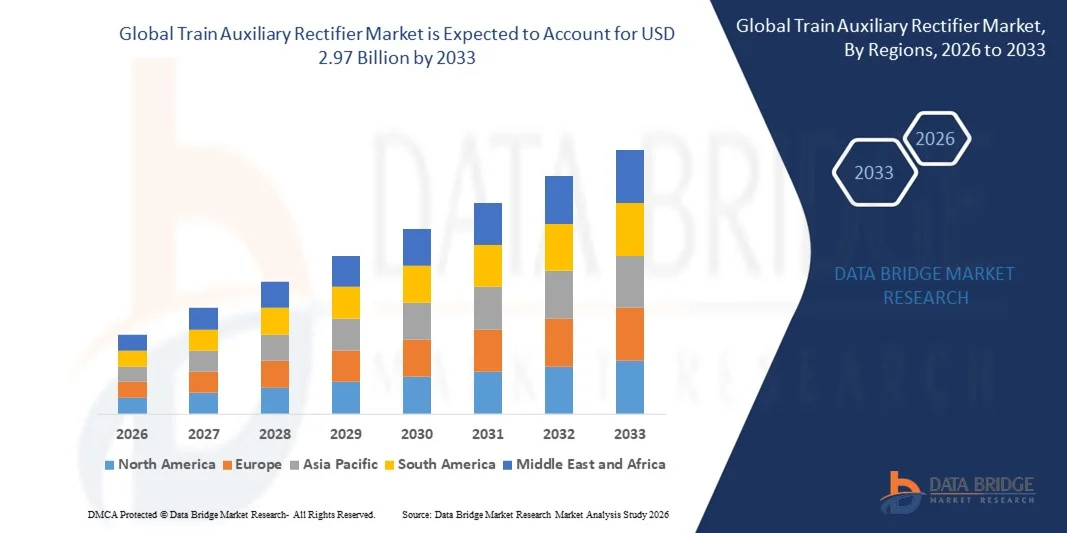
- The global train auxiliary rectifier market size was valued at USD 1.94 billion in 2025 and is expected to reach USD 2.97 billion by 2033, at a CAGR of 5.5% during the forecast period
- The market growth is largely fueled by increasing electrification of rail networks, rising demand for energy-efficient auxiliary power systems, and ongoing modernization of passenger and freight trains, which require reliable rectification solutions for onboard electrical systems
- Furthermore, growing government investments in sustainable and high-speed rail infrastructure, coupled with rising adoption of regenerative braking and digital train management systems, are establishing advanced auxiliary rectifiers as essential components for modern rail operations. These converging factors are accelerating the deployment of train auxiliary rectifier solutions, thereby significantly boosting the industry’s growth
Train Auxiliary Rectifier Market Analysis
- Train auxiliary rectifiers, which convert and regulate electrical power for onboard systems such as lighting, HVAC, and control electronics, are increasingly vital components of modern trains due to their role in ensuring operational efficiency, reliability, and energy optimization across passenger and freight rail applications
- The escalating demand for train auxiliary rectifiers is primarily fueled by expanding electrified rail networks, rising focus on energy efficiency, growing replacement and retrofit activities in aging fleets, and the need for reliable, low-maintenance power conversion solutions that support both conventional and high-speed trains
- North America dominated the train auxiliary rectifier market in 2025, due to increasing investments in railway electrification and modernization of locomotive fleets
- Asia-Pacific is expected to be the fastest growing region in the train auxiliary rectifier market during the forecast period due to rapid rail network expansion, increasing electrification of trains, and rising demand for energy-efficient auxiliary power systems in countries such as China, India, and Japan
- Three phase segment dominated the market with a market share of 62.5% in 2025, due to its capability to efficiently manage higher power loads and provide stable AC to DC conversion for auxiliary systems in long-distance and high-speed trains. Rail operators often rely on three-phase rectifiers for critical functions such as traction auxiliaries, lighting, and onboard HVAC systems to ensure operational reliability and minimize downtime
Report Scope and Train Auxiliary Rectifier Market Segmentation
|
Attributes |
Train Auxiliary Rectifier Key Market Insights |
|
Segments Covered |
|
|
Countries Covered |
North America
Europe
Asia-Pacific
Middle East and Africa
South America
|
|
Key Market Players |
|
|
Market Opportunities |
|
|
Value Added Data Infosets |
In addition to the market insights such as market value, growth rate, market segments, geographical coverage, market players, and market scenario, the market report curated by the Data Bridge Market Research team includes in-depth expert analysis, import/export analysis, pricing analysis, production consumption analysis, and pestle analysis. |
Train Auxiliary Rectifier Market Trends
Growing Adoption of Energy-Efficient Auxiliary Power Systems
- A significant trend in the train auxiliary rectifier market is the increasing adoption of energy-efficient auxiliary power systems, driven by the rising need to reduce operational energy consumption and improve reliability in rail transport. These systems are becoming critical for modern trains to ensure stable power supply for auxiliary functions such as lighting, HVAC, and onboard electronics
- For instance, Siemens Mobility provides energy-efficient auxiliary rectifiers that are integrated into electric and hybrid locomotives, helping operators reduce energy losses and enhance overall system efficiency. Such solutions support rail companies in meeting sustainability goals while maintaining consistent power availability for passenger and freight services
- Rail operators are increasingly deploying auxiliary rectifiers with improved thermal management and voltage regulation, which enhance performance under variable load conditions. This is positioning advanced rectifiers as essential components for ensuring uninterrupted train operations and reducing maintenance-related downtime
- The integration of auxiliary rectifiers in modern electric multiple units (EMUs) is rising, with components supporting regenerative braking systems and power redistribution. These applications contribute to lowering total energy consumption and optimizing onboard electrical management
- Industrial focus on retrofitting existing locomotives with energy-efficient rectifiers is expanding, where upgrades replace legacy systems to improve energy usage and reduce carbon footprint. This trend is shaping stronger demand for compact, high-performance rectifiers capable of handling diverse voltage and current requirements
- The market is witnessing growth driven by demand for reliable power solutions in high-speed rail networks, where auxiliary rectifiers play a key role in supporting sensitive electronic systems and passenger amenities. This rising incorporation is reinforcing the importance of auxiliary power systems in modern, energy-conscious rail infrastructure
Train Auxiliary Rectifier Market Dynamics
Driver
Expansion and Electrification of Rail Networks
- The expansion and electrification of rail networks globally are driving demand for auxiliary rectifiers that support increasing numbers of electric locomotives and EMUs. As rail operators modernize fleets and infrastructure, the need for reliable, high-efficiency power conversion for auxiliary systems is becoming more critical
- For instance, Alstom supplies auxiliary rectifiers for its Coradia and Prima electric trains deployed across Europe, enabling stable onboard power management and integration with regenerative braking systems. These deployments enhance operational efficiency and ensure smooth performance across electrified routes
- Government initiatives supporting electrified rail corridors, such as the Indian Railways’ Mission Electrification program, are boosting demand for auxiliary rectifiers in both passenger and freight segments. Electrification reduces dependence on diesel, creating a requirement for high-capacity rectifiers to manage auxiliary loads efficiently
- The increasing adoption of hybrid and battery-assisted locomotives is creating new opportunities for auxiliary rectifier integration, where systems must handle both grid and battery inputs for continuous power availability. This dual-source capability positions rectifiers as crucial components for flexible energy management
- Growing global investments in high-speed rail projects continue to support the demand for advanced auxiliary rectifiers capable of operating under high voltage and variable power conditions. The need for efficient, resilient power systems is cementing rectifiers as a vital component in electrified rail infrastructure
Restraint/Challenge
High Manufacturing and Integration Costs
- The train auxiliary rectifier market faces challenges due to high manufacturing and integration costs associated with producing reliable, high-efficiency power electronics capable of operating under demanding rail conditions. Advanced thermal management, ruggedized designs, and compliance with rail standards increase production complexity and expense
- For instance, ABB manufactures auxiliary rectifiers for electric locomotives with precision-engineered components and specialized enclosures to withstand vibration and temperature extremes. These factors elevate cost structures and create barriers for smaller rail operators seeking affordable solutions
- Integrating auxiliary rectifiers into existing train systems requires careful design and compatibility testing to avoid disruptions in onboard power distribution. This increases engineering effort and implementation timelines, adding to overall project costs
- The need for high-reliability components that can function in extreme environmental conditions, including temperature swings and electromagnetic interference, further contributes to elevated production costs. Manufacturers must balance durability, performance, and cost efficiency
- Limited standardization in auxiliary rectifier specifications across different rail operators and rolling stock models introduces additional design and customization expenses. These challenges collectively constrain adoption rates and necessitate strategic investment planning by rail companies
Train Auxiliary Rectifier Market Scope
The market is segmented on the basis of product type, circuit, and sales channel.
- By Product Type
On the basis of product type, the Train Auxiliary Rectifier market is segmented into less than 500 KVA, 500–2000 KVA, and more than 2000 KVA. The 500–2000 KVA segment dominated the market with the largest revenue share in 2025, driven by its optimal balance of power output and efficiency suitable for a wide range of locomotive and EMU (Electric Multiple Unit) applications. Railway operators often prioritize this segment due to its proven reliability, ease of integration into existing auxiliary power systems, and cost-effectiveness for mid-sized trains. The market also sees strong demand for 500–2000 KVA rectifiers due to their compatibility with both conventional and modern train fleets, ensuring uninterrupted power supply for auxiliary systems such as lighting, HVAC, and control circuits.
The less than 500 KVA segment is anticipated to witness the fastest growth rate from 2026 to 2033, fueled by rising electrification of light rail, metro, and regional train networks. For instance, companies such as Siemens Mobility have adopted compact auxiliary rectifiers under 500 KVA to support lightweight EMUs and suburban trains where space and weight constraints are critical. Their smaller size, energy efficiency, and ease of maintenance make them highly suitable for new train models and fleet modernization projects. Increasing focus on energy savings and the deployment of auxiliary systems in urban transit solutions further drives growth in this segment.
- By Circuit
On the basis of circuit, the Train Auxiliary Rectifier market is segmented into single-phase and three-phase. The three-phase segment held the largest market revenue share of 62.5% in 2025, attributed to its capability to efficiently manage higher power loads and provide stable AC to DC conversion for auxiliary systems in long-distance and high-speed trains. Rail operators often rely on three-phase rectifiers for critical functions such as traction auxiliaries, lighting, and onboard HVAC systems to ensure operational reliability and minimize downtime. The segment’s robust design, reduced harmonic distortion, and higher load capacity have established it as the preferred choice for most modern railway networks.
The single-phase segment is expected to witness the fastest CAGR from 2026 to 2033, driven by its suitability for light rail, metro, and regional trains where power requirements are moderate. For instance, Alstom has implemented single-phase auxiliary rectifiers in urban transit trains to optimize energy efficiency and reduce installation complexity. Single-phase rectifiers provide simpler wiring, easier maintenance, and lower upfront costs, making them attractive for expanding urban rail networks and retrofitting older fleets with modern auxiliary systems.
- By Sales Channel
On the basis of sales channel, the Train Auxiliary Rectifier market is segmented into Original Equipment Manufacturer (OEM) and aftermarket. The OEM segment dominated the market in 2025 due to strong collaborations between rail operators and equipment manufacturers for fully integrated train solutions. OEM-supplied rectifiers are often designed specifically for the train model, ensuring high compatibility, reliability, and adherence to industry standards, which encourages railway companies to procure directly from manufacturers. The segment also benefits from long-term service contracts, extended warranties, and coordinated upgrades, making OEM products a preferred choice for large-scale train deployments.
The aftermarket segment is anticipated to witness the fastest growth rate from 2026 to 2033, driven by the increasing need for retrofitting, modernization, and replacement of aging auxiliary systems in existing trains. For instance, Bombardier Transportation has actively supplied aftermarket rectifiers to upgrade older fleets, enhancing efficiency and reliability without replacing the entire train system. The growth of the aftermarket segment is supported by rising fleet expansions, focus on reducing operational downtime, and cost-effective solutions for maintenance and repair projects across global railway networks.
Train Auxiliary Rectifier Market Regional Analysis
- North America dominated the train auxiliary rectifier market with the largest revenue share in 2025, driven by increasing investments in railway electrification and modernization of locomotive fleets
- Rail operators in the region highly value the reliability, efficiency, and advanced monitoring features offered by modern auxiliary rectifiers, ensuring uninterrupted power supply to train auxiliary systems such as lighting, HVAC, and control circuits
- This widespread adoption is further supported by well-established railway infrastructure, government funding for rail upgrades, and the presence of leading manufacturers, establishing North America as a key market for both new train projects and retrofitting initiatives
U.S. Train Auxiliary Rectifier Market Insight
The U.S. train auxiliary rectifier market captured the largest revenue share in 2025 within North America, driven by the rapid expansion of electrified commuter and high-speed rail networks. The focus on energy-efficient, reliable power conversion and the integration of rectifiers with modern train management systems is enhancing operational efficiency. Moreover, federal initiatives to modernize rail infrastructure and the growing adoption of regenerative braking systems further boost market growth.
Europe Train Auxiliary Rectifier Market Insight
The Europe train auxiliary rectifier market is projected to expand at a significant CAGR during the forecast period, primarily fueled by modernization of legacy rail networks and stringent efficiency standards. Increasing electrification of regional and intercity railways, coupled with investments in green transportation, is supporting market adoption. European operators also value reduced maintenance requirements and enhanced system performance, contributing to sustained market expansion.
U.K. Train Auxiliary Rectifier Market Insight
The U.K. train auxiliary rectifier market is expected to grow steadily, driven by government plans for rail electrification and upgrading suburban and intercity trains with modern power electronics. Rising demand for energy-efficient, low-maintenance rectifiers, alongside digital integration for train control systems, is fueling market growth. The expansion of electrified rail corridors and strong domestic rail operators further supports adoption across the region.
Germany Train Auxiliary Rectifier Market Insight
The Germany train auxiliary rectifier market is anticipated to expand at a robust CAGR due to the country’s emphasis on advanced rail infrastructure and energy-efficient operations. Germany’s focus on sustainability and electrification, along with technological advancements in traction and auxiliary systems, is accelerating market uptake. Integration of rectifiers with modern train management and predictive maintenance systems is also a key growth factor.
Asia-Pacific Train Auxiliary Rectifier Market Insight
The Asia-Pacific train auxiliary rectifier market is poised to grow at the fastest CAGR during 2026–2033, driven by rapid rail network expansion, increasing electrification of trains, and rising demand for energy-efficient auxiliary power systems in countries such as China, India, and Japan. Government initiatives supporting high-speed and urban rail electrification, combined with strong domestic manufacturing capabilities, are enhancing affordability and accessibility, propelling market growth across the region.
Japan Train Auxiliary Rectifier Market Insight
The Japan train auxiliary rectifier market is gaining traction due to advanced high-speed rail networks, stringent safety standards, and a focus on energy-efficient operations. Japan’s emphasis on minimizing energy losses and ensuring operational reliability is driving adoption in both commuter and long-distance rail services. Integration with IoT-based monitoring and predictive maintenance systems is further strengthening market prospects.
China Train Auxiliary Rectifier Market Insight
The China train auxiliary rectifier market held the largest share in Asia-Pacific in 2025, supported by extensive high-speed rail expansion and modernization of urban metro systems. Strong government support for electrification, the push towards green and energy-efficient rail solutions, and a large manufacturing base for rectifier components are key factors driving market growth. The growing adoption of advanced rectifiers in both passenger and freight trains ensures China remains a dominant market in the region.
Train Auxiliary Rectifier Market Share
The train auxiliary rectifier industry is primarily led by well-established companies, including:
- ABB Ltd. (Switzerland)
- Siemens AG (Germany)
- MEIDENSHA CORPORATION (Japan)
- MEDCOM Sp. z o.o. (Poland)
- Fuji Electric Co. Ltd. (Japan)
- Henan (China)
- ZHEJIANG LONGXIANG ELECTRIC CO. LTD (China)
- SHINDENGEN ELECTRIC MANUFACTURING CO. LTD. (Japan)
- The Railway Technical (U.K.)
- General Electric Company (U.S.)
- Mitsubishi Electric Corporation (Japan)
- Schneider Electric SE (France)
- Alstom SA (France)
- Toshiba Corporation (Japan)
Latest Developments in Global Train Auxiliary Rectifier Market
- In July 2025, Hitachi Ltd launched a modular rectifier platform designed for rail applications, offering higher operational efficiency, easier maintenance, and enhanced flexibility in power management. This development enables rail operators to reduce downtime and operational costs while improving energy utilization. The launch strengthens market competitiveness by providing scalable solutions adaptable to different train types and service conditions, driving modernization across passenger and freight networks
- In June 2025, Siemens AG entered into a strategic partnership with Stadler Rail AG to co‑develop next-generation on-board rectifier and auxiliary power systems for regional trains. This collaboration enhances the capability of rail operators to deploy integrated, energy-efficient power systems and supports faster modernization of regional fleets. It is expected to stimulate broader market growth by promoting adoption of advanced rectifiers that reduce maintenance requirements and improve overall train performance
- In March 2025, ABB secured a major contract to supply traction power rectifier systems for a new metro line, strengthening its position in North American and global rail electrification markets. This development is expected to accelerate the adoption of advanced auxiliary rectifiers in urban transit networks by demonstrating reliability, high efficiency, and scalability. It also intensifies competition among key players, encouraging rail operators to invest in modern, energy-efficient solutions
- In 2024, Medcom secured a retrofit contract in Romania to replace over 200 aging rectifier units in commuter trains with air-cooled, IGBT-based modules. This retrofit highlights growing investment in upgrading older fleets with modern auxiliary rectification technology. It demonstrates rising aftermarket demand for energy-efficient and low-maintenance rectifiers, creating opportunities for suppliers to expand their presence in regions focusing on fleet modernization and electrification upgrades
- In 2023, CRRC began testing gallium nitride (GaN)-based rectifiers in select high-speed trains in China, marking a significant step toward next-generation semiconductor technology in rail auxiliary systems. This testing emphasizes improvements in power density, efficiency, and thermal management, which can lead to lighter, more compact rectifiers. Adoption of GaN technology is expected to influence long-term market trends by enabling high-speed and high-capacity trains to operate more efficiently, boosting overall electrification efforts and reducing energy consumption
SKU-
Get online access to the report on the World's First Market Intelligence Cloud

- Interactive Data Analysis Dashboard
- Company Analysis Dashboard for high growth potential opportunities
- Research Analyst Access for customization & queries
- Competitor Analysis with Interactive dashboard
- Latest News, Updates & Trend analysis
- Harness the Power of Benchmark Analysis for Comprehensive Competitor Tracking
Research Methodology
Data collection and base year analysis are done using data collection modules with large sample sizes. The stage includes obtaining market information or related data through various sources and strategies. It includes examining and planning all the data acquired from the past in advance. It likewise envelops the examination of information inconsistencies seen across different information sources. The market data is analysed and estimated using market statistical and coherent models. Also, market share analysis and key trend analysis are the major success factors in the market report. To know more, please request an analyst call or drop down your inquiry.
The key research methodology used by DBMR research team is data triangulation which involves data mining, analysis of the impact of data variables on the market and primary (industry expert) validation. Data models include Vendor Positioning Grid, Market Time Line Analysis, Market Overview and Guide, Company Positioning Grid, Patent Analysis, Pricing Analysis, Company Market Share Analysis, Standards of Measurement, Global versus Regional and Vendor Share Analysis. To know more about the research methodology, drop in an inquiry to speak to our industry experts.
Customization Available
Data Bridge Market Research is a leader in advanced formative research. We take pride in servicing our existing and new customers with data and analysis that match and suits their goal. The report can be customized to include price trend analysis of target brands understanding the market for additional countries (ask for the list of countries), clinical trial results data, literature review, refurbished market and product base analysis. Market analysis of target competitors can be analyzed from technology-based analysis to market portfolio strategies. We can add as many competitors that you require data about in the format and data style you are looking for. Our team of analysts can also provide you data in crude raw excel files pivot tables (Fact book) or can assist you in creating presentations from the data sets available in the report.












