Global Transcritical Co2 Systems Market
Market Size in USD Billion
CAGR :
% 
 USD
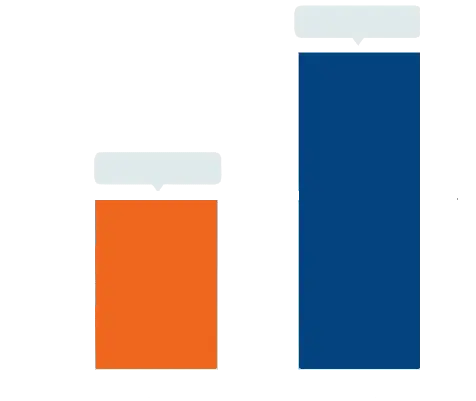
41.30 Billion
USD
149.03 Billion
2025
2033
USD
41.30 Billion
USD
149.03 Billion
2025
2033
 Forecast Period Forecast Period |
2026 –2033 |
 Market Size (Base Year) Market Size (Base Year) |
USD 41.30 Billion |
 Market Size (Forecast Year) Market Size (Forecast Year) |
USD 149.03 Billion |
 CAGR CAGR |
% |
| Major Markets Players |
|
Transcritical CO2 Systems Market Size
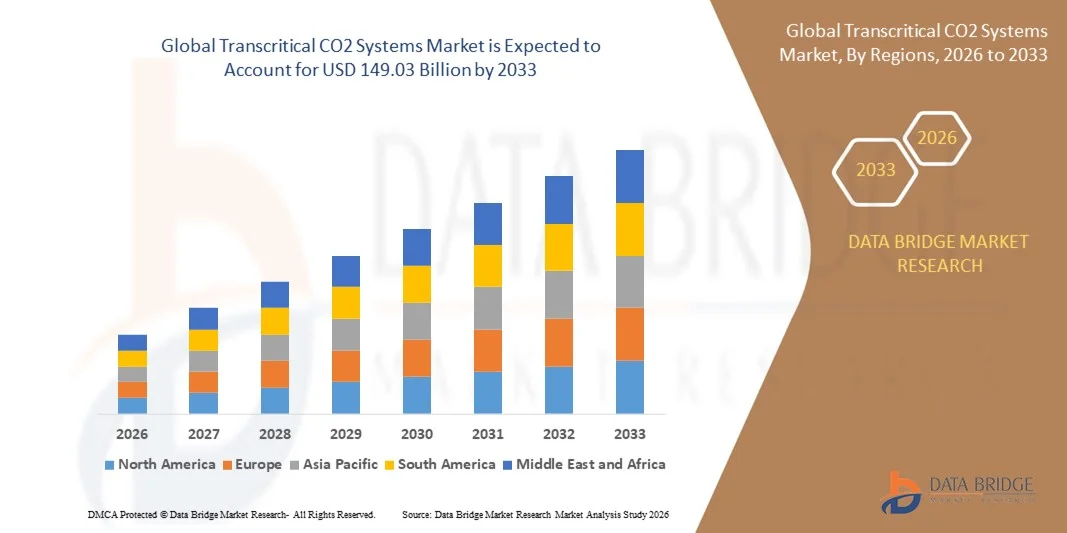
- The global transcritical CO2 systems market size was valued at USD 41.3 billion in 2025 and is expected to reach USD 149.03 billion by 2033, at a CAGR of 17.4% during the forecast period
- The market growth is largely fueled by the increasing shift toward natural refrigerants and the global push to reduce greenhouse gas emissions, which is accelerating the adoption of transcritical CO₂ systems across commercial and industrial refrigeration applications
- Furthermore, stringent environmental regulations, rising energy efficiency requirements, and growing investments in sustainable cooling and heating infrastructure are positioning transcritical CO₂ systems as a preferred alternative to conventional HFC-based technologies, thereby significantly boosting overall market growth
Transcritical CO2 Systems Market Analysis
- Transcritical CO₂ systems, which utilize carbon dioxide as a natural refrigerant for refrigeration, heating, and air conditioning, are becoming critical components of sustainable cooling and heating infrastructure in supermarkets, cold storage facilities, and industrial applications due to their low global warming potential and high energy efficiency
- The growing demand for these systems is primarily driven by tightening refrigerant regulations, increasing focus on decarbonization, and continuous technological advancements that improve system performance across diverse climate conditions, supporting widespread adoption in both developed and emerging markets
- Europe dominated the transcritical CO2 systems market with a share of 77.7% in 2025, due to stringent environmental regulations, early adoption of natural refrigerants, and strong commitments toward carbon emission reduction
- Asia-Pacific is expected to be the fastest growing region in the transcritical CO2 systems market during the forecast period due to rapid urbanization, expansion of modern retail formats, and growing cold chain infrastructure
- Refrigeration segment dominated the market with a market share of 90.7% in 2025, due to the widespread adoption of CO₂-based systems in commercial and industrial refrigeration applications. Supermarkets, cold storage operators, and food retailers increasingly prefer transcritical CO₂ refrigeration due to its high energy efficiency, low global warming potential, and compliance with stringent environmental regulations. The ability of these systems to deliver reliable cooling performance across varying ambient conditions further strengthens their dominance. In addition, continuous advancements in system design, compressors, and controls have improved operational stability and lifecycle cost benefits. Strong regulatory pressure to phase out synthetic refrigerants has also accelerated replacement demand for CO₂ refrigeration solutions
Report Scope and Transcritical CO2 Systems Market Segmentation
|
Attributes |
Transcritical CO2 Systems Key Market Insights |
|
Segments Covered |
|
|
Countries Covered |
North America
Europe
Asia-Pacific
Middle East and Africa
South America
|
|
Key Market Players |
|
|
Market Opportunities |
|
|
Value Added Data Infosets |
In addition to the insights on market scenarios such as market value, growth rate, segmentation, geographical coverage, and major players, the market reports curated by the Data Bridge Market Research also include import export analysis, production capacity overview, production consumption analysis, price trend analysis, climate change scenario, supply chain analysis, value chain analysis, raw material/consumables overview, vendor selection criteria, PESTLE Analysis, Porter Analysis, and regulatory framework. |
Transcritical CO2 Systems Market Trends
Adoption of Natural Refrigerants and Heat Recovery Integration
- A major trend in the transcritical CO₂ systems market is the accelerating adoption of natural refrigerants combined with integrated heat recovery solutions, driven by global efforts to reduce carbon emissions and eliminate high-GWP refrigerants from refrigeration and heating systems. Transcritical CO₂ technology enables simultaneous cooling and heat recovery, allowing end users to improve overall energy utilization across commercial and industrial facilities
- For instance, Danfoss has actively promoted integrated heat recovery solutions within transcritical CO₂ supermarket systems, enabling retailers to reuse waste heat for space heating and hot water applications. This approach significantly improves system efficiency while helping operators comply with environmental regulations
- Food retail chains are increasingly deploying transcritical CO₂ systems with heat reclaim features to reduce total energy consumption and operating costs. This trend is particularly evident in large supermarket installations where continuous refrigeration loads generate substantial recoverable heat
- Manufacturers such as Carrier Commercial Refrigeration and Hussmann are integrating advanced controls and heat recovery modules into CO₂ systems to optimize performance across varying ambient conditions. These developments enhance system reliability and broaden applicability across diverse climates
- The growing emphasis on sustainable building design and energy-efficient infrastructure is reinforcing the integration of heat recovery in CO₂ systems. This trend aligns with corporate sustainability goals and regulatory requirements targeting reduced lifecycle emissions
- As natural refrigerant adoption expands, transcritical CO₂ systems with heat recovery are becoming central to modern refrigeration and heating strategies. This transition is strengthening the market’s role in enabling low-carbon, high-efficiency thermal management solutions
Transcritical CO2 Systems Market Dynamics
Driver
Stringent Environmental Regulations and Phase-Out of High-GWP Refrigerants
- The primary driver of the transcritical CO₂ systems market is the implementation of stringent environmental regulations aimed at phasing out high-GWP refrigerants and promoting climate-friendly alternatives. Regulatory frameworks across Europe and other regions are compelling end users to transition toward natural refrigerants such as CO₂
- For instance, the European Union’s F-Gas Regulation has directly accelerated adoption of transcritical CO₂ systems by restricting the use of HFC refrigerants in commercial refrigeration. This has driven widespread replacement of conventional systems in supermarkets and cold storage facilities
- Retailers and food processing companies are increasingly adopting CO₂ systems to ensure long-term regulatory compliance and avoid future refrigerant phase-down risks. This regulatory certainty is encouraging higher investment in transcritical CO₂ infrastructure
- Government-backed sustainability targets and climate action plans are further reinforcing demand for low-emission refrigeration and heating technologies. These policies are positioning transcritical CO₂ systems as a preferred solution for compliance-driven upgrades
- The continued tightening of refrigerant regulations is expected to sustain strong demand for transcritical CO₂ systems. This driver is fundamentally reshaping refrigeration and heating markets toward long-term environmentally responsible technologies
Restraint/Challenge
High Initial Installation Costs and System Complexity
- A key challenge facing the transcritical CO₂ systems market is the high initial installation cost and technical complexity associated with system design and deployment. These systems require specialized components, advanced controls, and skilled installation expertise, which can deter adoption among cost-sensitive users
- For instance, early-stage transcritical CO₂ installations reported by supermarket operators highlighted higher upfront capital expenditure compared to traditional HFC systems, particularly due to specialized compressors, piping, and control systems supplied by companies such as GEA Group and Carel Industries
- The need for trained technicians and experienced system integrators increases installation timelines and labor costs. Limited availability of skilled personnel in certain regions further adds to deployment challenges
- System complexity related to high operating pressures and performance optimization in warm climates also requires advanced engineering solutions. This increases dependence on sophisticated components and monitoring technologies
- While technological advancements are gradually reducing cost and complexity, this challenge continues to influence purchasing decisions. Addressing installation barriers remains critical for expanding transcritical CO₂ system adoption across a wider range of end users
Transcritical CO2 Systems Market Scope
The market is segmented on the basis of function and application.
- By Function
On the basis of function, the transcritical CO₂ systems market is segmented into refrigeration, heating, and air conditioning. The refrigeration segment dominated the market with the largest revenue share of 90.7% in 2025, driven by the widespread adoption of CO₂-based systems in commercial and industrial refrigeration applications. Supermarkets, cold storage operators, and food retailers increasingly prefer transcritical CO₂ refrigeration due to its high energy efficiency, low global warming potential, and compliance with stringent environmental regulations. The ability of these systems to deliver reliable cooling performance across varying ambient conditions further strengthens their dominance. In addition, continuous advancements in system design, compressors, and controls have improved operational stability and lifecycle cost benefits. Strong regulatory pressure to phase out synthetic refrigerants has also accelerated replacement demand for CO₂ refrigeration solutions.
The heating segment is anticipated to witness the fastest growth from 2026 to 2033, supported by rising adoption of CO₂-based heat pumps for space heating and water heating applications. Transcritical CO₂ heating systems offer superior efficiency in high-temperature heat generation, making them suitable for residential, commercial, and district heating projects. Growing focus on decarbonizing heating infrastructure and reducing dependence on fossil fuels is accelerating investments in CO₂ heat pump technologies. These systems also benefit from stable performance in cold climates, which enhances their appeal in northern regions. Government incentives promoting energy-efficient heating solutions further support rapid growth. Increasing awareness of long-term operational savings continues to drive adoption across new installations and retrofits.
- By Application
On the basis of application, the transcritical CO₂ systems market is segmented into supermarkets and convenience stores, heat pumps, food processing and storage facilities, ice skating rinks, and others. Supermarkets and convenience stores dominated the market in 2025, owing to early adoption of transcritical CO₂ refrigeration systems to meet environmental compliance and sustainability targets. Large retail chains increasingly deploy these systems to replace HFC-based refrigeration, benefiting from reduced carbon footprint and improved energy performance. The high cooling demand and continuous operation of supermarkets make efficiency gains economically significant. Standardization of CO₂ system designs has also reduced installation complexity and maintenance concerns. Strong corporate sustainability commitments further reinforce this segment’s leadership. The availability of proven reference installations supports continued dominance.
The heat pumps application segment is expected to register the fastest growth rate from 2026 to 2033, driven by expanding use of transcritical CO₂ systems in residential and commercial heating applications. CO₂ heat pumps are gaining traction due to their ability to deliver high-temperature output with lower energy consumption compared to conventional systems. Rising electrification of heating and increasing renewable energy integration enhance their attractiveness. Urban infrastructure projects and district heating networks are increasingly incorporating CO₂-based heat pump solutions. Supportive regulatory frameworks aimed at reducing building emissions further accelerate adoption. Technological improvements and declining system costs are expected to sustain strong growth momentum over the forecast period.
Transcritical CO2 Systems Market Regional Analysis
- Europe dominated the transcritical CO2 systems market with the largest revenue share of 77.7% in 2025, driven by stringent environmental regulations, early adoption of natural refrigerants, and strong commitments toward carbon emission reduction
- Regulatory frameworks such as F-Gas regulations and climate policies across the region strongly favor CO₂-based refrigeration and heating systems, accelerating large-scale replacement of conventional refrigerants
- This dominance is further supported by high adoption across supermarkets, cold chains, and industrial refrigeration, along with continuous investments in energy-efficient and sustainable cooling and heating infrastructure
Germany Transcritical CO₂ Systems Market Insight
The Germany transcritical CO₂ systems market is expected to expand at a considerable CAGR during the forecast period, driven by the country’s focus on energy efficiency, industrial decarbonization, and advanced refrigeration technologies. Germany’s strong food processing and cold storage sectors actively deploy CO₂ systems to meet sustainability targets. High awareness of lifecycle cost benefits and strong government support for natural refrigerants further support adoption. Continuous innovation in system optimization and heat recovery solutions is also boosting market growth.
France Transcritical CO₂ Systems Market Insight
The France transcritical CO₂ systems market is projected to grow steadily, supported by rising investments in sustainable retail refrigeration and heating applications. National policies encouraging low-global-warming-potential refrigerants are accelerating adoption across supermarkets and commercial buildings. The increasing use of CO₂ heat pumps for space and water heating is also gaining traction. Strong emphasis on energy transition and green infrastructure development continues to drive market expansion.
Asia-Pacific Transcritical CO₂ Systems Market Insight
The Asia-Pacific transcritical CO₂ systems market is expected to register the fastest CAGR during the forecast period of 2026 to 2033, driven by rapid urbanization, expansion of modern retail formats, and growing cold chain infrastructure. Increasing awareness of environmental regulations and energy efficiency is encouraging adoption across emerging economies. Government initiatives promoting sustainable refrigeration and heating solutions further support market growth. Rising investments in food processing and storage facilities also contribute to strong demand.
Japan Transcritical CO₂ Systems Market Insight
The Japan transcritical CO₂ systems market is witnessing notable growth due to strong emphasis on energy efficiency, advanced technology adoption, and climate commitments. Japan has been an early adopter of CO₂ refrigeration systems, particularly in supermarkets and convenience stores. The integration of heat recovery and space heating applications enhances system efficiency and appeal. Continuous innovation and favorable regulatory support continue to drive market expansion.
China Transcritical CO₂ Systems Market Insight
The China transcritical CO₂ systems market is gaining momentum, supported by rapid expansion of cold chain logistics, large-scale food retail growth, and increasing regulatory focus on emission reduction. Adoption is rising across supermarkets, food processing facilities, and industrial refrigeration applications. Growing investments in sustainable infrastructure and domestic manufacturing capabilities are improving system affordability. Strong government push toward green technologies further accelerates market development across the country.
Transcritical CO2 Systems Market Share
The transcritical CO2 systems industry is primarily led by well-established companies, including:
- Carrier Commercial Refrigeration (U.S.)
- SCM Frigo S.p.A (Italy)
- Emerson Electric Co. (U.S.)
- Danfoss A/S (Denmark)
- Dorin S.p.A (Italy)
- Baltimore Aircoil Company (U.S.)
- Bitzer SE (Germany)
- LMP Systems (U.S.)
- MAYEKAWA MFG. CO., LTD. (Japan)
- Henry Group Industries (U.S.)
- Panasonic Corporation (Japan)
- Carel Industries S.p.A (Italy)
- Parker Hannifin Corp. (U.S.)
- GEA Group Aktiengesellschaft (Germany)
- Hussmann Corporation (U.S.)
- Kysor Warren Corp. (U.S.)
- LU-VE S.p.A (Italy)
- ALFA LAVAL (Sweden)
- Ritchie Engineering Co., Inc. (U.S.)
- Thermal Transfer Technology Limited (U.K.)
Latest Developments in Global Transcritical CO2 Systems Market
- In May 2025, Panasonic Corporation’s subsidiary Hussmann Australia reinforced its competitiveness in the transcritical CO₂ systems market by launching a 20 HP transcritical CO₂ condensing unit designed for supermarkets and light industrial cooling. This development enhances energy efficiency and system compactness, enabling retailers to optimize floor space while meeting increasingly strict refrigerant and emission regulations. The product supports the shift away from HFC-based systems and strengthens Panasonic’s presence in sustainable refrigeration across the Australian market
- In May 2025, Panasonic Corporation’s subsidiary Hussman accelerated market expansion by entering an exclusive agreement with Refra to supply transcritical CO₂ racks, chillers, and R290 heat-pump systems in Australia. This partnership improves regional access to advanced natural refrigerant solutions and supports faster deployment across food retail and industrial refrigeration. The agreement also signals growing confidence in CO₂ and hydrocarbon technologies as long-term alternatives to conventional systems
- In March 2024, Danfoss advanced the transcritical CO₂ systems market by introducing enhanced system components with improved controls, heat recovery integration, and optimized energy management. These upgrades improve performance stability and reduce operating costs, particularly in high-load supermarket and industrial applications. The innovation supports broader adoption of CO₂ systems by addressing efficiency concerns in varying climate conditions
- In September 2023, Bitzer expanded its transcritical CO₂ compressor portfolio to support higher capacities and improved performance in warm and hot climates. This development addresses a key limitation of earlier CO₂ systems and increases their suitability across diverse geographic regions. Enhanced compressor efficiency and reliability help lower lifecycle costs and encourage adoption in both emerging and established markets
- In March 2023, Emerson strengthened the transcritical CO₂ systems market through the launch of its Copeland semi-hermetic reciprocating compressor with the largest displacement in its range. The 303 kBTU/hour capacity improves system design flexibility and reduces the number of compressors required in CO₂ booster systems. This leads to simplified rack designs, lower installation complexity, and improved overall system efficiency for medium-temperature refrigeration applications
SKU-
Get online access to the report on the World's First Market Intelligence Cloud

- Interactive Data Analysis Dashboard
- Company Analysis Dashboard for high growth potential opportunities
- Research Analyst Access for customization & queries
- Competitor Analysis with Interactive dashboard
- Latest News, Updates & Trend analysis
- Harness the Power of Benchmark Analysis for Comprehensive Competitor Tracking
Global Transcritical Co2 Systems Market, Supply Chain Analysis and Ecosystem Framework
To support market growth and help clients navigate the impact of geopolitical shifts, DBMR has integrated in-depth supply chain analysis into its Global Transcritical Co2 Systems Market research reports. This addition empowers clients to respond effectively to global changes affecting their industries. The supply chain analysis section includes detailed insights such as Global Transcritical Co2 Systems Market consumption and production by country, price trend analysis, the impact of tariffs and geopolitical developments, and import and export trends by country and HSN code. It also highlights major suppliers with data on production capacity and company profiles, as well as key importers and exporters. In addition to research, DBMR offers specialized supply chain consulting services backed by over a decade of experience, providing solutions like supplier discovery, supplier risk assessment, price trend analysis, impact evaluation of inflation and trade route changes, and comprehensive market trend analysis.
Research Methodology
Data collection and base year analysis are done using data collection modules with large sample sizes. The stage includes obtaining market information or related data through various sources and strategies. It includes examining and planning all the data acquired from the past in advance. It likewise envelops the examination of information inconsistencies seen across different information sources. The market data is analysed and estimated using market statistical and coherent models. Also, market share analysis and key trend analysis are the major success factors in the market report. To know more, please request an analyst call or drop down your inquiry.
The key research methodology used by DBMR research team is data triangulation which involves data mining, analysis of the impact of data variables on the market and primary (industry expert) validation. Data models include Vendor Positioning Grid, Market Time Line Analysis, Market Overview and Guide, Company Positioning Grid, Patent Analysis, Pricing Analysis, Company Market Share Analysis, Standards of Measurement, Global versus Regional and Vendor Share Analysis. To know more about the research methodology, drop in an inquiry to speak to our industry experts.
Customization Available
Data Bridge Market Research is a leader in advanced formative research. We take pride in servicing our existing and new customers with data and analysis that match and suits their goal. The report can be customized to include price trend analysis of target brands understanding the market for additional countries (ask for the list of countries), clinical trial results data, literature review, refurbished market and product base analysis. Market analysis of target competitors can be analyzed from technology-based analysis to market portfolio strategies. We can add as many competitors that you require data about in the format and data style you are looking for. Our team of analysts can also provide you data in crude raw excel files pivot tables (Fact book) or can assist you in creating presentations from the data sets available in the report.