




Global Turmeric Spices Market
Market Size in USD Million
CAGR :
% 
 USD
741.47 Million
USD
1,181.79 Million
2025
2033
USD
741.47 Million
USD
1,181.79 Million
2025
2033
 Forecast Period Forecast Period |
2026 - 2033 |
 Market Size (Base Year) Market Size (Base Year) |
USD 741.47 Million |
 Market Size (Forecast Year) Market Size (Forecast Year) |
USD 1,181.79 Million |
 CAGR CAGR |
% |
| Major Markets Players |
|
Turmeric Spices Market Overview
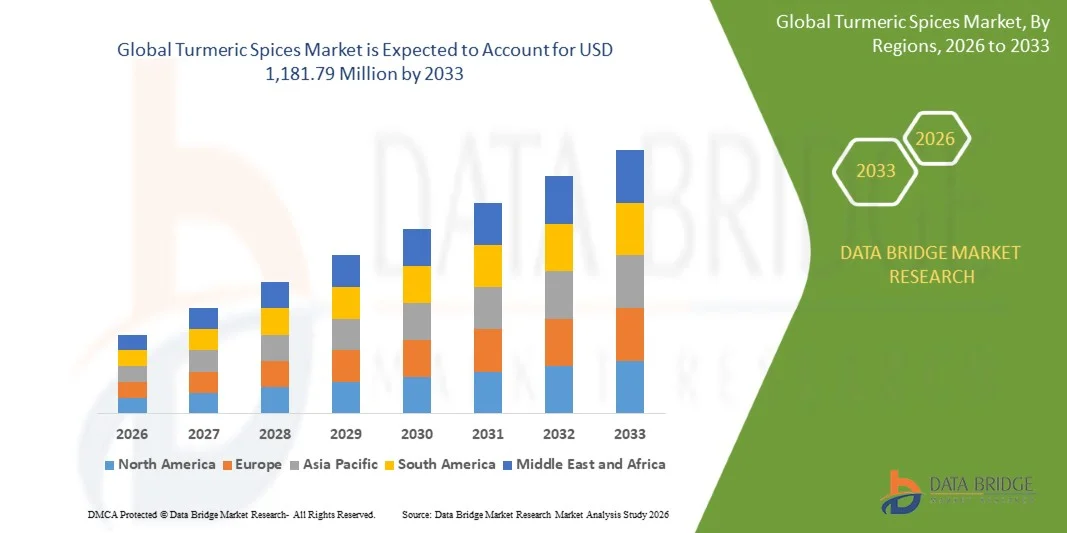
The Turmeric Spices Market was valued at USD 741.47 million in 2025 and is projected to reach USD 1,181.79 million by 2033, growing at a CAGR of 6.00% from 2026 to 2033. The market is experiencing steady growth driven by increasing consumer preference for natural and functional food ingredients, rising awareness of turmeric’s medicinal and anti-inflammatory properties, and expanding application across food and beverage, nutraceuticals, and personal care industries.
The growing shift toward clean-label products, coupled with rising demand for plant-based and organic food ingredients, is significantly boosting turmeric consumption worldwide. In addition, expanding use of turmeric in traditional medicine systems, dietary supplements, and herbal formulations is further supporting market growth. Increasing penetration of turmeric-based functional beverages and ready-to-eat food products, along with strong export demand from Asia-Pacific producing countries, continues to strengthen the Turmeric Spices Market outlook.
Key Market Trends & Insights
- North America dominated the turmeric spices market with the largest revenue share of 32.6% in 2025, supported by strong demand for functional foods, increasing consumption of dietary supplements, rising adoption of clean-label ingredients, and growing awareness of turmeric’s health benefits among consumers.
- Asia-Pacific is expected to be the fastest-growing region, recording a CAGR of 7.2% from 2026 to 2033. Growth is driven by strong production base, rising domestic consumption, increasing export demand, growing health awareness, and expanding applications in food, pharmaceutical, and personal care industries.
- The Conventional segment held the largest market revenue share of approximately 71.3% in 2025 driven by its wide availability, lower production cost, and strong supply chain dominance across major producing regions such as India and Southeast Asia. Conventional turmeric continues to be extensively used in food processing, household cooking, and industrial spice formulations due to its affordability and large-scale production capacity.
- The Organic segment is projected to register the fastest growth at a CAGR of 9.6% from 2026 to 2033, driven by rising consumer demand for chemical-free and sustainably sourced food ingredients. Increasing adoption of organic certification standards in North America and Europe, along with premium pricing for organic turmeric, is accelerating segment expansion.
- The Household segment held the largest market revenue share of approximately 38.5% in 2025 driven by high daily consumption in cooking, traditional diets, and home-based food preparation across Asia-Pacific regions, particularly India.
- The Health and Personal Care Products segment is projected to register the fastest growth at a CAGR of 10.2% from 2026 to 2033, driven by increasing use of turmeric in nutraceuticals, dietary supplements, skincare, and herbal cosmetic formulations. Rising consumer preference for natural wellness products and functional health ingredients is significantly supporting segment growth.
- The Raw segment held the largest market revenue share of approximately 62.7% in 2025 driven by strong agricultural output, lower processing dependency, and widespread use in domestic consumption and spice trade markets. Raw turmeric remains a key export commodity from major producing countries such as India.
- The Processed segment is projected to register the fastest growth at a CAGR of 8.9% from 2026 to 2033, driven by increasing demand for value-added products such as turmeric powder, extracts, and standardized curcumin formulations used in food, pharmaceutical, and cosmetic industries.
- The Powder segment held the largest market revenue share of approximately 44.1% in 2025 driven by its extensive use in food processing, ready-to-eat meals, spice blends, and nutraceutical formulations. Turmeric powder offers ease of storage, higher usability, and strong demand across retail and industrial applications.
- The Slice Turmeric segment is projected to register the fastest growth at a CAGR of 9.1% from 2026 to 2033, driven by increasing demand from export markets and food processing industries requiring raw material for further grinding and extraction of curcumin-based compounds.
- The Indirect Sales segment held the largest market revenue share of approximately 78.4% in 2025 driven by strong penetration of supermarkets, hypermarkets, retail stores, and online platforms across global consumer markets. Indirect channels enable wider product accessibility and brand visibility across urban and semi-urban regions.
- The Direct Sales segment is projected to register the fastest growth at a CAGR of 8.3% from 2026 to 2033, driven by increasing farm-to-business supply models, export-oriented trade practices, and rising demand for bulk procurement by food processors, nutraceutical companies, and industrial buyers.
Market Size & Forecast
- Global Market Value (2025): USD 741.47 Million
- Expected Market Value (2033): USD 1,181.79 Million
- Forecast CAGR (2026–2033): 6.00%
- Leading Region in 2025: North America
- Fastest Growing Region: Asia-Pacific
Report Scope and Turmeric Spices Market Segmentation
|
Attributes |
Turmeric Spices Key Market Insights |
|
Segments Covered |
|
|
Countries Covered |
North America
Europe
Asia-Pacific
Middle East and Africa
South America
|
|
Key Market Players |
• Chr. Hansen Holding A/S (Denmark) |
|
Market Opportunities |
• Expansion Of Organic And Clean Label Turmeric Products • Rising Demand For Turmeric In Nutraceuticals And Functional Beverages |
|
Value Added Data Infosets |
In addition to the insights on market scenarios such as market value, growth rate, segmentation, geographical coverage, and major players, the market reports curated by the Data Bridge Market Research also include in-depth expert analysis, pricing analysis, brand share analysis, consumer survey, demography analysis, supply chain analysis, value chain analysis, raw material/consumables overview, vendor selection criteria, PESTLE Analysis, Porter Analysis, and regulatory framework. |
Turmeric Spices Market Trends
Trend: Rising Demand For Organic Cultivation, Functional Foods, And Turmeric-Based Nutraceutical Applications
The increasing consumer shift toward natural, chemical-free, and functional food ingredients is driving strong demand for turmeric spices across global food, beverage, and health industries. Conventional synthetic additives are being replaced by plant-based alternatives, encouraging manufacturers to adopt turmeric as a natural coloring, flavoring, and medicinal ingredient. Rising awareness of curcumin’s anti-inflammatory, antioxidant, and immunity-boosting properties is further strengthening its adoption in functional food formulations and dietary supplements.
In modern nutraceutical applications, companies are increasingly integrating turmeric extracts into capsules, powders, and fortified beverages. For instance, curcumin-based supplements are widely used in joint health and immunity products, with global supplement consumption witnessing steady growth of over 7–9% annually in key markets such as the U.S., India, and Europe. In the food industry, turmeric is increasingly used in ready-to-eat meals, dairy alternatives, and functional drinks to enhance nutritional value and natural appeal while reducing reliance on artificial additives.
The rapid expansion of clean-label and organic food consumption is also increasing demand for sustainably sourced turmeric, particularly from major producing countries such as India, which accounts for nearly 75–80% of global turmeric production. In addition, growing adoption in cosmetic and personal care formulations, including skin-brightening creams and herbal skincare products, is expanding the application scope of turmeric globally. Industry reports from 2025 indicate rising export demand for organic turmeric varieties, with price premiums of 15–25% compared to conventional turmeric in international trade markets.
Turmeric Spices Market Dynamics
Key Market Driver: Increasing Health Awareness And Expansion Of Functional Food Consumption
Consumers worldwide are increasingly focusing on preventive healthcare, driving demand for natural ingredients with proven health benefits. Turmeric, widely recognized for its medicinal properties in traditional systems such as Ayurveda, is gaining strong traction as a functional ingredient in modern diets. Growing prevalence of lifestyle-related disorders such as inflammation, obesity, and cardiovascular diseases is further boosting adoption of turmeric-based products.
Food manufacturers are increasingly incorporating turmeric into functional beverages, dietary supplements, and fortified food products to enhance nutritional profiles. For instance, turmeric-infused drinks and immunity shots have seen rising popularity in urban markets across North America and Asia-Pacific. The expansion of wellness-oriented retail channels and e-commerce platforms is further improving accessibility and consumer awareness of turmeric-based products.
Similarly, the global shift toward plant-based diets and clean-label food consumption is accelerating demand for natural spices. India’s turmeric exports reached significant volumes in recent years, with increasing demand from Europe and the Middle East driven by clean-label food regulations and growing preference for organic spices.
Key Restraint/Challenge: Price Volatility And Climate-Sensitive Production
The turmeric spices market is highly dependent on agricultural output, making it vulnerable to climatic variations, monsoon fluctuations, and soil conditions. Unpredictable weather patterns and extreme climate events can significantly impact crop yield and quality, leading to price volatility in global markets.
In addition, turmeric production is concentrated in specific regions, particularly India, which creates supply chain dependency risks. Seasonal fluctuations and labor-intensive cultivation processes further contribute to inconsistent supply levels. Small-scale farmers often face challenges related to storage, processing, and export compliance, limiting efficiency across the value chain.
Market assessments indicate that turmeric prices can fluctuate by 10–20% annually depending on harvest quality and global demand conditions. This volatility poses challenges for food manufacturers and nutraceutical companies that rely on stable raw material pricing for large-scale production planning.
Key Market Opportunity: Expansion Of Organic Farming And Turmeric-Based Functional Product Innovation
The growing global demand for organic and sustainably sourced food ingredients is creating significant opportunities for turmeric producers and exporters. Increasing consumer willingness to pay premium prices for certified organic spices is encouraging farmers to adopt organic cultivation practices and sustainable farming techniques.
Food and beverage companies are increasingly launching turmeric-based functional products such as golden milk mixes, herbal teas, and immunity-boosting supplements. For instance, turmeric latte products have gained strong popularity in cafés and wellness stores across Europe and North America, reflecting rising mainstream acceptance of turmeric-based beverages.
In addition, advancements in extraction technologies are improving curcumin concentration and bioavailability, opening new opportunities in pharmaceuticals, nutraceuticals, and cosmetics industries. Expanding applications in skincare formulations, anti-aging products, and herbal personal care solutions are further strengthening market potential. Industry data from 2025 shows increasing investment in turmeric processing facilities in Asia-Pacific, particularly in India, to meet rising global demand for high-purity turmeric extracts used in health and wellness applications.
Turmeric Spices Market Scope
The market is segmented on the basis of category, application, type, product, and distribution channel.
• By Category
On the basis of category, the turmeric spices market is segmented into Organic and Conventional. The Conventional segment held the largest market revenue share of approximately 71.3% in 2025 driven by its wide availability, lower production cost, and strong supply chain dominance across major producing regions such as India and Southeast Asia. Conventional turmeric continues to be extensively used in food processing, household cooking, and industrial spice formulations due to its affordability and large-scale production capacity.
The Organic segment is projected to register the fastest growth at a CAGR of 9.6% from 2026 to 2033, driven by rising consumer demand for chemical-free and sustainably sourced food ingredients. Increasing adoption of organic certification standards in North America and Europe, along with premium pricing for organic turmeric, is accelerating segment expansion.
• By Application
On the basis of application, the turmeric spices market is segmented into Industrial, Health and Personal Care Products, Commercial, and Household. The Household segment held the largest market revenue share of approximately 38.5% in 2025 driven by high daily consumption in cooking, traditional diets, and home-based food preparation across Asia-Pacific regions, particularly India.
The Health and Personal Care Products segment is projected to register the fastest growth at a CAGR of 10.2% from 2026 to 2033, driven by increasing use of turmeric in nutraceuticals, dietary supplements, skincare, and herbal cosmetic formulations. Rising consumer preference for natural wellness products and functional health ingredients is significantly supporting segment growth.
• By Type
On the basis of type, the turmeric spices market is segmented into Raw and Processed. The Raw segment held the largest market revenue share of approximately 62.7% in 2025 driven by strong agricultural output, lower processing dependency, and widespread use in domestic consumption and spice trade markets. Raw turmeric remains a key export commodity from major producing countries such as India.
The Processed segment is projected to register the fastest growth at a CAGR of 8.9% from 2026 to 2033, driven by increasing demand for value-added products such as turmeric powder, extracts, and standardized curcumin formulations used in food, pharmaceutical, and cosmetic industries.
• By Product
On the basis of product, the turmeric spices market is segmented into Unpolished Finger, Polished Finger, Double Polished Finger, Slice Turmeric, Powder, and Others. The Powder segment held the largest market revenue share of approximately 44.1% in 2025 driven by its extensive use in food processing, ready-to-eat meals, spice blends, and nutraceutical formulations. Turmeric powder offers ease of storage, higher usability, and strong demand across retail and industrial applications.
The Slice Turmeric segment is projected to register the fastest growth at a CAGR of 9.1% from 2026 to 2033, driven by increasing demand from export markets and food processing industries requiring raw material for further grinding and extraction of curcumin-based compounds.
• By Distribution Channel
On the basis of distribution channel, the turmeric spices market is segmented into Direct Sales and Indirect Sales. The Indirect Sales segment held the largest market revenue share of approximately 78.4% in 2025 driven by strong penetration of supermarkets, hypermarkets, retail stores, and online platforms across global consumer markets. Indirect channels enable wider product accessibility and brand visibility across urban and semi-urban regions.
The Direct Sales segment is projected to register the fastest growth at a CAGR of 8.3% from 2026 to 2033, driven by increasing farm-to-business supply models, export-oriented trade practices, and rising demand for bulk procurement by food processors, nutraceutical companies, and industrial buyers.
Turmeric Spices Market Regional Analysis
North America Turmeric Spices Market Insight
North America dominated the turmeric spices market with the largest revenue share of 32.6% in 2025, supported by rising demand for functional foods, growing adoption of natural ingredients in food processing, and increasing consumer awareness regarding health benefits of turmeric. The region is witnessing strong uptake of turmeric in dietary supplements, nutraceuticals, and clean-label food formulations. High disposable incomes, expanding organic food retail networks, and growing preference for plant-based wellness products are further strengthening market growth across the region.
U.S. Turmeric Spices Market Insight
The U.S. turmeric spices market captured the largest revenue share in 2025 within North America, driven by increasing consumption of turmeric-based supplements, rising popularity of immunity-boosting products, and strong demand for natural food colorants. The expansion of health-focused retail chains, e-commerce penetration, and growing use of turmeric in functional beverages such as golden milk and wellness shots are significantly contributing to market growth. In addition, rising cases of lifestyle-related diseases are accelerating demand for preventive nutrition solutions.
Europe Turmeric Spices Market Insight
The Europe turmeric spices market is expected to witness the fastest growth rate from 2026 to 2033, primarily driven by increasing demand for organic spices, clean-label food products, and plant-based nutraceuticals. The region is experiencing strong adoption of turmeric in dietary supplements, functional foods, and natural cosmetic formulations. Strict food safety regulations and rising preference for natural additives over synthetic ingredients are further encouraging turmeric consumption across food and personal care industries.
U.K. Turmeric Spices Market Insight
The U.K. turmeric spices market is expected to witness strong growth from 2026 to 2033, driven by increasing consumer shift toward wellness-oriented diets and rising demand for functional beverages and supplements. Growing popularity of turmeric lattes, herbal teas, and immunity-boosting formulations is supporting market expansion. In addition, the expansion of organic retail stores and online health product platforms is improving turmeric accessibility across the country.
Germany Turmeric Spices Market Insight
The Germany turmeric spices market is expected to witness steady growth from 2026 to 2033, fueled by rising demand for natural food ingredients, strong preference for organic products, and increasing use of turmeric in pharmaceutical and cosmetic applications. Germany’s focus on sustainability and clean-label food trends is encouraging manufacturers to incorporate turmeric into health-focused product formulations. Growing awareness of anti-inflammatory and antioxidant benefits is further supporting demand.
Asia-Pacific Turmeric Spices Market Insight
The Asia-Pacific turmeric spices market is expected to witness the fastest growth rate from 2026 to 2033, supported by strong production base, rising domestic consumption, and expanding applications in food, pharmaceuticals, and personal care industries. Countries such as India, China, and Indonesia are major contributors to both production and consumption. Increasing export demand, rising health awareness, and government support for spice cultivation are driving regional market expansion.
Japan Turmeric Spices Market Insight
The Japan turmeric spices market is expected to witness steady growth from 2026 to 2033 due to rising demand for functional foods, dietary supplements, and herbal health products. The aging population and increasing focus on preventive healthcare are driving turmeric adoption in nutraceutical formulations. Growing incorporation of turmeric in ready-to-drink wellness beverages and health supplements is further supporting market growth.
China Turmeric Spices Market Insight
The China turmeric spices market accounted for the largest market revenue share in Asia-Pacific in 2025, attributed to increasing demand for traditional medicinal ingredients, expanding nutraceutical industry, and rising consumer preference for natural health products. Strong domestic production, growing e-commerce penetration, and increasing use of turmeric in food, cosmetics, and herbal medicine formulations are key factors driving market growth in the country.
Turmeric Spices Market Share
The Turmeric Spices industry is primarily led by well-established companies, including:
• Chr. Hansen Holding A/S (Denmark)
• Sabinsa (U.S.)
• Synthite Industries Ltd. (India)
• Everest Spices (India)
• ITC Limited (India)
• Mane KANCOR (India)
• Roha (India)
• Kalsec Inc. (U.S.)
• International Flavors & Fragrances Inc. (U.S.)
• Vigon International, LLC. (U.S.)
• Sudarshan Agro Foods (India)
• MDH Spices (India)
• SHAH RATANSHI KHIMJI & CO. (India)
• Shimlahills (India)
• Nugen Foods (India)
• AGRIM PTE LTD (Singapore)
SKU-
Get online access to the report on the World's First Market Intelligence Cloud

- Interactive Data Analysis Dashboard
- Company Analysis Dashboard for high growth potential opportunities
- Research Analyst Access for customization & queries
- Competitor Analysis with Interactive dashboard
- Latest News, Updates & Trend analysis
- Harness the Power of Benchmark Analysis for Comprehensive Competitor Tracking
Global Turmeric Spices Market, Supply Chain Analysis and Ecosystem Framework
To support market growth and help clients navigate the impact of geopolitical shifts, DBMR has integrated in-depth supply chain analysis into its Global Turmeric Spices Market research reports. This addition empowers clients to respond effectively to global changes affecting their industries. The supply chain analysis section includes detailed insights such as Global Turmeric Spices Market consumption and production by country, price trend analysis, the impact of tariffs and geopolitical developments, and import and export trends by country and HSN code. It also highlights major suppliers with data on production capacity and company profiles, as well as key importers and exporters. In addition to research, DBMR offers specialized supply chain consulting services backed by over a decade of experience, providing solutions like supplier discovery, supplier risk assessment, price trend analysis, impact evaluation of inflation and trade route changes, and comprehensive market trend analysis.
Research Methodology
Data collection and base year analysis are done using data collection modules with large sample sizes. The stage includes obtaining market information or related data through various sources and strategies. It includes examining and planning all the data acquired from the past in advance. It likewise envelops the examination of information inconsistencies seen across different information sources. The market data is analysed and estimated using market statistical and coherent models. Also, market share analysis and key trend analysis are the major success factors in the market report. To know more, please request an analyst call or drop down your inquiry.
The key research methodology used by DBMR research team is data triangulation which involves data mining, analysis of the impact of data variables on the market and primary (industry expert) validation. Data models include Vendor Positioning Grid, Market Time Line Analysis, Market Overview and Guide, Company Positioning Grid, Patent Analysis, Pricing Analysis, Company Market Share Analysis, Standards of Measurement, Global versus Regional and Vendor Share Analysis. To know more about the research methodology, drop in an inquiry to speak to our industry experts.
Customization Available
Data Bridge Market Research is a leader in advanced formative research. We take pride in servicing our existing and new customers with data and analysis that match and suits their goal. The report can be customized to include price trend analysis of target brands understanding the market for additional countries (ask for the list of countries), clinical trial results data, literature review, refurbished market and product base analysis. Market analysis of target competitors can be analyzed from technology-based analysis to market portfolio strategies. We can add as many competitors that you require data about in the format and data style you are looking for. Our team of analysts can also provide you data in crude raw excel files pivot tables (Fact book) or can assist you in creating presentations from the data sets available in the report.












