


Global Ultra Low Power Microcontroller Market
Market Size in USD Billion
CAGR :
% 
 USD
6.12 Billion
USD
13.89 Billion
2025
2033
USD
6.12 Billion
USD
13.89 Billion
2025
2033
 Forecast Period Forecast Period |
2026 –2033 |
 Market Size (Base Year) Market Size (Base Year) |
USD 6.12 Billion |
 Market Size (Forecast Year) Market Size (Forecast Year) |
USD 13.89 Billion |
 CAGR CAGR |
% |
| Major Markets Players |
|
Ultra-Low-Power Microcontroller Market Size
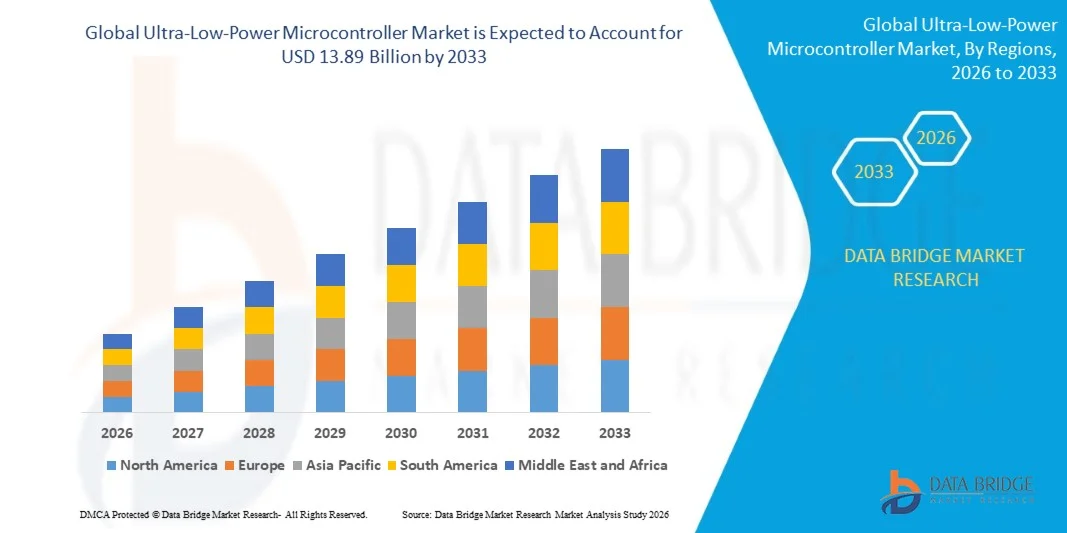
- The global ultra-low-power microcontroller market size was valued at USD 6.12 billion in 2025 and is expected to reach USD 13.89 billion by 2033, at a CAGR of 10.80% during the forecast period
- The market growth is largely fuelled by the increasing adoption of IoT devices, wearable electronics, and smart sensors, where energy efficiency and extended battery life are critical requirements
- Rising demand for connected healthcare devices, smart home systems, and industrial automation solutions is further accelerating the use of ultra-low-power microcontrollers across multiple applications
Ultra-Low-Power Microcontroller Market Analysis
- The ultra-low-power microcontroller market is experiencing strong growth due to rapid expansion of IoT ecosystems and increasing need for energy-efficient embedded systems
- Continuous advancements in semiconductor technology and low-power chip design are enabling enhanced performance with reduced energy consumption, supporting widespread adoption in consumer electronics and industrial applications
- North America dominated the ultra-low-power microcontroller market with the largest revenue share in 2025, driven by strong demand for IoT devices, wearable electronics, smart healthcare systems, and industrial automation solutions
- Asia-Pacific region is expected to witness the highest growth rate in the global ultra-low-power microcontroller market, driven by strong growth in consumer electronics manufacturing, rapid urbanization, increasing adoption of IoT and smart devices, and expanding semiconductor production capabilities across emerging economies
- The general purpose sensing and measurement MCUs segment held the largest market revenue share in 2025 driven by its wide usage across consumer electronics, industrial monitoring, and IoT applications. These MCUs offer flexibility, low energy consumption, and reliable performance for diverse embedded system requirements. Increasing use in smart home devices and portable electronics is further boosting demand. Strong compatibility with multiple sensors and communication protocols is also enhancing adoption. Continuous innovation in multi-functional microcontroller platforms is strengthening segment dominance
Report Scope and Ultra-Low-Power Microcontroller Market Segmentation
|
Attributes |
Ultra-Low-Power Microcontroller Key Market Insights |
|
Segments Covered |
|
|
Countries Covered |
North America
Europe
Asia-Pacific
Middle East and Africa
South America
|
|
Key Market Players |
• Texas Instruments Incorporated (U.S.) |
|
Market Opportunities |
• Expansion In IoT And Wearable Devices • Growth In Smart Healthcare And Industrial Automation |
|
Value Added Data Infosets |
In addition to the insights on market scenarios such as market value, growth rate, segmentation, geographical coverage, and major players, the market reports curated by the Data Bridge Market Research also include in-depth expert analysis, geographically represented company-wise production and capacity, network layouts of distributors and partners, detailed and updated price trend analysis and deficit analysis of supply chain and demand. |
Ultra-Low-Power Microcontroller Market Trends
“Rising Demand For Energy-Efficient And IoT-Enabled Devices”
• The growing focus on low power consumption and extended battery life is significantly shaping the ultra-low-power microcontroller market, as manufacturers increasingly prioritize energy-efficient computing solutions for compact and connected devices. Ultra-low-power microcontrollers are gaining traction due to their ability to deliver high performance while minimizing energy usage, making them essential for battery-operated and portable electronics. This trend strengthens their adoption across IoT devices, wearable electronics, and smart sensor applications, encouraging semiconductor companies to innovate with advanced low-power architectures
• Increasing adoption of connected healthcare, smart home systems, and industrial automation has accelerated the demand for ultra-low-power microcontrollers in real-time monitoring and control applications. Healthcare devices, fitness trackers, and remote patient monitoring systems are actively integrating these microcontrollers to ensure longer operational life and reliable performance. This has also led to collaborations between semiconductor manufacturers and device makers to enhance processing efficiency and wireless connectivity features
• Energy efficiency and miniaturization trends are influencing product development strategies, with companies emphasizing ultra-low leakage designs, optimized power modes, and integrated system-on-chip solutions. These factors are helping manufacturers differentiate products in a highly competitive semiconductor market while meeting stringent energy regulations and sustainability goals. Companies are increasingly highlighting low power performance in marketing strategies to strengthen adoption in consumer and industrial electronics
• For instance, in 2024, STMicroelectronics in Switzerland and Texas Instruments in the U.S. expanded their ultra-low-power microcontroller portfolios by introducing new energy-efficient chipsets for wearable devices and industrial IoT applications. These products were designed to support longer battery life and enhanced processing efficiency, with distribution across consumer electronics and industrial automation sectors. The solutions were also positioned as high-performance and energy-optimized technologies, improving product adoption among device manufacturers
• While demand for ultra-low-power microcontrollers is growing, sustained market expansion depends on continuous semiconductor innovation, cost-effective chip production, and improved integration capabilities. Manufacturers are also focusing on scaling fabrication technologies, enhancing power optimization techniques, and developing next-generation architectures for broader application adoption
Ultra-Low-Power Microcontroller Market Dynamics
Driver
“Growing Adoption Of IoT And Battery Powered Smart Devices”
• Rising demand for connected and battery-operated devices is a major driver for the ultra-low-power microcontroller market. Manufacturers are increasingly using these microcontrollers in IoT systems, wearable devices, and smart sensors to extend battery life and improve energy efficiency. This trend is also driving innovation in low-power embedded systems and edge computing solutions
• Expanding applications in healthcare monitoring, smart homes, industrial automation, and consumer electronics are influencing market growth. Ultra-low-power microcontrollers enable real-time data processing with minimal energy consumption, making them suitable for continuous monitoring and portable applications. The increasing deployment of smart city infrastructure further reinforces this demand
• Semiconductor companies and electronics manufacturers are actively investing in R&D to develop more efficient and compact microcontroller architectures. These efforts are supported by growing demand for intelligent, always-on devices that require optimized energy performance and enhanced connectivity features
• For instance, in 2023, NXP Semiconductors in the Netherlands and Renesas Electronics in Japan reported increased adoption of ultra-low-power microcontrollers in wearable health devices and industrial IoT systems. This expansion followed rising demand for energy-efficient embedded solutions, supporting longer device lifecycles and improved performance reliability. Both companies also emphasized innovation in low-power design to strengthen market competitiveness
• Although rising demand supports growth, wider adoption depends on cost optimization, fabrication efficiency, and improved integration with advanced semiconductor technologies. Investment in next-generation chip design and power management solutions will be critical for sustaining long-term market expansion
Restraint/Challenge
“High Development Costs And Design Complexity”
• The relatively high cost of designing and manufacturing ultra-low-power microcontrollers remains a key challenge, limiting adoption among cost-sensitive applications. Advanced semiconductor fabrication processes, complex architecture design, and high R&D investments contribute to elevated production costs. In addition, balancing performance with ultra-low energy consumption adds further design complexity
• Limited technical expertise and longer development cycles also impact market growth, particularly in emerging regions where semiconductor design capabilities are still developing. This leads to slower adoption in small-scale consumer electronics and low-cost IoT devices. It also restricts innovation speed in highly competitive markets
• Supply chain dependencies and semiconductor shortages further affect market stability, as ultra-low-power microcontrollers rely on advanced fabrication facilities and specialized materials. Disruptions in semiconductor manufacturing and logistics can delay production and increase costs for end-use industries
• For instance, in 2024, electronics manufacturers in India and Southeast Asia reported delays in IoT device production due to limited availability of advanced low-power microcontroller chips from suppliers such as Microchip Technology and STMicroelectronics. Supply constraints and high procurement costs affected product rollout timelines and increased dependency on global suppliers
• Overcoming these challenges will require cost-efficient semiconductor manufacturing, improved design automation tools, and stronger supply chain resilience. Increased investment in fabrication capacity, advanced chip design platforms, and collaborative development with device manufacturers will be essential for long-term growth in the global ultra-low-power microcontroller market
Ultra-Low-Power Microcontroller Market Scope
The ultra-low-power microcontroller market is segmented into multiple notable segments based on peripheral type, type, component, packaging type, network connectivity, RAM capacity, retention power mode, and application.
• By Peripheral Type
On the basis of peripheral type, the market is segmented into analog devices and digital devices. The digital devices segment held the largest market revenue share in 2025 driven by the growing demand for smart, connected, and programmable embedded systems used in IoT devices, wearables, and industrial automation. Digital peripherals are widely preferred due to their high processing efficiency, better integration capabilities, and suitability for low-power architectures in modern electronic systems. Increasing deployment in edge computing and AI-enabled devices is further strengthening demand. Rising need for compact and multifunctional microcontroller units is also supporting adoption across consumer electronics and industrial applications. Continuous advancements in digital signal processing are enhancing system performance while maintaining ultra-low power consumption.
The analog devices segment is expected to witness the fastest growth rate from 2026 to 2033, driven by increasing adoption in sensing, measurement, and real-time signal processing applications. Rising demand for precise data acquisition in healthcare monitoring, environmental sensing, and industrial control systems is further accelerating the adoption of analog-based ultra-low-power microcontrollers. Expanding use in smart energy systems and predictive maintenance applications is also contributing to market growth. Growing need for accurate signal conditioning in compact devices is supporting innovation in analog microcontroller design. In addition, integration of analog peripherals with digital control systems is improving overall efficiency and functionality.
• By Type
On the basis of type, the market is segmented into general purpose sensing and measurement MCUs, capacitive touch sensing MCUs, and ultrasonic sensing MCUs. The general purpose sensing and measurement MCUs segment held the largest market revenue share in 2025 driven by its wide usage across consumer electronics, industrial monitoring, and IoT applications. These MCUs offer flexibility, low energy consumption, and reliable performance for diverse embedded system requirements. Increasing use in smart home devices and portable electronics is further boosting demand. Strong compatibility with multiple sensors and communication protocols is also enhancing adoption. Continuous innovation in multi-functional microcontroller platforms is strengthening segment dominance.
The capacitive touch sensing MCUs segment is expected to witness the fastest growth rate from 2026 to 2033, driven by increasing integration in smartphones, wearable devices, and smart home interfaces. Growing demand for intuitive user interfaces and touch-based control systems is further supporting segment expansion across consumer electronics and smart devices. Rising adoption in automotive infotainment systems and smart appliances is also contributing to growth. Enhanced user experience and reduced mechanical components are increasing product reliability. In addition, advancements in touch sensitivity and low-power design are accelerating market penetration.
• By Component
On the basis of component, the market is segmented into hardware, software, and services. The hardware segment held the largest market revenue share in 2025 driven by strong demand for energy-efficient microcontroller chips used in IoT devices, industrial systems, and wearable electronics. Continuous advancements in semiconductor fabrication are further enhancing hardware performance and power efficiency. Growing demand for miniaturized electronic components is also boosting hardware adoption. Increasing deployment in embedded systems across industries is supporting consistent market growth. Rising investment in chip manufacturing facilities is strengthening supply capabilities.
The software segment is expected to witness the fastest growth rate from 2026 to 2033, driven by increasing demand for embedded firmware, operating systems, and development tools that support ultra-low-power optimization. Growing adoption of smart applications and connected ecosystems is further boosting software integration in microcontroller platforms. Rising need for real-time analytics and device management is also supporting demand. Expansion of AI-enabled embedded software solutions is enhancing system intelligence. In addition, increasing use of simulation and development platforms is accelerating innovation cycles.
• By Packaging Type
On the basis of packaging type, the market is segmented into 32 bit packaging, 16 bit packaging, and 8 bit packaging. The 32 bit packaging segment held the largest market revenue share in 2025 driven by rising demand for high-performance computing, advanced IoT applications, and complex embedded systems requiring greater processing power and memory efficiency. Increasing use in industrial automation and smart electronics is further supporting dominance. Enhanced computational capabilities and multitasking efficiency are strengthening adoption. Growing demand for real-time processing in connected devices is also boosting this segment. Continuous innovation in high-density chip packaging is improving performance and energy efficiency.
The 8 bit packaging segment is expected to witness the fastest growth rate from 2026 to 2033, driven by its cost-effectiveness, low power consumption, and suitability for simple control and sensing applications in consumer electronics and basic industrial systems. Rising demand in low-cost IoT devices and entry-level embedded applications is further supporting growth. Increasing use in home appliances and small-scale automation systems is also contributing to expansion. Simplicity of design and ease of integration are enhancing adoption. In addition, growing demand in emerging markets is accelerating penetration.
• By Network Connectivity
On the basis of network connectivity, the market is segmented into wireless and wired. The wireless segment held the largest market revenue share in 2025 driven by rapid expansion of IoT ecosystems, smart devices, and remote monitoring applications. Wireless connectivity enables seamless communication, mobility, and energy-efficient data transmission in modern embedded systems. Increasing adoption in wearable devices and smart home systems is further strengthening demand. Growing preference for cloud-connected devices is also supporting expansion. Advancements in low-power wireless protocols are enhancing system efficiency.
The wired segment is expected to witness steady growth from 2026 to 2033, driven by demand for secure, stable, and low-latency communication in industrial automation, medical equipment, and critical infrastructure applications. High reliability and reduced interference are key factors supporting adoption. Increasing use in factory automation and control systems is further contributing to growth. Demand for real-time data accuracy in mission-critical applications is also strengthening this segment. In addition, cost-effectiveness in certain industrial environments is supporting continued usage.
• By RAM Capacity
On the basis of RAM capacity, the market is segmented into more than 512 Kb, 96 Kb–512 Kb, and less than 96 Kb. The 96 Kb–512 Kb segment held the largest market revenue share in 2025 driven by balanced performance, cost efficiency, and suitability for a wide range of IoT and embedded applications. It offers an optimal mix of processing capability and energy efficiency for mid-range applications. Increasing use in consumer electronics and industrial automation is further boosting demand. Strong compatibility with multiple embedded systems is also supporting growth. Continuous improvements in memory optimization are enhancing performance.
The more than 512 Kb segment is expected to witness the fastest growth rate from 2026 to 2033, driven by increasing demand for advanced processing, AI-enabled edge computing, and complex industrial applications requiring higher memory capacity. Rising adoption in smart devices and high-performance embedded systems is further supporting expansion. Growing need for real-time analytics and data-intensive applications is also boosting demand. Integration with advanced IoT architectures is enhancing functionality. In addition, increasing semiconductor innovation is enabling higher memory efficiency.
• By Retention Power Mode
On the basis of retention power mode, the market is segmented into 2.4 μW–3.5 μW, 1.6 μW–2.4 μW, and more than 3.5 μW. The 1.6 μW–2.4 μW segment held the largest market revenue share in 2025 driven by optimal energy efficiency and widespread use in battery-powered IoT devices and wearable electronics. It provides a strong balance between performance and ultra-low power consumption. Increasing deployment in portable medical devices is further supporting demand. Growing adoption in smart sensor systems is also boosting usage. Continuous innovation in power management technologies is enhancing efficiency.
The 2.4 μW–3.5 μW segment is expected to witness the fastest growth rate from 2026 to 2033, driven by increasing demand for higher processing capability while maintaining low power consumption in smart sensors and industrial monitoring systems. Rising use in edge computing devices is further strengthening growth. Expanding applications in connected industrial systems are also supporting adoption. Enhanced performance efficiency in mid-power devices is driving demand. In addition, improvements in energy optimization techniques are accelerating segment expansion.
• By Application
On the basis of application, the market is segmented into general test and measurement, sensing, flow measurement, and others. The sensing segment held the largest market revenue share in 2025 driven by widespread adoption in IoT devices, healthcare monitoring systems, and industrial automation applications requiring continuous data collection and real-time analysis. Increasing deployment in smart environments is further boosting demand. Growing use in predictive maintenance systems is also supporting expansion. Strong integration with wireless sensor networks is enhancing performance. Continuous innovation in sensor technologies is strengthening adoption.
The flow measurement segment is expected to witness the fastest growth rate from 2026 to 2033, driven by increasing use in industrial automation, smart utilities, and environmental monitoring systems where precise fluid and gas measurement is essential for efficiency and control. Rising demand in water management and energy sectors is further supporting growth. Expanding smart infrastructure projects are also boosting adoption. Increasing need for real-time monitoring and automation is enhancing demand. In addition, technological advancements in flow sensing devices are accelerating market expansion.
Ultra-Low-Power Microcontroller Market Regional Analysis
• North America dominated the ultra-low-power microcontroller market with the largest revenue share in 2025, driven by strong demand for IoT devices, wearable electronics, smart healthcare systems, and industrial automation solutions
• Consumers and industries in the region highly value the energy efficiency, compact design, high performance, and extended battery life offered by ultra-low-power microcontrollers, enabling seamless operation in connected and portable devices
• This widespread adoption is further supported by advanced semiconductor manufacturing capabilities, high R&D investments, and rapid integration of smart technologies across consumer and industrial applications, establishing ultra-low-power microcontrollers as a core component in modern embedded systems
U.S. Ultra-Low-Power Microcontroller Market Insight
The U.S. ultra-low-power microcontroller market captured the largest revenue share in 2025 within North America, fueled by rapid growth in IoT ecosystems, wearable medical devices, and smart home technologies. Increasing demand for energy-efficient embedded systems in healthcare monitoring, industrial automation, and consumer electronics is driving market expansion. Strong presence of leading semiconductor companies and continuous innovation in low-power chip design are further strengthening the industry. In addition, rising adoption of edge computing and AI-enabled devices is significantly contributing to market growth.
Europe Ultra-Low-Power Microcontroller Market Insight
The Europe ultra-low-power microcontroller market is expected to witness the fastest growth rate from 2026 to 2033, primarily driven by increasing adoption of smart industrial systems, healthcare technologies, and energy-efficient electronic devices. Strict energy regulations and sustainability initiatives are encouraging manufacturers to integrate low-power embedded solutions. Growing demand for connected automotive systems, smart meters, and industrial IoT applications is further supporting market expansion. Rising investments in semiconductor innovation and green electronics are also strengthening regional growth.
U.K. Ultra-Low-Power Microcontroller Market Insight
The U.K. ultra-low-power microcontroller market is expected to witness strong growth from 2026 to 2033, driven by increasing demand for smart home devices, wearable healthcare solutions, and industrial automation systems. Rising focus on energy-efficient technologies and digital transformation across industries is supporting adoption. Growing use of connected devices in security systems and remote monitoring applications is further accelerating market growth. In addition, strong innovation ecosystem and expanding IoT infrastructure are boosting demand.
Germany Ultra-Low-Power Microcontroller Market Insight
The Germany ultra-low-power microcontroller market is expected to witness significant growth from 2026 to 2033, fueled by strong industrial automation, automotive innovation, and advanced manufacturing capabilities. Increasing adoption of smart sensors, electric vehicles, and energy-efficient industrial systems is driving demand. Germany’s emphasis on sustainability and high-performance engineering is further supporting market expansion. Integration of ultra-low-power microcontrollers in Industry 4.0 applications is also enhancing growth prospects.
Asia-Pacific Ultra-Low-Power Microcontroller Market Insight
The Asia-Pacific ultra-low-power microcontroller market is expected to witness the fastest growth rate from 2026 to 2033, driven by rapid industrialization, expanding electronics manufacturing, and rising adoption of IoT technologies in countries such as China, Japan, and India. Growing demand for consumer electronics, smart devices, and industrial automation is significantly boosting market growth. Increasing investments in semiconductor production and cost-effective manufacturing are further supporting expansion. Strong government initiatives promoting digitalization and smart infrastructure are also accelerating adoption.
Japan Ultra-Low-Power Microcontroller Market Insight
The Japan ultra-low-power microcontroller market is expected to witness steady growth from 2026 to 2033 due to strong demand from robotics, automotive electronics, and healthcare monitoring systems. Japan’s high-tech ecosystem and focus on precision engineering are driving adoption of energy-efficient embedded systems. Increasing use in wearable devices, industrial robots, and smart appliances is further supporting growth. In addition, aging population trends are boosting demand for remote healthcare and monitoring solutions.
China Ultra-Low-Power Microcontroller Market Insight
The China ultra-low-power microcontroller market accounted for the largest market revenue share in Asia-Pacific in 2025, attributed to rapid urbanization, strong electronics manufacturing base, and high adoption of IoT and smart devices. Growing demand for consumer electronics, smart home systems, and industrial automation is driving market expansion. China’s dominance in semiconductor production and government support for smart city development are key growth drivers. In addition, rising investments in AI-enabled devices and connected infrastructure are further accelerating market growth.
Ultra-Low-Power Microcontroller Market Share
The Ultra-Low-Power Microcontroller industry is primarily led by well-established companies, including:
• Texas Instruments Incorporated (U.S.)
• STMicroelectronics (Switzerland)
• Analog Devices, Inc. (U.S.)
• NXP Semiconductors (Netherlands)
• EM Microelectronic (Switzerland)
• Nuvoton Technology Corporation (Taiwan)
• Seiko Epson Corporation (Japan)
• Microchip Technology Inc. (U.S.)
• Broadcom (U.S.)
• Semiconductor Components Industries, LLC (U.S.)
• Holtek Semiconductor Inc. (Taiwan)
• Zilog, Inc. (U.S.)
• Silicon Laboratories (U.S.)
• LAPIS Semiconductor Co., Ltd. (Japan)
• Infineon Technologies AG (Germany)
• Renesas Electronics Corporation (Japan)
• ESPRESSIF SYSTEMS (SHANGHAI) CO., LTD. (China)
• Profichip USA (U.S.)
• e-peas (Belgium)
• Ambiq Micro, Inc. (U.S.)
• TOSHIBA ELECTRONIC DEVICES & STORAGE CORPORATION (Japan)
Latest Developments in Global Ultra-Low-Power Microcontroller Market
- In October 2023, Texas Instruments (U.S.) announced a strategic initiative focused on enhancing supply chain resilience through AI-driven analytics and advanced digital technologies. This development is aimed at improving operational efficiency, forecasting accuracy, and production responsiveness. It is expected to strengthen TI’s competitiveness in the ultra-low-power microcontroller market and ensure more stable product availability amid fluctuating semiconductor demand
- In September 2023, NXP Semiconductors (Netherlands) entered into a strategic partnership with a leading automotive manufacturer to develop next-generation ultra-low-power microcontrollers for electric vehicles. This collaboration is designed to enhance energy-efficient computing and enable advanced automotive electronics. It is expected to expand NXP’s presence in the electric mobility sector and accelerate innovation in automotive semiconductor solutions
- In August 2023, Microchip Technology (U.S.) launched a new ultra-low-power microcontroller series designed specifically for battery-operated and IoT-enabled devices. This development focuses on improving energy efficiency, performance optimization, and extended device lifecycle. It is expected to strengthen Microchip’s position in the IoT market and increase its share in energy-efficient embedded systems applications
- In July 2023, NXP Semiconductors (Netherlands) introduced its latest ultra-low-power Kinetis microcontroller lineup targeting IoT, industrial, and consumer electronics applications. The product offers enhanced power management capabilities and improved low-power modes for extended battery performance. It is expected to boost adoption of NXP’s MCUs in energy-sensitive applications and enhance its competitive positioning in the global semiconductor market
- In June 2023, Texas Instruments (U.S.) expanded its ultra-low-power microcontroller portfolio by introducing new variants with improved energy efficiency and advanced functional capabilities. These MCUs are designed for IoT devices, wearables, and consumer electronics requiring minimal power consumption. This expansion is expected to enhance TI’s product diversification, strengthen its leadership in low-power semiconductor solutions, and support growing demand for connected devices
SKU-
Get online access to the report on the World's First Market Intelligence Cloud

- Interactive Data Analysis Dashboard
- Company Analysis Dashboard for high growth potential opportunities
- Research Analyst Access for customization & queries
- Competitor Analysis with Interactive dashboard
- Latest News, Updates & Trend analysis
- Harness the Power of Benchmark Analysis for Comprehensive Competitor Tracking
Global Ultra Low Power Microcontroller Market, Supply Chain Analysis and Ecosystem Framework
To support market growth and help clients navigate the impact of geopolitical shifts, DBMR has integrated in-depth supply chain analysis into its Global Ultra Low Power Microcontroller Market research reports. This addition empowers clients to respond effectively to global changes affecting their industries. The supply chain analysis section includes detailed insights such as Global Ultra Low Power Microcontroller Market consumption and production by country, price trend analysis, the impact of tariffs and geopolitical developments, and import and export trends by country and HSN code. It also highlights major suppliers with data on production capacity and company profiles, as well as key importers and exporters. In addition to research, DBMR offers specialized supply chain consulting services backed by over a decade of experience, providing solutions like supplier discovery, supplier risk assessment, price trend analysis, impact evaluation of inflation and trade route changes, and comprehensive market trend analysis.
Research Methodology
Data collection and base year analysis are done using data collection modules with large sample sizes. The stage includes obtaining market information or related data through various sources and strategies. It includes examining and planning all the data acquired from the past in advance. It likewise envelops the examination of information inconsistencies seen across different information sources. The market data is analysed and estimated using market statistical and coherent models. Also, market share analysis and key trend analysis are the major success factors in the market report. To know more, please request an analyst call or drop down your inquiry.
The key research methodology used by DBMR research team is data triangulation which involves data mining, analysis of the impact of data variables on the market and primary (industry expert) validation. Data models include Vendor Positioning Grid, Market Time Line Analysis, Market Overview and Guide, Company Positioning Grid, Patent Analysis, Pricing Analysis, Company Market Share Analysis, Standards of Measurement, Global versus Regional and Vendor Share Analysis. To know more about the research methodology, drop in an inquiry to speak to our industry experts.
Customization Available
Data Bridge Market Research is a leader in advanced formative research. We take pride in servicing our existing and new customers with data and analysis that match and suits their goal. The report can be customized to include price trend analysis of target brands understanding the market for additional countries (ask for the list of countries), clinical trial results data, literature review, refurbished market and product base analysis. Market analysis of target competitors can be analyzed from technology-based analysis to market portfolio strategies. We can add as many competitors that you require data about in the format and data style you are looking for. Our team of analysts can also provide you data in crude raw excel files pivot tables (Fact book) or can assist you in creating presentations from the data sets available in the report.












