




Global Underfill Dispenser Market
Market Size in USD Billion
CAGR :
% 
 USD
108.42 Billion
USD
450.90 Billion
2025
2033
USD
108.42 Billion
USD
450.90 Billion
2025
2033
 Forecast Period Forecast Period |
2026 –2033 |
 Market Size (Base Year) Market Size (Base Year) |
USD 108.42 Billion |
 Market Size (Forecast Year) Market Size (Forecast Year) |
USD 450.90 Billion |
 CAGR CAGR |
% |
| Major Markets Players |
|
Underfill Dispenser Market Size
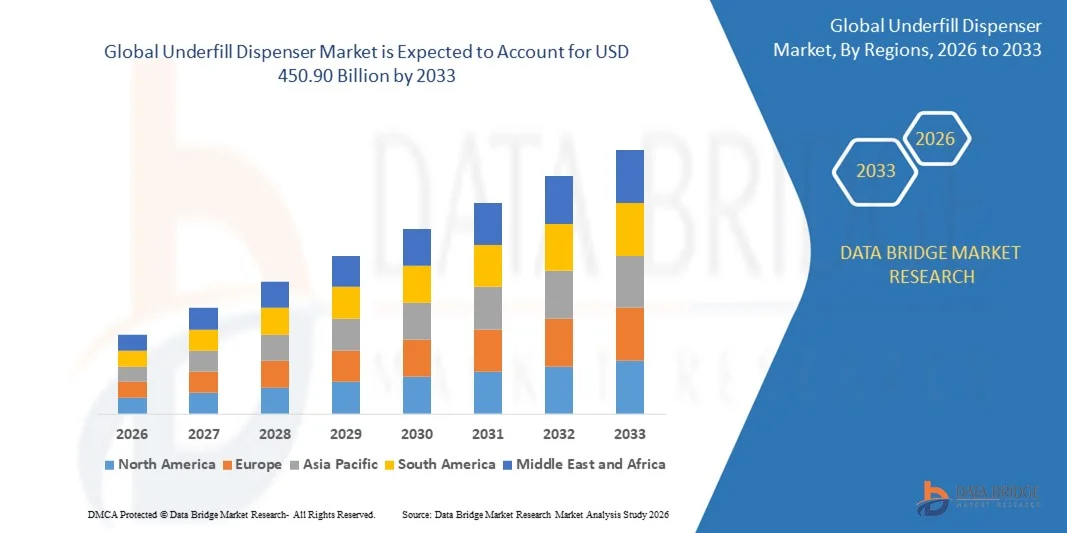
- The global underfill dispenser market size was valued at USD 108.42 billion in 2025 and is expected to reach USD 450.90 billion by 2033, at a CAGR of 19.50% during the forecast period
- The market growth is largely fuelled by the increasing demand for precise liquid filling in pharmaceutical, cosmetic, and food & beverage industries
- Growing adoption of automation and advanced filling technologies is driving efficiency and reducing product waste
Underfill Dispenser Market Analysis
- The market is characterized by the adoption of automated dispensing systems that improve accuracy and reduce human error
- Demand is increasing across industries such as pharmaceuticals, personal care, and food & beverages due to the need for precise and contamination-free liquid dispensing
- North America dominated the global underfill dispenser market with the largest revenue share of 38.50% in 2025, driven by the growing adoption of automation in pharmaceuticals, food & beverage, and personal care industries, as well as rising demand for precise and contamination-free liquid filling
- Asia-Pacific region is expected to witness the highest growth rate in the global underfill dispenser market, driven by rapid industrialization, expansion of manufacturing facilities, adoption of automated production systems, and supportive government initiatives for modernizing industries
- The capillary flow underfill segment held the largest market revenue share in 2025, driven by its wide usage in semiconductor assembly due to its ability to fill gaps between components efficiently and provide strong mechanical support. CUF dispensers enable precise, consistent application, improving reliability and reducing defects in electronic devices
Report Scope and Underfill Dispenser Market Segmentation
|
Attributes |
Underfill Dispenser Key Market Insights |
|
Segments Covered |
|
|
Countries Covered |
North America
Europe
Asia-Pacific
Middle East and Africa
South America
|
|
Key Market Players |
|
|
Market Opportunities |
|
|
Value Added Data Infosets |
In addition to the market insights such as market value, growth rate, market segments, geographical coverage, market players, and market scenario, the market report curated by the Data Bridge Market Research team includes in-depth expert analysis, import/export analysis, pricing analysis, production consumption analysis, and pestle analysis. |
Underfill Dispenser Market Trends
Rising Demand for Precise, Automated Liquid Filling Solutions
- The growing focus on accuracy, efficiency, and contamination-free liquid filling is significantly shaping the underfill dispenser market, as manufacturers increasingly prefer systems that minimize waste and maintain consistent product quality. Automated underfill dispensers are gaining traction due to their ability to handle high-speed production while ensuring precise fill volumes across packaging types. This trend strengthens adoption across pharmaceutical, food & beverage, and personal care industries, encouraging suppliers to innovate with versatile and customizable dispensing solutions
- Increasing awareness around operational efficiency, regulatory compliance, and waste reduction has accelerated the demand for advanced underfill dispensers in high-value and sensitive product segments. Industries are actively seeking solutions that improve consistency, reduce errors, and enhance production throughput, prompting collaborations between equipment manufacturers and end-users to deliver optimized filling performance
- Precision, reliability, and sustainability trends are influencing purchasing decisions, with manufacturers emphasizing automated, sensor-based, and servo-driven dispensing systems. These factors help companies differentiate their operations in a competitive market, improve cost efficiency, and maintain compliance with industry standards. Marketing and demonstrations of advanced dispensing solutions are increasingly used to reinforce brand positioning and adoption among industrial clients
- For instance, in 2024, companies such as Nordson (U.S.) and ViscoTec (Germany) expanded their underfill dispenser offerings to include high-speed, multi-head, and customizable systems for pharmaceutical and food & beverage applications. These launches responded to rising demand for accurate, efficient, and contamination-free liquid filling, with distribution across direct industrial channels, distributors, and trade shows
- While demand for underfill dispensers is growing, sustained market expansion depends on continuous R&D, cost-effective production, and maintaining precision comparable to manual or semi-automated systems. Manufacturers are also focusing on improving scalability, system reliability, and integration with automated production lines to support broader adoption
Underfill Dispenser Market Dynamics
Driver
Growing Preference for Automated and High-Precision Filling Solutions
- Rising demand for precise, automated liquid filling systems is a major driver for the underfill dispenser market. Manufacturers are increasingly replacing manual filling methods with automated dispensers to enhance accuracy, reduce product wastage, and maintain consistent quality. This trend is also encouraging R&D in high-speed, multi-head, and sensor-driven dispensing systems
- Expanding applications in pharmaceuticals, personal care, food & beverage, and specialty chemicals are influencing market growth. Underfill dispensers improve fill accuracy, reduce spillage, and ensure regulatory compliance, enabling manufacturers to meet industrial standards while maintaining operational efficiency. Increasing adoption of automation across production lines further reinforces this trend
- Equipment manufacturers are actively promoting underfill dispenser-based solutions through product innovation, industry certifications, and demonstrations. These efforts are supported by growing awareness of the benefits of automated dispensing, encouraging partnerships between suppliers and industrial clients to improve performance and reduce operational costs
- For instance, in 2023, Nordson (U.S.) and ViscoTec (Germany) reported increased adoption of automated underfill dispensers in pharmaceutical and food & beverage production lines. The expansion followed higher demand for precise, contamination-free filling and the need for consistent product quality. Both companies emphasized efficiency, reliability, and integration in marketing campaigns to strengthen client trust and adoption
- Although rising automation trends support growth, wider adoption depends on cost optimization, equipment availability, and scalable production capabilities. Investment in supply chain efficiency, advanced control systems, and user-friendly interfaces will be critical for meeting global demand and maintaining competitive advantage
Restraint/Challenge
High Equipment Costs and Complex Integration Requirements
- The relatively high cost of underfill dispensers compared to manual or semi-automated systems remains a key challenge, limiting adoption among smaller manufacturers. Equipment purchase, installation, and maintenance expenses contribute to elevated total costs
- Integration with existing production lines and compatibility with different packaging types can be complex, further restricting adoption across certain industrial segments. Technical expertise is often required for operation and calibration, which may limit implementation in resource-constrained facilities
- Supply chain and service support challenges also impact market growth, as underfill dispensers require sourcing from specialized manufacturers and adherence to strict maintenance protocols. Downtime, calibration errors, or delayed technical support can affect operational efficiency and overall production output
- For instance, in 2024, pharmaceutical and food manufacturers in Southeast Asia reported slower adoption of advanced underfill dispensers due to high upfront costs, complex integration, and limited local service support. Smaller production units often relied on semi-automated or manual filling methods, restricting market penetration in certain regions
- Overcoming these challenges will require cost-efficient production, simplified integration, and enhanced after-sales support. Collaboration with industrial clients, training programs, and scalable, modular dispenser designs can help unlock the long-term growth potential of the global underfill dispenser market. Developing cost-competitive, easy-to-install systems while emphasizing precision, efficiency, and compliance will be essential for widespread adoption
Underfill Dispenser Market Scope
The market is segmented on the basis of product type and application.
- By Product Type
On the basis of product type, the underfill dispenser market is segmented into capillary flow underfill (CUF), no flow underfill (NUF), and molded underfill (MUF). The capillary flow underfill segment held the largest market revenue share in 2025, driven by its wide usage in semiconductor assembly due to its ability to fill gaps between components efficiently and provide strong mechanical support. CUF dispensers enable precise, consistent application, improving reliability and reducing defects in electronic devices.
The molded underfill segment is expected to witness the fastest growth rate from 2026 to 2033, driven by increasing adoption in advanced packaging solutions, higher thermal stability, and superior mechanical performance. Molded underfill dispensers are preferred in high-performance electronics, offering better protection and durability for sensitive components.
- By Application
On the basis of application, the market is segmented into flip chips, ball grid array (BGA), and chip scale packaging (CSP). The flip chip segment held the largest market revenue share in 2025, fueled by the growing use of flip chip technology in consumer electronics, automotive, and telecommunication devices. Flip chip applications benefit from high-density connections and improved electrical performance, making underfill dispensers critical for assembly efficiency.
The chip scale packaging segment is expected to witness the fastest growth from 2026 to 2033, driven by miniaturization trends in electronics, higher adoption of mobile devices, and demand for compact, reliable packaging solutions. CSP applications require precise underfill dispensing to enhance thermal management and mechanical strength, which is boosting market demand.
Underfill Dispenser Market Regional Analysis
- North America dominated the global underfill dispenser market with the largest revenue share of 38.50% in 2025, driven by the growing adoption of automation in pharmaceuticals, food & beverage, and personal care industries, as well as rising demand for precise and contamination-free liquid filling
- Manufacturers in the region highly value accuracy, speed, and consistency offered by underfill dispensers, which reduce product wastage and improve operational efficiency across production lines
- This widespread adoption is further supported by high industrial investments, advanced manufacturing infrastructure, and stringent quality standards, establishing underfill dispensers as a preferred solution for both large-scale and specialized manufacturing operations
U.S. Underfill Dispenser Market Insight
The U.S. underfill dispenser market captured the largest revenue share in 2025 within North America, fueled by the rapid adoption of automated filling systems and the increasing demand for precision in liquid dispensing. Industries are increasingly prioritizing accuracy and operational efficiency to meet regulatory compliance and reduce product loss. The growing integration of underfill dispensers with smart production lines, IoT-enabled monitoring, and automated quality control systems is significantly contributing to market expansion.
Europe Underfill Dispenser Market Insight
The Europe underfill dispenser market is expected to witness the fastest growth rate from 2026 to 2033, primarily driven by stringent quality regulations and the rising demand for high-precision liquid filling in pharmaceutical, food & beverage, and cosmetic applications. Increasing industrial automation, coupled with the adoption of advanced technologies, is encouraging the installation of automated dispensers across production facilities. The region is seeing significant growth across both new manufacturing units and upgrades to existing production lines.
U.K. Underfill Dispenser Market Insight
The U.K. underfill dispenser market is expected to witness the fastest growth rate from 2026 to 2033, driven by the rising adoption of automated and high-precision filling systems. Growing focus on reducing waste, ensuring consistency, and meeting strict regulatory requirements is encouraging manufacturers to invest in advanced dispensing solutions. The U.K.’s robust industrial infrastructure and technological expertise are expected to continue supporting market growth.
Germany Underfill Dispenser Market Insight
The Germany underfill dispenser market is expected to witness the fastest growth rate from 2026 to 2033, fueled by increasing awareness of precision manufacturing and the demand for technologically advanced, efficient, and sustainable dispensing solutions. Germany’s strong emphasis on industrial innovation and quality standards promotes the adoption of automated underfill dispensers, particularly in pharmaceutical and personal care production. Integration with smart production systems and eco-conscious practices is becoming increasingly prevalent.
Asia-Pacific Underfill Dispenser Market Insight
The Asia-Pacific underfill dispenser market is expected to witness the fastest growth rate from 2026 to 2033, driven by rapid industrialization, rising disposable incomes, and increasing adoption of automation in countries such as China, India, and Japan. Government initiatives supporting manufacturing modernization and digitalization are driving demand for precision dispensing systems. In addition, as APAC emerges as a manufacturing hub for dispenser components and systems, affordability and accessibility are expanding adoption among both large-scale and small-to-medium manufacturers.
Japan Underfill Dispenser Market Insight
The Japan underfill dispenser market is expected to witness strong growth from 2026 to 2033 due to the country’s high-tech manufacturing environment, focus on precision, and rising demand for efficient production systems. Japanese industries emphasize accuracy, automation, and contamination-free dispensing in pharmaceuticals, cosmetics, and food & beverage applications. Integration with IoT-enabled production lines and smart monitoring systems is fueling growth, while an aging workforce is likely to drive demand for automated and easy-to-operate dispensing solutions.
China Underfill Dispenser Market Insight
The China underfill dispenser market accounted for the largest market revenue share in Asia-Pacific in 2025, attributed to rapid industrialization, expanding manufacturing capacity, and high adoption of automation technologies. China is one of the largest markets for automated liquid filling systems, with strong demand across pharmaceuticals, personal care, and food & beverage industries. The push towards smart factories, availability of affordable dispenser systems, and the presence of domestic manufacturers are key factors propelling market growth.
Underfill Dispenser Market Share
The Underfill Dispenser industry is primarily led by well-established companies, including:
- Henkel AG & Co. KGaA (Germany)
- MKS Instruments, Inc. (U.S.)
- Shenzhen STIHOM Machine Electronics Co., Ltd (China)
- Zmation Inc. (U.S.)
- Nordson Corporation (U.S.)
- Illinois Tool Works (U.S.)
- Master Bond Inc. (U.S.)
- Essemtec AG (Switzerland)
- Sulzer Ltd. (Switzerland)
Latest Developments in Global Underfill Dispenser Market
- In August 2023, ASM Assembly Systems (Germany) and SCREEN Holdings Co., Ltd. (Japan) formed a strategic partnership to develop next-generation underfill dispensers. The collaboration aims to leverage both companies’ expertise in semiconductor manufacturing and dispensing technology to create more efficient, accurate, and reliable systems. This initiative is expected to enhance product performance, reduce operational errors, and strengthen their market presence in the semiconductor and electronics industries
- In August 2023, Mycronic AB (Sweden) completed the acquisition of Silex Insight (Netherlands), a manufacturer of underfill dispensing equipment. The acquisition is designed to expand Mycronic AB’s product portfolio and customer base, enabling the company to offer a broader range of precision dispensing solutions. This strategic move strengthens Mycronic’s competitive position and supports growth in the global underfill dispenser market
- In May 2023, Viscom AG (Germany) acquired the underfill dispensing business of PVA TePla AG (Germany). This acquisition will allow Viscom AG to expand its product offerings and provide customers with a more comprehensive range of automated dispensing solutions. The move is expected to enhance operational efficiency, increase market share, and reinforce Viscom’s presence in the electronics and semiconductor manufacturing sectors
SKU-
Get online access to the report on the World's First Market Intelligence Cloud

- Interactive Data Analysis Dashboard
- Company Analysis Dashboard for high growth potential opportunities
- Research Analyst Access for customization & queries
- Competitor Analysis with Interactive dashboard
- Latest News, Updates & Trend analysis
- Harness the Power of Benchmark Analysis for Comprehensive Competitor Tracking
Research Methodology
Data collection and base year analysis are done using data collection modules with large sample sizes. The stage includes obtaining market information or related data through various sources and strategies. It includes examining and planning all the data acquired from the past in advance. It likewise envelops the examination of information inconsistencies seen across different information sources. The market data is analysed and estimated using market statistical and coherent models. Also, market share analysis and key trend analysis are the major success factors in the market report. To know more, please request an analyst call or drop down your inquiry.
The key research methodology used by DBMR research team is data triangulation which involves data mining, analysis of the impact of data variables on the market and primary (industry expert) validation. Data models include Vendor Positioning Grid, Market Time Line Analysis, Market Overview and Guide, Company Positioning Grid, Patent Analysis, Pricing Analysis, Company Market Share Analysis, Standards of Measurement, Global versus Regional and Vendor Share Analysis. To know more about the research methodology, drop in an inquiry to speak to our industry experts.
Customization Available
Data Bridge Market Research is a leader in advanced formative research. We take pride in servicing our existing and new customers with data and analysis that match and suits their goal. The report can be customized to include price trend analysis of target brands understanding the market for additional countries (ask for the list of countries), clinical trial results data, literature review, refurbished market and product base analysis. Market analysis of target competitors can be analyzed from technology-based analysis to market portfolio strategies. We can add as many competitors that you require data about in the format and data style you are looking for. Our team of analysts can also provide you data in crude raw excel files pivot tables (Fact book) or can assist you in creating presentations from the data sets available in the report.












