Global Underwater Acoustic Communication Market
Market Size in USD Billion
CAGR :
% 
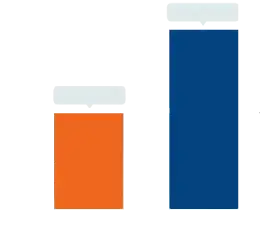 USD
2.73 Billion
USD
7.92 Billion
2025
2033
USD
2.73 Billion
USD
7.92 Billion
2025
2033
 Forecast Period Forecast Period |
2026 –2033 |
 Market Size (Base Year) Market Size (Base Year) |
USD 2.73 Billion |
 Market Size (Forecast Year) Market Size (Forecast Year) |
USD 7.92 Billion |
 CAGR CAGR |
% |
| Major Markets Players |
|
What is the Global Underwater Acoustic Communication Market Size and Growth Rate?
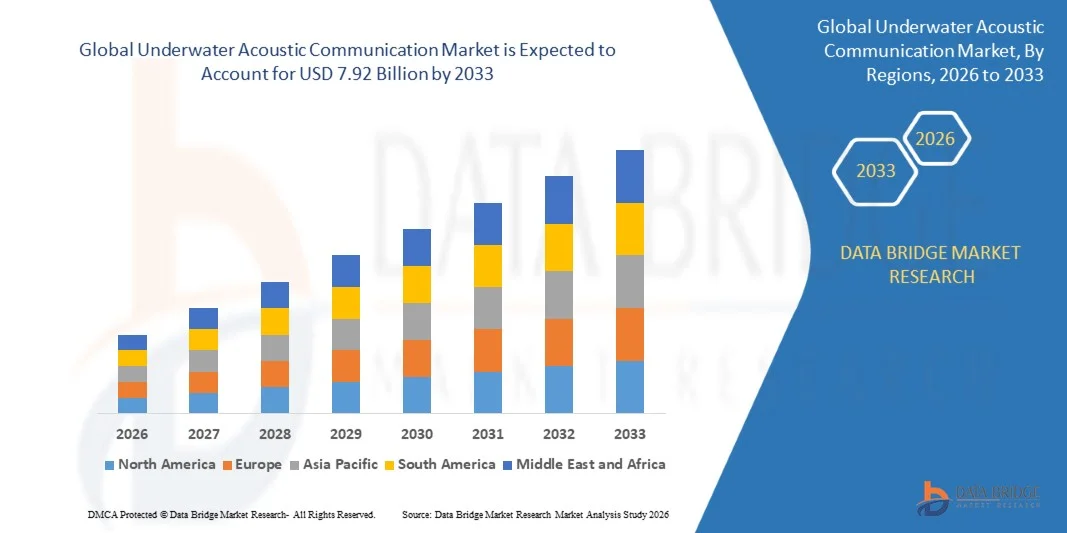
- The global underwater acoustic communication market size was valued at USD 2.73 billion in 2025 and is expected to reach USD 7.92 billion by 2033, at a CAGR of14.20% during the forecast period
- The underwater acoustic communication market is being driven by the rising importance of reliable and secured communication in defense and homeland security end-user. The upsurge in the adoption rate of underwater acoustic modems in naval defense is a major factor driving the market's growth
What are the Major Takeaways of Underwater Acoustic Communication Market?
- The increase in the addition of unmanned underwater vehicles along with the developed sensors providing surveillance and threat detection solutions is driving up demand for underwater acoustic communication equipment market. Other significant factors such as rising demand for high-capacity, reliable underwater acoustic networks and high demand from oil and gas industry will cushion the growth rate of underwater acoustic communication market
- Moreover, increasing underwater exploration projects and rising demand for environmental protection will boost the beneficial opportunities for the underwater acoustic communication market growth
- North America dominated the underwater acoustic communication market with an estimated 40.8% revenue share in 2025, driven by strong investments in naval defence modernization, offshore oil & gas exploration, oceanographic research, and subsea communication infrastructure across the U.S. and Canada
- Asia-Pacific is projected to register the fastest CAGR of 11.2% from 2026 to 2033, driven by rising naval modernization, expanding offshore energy exploration, and growing marine research investments across China, Japan, India, South Korea, and Southeast Asia
- The Acoustic Modem segment dominated the market with an estimated 46.7% share in 2025, as it remains the core technology enabling reliable subsea data transmission between underwater devices, autonomous vehicles, offshore platforms, and monitoring stations
Report Scope and Underwater Acoustic Communication Market Segmentation
|
Attributes |
Underwater Acoustic Communication Key Market Insights |
|
Segments Covered |
|
|
Countries Covered |
North America
Europe
Asia-Pacific
Middle East and Africa
South America
|
|
Key Market Players |
|
|
Market Opportunities |
|
|
Value Added Data Infosets |
In addition to the insights on market scenarios such as market value, growth rate, segmentation, geographical coverage, and major players, the market reports curated by the Data Bridge Market Research also include in-depth expert analysis, pricing analysis, brand share analysis, consumer survey, demography analysis, supply chain analysis, value chain analysis, raw material/consumables overview, vendor selection criteria, PESTLE Analysis, Porter Analysis, and regulatory framework. |
What is the Key Trend in the Underwater Acoustic Communication Market?
“Increasing Shift Toward High-Speed, Low-Power, and AI-Enabled Underwater Communication Systems”
- The underwater acoustic communication market is witnessing strong adoption of high-speed, compact, and energy-efficient communication systems designed for subsea data transmission across long distances
- Manufacturers are introducing AI-enabled modems, adaptive signal processing systems, and multi-node acoustic networks that offer improved bandwidth efficiency, lower latency, and better signal reliability in harsh underwater environments
- Growing demand for autonomous underwater vehicles (AUVs), remotely operated vehicles (ROVs), offshore monitoring, and defence surveillance systems is driving deployment across marine research and industrial applications
- For instance, companies such as KONGSBERG, Teledyne, EvoLogics, and Thales are expanding their underwater communication portfolios with advanced acoustic modems and intelligent sensing platforms
- Increasing need for real-time subsea data exchange, long-range communication, and environmental monitoring is accelerating innovation in underwater acoustic technologies
- As offshore operations and marine digitalization continue to expand, underwater acoustic communication systems will remain vital for secure, reliable, and long-distance subsea connectivity
What are the Key Drivers of Underwater Acoustic Communication Market?
- Rising demand for reliable subsea communication systems in offshore oil & gas, naval defence, oceanography, and underwater exploration is a major growth driver
- For instance, in 2025, leading companies such as KONGSBERG, Teledyne, and EvoLogics enhanced their acoustic modem solutions with improved signal clarity, extended range, and AI-based data optimization
- Growing adoption of AUVs, underwater drones, marine robotics, and smart ocean monitoring systems is boosting demand across the U.S., Europe, and Asia-Pacific
- Advancements in digital signal processing, low-power transducers, and adaptive modulation techniques have strengthened transmission efficiency and communication stability
- Rising investments in naval modernization, underwater surveillance, and deep-sea exploration projects are creating demand for high-performance acoustic communication systems
- Supported by steady investments in marine research infrastructure, defence systems, and offshore industrial automation, the market is expected to witness strong long-term growth
Which Factor is Challenging the Growth of the Underwater Acoustic Communication Market?
- High costs associated with advanced acoustic modems, subsea sensors, and long-range communication equipment restrict adoption among small marine operators and research institutes
- For instance, during 2024–2025, rising component costs, pressure-resistant hardware requirements, and specialized manufacturing increased system deployment costs for several vendors
- Complexity in maintaining stable signal transmission in deep water, noisy marine environments, and varying salinity conditions increases technological challenges
- Limited bandwidth and slower data transfer rates compared with terrestrial wireless systems continue to restrain performance in some applications
- Competition from optical underwater communication and hybrid communication technologies creates pricing pressure and reduces market differentiation
- To address these issues, companies are focusing on AI-driven signal optimization, cost-efficient modem designs, and hybrid communication architectures to increase global adoption of underwater acoustic communication systems
How is the Underwater Acoustic Communication Market Segmented?
The market is segmented on the basis of interface platform, communication range, application, and end-user.
• By Interface Platform
On the basis of interface platform, the Underwater Acoustic Communication market is segmented into Sensor Interface, Acoustic Modem, and Others. The Acoustic Modem segment dominated the market with an estimated 46.7% share in 2025, as it remains the core technology enabling reliable subsea data transmission between underwater devices, autonomous vehicles, offshore platforms, and monitoring stations. Acoustic modems are widely adopted due to their ability to transmit signals over long distances in marine environments where radio and optical signals are less effective. Their compatibility with AUVs, ROVs, seabed sensors, and offshore surveillance systems continues to drive strong market penetration across defence, scientific, and industrial applications.
The Sensor Interface segment is expected to grow at the fastest CAGR from 2026 to 2033, driven by increasing deployment of real-time marine sensing systems, environmental monitoring platforms, and smart subsea infrastructure. Rising investments in digital ocean monitoring and underwater IoT ecosystems are further accelerating growth.
• By Communication Range
On the basis of communication range, the market is segmented into Shallow Water Range, Medium Water Range, Long Water Range, and Full Ocean Range. The Long Water Range segment dominated the market with a 38.9% share in 2025, supported by extensive use in offshore oil & gas operations, naval surveillance, deep-sea exploration, and marine data collection systems. Long-range communication systems are essential for transmitting data between subsea assets and surface control stations over several kilometres, ensuring uninterrupted communication in challenging underwater conditions.
The Full Ocean Range segment is projected to grow at the fastest CAGR from 2026 to 2033, driven by rising demand for deep-ocean exploration, transoceanic defence monitoring, and scientific oceanography missions. Growing deployment of subsea autonomous systems and deep-water climate monitoring solutions is expected to significantly boost adoption.
• By Application
On the basis of application, the market is segmented into Environmental Monitoring, Pollution Monitoring, Climate Monitoring, Hydrography, Oceanography, and Others. The Oceanography segment dominated the market with a 34.6% share in 2025, driven by growing investments in marine research, seabed mapping, underwater biodiversity studies, and ocean current analysis. Underwater acoustic communication systems play a critical role in enabling data exchange among subsea sensors, research vessels, and autonomous monitoring devices.
The Climate Monitoring segment is expected to grow at the fastest CAGR from 2026 to 2033, propelled by increasing global focus on ocean temperature tracking, sea-level rise studies, and climate change assessment programs. Government and research institution funding for long-term marine data collection is further supporting segment growth.
• By End-User
On the basis of end-user, the market is segmented into Oil and Gas, Military and Defense, Homeland Security, Scientific Research and Development, and Marine. The Military and Defense segment dominated the market with a 41.2% share in 2025, driven by extensive deployment in underwater surveillance, submarine communication, mine detection, and naval intelligence operations. Rising geopolitical tensions and investments in maritime security infrastructure continue to strengthen demand.
The Scientific Research and Development segment is expected to grow at the fastest CAGR from 2026 to 2033, supported by increasing oceanographic research projects, smart marine laboratories, and underwater robotics innovation. Expansion in marine exploration and subsea environmental analytics is expected to drive long-term growth.
Which Region Holds the Largest Share of the Underwater Acoustic Communication Market?
- North America dominated the underwater acoustic communication market with an estimated 40.8% revenue share in 2025, driven by strong investments in naval defence modernization, offshore oil & gas exploration, oceanographic research, and subsea communication infrastructure across the U.S. and Canada. High adoption of underwater communication systems in autonomous underwater vehicles (AUVs), remotely operated vehicles (ROVs), submarine surveillance, and offshore monitoring platforms continues to fuel market demand across defence agencies, research institutions, and industrial operators.
- Leading companies in North America are introducing advanced acoustic modems, AI-enabled signal processing systems, and long-range subsea communication networks, strengthening the region’s technological advantage. Continuous investment in maritime security, ocean exploration, and digital offshore infrastructure supports long-term market expansion.
- Strong defence budgets, advanced marine engineering capabilities, and established offshore ecosystems further reinforce regional market leadership
U.S. Underwater Acoustic Communication Market Insight
The U.S. is the largest contributor in North America, supported by robust defence spending, growing deployment of naval surveillance systems, and strong presence of offshore oil & gas operations. Increasing development of submarine communication systems, autonomous marine drones, and deep-sea exploration platforms intensifies demand for reliable underwater acoustic communication technologies. Presence of major defence contractors, marine technology firms, and oceanographic research centres further drives market growth.
Canada Underwater Acoustic Communication Market Insight
Canada contributes significantly to regional growth, driven by expanding marine research initiatives, Arctic surveillance projects, and offshore energy activities. Government-backed Ocean monitoring programs and growing interest in environmental data collection strengthen market adoption across the country.
Asia-Pacific Underwater Acoustic Communication Market
Asia-Pacific is projected to register the fastest CAGR of 11.2% from 2026 to 2033, driven by rising naval modernization, expanding offshore energy exploration, and growing marine research investments across China, Japan, India, South Korea, and Southeast Asia. Increasing deployment of underwater drones, smart ports, and ocean observation systems continues to accelerate demand for high-performance acoustic communication solutions.
China Underwater Acoustic Communication Market Insight
China is the largest contributor to Asia-Pacific due to substantial investments in naval defence, deep-sea exploration, and subsea infrastructure development. Rapid expansion of maritime surveillance and oceanographic programs is driving strong demand.
Japan Underwater Acoustic Communication Market Insight
Japan shows steady growth supported by advanced marine engineering, coastal monitoring systems, and underwater robotics development. Strong emphasis on disaster monitoring and ocean science supports long-term expansion.
India Underwater Acoustic Communication Market Insight
India is emerging as a major growth hub, driven by expanding naval capabilities, blue economy initiatives, and offshore energy exploration projects. Rising investments in marine R&D and coastal security systems are accelerating adoption.
South Korea Underwater Acoustic Communication Market Insight
South Korea contributes significantly due to strong shipbuilding capabilities, naval modernization programs, and growing smart marine infrastructure investments. Technological innovation and digital maritime ecosystems support sustained market growth.
Which are the Top Companies in Underwater Acoustic Communication Market?
The underwater acoustic communication industry is primarily led by well-established companies, including:
- KONGSBERG (Norway)
- Ultra (U.K.)
- EvoLogics GmbH (Germany)
- Hydroacoustics, Inc. (U.S.)
- Gavial Holdings (U.K.)
- Teledyne Technologies Incorporated (U.S.)
- UniEnergy Technologies (U.S.)
- Thales Group (France)
- Mistral Solutions Pvt. Ltd. (India)
- Proserv UK Ltd. (U.K.)
- RTSYS (France)
- Subnero Pte. Ltd. (Singapore)
- JPAnalytics (India)
- SEAGNAL SAS (France)
- Underwater Wireless Modem & Communication Devices (U.S.)
- Aquatec Group Ltd. (U.K.)
- BaltRobotics (Lithuania)
- Nortek AS (Norway)
What are the Recent Developments in Global Underwater Acoustic Communication Market?
- In August 2022, KONGSBERG Marine introduced EcoAdvisor, an advanced vessel performance optimization solution that continuously monitors vessel operations and surrounding environmental conditions, including propulsion, power generation, control systems, and external forces. This launch is expected to support fuel efficiency, lower emissions, and reduced maintenance expenses, thereby strengthening operational sustainability in the marine sector
- In July 2022, Teledyne Technologies completed the acquisition of NL Acoustics, Finland-based provider of advanced acoustics-driven predictive maintenance solutions. The company’s acoustic imaging cameras are widely used for fault detection, process optimization, and energy savings, and this acquisition is expected to enhance Teledyne’s position in industrial acoustic monitoring and predictive maintenance technologies
- In March 2022, Sonardyne launched Deck Topside, a new solution capable of acoustically testing, loading, interrogating, and activating acoustic release transponders along with initiation transponder 6 IT systems. This development is expected to improve reliability and operational efficiency in subsea communication and offshore monitoring applications
SKU-
Get online access to the report on the World's First Market Intelligence Cloud

- Interactive Data Analysis Dashboard
- Company Analysis Dashboard for high growth potential opportunities
- Research Analyst Access for customization & queries
- Competitor Analysis with Interactive dashboard
- Latest News, Updates & Trend analysis
- Harness the Power of Benchmark Analysis for Comprehensive Competitor Tracking
Research Methodology
Data collection and base year analysis are done using data collection modules with large sample sizes. The stage includes obtaining market information or related data through various sources and strategies. It includes examining and planning all the data acquired from the past in advance. It likewise envelops the examination of information inconsistencies seen across different information sources. The market data is analysed and estimated using market statistical and coherent models. Also, market share analysis and key trend analysis are the major success factors in the market report. To know more, please request an analyst call or drop down your inquiry.
The key research methodology used by DBMR research team is data triangulation which involves data mining, analysis of the impact of data variables on the market and primary (industry expert) validation. Data models include Vendor Positioning Grid, Market Time Line Analysis, Market Overview and Guide, Company Positioning Grid, Patent Analysis, Pricing Analysis, Company Market Share Analysis, Standards of Measurement, Global versus Regional and Vendor Share Analysis. To know more about the research methodology, drop in an inquiry to speak to our industry experts.
Customization Available
Data Bridge Market Research is a leader in advanced formative research. We take pride in servicing our existing and new customers with data and analysis that match and suits their goal. The report can be customized to include price trend analysis of target brands understanding the market for additional countries (ask for the list of countries), clinical trial results data, literature review, refurbished market and product base analysis. Market analysis of target competitors can be analyzed from technology-based analysis to market portfolio strategies. We can add as many competitors that you require data about in the format and data style you are looking for. Our team of analysts can also provide you data in crude raw excel files pivot tables (Fact book) or can assist you in creating presentations from the data sets available in the report.