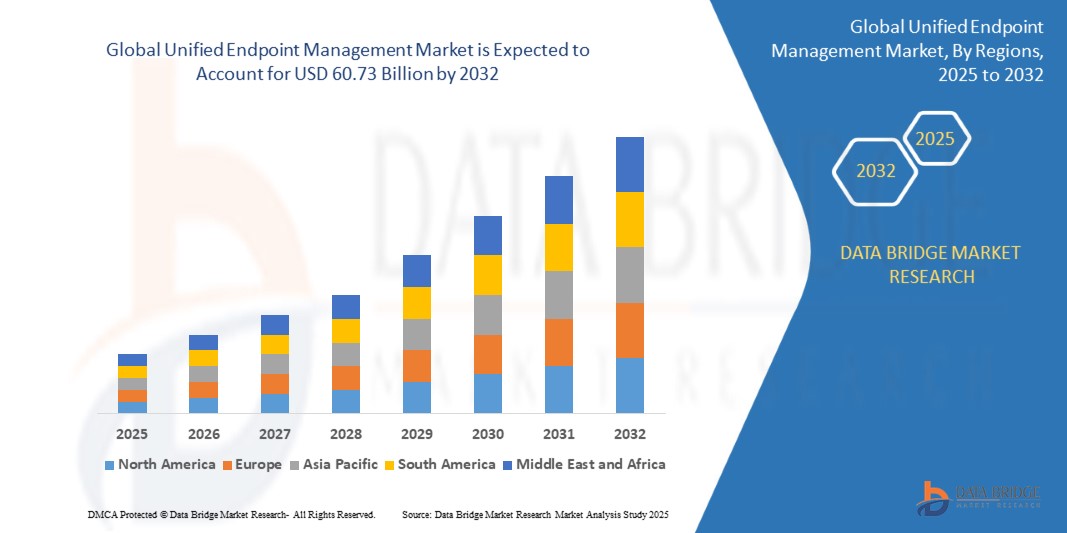
Unified Endpoint Management Market Size
- The global unified endpoint management market size was valued at USD 12.05 billion in 2024 and is expected to reach USD 60.73 billion by 2032, at a CAGR of 22.4% during the forecast period
- The market growth is largely fuelled by the rising adoption of remote work policies, increasing cybersecurity threats, and the need for centralized management of diverse endpoint devices, including smartphones, tablets, laptops, and IoT assets
- Growing digital transformation across industries and the proliferation of cloud-based solutions are further propelling the demand for unified endpoint management platforms
Unified Endpoint Management Market Analysis
- The market is undergoing rapid evolution due to increased dependency on digital infrastructure and multi-device work environments, leading enterprises to adopt integrated endpoint management solutions
- Key players are focusing on enhanced security frameworks, artificial intelligence-driven analytics, and support for hybrid deployment models to meet the dynamic needs of businesses
- North America dominated the unified endpoint management market with the largest revenue share of 41.35% in 2024, driven by the widespread adoption of remote work models, a strong focus on cybersecurity, and the presence of technologically advanced enterprises
- Asia-Pacific region is expected to witness the highest growth rate in the global unified endpoint management market, driven by rapid economic development, increasing mobile workforce, and growing investments in IT infrastructure. Countries such as China, Japan, and India are seeing rising demand for centralized device management solutions across industries, supported by favorable regulatory policies and expanding internet penetration
- The solutions segment dominated the market with the largest market revenue share of 64.5% in 2024, driven by the rising need for centralized management of devices, applications, and networks across enterprises. Organizations are increasingly deploying UEM solutions to improve security posture, reduce endpoint complexity, and streamline IT operations. The growth of bring-your-own-device (BYOD) culture and increasing remote workforces further drive demand for advanced endpoint monitoring and policy enforcement capabilities
Report Scope and Unified Endpoint Management Market Segmentation
|
Attributes |
Unified Endpoint Management Key Market Insights |
|
Segments Covered |
|
|
Countries Covered |
North America
Europe
Asia-Pacific
Middle East and Africa
South America
|
|
Key Market Players |
|
|
Market Opportunities |
|
|
Value Added Data Infosets |
In addition to the market insights such as market value, growth rate, market segments, geographical coverage, market players, and market scenario, the market report curated by the Data Bridge Market Research team includes in-depth expert analysis, import/export analysis, pricing analysis, production consumption analysis, and pestle analysis. |
Unified Endpoint Management Market Trends
“Rising Integration of Zero Trust Architecture in UEM Platforms”
- Enterprises are adopting zero trust security frameworks across UEM platforms to enhance protection against advanced threats as they transition toward remote and hybrid work models, emphasizing continuous authentication and device-level policy enforcement
- Vendors are embedding zero trust principles into endpoint security by enabling real-time user verification, threat detection, and adaptive access control within a centralized management environment
- The growing need to prevent lateral movement of threats and unauthorized data access is accelerating the demand for UEM solutions aligned with zero trust security practices across sectors such as finance and healthcare
- This trend is also driven by increasing pressure to comply with data protection regulations such as GDPR and HIPAA, pushing companies to adopt stricter device access and usage controls within UEM ecosystems
- For instance, Microsoft’s Endpoint Manager has introduced enhanced zero trust policies and conditional access capabilities that allow enterprises to manage identity, compliance, and threat mitigation from a unified interface
Unified Endpoint Management Market Dynamics
Driver
“Expansion of Remote Work and BYOD Culture Accelerating UEM Adoption”
- The surge in remote and hybrid workforces has compelled organizations to manage a growing number of endpoints, including employee-owned smartphones, tablets, and laptops, under a unified platform to ensure consistent control and compliance
- UEM platforms offer centralized visibility and policy enforcement across various operating systems, reducing fragmentation and risk of unmanaged endpoints, which is crucial as workforce mobility and device diversity continue to increase
- Businesses increasingly demand integrated solutions that not only secure endpoints but also enhance productivity through remote access, patch management, application provisioning, and real-time monitoring
- UEM systems streamline IT operations by consolidating mobile device management, identity access management, and endpoint security, enabling IT teams to scale support efficiently across multiple geographies
- For instance, IBM MaaS360 experienced significant uptake during the pandemic due to its ability to manage remote devices securely, enabling enterprises to maintain workforce productivity while adhering to corporate security standards
Restraint/Challenge
“Integration Complexities with Legacy Systems and Cost Barriers”
- Companies using outdated IT infrastructure often face interoperability issues when implementing UEM platforms, as older systems may lack APIs or standardized protocols necessary for smooth integration and automation
- The substantial upfront costs associated with UEM—covering software licensing, technical consultancy, hardware upgrades, and workforce training—pose a financial barrier especially for small and medium-sized enterprises
- Transitioning from traditional or standalone endpoint solutions to unified platforms can disrupt operations due to the need for data migration, policy redesign, and change management across departments
- Highly regulated industries such as banking, healthcare, and defense face additional hurdles in aligning UEM deployments with complex data privacy laws, audit requirements, and compliance mandates
- For instance, several small firms in Southeast Asia postponed UEM deployment after encountering challenges integrating legacy ERP and HRM systems with newer endpoint management platforms due to budget and compatibility constraints
Unified Endpoint Management Market Scope
The market is segmented on the basis of type, organization size, and vertical.
• By Type
On the basis of type, the unified endpoint management market is segmented into solutions and services. The solutions segment dominated the market with the largest market revenue share of 64.5% in 2024, driven by the rising need for centralized management of devices, applications, and networks across enterprises. Organizations are increasingly deploying UEM solutions to improve security posture, reduce endpoint complexity, and streamline IT operations. The growth of bring-your-own-device (BYOD) culture and increasing remote workforces further drive demand for advanced endpoint monitoring and policy enforcement capabilities.
The services segment is expected to witness the fastest growth rate from 2025 to 2032, fueled by the growing reliance on third-party expertise for deployment, customization, and training. Managed service providers are increasingly offering end-to-end UEM support, which appeals to organizations seeking scalable and cost-effective ways to manage diverse device environments. The demand for consulting, integration, and ongoing support services is also expanding due to rapid digital transformation efforts.
• By Organization Size
On the basis of organization size, the unified endpoint management market is segmented into large enterprises and small and medium-sized enterprises (SMEs). The large enterprises segment held the largest market revenue share in 2024 due to their greater capacity for IT investment, more complex device infrastructure, and heightened compliance needs. Large organizations often require comprehensive UEM platforms that integrate seamlessly across hybrid environments while ensuring consistent security policies.
The SMEs segment is expected to witness the fastest growth rate from 2025 to 2032, supported by the growing need to manage endpoints efficiently with limited IT staff. SMEs are increasingly adopting cloud-based UEM platforms for their affordability, ease of use, and scalability, allowing smaller businesses to enforce security standards across mobile and desktop endpoints without substantial overhead.
• By Vertical
On the basis of vertical, the unified endpoint management market is segmented into banking, financial services and insurance (BFSI), telecommunication and information technology, consumer goods and retail, government and defense, healthcare, manufacturing, transportation and logistics, automotive, and others. The BFSI segment accounted for the largest market share in 2024 due to stringent data privacy regulations, critical need for secure device access, and the sector's early adoption of digital infrastructure. Financial institutions increasingly rely on UEM to maintain visibility and control over both corporate and employee-owned devices handling sensitive data.
The healthcare segment is expected to witness the fastest growth rate from 2025 to 2032, due to the surge in telemedicine, electronic health records, and mobile health applications. With rising cyber threats targeting patient data and connected medical devices, healthcare providers are turning to UEM for real-time monitoring, compliance enforcement, and zero-trust architecture integration.
Unified Endpoint Management Market Regional Analysis
- North America dominated the unified endpoint management market with the largest revenue share of 41.35% in 2024, driven by the widespread adoption of remote work models, a strong focus on cybersecurity, and the presence of technologically advanced enterprises
- Organizations across the region are increasingly integrating unified endpoint management platforms to monitor, secure, and control a wide range of devices, including desktops, laptops, mobile phones, and Internet of Things endpoints
- The rise of cloud-first strategies, coupled with the prevalence of bring-your-own-device policies and rising endpoint-related vulnerabilities, is reinforcing the importance of centralized endpoint management solutions across North American enterprises
U.S. Unified Endpoint Management Market Insight
The U.S. unified endpoint management market captured the largest revenue share in 2024 within North America, propelled by the expanding digital workforce and heightened demand for device security in remote and hybrid work environments. The proliferation of diverse endpoints across industries is encouraging enterprises to adopt robust UEM platforms to ensure centralized control and real-time visibility. The U.S. market is further supported by strong regulatory frameworks, the early adoption of AI-driven endpoint protection, and the presence of key technology providers offering scalable, integrated solutions.
Europe Unified Endpoint Management Market Insight
The Europe unified endpoint management market is expected to witness the fastest growth rate from 2025 to 2032, driven by strict data protection laws, such as the General Data Protection Regulation (GDPR), and the growing need for secure device management across enterprises. Organizations across sectors such as banking, government, and healthcare are deploying UEM solutions to ensure data security and unified policy enforcement. The surge in remote work and BYOD (Bring Your Own Device) trends is encouraging broader adoption. Europe’s digital transformation strategies and increasing demand for cloud-based UEM platforms are reinforcing market growth across countries including Germany, France, and the Netherlands
Germany Unified Endpoint Management Market Insight
The Germany unified endpoint management market is expected to witness the fastest growth rate from 2025 to 2032, supported by its robust manufacturing and industrial base transitioning to digital operations. German enterprises are adopting UEM platforms to integrate security, manage multiple endpoints, and ensure compliance with local and EU-level cybersecurity mandates. The rising implementation of Internet of Things (IoT) devices and emphasis on secure IT infrastructure in the country are key factors driving the uptake of unified endpoint solutions
U.K. Unified Endpoint Management Market Insight
The U.K. unified endpoint management market is expected to witness the fastest growth rate from 2025 to 2032, driven by the country's growing focus on cybersecurity, digital workplace transformation, and regulatory compliance. U.K. enterprises are increasingly adopting UEM tools to manage endpoints across hybrid work models, especially in finance, education, and public sector organizations. The demand for centralized device control, mobile content management, and integration with threat intelligence tools is boosting the market in the U.K.
Asia-Pacific Unified Endpoint Management Market Insight
The Asia-Pacific unified endpoint management market is expected to witness the fastest growth rate from 2025 to 20322, driven by rapid digitalization, increasing smartphone penetration, and rising awareness of endpoint security across emerging economies. Countries such as China, India, and Japan are seeing robust demand for centralized management solutions due to the expanding IT workforce and increasing cloud adoption. Government digital initiatives and the growth of small and medium-sized enterprises are accelerating the deployment of scalable and cost-effective UEM platforms.
China Unified Endpoint Management Market Insight
The China unified endpoint management market accounted for the largest revenue share in Asia-Pacific in 2024, fueled by the country's expanding digital infrastructure, increasing adoption of enterprise mobility, and strong emphasis on cybersecurity policies. Chinese enterprises are deploying UEM tools to manage growing fleets of devices and to support large-scale remote workforces. The government's drive toward secure digital governance and smart city developments is further propelling UEM solution adoption across various sectors.
Japan Unified Endpoint Management Market Insight
The Japan unified endpoint management market is expected to witness the fastest growth rate from 2025 to 2032, due to the country’s technologically advanced landscape, strong corporate compliance culture, and focus on integrated IT infrastructure. Japanese businesses, especially in the automotive and electronics sectors, are adopting UEM platforms to streamline IT management, enforce endpoint security, and align with strict corporate governance requirements. The rise in hybrid and remote working models post-pandemic is further accelerating UEM adoption in both private and public organizations.
Unified Endpoint Management Market Share
The Unified Endpoint Management industry is primarily led by well-established companies, including:
- Broadcom (U.S.)
- Microsoft (U.S.)
- IBM Corp. (U.S.)
- MobileIron (U.S.)
- BlackBerry Limited (Canada)
- Citrix Systems, Inc. (U.S.)
- Ivanti (U.S.)
- Sophos Ltd. (U.K.)
- SOTI Inc. (Canada)
- Jamf (U.S.)
- Cisco Systems, Inc. (U.S.)
- Zoho Corporation Pvt. Ltd. (India)
- 42Gears Mobility Systems Pvt Ltd. (India)
- Matrix42 AG (Germany)
- Unisys (U.S.)
- Dell (U.S.)
Latest Developments in Global Unified Endpoint Management Market
- In January 2023, ManageEngine, a division of Zoho, announced the launch of two new data centers in Canada as part of its expansion strategy. This development aims to enhance the company's service delivery by enabling data storage and processing within Canadian borders. The initiative is expected to benefit local enterprises by addressing data sovereignty concerns while encouraging on-premises clients to migrate toward cloud-based solutions. This move strengthens ManageEngine’s presence in North America and contributes to the growing adoption of unified endpoint management across the region
- In July 2021, ScalePad initiated a beta testing phase for its new API integration with Microsoft Endpoint Manager (MEM), specifically targeting managed service providers (MSPs). This integration is designed to streamline the detection and import of devices managed through Intune, enhancing operational efficiency. By simplifying device management workflows during the early stages of deployment, the solution minimizes oversights and improves visibility, ultimately supporting stronger endpoint management practices across MSP networks

- Interactive Data Analysis Dashboard
- Company Analysis Dashboard for high growth potential opportunities
- Research Analyst Access for customization & queries
- Competitor Analysis with Interactive dashboard
- Latest News, Updates & Trend analysis
- Harness the Power of Benchmark Analysis for Comprehensive Competitor Tracking
Data collection and base year analysis are done using data collection modules with large sample sizes. The stage includes obtaining market information or related data through various sources and strategies. It includes examining and planning all the data acquired from the past in advance. It likewise envelops the examination of information inconsistencies seen across different information sources. The market data is analysed and estimated using market statistical and coherent models. Also, market share analysis and key trend analysis are the major success factors in the market report. To know more, please request an analyst call or drop down your inquiry.
The key research methodology used by DBMR research team is data triangulation which involves data mining, analysis of the impact of data variables on the market and primary (industry expert) validation. Data models include Vendor Positioning Grid, Market Time Line Analysis, Market Overview and Guide, Company Positioning Grid, Patent Analysis, Pricing Analysis, Company Market Share Analysis, Standards of Measurement, Global versus Regional and Vendor Share Analysis. To know more about the research methodology, drop in an inquiry to speak to our industry experts.
Data Bridge Market Research is a leader in advanced formative research. We take pride in servicing our existing and new customers with data and analysis that match and suits their goal. The report can be customized to include price trend analysis of target brands understanding the market for additional countries (ask for the list of countries), clinical trial results data, literature review, refurbished market and product base analysis. Market analysis of target competitors can be analyzed from technology-based analysis to market portfolio strategies. We can add as many competitors that you require data about in the format and data style you are looking for. Our team of analysts can also provide you data in crude raw excel files pivot tables (Fact book) or can assist you in creating presentations from the data sets available in the report.