


Ureteroscopes Market Size
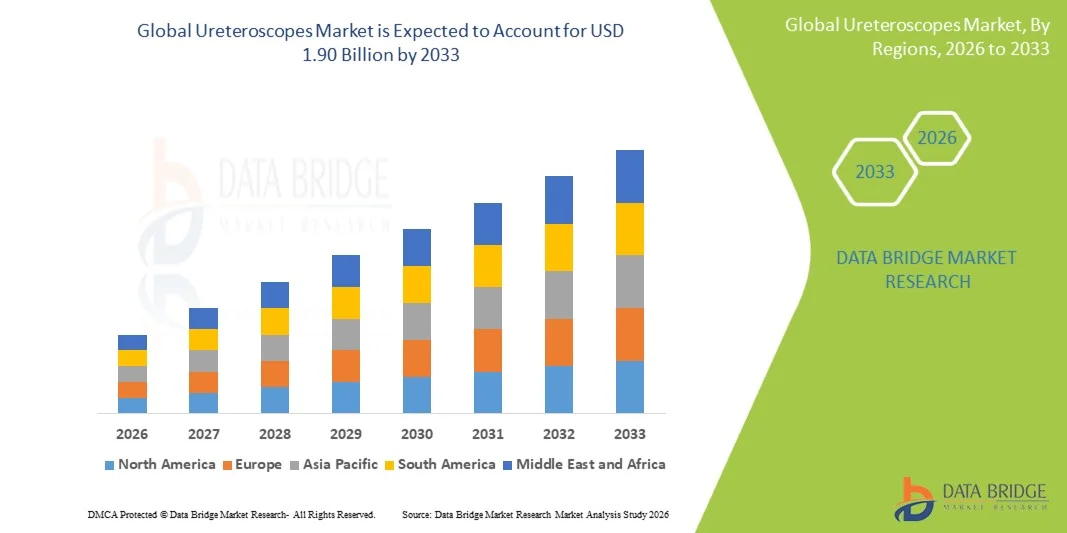
- The global ureteroscopes market size was valued at USD 1.30 billion in 2025 and is expected to reach USD 1.90 billion by 2033, at a CAGR of 4.90% during the forecast period
- The market growth is largely fueled by the increasing prevalence of urolithiasis and other urinary tract disorders, along with the rising adoption of minimally invasive procedures, leading to greater demand for advanced endoscopic solutions in both hospitals and specialty clinics
- Furthermore, continuous technological advancements in flexible and digital ureteroscopes, coupled with growing patient preference for faster recovery and improved clinical outcomes, are establishing ureteroscopes as a critical tool in modern urology. These converging factors are accelerating the uptake of ureteroscopic procedures, thereby significantly boosting the industry's growth
Ureteroscopes Market Analysis
- Ureteroscopes, offering minimally invasive endoscopic visualization and treatment of the urinary tract, are increasingly vital tools in modern urology for diagnosing and managing conditions such as kidney stones and ureteral strictures in both hospital and ambulatory surgical settings due to their precision, reduced recovery time, and improved patient outcomes
- The escalating demand for ureteroscopes is primarily fueled by the rising prevalence of urolithiasis, increasing geriatric population, and a growing preference for minimally invasive surgical procedures among patients and healthcare providers
- North America dominated the ureteroscopes market with the largest revenue share of 40.7% in 2025, characterized by advanced healthcare infrastructure, high adoption of innovative medical technologies, and a strong presence of leading market players, with the U.S. experiencing substantial growth in ureteroscopic procedures driven by increasing awareness and availability of specialized urology services
- Asia-Pacific is expected to be the fastest growing region in the ureteroscopes market during the forecast period due to improving healthcare infrastructure, rising medical tourism, and increasing healthcare expenditure
- Flexible ureteroscopes segment dominated the ureteroscopes market with a market share of 43.9% in 2025, driven by their superior maneuverability, enhanced imaging capabilities, and growing preference among urologists for complex stone management procedures
Report Scope and Ureteroscopes Market Segmentation
|
Attributes |
Ureteroscopes Key Market Insights |
|
Segments Covered |
|
|
Countries Covered |
North America
Europe
Asia-Pacific
Middle East and Africa
South America
|
|
Key Market Players |
|
|
Market Opportunities |
|
|
Value Added Data Infosets |
In addition to the insights on market scenarios such as market value, growth rate, segmentation, geographical coverage, and major players, the market reports curated by the Data Bridge Market Research also include in-depth expert analysis, patient epidemiology, pipeline analysis, pricing analysis, and regulatory framework |
Ureteroscopes Market Trends
“Advancements in Digital Imaging and Single-Use Technologies”
- A significant and accelerating trend in the global ureteroscopes market is the increasing adoption of advanced digital imaging systems and single-use (disposable) ureteroscopes. This combination of technologies is significantly enhancing procedural efficiency and patient safety.
- For instance, Olympus Corporation offers digital flexible ureteroscopes with high-definition visualization, while Boston Scientific has introduced single-use ureteroscopes designed to eliminate reprocessing and reduce contamination risks.
- Technological integration in ureteroscopes enables features such as enhanced visualization, improved maneuverability, and reduced infection risks. For instance, some single-use models provide consistent performance without degradation from repeated sterilization and can support better clinical outcomes in complex procedures. Furthermore, digital systems allow urologists to perform more precise diagnostics and treatments with improved clarity.
- The seamless integration of ureteroscopes with advanced imaging platforms and hospital information systems facilitates better workflow and data management. Through a single interface, healthcare providers can manage imaging, patient data, and procedural insights, creating a more efficient clinical environment.
- This trend towards more advanced, efficient, and safer ureteroscopic solutions is fundamentally reshaping clinical expectations in urology. Consequently, companies such as Karl Storz are developing next-generation ureteroscopes with improved ergonomics, digital capabilities, and single-use options.
- The demand for ureteroscopes that offer superior imaging and reduced infection risks is growing rapidly across hospitals and ambulatory surgical centers, as healthcare providers increasingly prioritize patient safety and operational efficiency
- Growing adoption of robotic-assisted and AI-integrated urology systems is further enhancing the precision and efficiency of ureteroscopic procedures, supporting better clinical decision-making and procedural outcomes
Ureteroscopes Market Dynamics
Driver
“Rising Prevalence of Urological Disorders and Demand for Minimally Invasive Procedures”
- The increasing prevalence of kidney stones and other urological conditions, coupled with the growing preference for minimally invasive surgical techniques, is a significant driver for the heightened demand for ureteroscopes
- For instance, in March 2025, Boston Scientific Corporation expanded its urology portfolio with advanced ureteroscopic solutions aimed at improving stone management procedures. Such strategies by key companies are expected to drive the ureteroscopes industry growth in the forecast period
- As patients and healthcare providers increasingly seek procedures with shorter recovery times and reduced complications, ureteroscopes provide effective solutions for diagnosis and treatment, offering a compelling alternative to traditional surgical methods
- Furthermore, the growing awareness of early diagnosis and the expansion of healthcare infrastructure are making ureteroscopic procedures more accessible, particularly in emerging markets
- The ability to perform precise stone removal, improved patient outcomes, and reduced hospital stays are key factors propelling the adoption of ureteroscopes in both developed and developing regions. The trend towards outpatient procedures and advancements in urology equipment further contribute to market growth
- Increasing investments in healthcare infrastructure and urology departments across emerging economies are further driving the demand for advanced ureteroscopic solutions
- Rising number of trained urologists and growing availability of specialized training programs are supporting wider adoption of ureteroscopic procedures globally
Restraint/Challenge
“High Costs and Risk of Device Reprocessing Limitations”
- Concerns surrounding the high cost of advanced ureteroscopes, particularly digital and single-use devices, pose a significant challenge to broader market penetration. As these devices require significant investment, they can strain healthcare budgets, especially in smaller facilities
- For instance, high procurement and maintenance costs associated with reusable ureteroscopes, along with the recurring expense of disposable variants, have made some healthcare providers cautious about widespread adoption
- Addressing these cost concerns through efficient pricing strategies, improved durability, and reimbursement support is crucial for broader adoption. Companies such as Olympus and Karl Storz emphasize product longevity and performance in their offerings to justify investment. Additionally, the need for specialized training and proper handling of ureteroscopes can be a barrier for healthcare professionals, particularly in resource-limited settings
- While technological advancements are improving usability, the complexity of procedures and device handling requirements can still hinder adoption, especially in regions with limited skilled professionals
- Overcoming these challenges through cost optimization, training programs, and improved device accessibility will be vital for sustained market growth
- Risk of device damage and limited lifespan of reusable ureteroscopes can increase overall operational costs and impact hospital procurement decisions
- Stringent regulatory requirements and approval processes for medical devices can delay product launches and limit the availability of advanced ureteroscopic technologies in certain regions
Ureteroscopes Market Scope
The market is segmented on the basis of product type, application, and end-user.
- By Product Type
On the basis of product type, the ureteroscopes market is segmented into digital ureteroscopes, flexible ureteroscopes, rigid ureteroscope, semi-rigid ureteroscopes, and fiberoptic ureteroscopes. The flexible ureteroscopes segment dominated the market with the largest market revenue share of 43.9% in 2025, driven by their superior maneuverability and ability to access complex anatomical structures within the urinary tract. These devices are widely preferred for treating kidney stones and other urological conditions due to their minimally invasive nature and enhanced patient outcomes. The growing adoption of flexible ureteroscopes is further supported by advancements in imaging technologies and improved durability. Their compatibility with laser lithotripsy and increasing use in outpatient procedures also contribute significantly to their dominance. Additionally, healthcare providers favor flexible ureteroscopes for their ability to reduce procedural complications and hospital stays, making them a standard choice in modern urology practices.
The digital ureteroscopes segment is anticipated to witness the fastest growth rate from 2026 to 2033, fueled by the increasing demand for high-definition imaging and improved visualization during procedures. Digital ureteroscopes offer superior image quality compared to traditional fiberoptic systems, enabling more accurate diagnosis and treatment. Their integration with advanced imaging platforms enhances clinical efficiency and supports better decision-making. The rising focus on precision medicine and technological innovation is further accelerating their adoption. Additionally, the shift towards disposable digital ureteroscopes to minimize infection risks and maintenance costs is boosting segment growth. Growing investments by key players in digital technologies are also contributing to the rapid expansion of this segment.
- By Application
On the basis of application, the ureteroscopes market is segmented into urinary stricture, urolithiasis, kidney cancer, and diagnostics. The urolithiasis segment dominated the market with the largest revenue share in 2025, driven by the high global prevalence of kidney stones and increasing incidence of lifestyle-related disorders. Ureteroscopes are extensively used for stone detection and removal due to their effectiveness in minimally invasive procedures. The growing preference for ureteroscopy over traditional surgical methods is further supporting segment growth. Advancements in laser lithotripsy and imaging technologies are enhancing treatment outcomes and efficiency. Additionally, the rising geriatric population, which is more prone to kidney stones, is contributing to the dominance of this segment. Increasing awareness and early diagnosis are also encouraging the use of ureteroscopes in urolithiasis management.
The diagnostics segment is expected to witness the fastest growth rate from 2026 to 2033, driven by the increasing emphasis on early detection of urological conditions. Ureteroscopes are increasingly utilized for detailed visualization and assessment of the urinary tract, enabling accurate diagnosis of various disorders. The integration of digital imaging and AI-based tools is enhancing diagnostic capabilities and clinical outcomes. Rising healthcare expenditure and improved access to diagnostic services are further supporting segment growth. Additionally, the growing prevalence of urological diseases is creating a need for advanced diagnostic solutions. The expansion of specialized urology centers is also contributing to the rapid adoption of ureteroscopes for diagnostic purposes.
- By End-User
On the basis of end-user, the ureteroscopes market is segmented into ambulatory surgical centers, specialty clinics, hospitals, urology clinics, diagnostic centers, endoscopic clinic, and others. The hospitals segment dominated the market with the largest revenue share in 2025, driven by the availability of advanced healthcare infrastructure and skilled professionals. Hospitals are the primary settings for complex ureteroscopic procedures, offering comprehensive diagnostic and treatment facilities. The high patient inflow and availability of reimbursement policies further support the dominance of this segment. Additionally, hospitals are more likely to invest in advanced ureteroscopic technologies, including digital and flexible devices. The presence of multidisciplinary teams enhances procedural success rates and patient outcomes. Continuous upgrades in hospital equipment and facilities also contribute to segment growth.
The ambulatory surgical centers segment is expected to witness the fastest growth rate from 2026 to 2033, fueled by the increasing shift towards outpatient and minimally invasive procedures. These centers offer cost-effective treatment options and reduced hospital stays, making them attractive to both patients and healthcare providers. The growing adoption of advanced ureteroscopic technologies in ambulatory settings is enhancing procedural efficiency. Additionally, shorter recovery times and lower risk of hospital-acquired infections are encouraging patients to opt for these facilities. The expansion of ambulatory care infrastructure in emerging markets is further driving growth. Increasing focus on value-based healthcare and operational efficiency is also supporting the rapid rise of this segment.
Ureteroscopes Market Regional Analysis
- North America dominated the ureteroscopes market with the largest revenue share of 40.7% in 2025, characterized by advanced healthcare infrastructure, high adoption of innovative medical technologies, and a strong presence of leading market players
- Healthcare providers in the region highly value the precision, improved clinical outcomes, and advanced imaging capabilities offered by ureteroscopes in the diagnosis and treatment of urinary tract conditions
- This widespread adoption is further supported by advanced healthcare infrastructure, high healthcare expenditure, and the strong presence of leading medical device manufacturers, establishing ureteroscopes as a preferred solution for urological procedures across hospitals and specialty clinics
U.S. Ureteroscopes Market Insight
The U.S. ureteroscopes market captured the largest revenue share of 81% in 2025 within North America, fueled by the rising prevalence of kidney stones and the expanding adoption of minimally invasive urological procedures. Healthcare providers are increasingly prioritizing advanced endoscopic solutions for improved clinical outcomes and reduced patient recovery time. The growing preference for outpatient procedures, combined with robust demand for digital and flexible ureteroscopes, further propels the market. Moreover, the increasing integration of advanced imaging technologies and laser lithotripsy systems is significantly contributing to the market's expansion.
Europe Ureteroscopes Market Insight
The Europe ureteroscopes market is projected to expand at a substantial CAGR throughout the forecast period, primarily driven by increasing incidence of urological disorders and the rising need for advanced diagnostic and treatment solutions. The increase in aging population, coupled with the demand for minimally invasive procedures, is fostering the adoption of ureteroscopes. European healthcare systems are also inclined toward improving patient outcomes and reducing hospital stays. The region is experiencing significant growth across hospitals and specialty clinics, with ureteroscopes being incorporated into both routine diagnostics and complex surgical procedures.
U.K. Ureteroscopes Market Insight
The U.K. ureteroscopes market is anticipated to grow at a noteworthy CAGR during the forecast period, driven by the increasing demand for efficient urological treatments and a focus on reducing surgical complications. Additionally, rising awareness regarding early diagnosis and treatment of urinary tract conditions is encouraging both patients and healthcare providers to opt for minimally invasive procedures. The UK’s advanced healthcare infrastructure, alongside its strong clinical research environment, is expected to continue to stimulate market growth.
Germany Ureteroscopes Market Insight
The Germany ureteroscopes market is expected to expand at a considerable CAGR during the forecast period, fueled by increasing adoption of technologically advanced medical devices and the demand for high-quality healthcare services. Germany’s well-developed healthcare system, combined with its emphasis on innovation and precision medicine, promotes the adoption of ureteroscopes, particularly in hospitals and specialized urology centers. The integration of digital ureteroscopes with advanced imaging systems is also becoming increasingly prevalent, with a strong preference for efficient and accurate diagnostic solutions aligning with clinical standards.
Asia-Pacific Ureteroscopes Market Insight
The Asia-Pacific ureteroscopes market is poised to grow at the fastest CAGR of 24% during the forecast period of 2026 to 2033, driven by increasing healthcare expenditure, rising prevalence of kidney stones, and improving medical infrastructure in countries such as China, Japan, and India. The region's growing focus on expanding access to advanced healthcare services is driving the adoption of ureteroscopes. Furthermore, as APAC emerges as a key market for medical device manufacturing and innovation, the affordability and accessibility of ureteroscopic procedures are expanding to a wider patient population.
Japan Ureteroscopes Market Insight
The Japan ureteroscopes market is gaining momentum due to the country’s advanced healthcare system, rapidly aging population, and demand for minimally invasive treatments. The Japanese market places a significant emphasis on precision and patient safety, and the adoption of ureteroscopes is driven by the increasing number of urological procedures. The integration of advanced imaging technologies and robotic-assisted systems is fueling growth. Moreover, Japan's aging population is likely to spur demand for efficient, safe, and minimally invasive urological solutions in both hospital and outpatient settings.
India Ureteroscopes Market Insight
The India ureteroscopes market accounted for the largest market revenue share in Asia Pacific in 2025, attributed to the country's growing healthcare infrastructure, rising burden of urological disorders, and increasing awareness of minimally invasive treatments. India stands as one of the fastest-growing markets for medical devices, and ureteroscopes are becoming increasingly utilized in hospitals, specialty clinics, and diagnostic centers. The push towards improving healthcare access and the availability of cost-effective treatment options, alongside the presence of domestic and international manufacturers, are key factors propelling the market in India.
Ureteroscopes Market Share
The Ureteroscopes industry is primarily led by well-established companies, including:
- Olympus Corporation (Japan)
- Boston Scientific Corporation (U.S.)
- Stryker (U.S.)
- KARL STORZ SE & Co. KG (Germany)
- Richard Wolf GmbH (Germany)
- PENTAX Medical (Japan)
- Cook (U.S.)
- Dornier MedTech GmbH (Germany)
- EMS Electro Medical Systems S.A. (Switzerland)
- Vimex Sp. z o.o. (Poland)
- Elmed Medical Systems (Turkey)
- Prosurg Inc. (U.S.)
- AED.MD (U.S.)
- Maxer Endoscopy GmbH (Germany)
- SCHÖLLY FIBEROPTIC GMBH (Germany)
- Rocamed SAM (Monaco)
- Coloplast A/S (Denmark)
- Medtronic (Ireland)
- CONMED Corporation (U.S.)
- Teleflex Incorporated (U.S.)
What are the Recent Developments in Global Ureteroscopes Market?
- In September 2025, Olympus Corporation announced the launch of its VISERA S OTV-S500 imaging platform in the U.S., integrating advanced diagnostic imaging capabilities for urology applications. The platform enhances visualization and workflow efficiency in both outpatient and hospital settings, supporting procedures involving ureteroscopes. This development reflects the growing emphasis on high-definition imaging systems to improve clinical outcomes in urological interventions
- In June 2024, Ambu A/S, a global leader in single-use endoscopy, announced U.S. FDA 510(k) clearance of its aScope™ 5 Uretero system along with the aBox™ 2 full-HD endoscopy platform. The solution offers improved optics, compact design, and is the first ureteroscope developed using bioplastic materials to reduce environmental impact. This development highlights the growing focus on sustainability and disposable device innovation in the ureteroscopes market
- In April 2024, Olympus Corporation, a leading global medical technology company, announced the U.S. FDA 510(k) clearance of its RenaFlex™ single-use flexible ureteroscope system, designed for diagnostic and therapeutic procedures within the urinary tract. The system offers advanced visualization, improved maneuverability, and supports minimally invasive treatment of conditions such as kidney stones. This launch highlights Olympus’ strategic expansion into disposable ureteroscope solutions aimed at reducing infection risks and improving procedural efficiency
- In November 2023, Ambu A/S, a prominent medical technology company, received CE mark approval in Europe for its aScope™ 5 Uretero ureteroscopy solution, enabling commercialization across European markets. The system supports high-definition imaging and is designed for single-use applications to enhance infection control and workflow efficiency. This regulatory milestone reflects increasing adoption of disposable ureteroscopes in global healthcare systems
- In February 2023, Boston Scientific Corporation, a leading medical device company, announced the U.S. FDA 510(k) clearance of its LithoVue™ Elite single-use digital flexible ureteroscope system, designed to provide real-time intrarenal pressure monitoring during ureteroscopy procedures. The system integrates advanced imaging with pressure-sensing technology to help physicians make more informed clinical decisions and reduce complications. This innovation represents a significant advancement in ureteroscopic safety and precision

- Interactive Data Analysis Dashboard
- Company Analysis Dashboard for high growth potential opportunities
- Research Analyst Access for customization & queries
- Competitor Analysis with Interactive dashboard
- Latest News, Updates & Trend analysis
- Harness the Power of Benchmark Analysis for Comprehensive Competitor Tracking
Data collection and base year analysis are done using data collection modules with large sample sizes. The stage includes obtaining market information or related data through various sources and strategies. It includes examining and planning all the data acquired from the past in advance. It likewise envelops the examination of information inconsistencies seen across different information sources. The market data is analysed and estimated using market statistical and coherent models. Also, market share analysis and key trend analysis are the major success factors in the market report. To know more, please request an analyst call or drop down your inquiry.
The key research methodology used by DBMR research team is data triangulation which involves data mining, analysis of the impact of data variables on the market and primary (industry expert) validation. Data models include Vendor Positioning Grid, Market Time Line Analysis, Market Overview and Guide, Company Positioning Grid, Patent Analysis, Pricing Analysis, Company Market Share Analysis, Standards of Measurement, Global versus Regional and Vendor Share Analysis. To know more about the research methodology, drop in an inquiry to speak to our industry experts.
Data Bridge Market Research is a leader in advanced formative research. We take pride in servicing our existing and new customers with data and analysis that match and suits their goal. The report can be customized to include price trend analysis of target brands understanding the market for additional countries (ask for the list of countries), clinical trial results data, literature review, refurbished market and product base analysis. Market analysis of target competitors can be analyzed from technology-based analysis to market portfolio strategies. We can add as many competitors that you require data about in the format and data style you are looking for. Our team of analysts can also provide you data in crude raw excel files pivot tables (Fact book) or can assist you in creating presentations from the data sets available in the report.













