




Global Usage Based Insurance For Automotive Market
Market Size in USD Billion
CAGR :
% 
 USD
77.54 Billion
USD
388.14 Billion
2025
2033
USD
77.54 Billion
USD
388.14 Billion
2025
2033
 Forecast Period Forecast Period |
2026 –2033 |
 Market Size (Base Year) Market Size (Base Year) |
USD 77.54 Billion |
 Market Size (Forecast Year) Market Size (Forecast Year) |
USD 388.14 Billion |
 CAGR CAGR |
% |
| Major Markets Players |
|
Usage-Based Insurance for Automotive Market Size
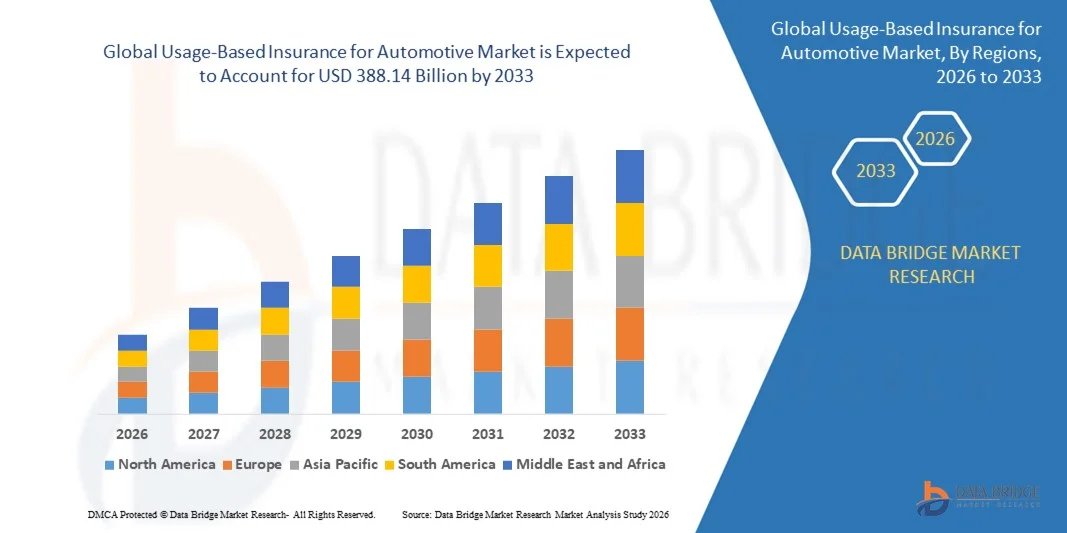
- The global usage-based insurance for automotive market size was valued at USD 77.54 billion in 2025 and is expected to reach USD 388.14 billion by 2033, at a CAGR of 22.30% during the forecast period
- The market growth is largely fuelled by the rising adoption of telematics and connected vehicle technologies, which enable insurers to monitor driver behavior and offer personalized insurance premiums
- Increasing awareness among consumers regarding cost-efficient insurance options and pay-as-you-drive models is further driving market demand
Usage-Based Insurance for Automotive Market Analysis
- The market is witnessing rapid transformation with advancements in connected car technologies, enabling insurers to provide tailored insurance plans based on actual driving patterns
- Insurance providers are increasingly collaborating with telematics companies and automotive manufacturers to leverage data analytics for risk assessment, claims management, and fraud prevention
- North America dominated the usage-based insurance for automotive market with the largest revenue share of 38.75% in 2025, driven by widespread adoption of connected vehicles, advanced telematics, and growing consumer interest in personalized insurance models
- Asia-Pacific region is expected to witness the highest growth rate in the global usage-based insurance for automotive market, driven by rapid urbanization, increasing digital infrastructure, and government initiatives supporting smart and connected mobility solutions
- The PAYD segment held the largest market revenue share in 2025, driven by its simplicity and cost-effectiveness, as premiums are calculated based on distance traveled. PAYD policies are widely preferred by occasional drivers and fleet operators who seek lower insurance costs without complex monitoring requirements
Report Scope and Usage-Based Insurance for Automotive Market Segmentation
|
Attributes |
Usage-Based Insurance for Automotive Key Market Insights |
|
Segments Covered |
|
|
Countries Covered |
North America
Europe
Asia-Pacific
Middle East and Africa
South America
|
|
Key Market Players |
|
|
Market Opportunities |
|
|
Value Added Data Infosets |
In addition to the market insights such as market value, growth rate, market segments, geographical coverage, market players, and market scenario, the market report curated by the Data Bridge Market Research team includes in-depth expert analysis, import/export analysis, pricing analysis, production consumption analysis, and pestle analysis. |
Usage-Based Insurance for Automotive Market Trends
Rising Adoption Of Telematics-Based And Pay-How-You-Drive Models
- The growing focus on personalized insurance solutions is significantly shaping the usage-based insurance for automotive market, as consumers increasingly prefer pay-as-you-drive and pay-how-you-drive models that reflect individual driving behavior. Telematics-based insurance is gaining traction due to its ability to reduce premiums for safe drivers while improving risk assessment for insurers. This trend encourages providers to innovate with new usage-based offerings tailored to evolving consumer needs
- Increasing awareness of vehicle safety, responsible driving, and insurance cost optimization has accelerated the adoption of usage-based insurance in passenger cars, commercial vehicles, and fleet operations. Policyholders are actively seeking solutions that reward safe driving and provide real-time feedback, prompting insurers to invest in telematics devices, mobile applications, and data analytics platforms
- Digitalization and connected vehicle technologies are influencing purchasing decisions, with insurers emphasizing real-time monitoring, automated claims processing, and predictive risk analytics. These factors help insurance companies differentiate products in a competitive market and build consumer trust, while also driving regulatory compliance and adoption of telematics-based rating systems
- For instance, in 2024, Progressive Corporation in the U.S. and Allianz in Germany expanded their usage-based insurance offerings by incorporating mobile telematics apps and connected vehicle platforms. These launches were introduced in response to rising consumer preference for personalized insurance, with distribution across direct channels, brokers, and digital platforms. The products were also marketed as cost-efficient and safe driving-oriented choices, enhancing customer loyalty and repeat policy renewals
- While adoption of usage-based insurance is growing, sustained market expansion depends on continuous innovation, data privacy assurance, and accurate risk modeling. Insurers are also focusing on improving scalability, cybersecurity, and predictive analytics capabilities to balance cost, accuracy, and customer satisfaction for broader adoption
Usage-Based Insurance for Automotive Market Dynamics
Driver
Rising Demand For Personalized And Cost-Efficient Insurance Solutions
- Growing preference for tailored insurance products is a major driver for the usage-based insurance market. Policyholders increasingly favor plans that reward safe driving behavior, reduce premiums, and provide transparent tracking of driving performance. This trend is also pushing insurers to develop new telematics-based solutions that align with evolving mobility trends
- Expanding adoption of connected vehicles, fleet telematics, and mobile applications is further fueling market growth. Usage-based insurance enables insurers to monitor driving patterns in real-time, improve claims accuracy, and offer flexible pricing models, enhancing operational efficiency and customer satisfaction
- Insurers are offering customized policies, including pay-as-you-drive, pay-how-you-drive, and mileage-based insurance, to meet individual and fleet requirements. These solutions also include incentives for eco-friendly driving, accident prevention, and safe driving programs
- For instance, in 2023, Allstate in the U.S. and AXA in France enhanced their telematics-based offerings for both individual and fleet customers. These initiatives allowed insurers to provide more competitive premiums, improve risk assessment, and encourage safer driving habits, supporting market adoption and customer retention
- The combination of cost efficiency, personalization, and advanced risk analytics is expected to continue driving global adoption of usage-based insurance solutions. In addition, integration with IoT-enabled vehicles and AI-powered predictive models ensures better risk management, lower claims, and increased ROI for insurers
Restraint/Challenge
Data Privacy Concerns And Technological Barriers
- Concerns regarding data privacy and cybersecurity remain key challenges, limiting adoption among privacy-conscious consumers. Continuous collection and analysis of driving data require strict regulatory compliance and robust data protection measures, which can increase operational costs for insurers
- Technological barriers, such as limited smartphone penetration, vehicle compatibility, and telematics device adoption, also restrict market growth. Policyholders in regions with underdeveloped connected infrastructure may face difficulties in accessing usage-based insurance products
- Consumer awareness and trust remain uneven, particularly in developing markets where telematics adoption and digital literacy are still emerging. Limited understanding of benefits and functional features reduces willingness to adopt usage-based models
- For instance, in 2024, some insurers in India and Southeast Asia reported slower uptake of pay-how-you-drive policies due to concerns about continuous monitoring, data sharing, and device installation. Regulatory uncertainties and regional variations in insurance laws further impacted adoption rates
- Overcoming these challenges will require improved cybersecurity, educational initiatives, and enhanced telematics integration. Collaboration between insurers, regulators, and technology providers can help unlock the long-term growth potential of the global usage-based insurance for automotive market. Furthermore, offering transparent policies and demonstrating clear cost benefits will be essential for wider adoption
Usage-Based Insurance for Automotive Market Scope
The usage-based insurance for automotive market is segmented on the basis of type, technology, and vehicle type.
- By Type
On the basis of type, the market is segmented into Pay-As-You-Drive (PAYD), Pay-How-You-Drive (PHYD), and Manage-How-You-Drive (MHYD). The PAYD segment held the largest market revenue share in 2025, driven by its simplicity and cost-effectiveness, as premiums are calculated based on distance traveled. PAYD policies are widely preferred by occasional drivers and fleet operators who seek lower insurance costs without complex monitoring requirements.
The PHYD segment is expected to witness the fastest growth rate from 2026 to 2033, driven by its ability to monitor driving behavior such as speed, braking, and acceleration, enabling insurers to reward safe driving. PHYD-based policies are particularly popular for individual policyholders and commercial fleets seeking personalized insurance premiums and enhanced risk management.
- By Technology
On the basis of technology, the market is segmented into OBD II, Black Box, Smartphones, and Others. The OBD II segment accounted for the largest market share in 2025, owing to its compatibility with most vehicles and ability to provide accurate driving data for premium calculation. OBD II devices are widely adopted by insurers for both passenger and commercial vehicles.
The Smartphone segment is expected to witness the fastest growth from 2026 to 2033, fueled by the proliferation of mobile apps and telematics platforms that allow easy installation, real-time monitoring, and direct feedback to drivers. Smartphone-based solutions are gaining popularity due to low cost, convenience, and integration with connected car ecosystems.
- By Vehicle Type
On the basis of vehicle type, the market is segmented into Passenger Auto and Commercial Auto. The Passenger Auto segment held the largest market revenue share in 2025, driven by widespread adoption of personalized insurance policies and increasing awareness of cost-saving opportunities among individual drivers.
The Commercial Auto segment is projected to witness the fastest growth from 2026 to 2033, propelled by rising demand from logistics, delivery, and fleet operators for telematics-based insurance solutions that optimize operational efficiency, reduce risk, and lower claims costs. Commercial fleets benefit from data-driven insights to enhance driver safety and minimize insurance premiums.
Usage-Based Insurance for Automotive Market Regional Analysis
- North America dominated the usage-based insurance for automotive market with the largest revenue share of 38.75% in 2025, driven by widespread adoption of connected vehicles, advanced telematics, and growing consumer interest in personalized insurance models
- The presence of well-established insurance providers, coupled with high vehicle ownership and technology-friendly consumers, further strengthens market penetration
- Digital platforms offering usage monitoring, mobile-based apps, and driver analytics are fueling adoption among individual and commercial policyholders
U.S. Usage-Based Insurance Market Insight
The U.S. usage-based insurance for automotive market captured the largest revenue share in 2025 within North America, propelled by the increasing penetration of connected and smart vehicles. Insurers are leveraging telematics, OBD II devices, and smartphone apps to collect real-time driving data, enabling personalized premiums based on driving behavior. Rising consumer awareness regarding cost savings, risk management, and safer driving incentives is further accelerating market expansion. Moreover, partnerships between automakers, telematics providers, and insurance companies are enhancing service offerings and customer experience.
Europe Usage-Based Insurance Market Insight
The Europe usage-based insurance market is expected to witness the fastest growth rate from 2026 to 2033, primarily driven by regulatory support for telematics-based insurance and growing demand for pay-as-you-drive and pay-how-you-drive models. Increasing vehicle connectivity and smart city initiatives are encouraging the adoption of digital insurance solutions. Consumers are attracted to flexible, behavior-based pricing models that reward safe driving while reducing premiums. The market is also benefiting from technological innovations in mobile applications and IoT-enabled insurance platforms.
U.K. Usage-Based Insurance Market Insight
The U.K. usage-based insurance market is expected to witness rapid growth from 2026 to 2033, fueled by the rising trend of connected vehicles and telematics adoption. Consumers are increasingly seeking insurance models that offer personalized premiums and rewards for safe driving behavior. The integration of smartphone-based monitoring systems and advanced driver analytics is driving higher engagement. In addition, the U.K.’s digital insurance ecosystem and strong automotive telematics infrastructure are supporting market development.
Germany Usage-Based Insurance Market Insight
The Germany usage-based insurance market is expected to witness significant growth from 2026 to 2033, driven by a strong automotive sector, digitalization of insurance services, and the growing acceptance of PAYD and PHYD insurance models. Increasing awareness of cost-saving opportunities, coupled with advanced vehicle telematics and smartphone monitoring solutions, is enhancing consumer adoption. German insurers are also collaborating with technology providers to improve data accuracy, user experience, and risk assessment capabilities.
Asia-Pacific Usage-Based Insurance Market Insight
The Asia-Pacific usage-based insurance market is expected to witness the fastest growth rate from 2026 to 2033, driven by rising vehicle sales, growing middle-class population, and increasing adoption of connected vehicles in countries such as China, India, and Japan. The region is witnessing rapid telematics penetration, smartphone-based insurance solutions, and regulatory initiatives supporting innovative insurance models. These factors, along with increased consumer awareness of safer driving incentives, are contributing to robust market expansion.
Japan Usage-Based Insurance Market Insight
The Japan usage-based insurance market is expected to witness strong growth from 2026 to 2033, fueled by technological adoption, high vehicle connectivity, and consumer preference for personalized insurance premiums. Telematics-enabled insurance models are increasingly integrated with mobile applications to monitor driver behavior, reduce risk, and offer rewards for safe driving. Japan’s aging population and focus on road safety are also driving demand for behavior-based insurance solutions across personal and commercial vehicles.
China Usage-Based Insurance Market Insight
The China usage-based insurance market accounted for the largest revenue share in Asia-Pacific in 2025, attributed to rapid urbanization, increasing vehicle ownership, and government support for telematics-based insurance. The adoption of smartphone-based monitoring and OBD II devices allows insurers to offer flexible pricing models and incentives for safe driving. Strong collaborations between insurance providers, automakers, and telematics solution vendors are further accelerating market growth, making China one of the leading markets for usage-based insurance globally.
Usage-Based Insurance for Automotive Market Share
The Usage-Based Insurance for Automotive industry is primarily led by well-established companies, including:
- Progressive Corporation (U.S.)
- Assicurazioni Generali S.p.A. (Italy)
- Mapfre S.A. (Spain)
- American International Group, Inc. (U.S.)
- Mechatronic Systems Inc. (U.S.)
- Nationwide Mutual Insurance Company (U.S.)
- Esurance Insurance Services, Inc. (U.S.)
- The Travelers Indemnity Company (U.S.)
- Progressive Casualty Insurance Co (U.S.)
- Metromile Inc. (U.S.)
- Liberty Mutual Insurance (U.S.)
- Trak Global Group (U.K.)
- Allianz (Germany)
- Desjardins General Insurance (Canada)
- Insurance Box Pty Ltd (Australia)
- Verizon (U.S.)
- Sierra Wireless (Canada)
- The Floow Limited (U.K.)
- TomTom International BV. (Netherlands)
- Cambridge Mobile Telematics (U.S.)
Latest Developments in Global Usage-Based Insurance for Automotive Market
- In April 2024, Allstate, Product Launch, introduced insights from its Drivewise application in partnership with Arity, a mobile data and analytics company. The solution provides users with feedback on safe driving after every trip, helping reduce the likelihood of severe collisions by 25% compared to non-users. This initiative promotes safer driving habits, encourages adoption of usage-based insurance programs, and is expected to strengthen Allstate’s position in the U.S. market
- In February 2022, Ford, Product Launch, rolled out the ‘Drive Safe & Save’ program in collaboration with State Farm Insurance for Lincoln and Ford vehicle owners in the U.S. The solution uses Bluetooth-enabled connected vehicles to track trips automatically, providing policyholders with personalized driving insights. This initiative aims to incentivize safe driving, reduce accident rates, and expand the penetration of usage-based insurance solutions across multiple states
SKU-
Get online access to the report on the World's First Market Intelligence Cloud

- Interactive Data Analysis Dashboard
- Company Analysis Dashboard for high growth potential opportunities
- Research Analyst Access for customization & queries
- Competitor Analysis with Interactive dashboard
- Latest News, Updates & Trend analysis
- Harness the Power of Benchmark Analysis for Comprehensive Competitor Tracking
Research Methodology
Data collection and base year analysis are done using data collection modules with large sample sizes. The stage includes obtaining market information or related data through various sources and strategies. It includes examining and planning all the data acquired from the past in advance. It likewise envelops the examination of information inconsistencies seen across different information sources. The market data is analysed and estimated using market statistical and coherent models. Also, market share analysis and key trend analysis are the major success factors in the market report. To know more, please request an analyst call or drop down your inquiry.
The key research methodology used by DBMR research team is data triangulation which involves data mining, analysis of the impact of data variables on the market and primary (industry expert) validation. Data models include Vendor Positioning Grid, Market Time Line Analysis, Market Overview and Guide, Company Positioning Grid, Patent Analysis, Pricing Analysis, Company Market Share Analysis, Standards of Measurement, Global versus Regional and Vendor Share Analysis. To know more about the research methodology, drop in an inquiry to speak to our industry experts.
Customization Available
Data Bridge Market Research is a leader in advanced formative research. We take pride in servicing our existing and new customers with data and analysis that match and suits their goal. The report can be customized to include price trend analysis of target brands understanding the market for additional countries (ask for the list of countries), clinical trial results data, literature review, refurbished market and product base analysis. Market analysis of target competitors can be analyzed from technology-based analysis to market portfolio strategies. We can add as many competitors that you require data about in the format and data style you are looking for. Our team of analysts can also provide you data in crude raw excel files pivot tables (Fact book) or can assist you in creating presentations from the data sets available in the report.












