


Global Variable Refrigerant Flow Vrf Systems Market
Market Size in USD Billion
CAGR :
% 
 USD
16.09 Billion
USD
37.09 Billion
2025
2033
USD
16.09 Billion
USD
37.09 Billion
2025
2033
 Forecast Period Forecast Period |
2026 –2033 |
 Market Size (Base Year) Market Size (Base Year) |
USD 16.09 Billion |
 Market Size (Forecast Year) Market Size (Forecast Year) |
USD 37.09 Billion |
 CAGR CAGR |
% |
| Major Markets Players |
|
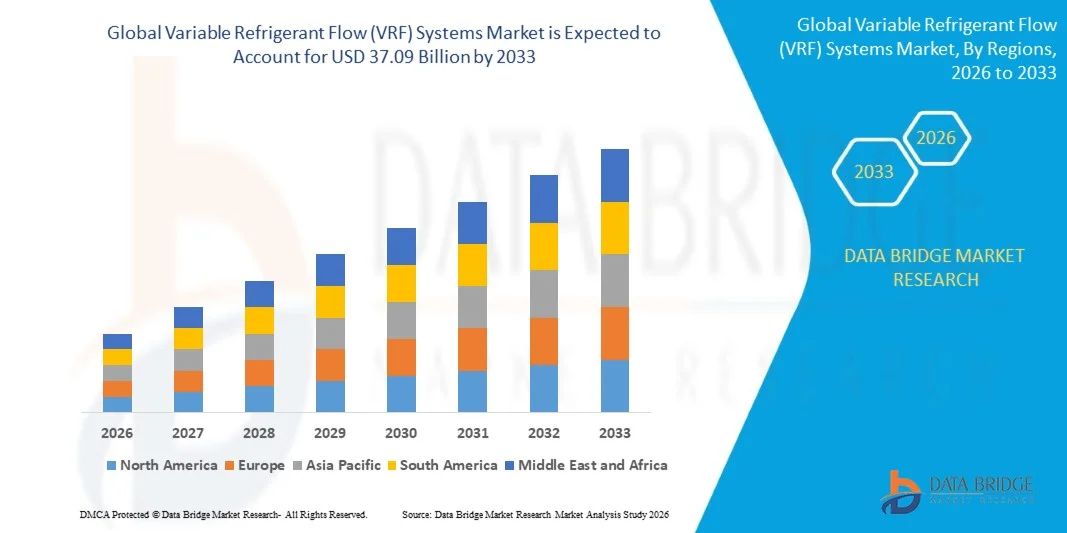
What is the Global Variable Refrigerant Flow (VRF) Systems Market Size and Growth Rate?
- The global variable refrigerant flow (VRF) systems market size was valued at USD 16.09 billion in 2025 and is expected to reach USD 37.09 billion by 2033, at a CAGR of 11.00% during the forecast period
- The Variable Refrigerant Flow (VRF) systems market has seen significant technological advancements, focusing on energy efficiency, adaptability, and integration with smart technologies
- Recent developments include the introduction of intelligent VRF systems that incorporate IoT-enabled sensors for monitoring and adjusting energy use in real-time, leading to increased efficiency. Inverter-driven compressors have been upgraded to provide more precise control over refrigerant flow, reducing energy consumption and enhancing system reliability
What are the Major Takeaways of Variable Refrigerant Flow (VRF) Systems Market?
- Key advancement is the use of heat recovery VRF systems, which allow simultaneous heating and cooling in different areas of a building, optimizing energy use. These systems are increasingly integrated with Building Management Systems (BMS), enabling remote monitoring and control, further enhancing operational efficiency
- The market's growth is driven by rising demand for energy-efficient solutions in commercial and residential buildings. The integration of smart thermostats and advanced controls has boosted adoption, especially in regions with extreme weather conditions. In addition, green building initiatives and regulatory support for reducing carbon emissions continue to drive the expansion of VRF systems globally
- North America dominated the variable refrigerant flow (VRF) systems market with a 35.2% revenue share in 2025, supported by strong demand for energy-efficient HVAC technologies across the U.S. and Canada
- Asia-Pacific is projected to register the fastest CAGR of 11.98% from 2026 to 2033, driven by rapid urbanization, strong construction growth, and increasing adoption of high-performance cooling systems in China, Japan, India, and South Korea
- The Outdoor Units segment dominated the market with a revenue share of 46.8% in 2025, driven by rising adoption of energy-efficient multi-unit outdoor modules used in commercial complexes, residential towers, and large corporate buildings
Report Scope and Variable Refrigerant Flow (VRF) Systems Market Segmentation
|
Attributes |
Variable Refrigerant Flow (VRF) Systems Key Market Insights |
|
Segments Covered |
|
|
Countries Covered |
North America
Europe
Asia-Pacific
Middle East and Africa
South America
|
|
Key Market Players |
|
|
Market Opportunities |
|
|
Value Added Data Infosets |
In addition to the insights on market scenarios such as market value, growth rate, segmentation, geographical coverage, and major players, the market reports curated by the Data Bridge Market Research also include in-depth expert analysis, pricing analysis, brand share analysis, consumer survey, demography analysis, supply chain analysis, value chain analysis, raw material/consumables overview, vendor selection criteria, PESTLE Analysis, Porter Analysis, and regulatory framework. |
What is the Key Trend in the Variable Refrigerant Flow (VRF) Systems Market?
“Rising Demand for Energy-Efficient and Multi-Functional Variable Refrigerant Flow (VRF) Systems”
- The Variable Refrigerant Flow (VRF) Systems market is witnessing strong growth toward high-efficiency, multifunctional, and smart HVAC solutions, driven by rising focus on energy savings, reduced carbon emissions, and sustainable cooling requirements across residential, commercial, and industrial spaces
- Manufacturers are introducing advanced VRF technologies such as heat-recovery VRF, smart zoning, cloud-controlled systems, and integrated sensors to enhance performance, reduce power consumption, and improve indoor comfort
- Consumers and enterprises are increasingly choosing low-energy, eco-friendly, and flexible VRF systems over traditional HVAC systems due to improved scalability, lower operational costs, and enhanced temperature control
- For instance, companies such as Daikin, Mitsubishi Electric, LG Electronics, and Samsung have expanded their VRF portfolios by introducing AI-enabled, IoT-integrated, and low-GWP refrigerant-based systems to support commercial buildings and green construction projects
- Growing awareness of sustainable cooling, building energy standards, and carbon-neutral infrastructure is accelerating global market adoption
- As industries continue seeking smart, efficient, and environmentally responsible cooling technologies, Variable Refrigerant Flow (VRF) Systems are expected to remain central to innovation within the global HVAC market
What are the Key Drivers of Variable Refrigerant Flow (VRF) Systems Market?
- Rising consumer and commercial preference for energy-efficient, flexible, and cost-effective HVAC systems is driving strong global adoption of VRF technology
- For instance, in 2025, major HVAC players such as Daikin and Mitsubishi Electric expanded their VRF product lines incorporating IoT monitoring, predictive maintenance, and low-GWP refrigerants to support green buildings and smart infrastructure
- Increasing global awareness of energy conservation, carbon-reduction policies, and sustainable construction standards is boosting VRF demand across the U.S., Europe, and Asia-Pacific
- Advancements in compressor technology, inverter-driven systems, heat-recovery capabilities, and AI-based automation have enhanced VRF performance, temperature precision, and energy optimization
- Rising demand for eco-friendly refrigerants, green-building certifications, and low-operational-cost HVAC systems is further contributing to market expansion
- With continuous investments in R&D, digital integration, multi-zone systems, and global distribution networks, the Variable Refrigerant Flow (VRF) Systems market is expected to maintain strong growth in the coming years
Which Factor is Challenging the Growth of the Variable Refrigerant Flow (VRF) Systems Market?
- High initial installation costs, advanced system design needs, and complex configuration requirements limit adoption in cost-sensitive regions
- For instance, during 2024–2025, fluctuations in prices of compressors, electronic components, and refrigerants impacted production and installation costs for several manufacturers
- Strict HVAC regulations, building codes, and refrigerant-compliance standards increase operational complexities for OEMs and distributors
- Limited specialist workforce for installation, maintenance, and integration restricts widespread adoption, especially in emerging markets
- Strong competition from traditional HVAC systems, chilled-water solutions, and split AC units creates pricing pressure and slower adoption in small commercial spaces
- To overcome these challenges, companies are focusing on cost-efficient system designs, increased installer training, regulatory alignment, and customer awareness programs to expand global adoption of high-performance Variable Refrigerant Flow (VRF) Systems
How is the Variable Refrigerant Flow (VRF) Systems Market Segmented?
The market is segmented on the basis of component, capacity, system type, and application.
• By Component
On the basis of component, the Variable Refrigerant Flow (VRF) Systems market is segmented into Outdoor Units, Indoor Units, Control Systems, and Accessories. The Outdoor Units segment dominated the market with a revenue share of 46.8% in 2025, driven by rising adoption of energy-efficient multi-unit outdoor modules used in commercial complexes, residential towers, and large corporate buildings. Their high cooling capacity, durability, and compatibility with advanced heat recovery networks enable superior performance in varying climatic conditions. Indoor units contribute significantly due to increasing demand for flexible air distribution and multi-zone control solutions.
The Control Systems segment is projected to grow at the fastest CAGR from 2026 to 2033, supported by rapid integration of IoT-based monitoring, AI-enabled optimization, and smart building automation technologies. Growing emphasis on real-time energy tracking, remote diagnostics, and climate automation is accelerating adoption of advanced VRF control platforms across commercial and residential sectors.
• By Capacity
On the basis of capacity, the Variable Refrigerant Flow (VRF) Systems market is segmented into Up to 10 Tons, 11 to 18 Tons, 19 to 26 Tons, and Above 26 Tons. The 19 to 26 Tons segment dominated the market with a revenue share of 39.2% in 2025, driven by strong deployment in mid-size commercial buildings, retail outlets, educational institutions, and premium residential projects. This range provides balanced operational efficiency, quiet functioning, and high load-handling capability, making it the preferred choice for multi-zone cooling and heating applications.
The Above 26 Tons segment is expected to grow at the fastest CAGR from 2026 to 2033, supported by increasing installations in airports, hospitals, data centers, and large industrial facilities requiring high-capacity systems. Rising urban construction, infrastructure expansion, and preference for centralized energy-efficient cooling systems are boosting adoption of large-capacity VRF installations globally.
• By System Type
On the basis of system type, the Variable Refrigerant Flow (VRF) Systems market is segmented into Heat Pump Systems and Heat Recovery Systems. The Heat Pump Systems segment dominated the market with a revenue share of 57.5% in 2025, driven by rising installations in residential and light commercial buildings requiring efficient heating and cooling from a single integrated unit. Their cost-effectiveness, ease of installation, and suitability for moderate climate zones support widespread market demand.
The Heat Recovery Systems segment is projected to grow at the fastest CAGR from 2026 to 2033, owing to increasing adoption in commercial spaces such as hotels, office complexes, hospitals, and educational institutions where simultaneous heating and cooling are required. Their ability to reuse waste heat, reduce energy consumption by up to 30%, and enhance sustainability performance is accelerating adoption. Growing emphasis on green buildings and regulatory push for energy-efficient HVAC solutions will continue strengthening this segment.
• By Application
On the basis of application, the Variable Refrigerant Flow (VRF) Systems market is segmented into Commercial, Residential, Industrial, Healthcare, and Education. The Commercial segment dominated the market with a revenue share of 52.1% in 2025, attributed to rapid growth of office spaces, retail centers, hospitality infrastructure, and mixed-use buildings. VRF systems in this segment are preferred for their zoning flexibility, superior energy savings, and adaptability to diverse building layouts.
The Healthcare segment is projected to grow at the fastest CAGR from 2026 to 2033, driven by rising demand for precise temperature control, humidity management, fresh-air ventilation, and contamination-free airflow in hospitals, clinics, laboratories, and diagnostic centers. Strict indoor air quality (IAQ) regulations and increasing investments in medical infrastructure are accelerating VRF adoption. In addition, the Education sector is witnessing rising installations due to the need for quiet, efficient, and low-maintenance HVAC solutions in schools, universities, and training institutions.
Which Region Holds the Largest Share of the Variable Refrigerant Flow (VRF) Systems Market?
- North America dominated the variable refrigerant flow (VRF) systems market with a 35.2% revenue share in 2025, supported by strong demand for energy-efficient HVAC technologies across the U.S. and Canada
- Rapid adoption of VRF systems in commercial buildings, corporate offices, retail centers, and residential complexes is driven by rising energy costs, sustainability goals, and growing preference for advanced zoning-based air conditioning. Increasing retrofitting activities, green building certifications, and government incentives for high-efficiency HVAC installations further strengthen regional leadership
- Leading players are expanding their VRF portfolios through innovations in heat recovery systems, smart control technologies, IoT-enabled diagnostics, and variable-speed compressor designs to enhance performance, energy optimization, and indoor comfort. Supportive regulatory frameworks promoting low-carbon cooling solutions and refrigerant transition policies boost industry expansion
U.S. Variable Refrigerant Flow (VRF) Systems Market Insight
The U.S. is the largest contributor in North America, driven by high adoption of VRF systems across commercial, educational, and healthcare infrastructures. Manufacturers are investing in advanced heat recovery models, AI-enabled control platforms, and low-GWP refrigerants to meet increasing efficiency regulations. Strong demand from data centers, corporate campuses, and high-rise residential buildings, combined with a mature construction market and widespread retrofitting initiatives, continues to accelerate VRF penetration.
Canada Variable Refrigerant Flow (VRF) Systems Market Insight
Canada contributes significantly to regional growth, supported by rising installations in cold-climate residential buildings, government facilities, and energy-efficient commercial spaces. Strong emphasis on carbon-neutral construction, rebates for high-efficiency HVAC systems, and growing demand for flexible heating-and-cooling solutions are driving adoption. Increasing investments in smart buildings and sustainable infrastructure support market expansion.
Asia-Pacific Variable Refrigerant Flow (VRF) Systems Market Insight
Asia-Pacific is projected to register the fastest CAGR of 11.98% from 2026 to 2033, driven by rapid urbanization, strong construction growth, and increasing adoption of high-performance cooling systems in China, Japan, India, and South Korea. Rising disposable incomes, climate variability, and growing awareness of energy-efficient HVAC systems are accelerating VRF deployment across commercial real estate, hospitality, retail, and residential buildings. Expanding e-commerce channels and aggressive marketing by regional players enhance accessibility.
China Variable Refrigerant Flow (VRF) Systems Market Insight
China is the largest contributor to Asia-Pacific, supported by strong manufacturing capacity, rising smart city development, and heavy investments in large commercial and industrial infrastructure. Demand is growing across office spaces, malls, educational institutions, and multi-family housing. Manufacturers are investing in R&D, eco-friendly refrigerants, and intelligent control platforms to strengthen both domestic and export markets.
Japan Variable Refrigerant Flow (VRF) Systems Market Insight
Japan shows steady growth due to its technological leadership, early adoption of VRF systems, and strong preference for compact, energy-efficient HVAC solutions. High usage in hotels, retail stores, and premium residential buildings supports consistent demand. Continuous innovation in inverter technology, noise reduction, and heat recovery ensures strong market penetration.
India Variable Refrigerant Flow (VRF) Systems Market Insight
India is emerging as a key growth market, fueled by rising construction activities, expansion of commercial office spaces, and growing demand for energy-efficient cooling in metro cities. Increasing adoption of VRF systems in IT parks, shopping malls, hospitals, and premium residential projects is strengthening market presence. Government focus on green buildings and rapid e-commerce penetration enhance market accessibility.
South Korea Variable Refrigerant Flow (VRF) Systems Market Insight
South Korea contributes significantly due to high acceptance of advanced HVAC solutions in smart buildings, tech campuses, and modern residential complexes. Strong influence from sustainability trends, smart-home technologies, and digital control systems drives widespread adoption. Continuous innovation in multi-zone systems and premium system designs supports market expansion.
Which are the Top Companies in Variable Refrigerant Flow (VRF) Systems Market?
The variable refrigerant flow (VRF) systems industry is primarily led by well-established companies, including:
- DAIKIN INDUSTRIES, Ltd. (Japan)
- AHIC (Australia) Pty Ltd (Australia)
- Mitsubishi Electric Corporation (Japan)
- Midea (China)
- Johnson Controls (U.S.)
- LG Electronics (South Korea)
- FUJITSU GENERAL (Japan)
- Ingersoll-Rand plc (Ireland)
- Lennox International Inc. (U.S.)
- Panasonic Corporation (Japan)
- Samsung HVAC (South Korea)
- Nortek Global HVAC (U.S.)
- GREE North America (China)
- Emerson Electric (U.S.)
- Whirlpool of India (India)
- Hitachi, Ltd. (Japan)
What are the Recent Developments in Global Variable Refrigerant Flow (VRF) Systems Market?
- In November 2024, Toshiba Carrier launched a heat recovery VRF system aimed at improving energy efficiency in large commercial spaces such as hotels and office complexes. This innovative system offers simultaneous heating and cooling, reducing energy consumption while ensuring optimal comfort levels in expansive commercial buildings. It highlights Toshiba Carrier’s commitment to sustainable energy solutions
- In September 2024, Daikin launched the VRV 5 system, a breakthrough in energy-efficient HVAC technology. It uses R-32 refrigerant, reducing environmental impact while maintaining high performance. The system’s flexible installation design makes it suitable for commercial buildings, providing reliable, energy-efficient solutions that contribute to reducing overall operational costs and enhancing comfort
- In August 2024, Fujitsu General unveiled a compact VRF system tailored for small to medium-sized commercial spaces. Designed for urban areas, it offers high energy efficiency and is easy to install, responding to the growing demand for eco-friendly HVAC solutions in commercial buildings. This system ensures cost-effective and sustainable energy use in smaller spaces
- In July 2024, Mitsubishi Electric introduced advanced control solutions for its VRF systems, integrating IoT and AI technologies to optimize real-time performance and energy management. These enhancements enable greater precision in controlling energy usage, ensuring that the systems operate at peak efficiency while minimizing energy waste, providing smarter and more efficient HVAC solutions
- In September 2023, Johnson Controls-Hitachi Air Conditioning unveiled a VRF heat pump designed for cold climates. This system delivers outstanding heating efficiency and energy savings even in extremely low temperatures. Tailored for commercial and residential buildings in colder regions, it ensures optimal performance and cost-effective energy use throughout harsh winter conditions
SKU-
Get online access to the report on the World's First Market Intelligence Cloud

- Interactive Data Analysis Dashboard
- Company Analysis Dashboard for high growth potential opportunities
- Research Analyst Access for customization & queries
- Competitor Analysis with Interactive dashboard
- Latest News, Updates & Trend analysis
- Harness the Power of Benchmark Analysis for Comprehensive Competitor Tracking
Global Variable Refrigerant Flow Vrf Systems Market, Supply Chain Analysis and Ecosystem Framework
To support market growth and help clients navigate the impact of geopolitical shifts, DBMR has integrated in-depth supply chain analysis into its Global Variable Refrigerant Flow Vrf Systems Market research reports. This addition empowers clients to respond effectively to global changes affecting their industries. The supply chain analysis section includes detailed insights such as Global Variable Refrigerant Flow Vrf Systems Market consumption and production by country, price trend analysis, the impact of tariffs and geopolitical developments, and import and export trends by country and HSN code. It also highlights major suppliers with data on production capacity and company profiles, as well as key importers and exporters. In addition to research, DBMR offers specialized supply chain consulting services backed by over a decade of experience, providing solutions like supplier discovery, supplier risk assessment, price trend analysis, impact evaluation of inflation and trade route changes, and comprehensive market trend analysis.
Research Methodology
Data collection and base year analysis are done using data collection modules with large sample sizes. The stage includes obtaining market information or related data through various sources and strategies. It includes examining and planning all the data acquired from the past in advance. It likewise envelops the examination of information inconsistencies seen across different information sources. The market data is analysed and estimated using market statistical and coherent models. Also, market share analysis and key trend analysis are the major success factors in the market report. To know more, please request an analyst call or drop down your inquiry.
The key research methodology used by DBMR research team is data triangulation which involves data mining, analysis of the impact of data variables on the market and primary (industry expert) validation. Data models include Vendor Positioning Grid, Market Time Line Analysis, Market Overview and Guide, Company Positioning Grid, Patent Analysis, Pricing Analysis, Company Market Share Analysis, Standards of Measurement, Global versus Regional and Vendor Share Analysis. To know more about the research methodology, drop in an inquiry to speak to our industry experts.
Customization Available
Data Bridge Market Research is a leader in advanced formative research. We take pride in servicing our existing and new customers with data and analysis that match and suits their goal. The report can be customized to include price trend analysis of target brands understanding the market for additional countries (ask for the list of countries), clinical trial results data, literature review, refurbished market and product base analysis. Market analysis of target competitors can be analyzed from technology-based analysis to market portfolio strategies. We can add as many competitors that you require data about in the format and data style you are looking for. Our team of analysts can also provide you data in crude raw excel files pivot tables (Fact book) or can assist you in creating presentations from the data sets available in the report.












