

Global Vegetable Shortening Market
Market Size in USD Billion
CAGR :
% 
 USD
17.00 Billion
USD
25.69 Billion
2025
2033
USD
17.00 Billion
USD
25.69 Billion
2025
2033
 Forecast Period Forecast Period |
2026 - 2033 |
 Market Size (Base Year) Market Size (Base Year) |
USD 17.00 Billion |
 Market Size (Forecast Year) Market Size (Forecast Year) |
USD 25.69 Billion |
 CAGR CAGR |
% |
| Major Markets Players |
|
Vegetable Shortening Market Overview
The Vegetable Shortening Market was valued at USD 17.00 billion in 2025 and is projected to reach USD 25.69 billion by 2033, growing at a CAGR of 5.30% from 2026 to 2033. The market is experiencing steady growth driven by increasing demand for processed bakery and confectionery products, rising consumption of convenience foods, and expanding use of vegetable-based fat alternatives across commercial food manufacturing applications. Growing preference for cost-effective and shelf-stable baking ingredients is encouraging food manufacturers to adopt vegetable shortening in products such as pastries, cakes, cookies, frostings, and fried snacks.
The rapid expansion of the global bakery industry, combined with changing dietary habits and increasing urbanization, is accelerating the demand for high-performance shortening products with improved texture, stability, and functionality. Manufacturers are increasingly developing trans-fat-free and palm-based shortening solutions to comply with evolving food safety regulations and changing consumer health preferences. In addition, rising demand for vegan and plant-based food products is supporting adoption of vegetable-derived shortening across foodservice and industrial baking operations, offering improved consistency, enhanced mouthfeel, and extended product shelf life in large-scale food production environments.
Key Market Trends & Insights
- North America dominated the vegetable shortening market with the largest revenue share of 36.8% in 2025, supported by strong demand for packaged bakery products, extensive quick-service restaurant penetration, and the presence of a highly developed food processing industry utilizing trans-fat-free and high-stability shortening solutions across commercial food production operations.
- Asia-Pacific is expected to be the fastest-growing region, recording a CAGR of 7.4% from 2026 to 2033. Growth is driven by rapid urbanization, increasing disposable incomes, rising consumption of baked and fried food products, and expanding industrial bakery and processed food manufacturing activities across countries such as China, India, and Japan.
- The All Purpose Shortening segment held the largest market revenue share of approximately 48.7% in 2025, driven by its extensive usage across bakery, confectionery, and frying applications due to its versatility, cost-effectiveness, and ability to provide improved texture and moisture retention in commercial food production. Food manufacturers widely prefer all purpose shortening for cakes, cookies, pastries, and snack products because of its stable performance and long shelf-life characteristics.
- The High Stability Shortening segment is projected to register the fastest growth at a CAGR of 7.9% from 2026 to 2033, driven by increasing demand from industrial frying and processed food manufacturers requiring enhanced oxidative stability, extended frying life, and improved thermal resistance. Rising adoption in quick-service restaurants and large-scale snack processing facilities is accelerating segment growth, particularly in regions with expanding convenience food consumption.
- The Baking segment dominated the market with a revenue share of approximately 42.3% in 2025, supported by rising global consumption of bread, cakes, cookies, and other baked products across retail and foodservice sectors. Vegetable shortening is extensively utilized in baking applications to improve dough consistency, aeration, flakiness, and product softness while enhancing shelf stability in packaged bakery goods.
- The Frying segment is expected to witness the fastest growth at a CAGR of 7.1% from 2026 to 2033, driven by increasing demand for fried snacks, quick-service restaurant meals, and processed convenience foods globally. High-stability vegetable shortening products are increasingly being adopted in commercial frying operations because of their ability to maintain frying performance, reduce oil degradation, and improve product crispiness during high-volume food production processes.
Market Size & Forecast
- Global Market Value (2025): USD 17.00 Billion
- Expected Market Value (2033): USD 25.69 Billion
- Forecast CAGR (2026–2033): 5.30%
- Leading Region in 2025: North America
- Fastest Growing Region: Asia-Pacific
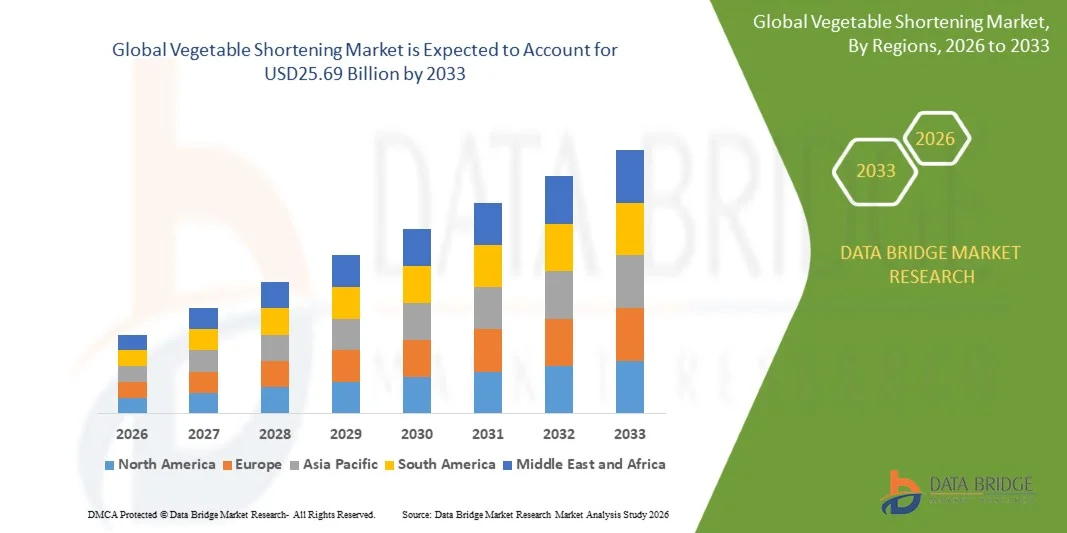
Report Scope and Vegetable Shortening Market Segmentation
|
Attributes |
Vegetable Shortening Key Market Insights |
|
Segments Covered |
· By Product: All Purpose Shortening, Emulsified Shortening, and High Stability Shortening · By Applications: Baking, Frying, Confectionary and Pastry, and Other |
|
Countries Covered |
North America · U.S. · Canada · Mexico Europe · Germany · France · U.K. · Netherlands · Switzerland · Belgium · Russia · Italy · Spain · Turkey · Rest of Europe Asia-Pacific · China · Japan · India · South Korea · Singapore · Malaysia · Australia · Thailand · Indonesia · Philippines · Rest of Asia-Pacific Middle East and Africa · Saudi Arabia · U.A.E. · South Africa · Egypt · Israel · Rest of Middle East and Africa South America · Brazil · Argentina · Rest of South America |
|
Key Market Players |
• The J.M. Smucker Company (U.S.) |
|
Market Opportunities |
• Rising Demand For Trans-Fat-Free And Clean-Label Shortening Products |
|
Value Added Data Infosets |
In addition to the insights on market scenarios such as market value, growth rate, segmentation, geographical coverage, and major players, the market reports curated by the Data Bridge Market Research also include in-depth expert analysis, pricing analysis, brand share analysis, consumer survey, demography analysis, supply chain analysis, value chain analysis, raw material/consumables overview, vendor selection criteria, PESTLE Analysis, Porter Analysis, and regulatory framework. |
Vegetable Shortening Market Trends
Trend: Rising Demand For Trans-Fat-Free And Plant-Based Bakery Ingredients
Increasing consumer awareness regarding healthy eating habits and regulatory restrictions on trans fats are driving strong demand for vegetable shortening products with improved nutritional profiles across bakery, confectionery, and processed food industries. Conventional animal-based fats and partially hydrogenated oils are increasingly being replaced by vegetable-derived alternatives that offer enhanced texture, extended shelf life, and better functionality in commercial food production.
Food manufacturers are increasingly introducing palm-based, soybean-based, and sunflower oil-based shortening formulations, For instance in cakes, pastries, cookies, and frostings, to improve product consistency while complying with evolving clean-label and low-trans-fat regulations. In industrial baking operations, vegetable shortening is being widely utilized to improve dough stability, aeration, and moisture retention while maintaining cost efficiency in large-scale production environments.
The rapid expansion of vegan and plant-based food categories is also accelerating demand for non-animal fat alternatives suitable for bakery and ready-to-eat food products. In addition, foodservice chains and packaged snack manufacturers continue to adopt customized shortening blends for frying and texture enhancement due to their oxidative stability and improved shelf-life performance. Commercial bakery product launches during 2025 across North America and Europe reported that trans-fat-free vegetable shortening formulations improved product shelf stability by nearly 10–14% while maintaining texture softness and flavor consistency during extended storage periods.
Vegetable Shortening Market Dynamics
Key Market Driver: Expansion Of Processed Bakery And Convenience Food Industries
Rapid urbanization, changing dietary habits, and increasing consumption of packaged and ready-to-eat food products are significantly driving demand for vegetable shortening across industrial food manufacturing applications. Bakery and confectionery manufacturers require stable and multifunctional fat ingredients capable of improving texture, mouthfeel, flakiness, and product consistency while supporting high-volume automated production systems.
Industries such as bakery, snack processing, and confectionery are increasingly utilizing vegetable shortening, For instance in cookies, donuts, pastries, and fried snacks, to improve frying performance, product aeration, and moisture retention while reducing production costs. Quick-service restaurant chains and frozen food manufacturers are also expanding usage of vegetable-based frying shortenings to support rising consumer demand for convenience foods and fried products globally.
Similarly, industrial food manufacturers are adopting customized shortening blends with enhanced oxidative stability to improve product shelf life and reduce spoilage during transportation and retail storage. Large-scale bakery production facilities in the U.S. and Germany during 2024 reported operational efficiency improvements of around 7–9% after integrating high-stability vegetable shortening systems into automated dough and frying applications.
Key Restraint/Challenge: Volatility In Raw Material Prices And Health Concerns
The vegetable shortening market faces significant challenges associated with fluctuating prices of raw materials such as palm oil, soybean oil, sunflower oil, and canola oil due to climate variability, geopolitical disruptions, and changing agricultural production patterns. Variations in edible oil prices directly impact manufacturing costs and profit margins, particularly for small and medium-sized food processing companies operating in highly competitive markets.
In addition, growing consumer concerns regarding saturated fat consumption and the health impact of highly processed fats are creating pressure on manufacturers to continuously reformulate shortening products with improved nutritional profiles. Regulatory restrictions on partially hydrogenated oils and increasing demand for clean-label ingredients further increase formulation complexity and production costs for food manufacturers.
Limited availability of sustainable and certified palm oil supplies also creates sourcing challenges for manufacturers seeking compliance with environmental and sustainability standards. Commercial food industry assessments conducted in 2025 indicated that edible oil price fluctuations across major producing regions increased vegetable shortening production costs by approximately 12–16% during periods of supply chain instability and adverse weather conditions.
Key Market Opportunity: Growth In Vegan Foods And Specialty Bakery Applications
The rapid expansion of vegan food products, premium bakery items, and specialty confectionery applications is creating strong growth opportunities for vegetable shortening manufacturers globally. Consumers are increasingly demanding plant-based and allergen-friendly bakery products with improved texture, shelf life, and sensory appeal, encouraging manufacturers to develop innovative shortening formulations tailored for modern food applications.
Food companies are actively introducing non-hydrogenated and specialty shortening solutions, For instance organic, low-saturated-fat, and palm-free formulations, to address changing consumer preferences and strengthen their presence in premium food categories. In industrial baking operations, customized shortening blends are improving dough machinability, layering performance, and crisp texture in laminated bakery products and frozen desserts.
In addition, advancements in oil blending technologies and emulsification systems are enabling manufacturers to improve shortening functionality while reducing trans fat and saturated fat content. Growing investments in plant-based bakery and confectionery production facilities across Asia-Pacific and Europe are expected to accelerate adoption of next-generation shortening products. Product performance testing conducted in 2025 for vegan pastry applications in Europe demonstrated texture consistency improvements of around 15–18% and shelf-life extension of nearly 12% after integrating advanced palm-free vegetable shortening formulations into commercial bakery production systems.
Vegetable Shortening Market Scope
The market is segmented on the basis of product and applications.
- By Product
On the basis of product, the vegetable shortening market is segmented into All Purpose Shortening, Emulsified Shortening, and High Stability Shortening. The All Purpose Shortening segment held the largest market revenue share of approximately 48.7% in 2025, driven by its extensive usage across bakery, confectionery, and frying applications due to its versatility, cost-effectiveness, and ability to provide improved texture and moisture retention in commercial food production. Food manufacturers widely prefer all purpose shortening for cakes, cookies, pastries, and snack products because of its stable performance and long shelf-life characteristics.
The High Stability Shortening segment is projected to register the fastest growth at a CAGR of 7.9% from 2026 to 2033, driven by increasing demand from industrial frying and processed food manufacturers requiring enhanced oxidative stability, extended frying life, and improved thermal resistance. Rising adoption in quick-service restaurants and large-scale snack processing facilities is accelerating segment growth, particularly in regions with expanding convenience food consumption.
- By Applications
On the basis of applications, the vegetable shortening market is segmented into Baking, Frying, Confectionary and Pastry, and Other. The Baking segment dominated the market with a revenue share of approximately 42.3% in 2025, supported by rising global consumption of bread, cakes, cookies, and other baked products across retail and foodservice sectors. Vegetable shortening is extensively utilized in baking applications to improve dough consistency, aeration, flakiness, and product softness while enhancing shelf stability in packaged bakery goods.
The Frying segment is expected to witness the fastest growth at a CAGR of 7.1% from 2026 to 2033, driven by increasing demand for fried snacks, quick-service restaurant meals, and processed convenience foods globally. High-stability vegetable shortening products are increasingly being adopted in commercial frying operations because of their ability to maintain frying performance, reduce oil degradation, and improve product crispiness during high-volume food production processes.
Vegetable Shortening Market Regional Analysis
North America Vegetable Shortening Market Insight
North America dominated the vegetable shortening market with the largest revenue share of 36.8% in 2025, supported by strong demand for processed bakery products, extensive consumption of fried and convenience foods, and the presence of a highly developed food processing industry. Consumers in the region increasingly prefer trans-fat-free and plant-based food ingredients, encouraging manufacturers to adopt advanced vegetable shortening formulations across bakery, confectionery, and foodservice applications. The region’s strong quick-service restaurant network and high consumption of packaged baked goods further support widespread market adoption.
U.S. Vegetable Shortening Market Insight
The U.S. vegetable shortening market captured the largest revenue share within North America in 2025, driven by rising demand for packaged bakery products, frozen snacks, and ready-to-eat food items. Food manufacturers are increasingly utilizing vegetable shortening to improve texture, moisture retention, and shelf stability in large-scale bakery and frying applications. Growing consumer preference for clean-label and non-hydrogenated food ingredients, combined with strong expansion of industrial baking operations and quick-service restaurants, is further accelerating market growth in the country.
Europe Vegetable Shortening Market Insight
The Europe vegetable shortening market is expected to witness the fastest growth rate from 2026 to 2033, primarily driven by increasing demand for clean-label bakery ingredients, strict regulations on trans fats, and growing preference for plant-based food products. Consumers across the region are increasingly adopting vegan and healthier processed food alternatives, encouraging food manufacturers to develop advanced palm-free and low-saturated-fat shortening formulations. Expansion of premium bakery and confectionery industries across major European economies is also supporting market growth.
U.K. Vegetable Shortening Market Insight
The U.K. vegetable shortening market is expected to witness steady growth from 2026 to 2033, driven by increasing demand for packaged bakery products, pastries, and vegan food applications. Rising consumer awareness regarding healthier fat alternatives and strong adoption of clean-label food ingredients are encouraging manufacturers to introduce trans-fat-free shortening products. In addition, the country’s well-developed retail and foodservice sectors continue to support rising consumption of processed and convenience food products.
Germany Vegetable Shortening Market Insight
The Germany vegetable shortening market is expected to witness significant growth from 2026 to 2033, fueled by rising demand for premium bakery products and increasing preference for sustainable and plant-based food ingredients. Germany’s advanced bakery and confectionery manufacturing industry is encouraging widespread adoption of vegetable shortening solutions with improved stability and functionality. Growing emphasis on clean-label formulations and environmentally responsible sourcing practices is further contributing to market expansion across industrial food processing applications.
Asia-Pacific Vegetable Shortening Market Insight
The Asia-Pacific vegetable shortening market is expected to witness the fastest growth rate from 2026 to 2033, supported by rapid urbanization, rising disposable incomes, and increasing consumption of bakery and fried food products across countries such as China, India, and Japan. Expansion of food processing industries, growing popularity of Western-style baked products, and rising investments in industrial bakery manufacturing are significantly driving demand for vegetable shortening products across the region.
Japan Vegetable Shortening Market Insight
The Japan vegetable shortening market is expected to witness steady growth from 2026 to 2033 due to rising consumption of packaged bakery products, convenience foods, and premium confectionery items. The country’s advanced food manufacturing sector and strong focus on high-quality food ingredients are encouraging adoption of specialized vegetable shortening formulations for pastries, cakes, and processed snacks. Increasing demand for stable and texture-enhancing bakery fats is also supporting market growth in Japan.
China Vegetable Shortening Market Insight
The China vegetable shortening market accounted for the largest market revenue share in Asia-Pacific in 2025, attributed to rapid urbanization, expanding middle-class population, and strong growth of industrial bakery and processed food industries. Increasing demand for packaged baked goods, fried snacks, and convenience food products is significantly driving adoption of vegetable shortening across food manufacturing operations. Strong domestic edible oil production capacity and rising investments in food processing infrastructure are further accelerating market growth in China.
Vegetable Shortening Market Share
The Vegetable Shortening industry is primarily led by well-established companies, including:
• The J.M. Smucker Company (U.S.)
• ADM (U.S.)
• Cargill, Incorporated (U.S.)
• Bunge North America, Inc. (U.S.)
• Wilmar International Ltd (Singapore)
• IFFCO (U.A.E.)
• Manildra Group (Australia)
• Associated British Foods plc (U.K.)
• Ruchi Soya (India)
• Al-Khaleej Industries Sdn Bhd. (Malaysia)
• MOI Foods U.S.A. Inc. (U.S.)
• Olenex Sàrl (Switzerland)
• Walter Rau AG (Germany)
• Yildiz Holding Inc. (Turkey)
• VFI GmbH (Austria)
• AAK AB (Sweden)
• PURATOS (Belgium)
• Ventura Foods (U.S.)
• Royal Zeelandia Group BV (Netherlands)
• Princes Limited (U.K.)
• B&G Foods, Inc. (U.S.)
Latest Developments in Vegetable Shortening Market
- In October 2023, Wesson (U.S.), product launch, introduced a new range of plant-based butter products available in olive oil-based and canola oil-based variants, targeting health-conscious consumers seeking dairy alternatives. The launch is expected to strengthen the company’s position in the plant-based food segment, expand its customer base, and support rising market demand for clean-label and vegan-friendly bakery and cooking ingredients.
- In October 2022, Bunge Limited (U.S.) and Olleco (U.K.), joint venture development, established a strategic partnership to manage the complete lifecycle of edible oils, including collection, recycling, and renewable fuel production. The collaboration is expected to improve sustainability practices, strengthen circular economy initiatives within the food industry, and enhance long-term supply chain efficiency across the edible oil and vegetable shortening market.
SKU-
Get online access to the report on the World's First Market Intelligence Cloud

- Interactive Data Analysis Dashboard
- Company Analysis Dashboard for high growth potential opportunities
- Research Analyst Access for customization & queries
- Competitor Analysis with Interactive dashboard
- Latest News, Updates & Trend analysis
- Harness the Power of Benchmark Analysis for Comprehensive Competitor Tracking
Global Vegetable Shortening Market, Supply Chain Analysis and Ecosystem Framework
To support market growth and help clients navigate the impact of geopolitical shifts, DBMR has integrated in-depth supply chain analysis into its Global Vegetable Shortening Market research reports. This addition empowers clients to respond effectively to global changes affecting their industries. The supply chain analysis section includes detailed insights such as Global Vegetable Shortening Market consumption and production by country, price trend analysis, the impact of tariffs and geopolitical developments, and import and export trends by country and HSN code. It also highlights major suppliers with data on production capacity and company profiles, as well as key importers and exporters. In addition to research, DBMR offers specialized supply chain consulting services backed by over a decade of experience, providing solutions like supplier discovery, supplier risk assessment, price trend analysis, impact evaluation of inflation and trade route changes, and comprehensive market trend analysis.
Research Methodology
Data collection and base year analysis are done using data collection modules with large sample sizes. The stage includes obtaining market information or related data through various sources and strategies. It includes examining and planning all the data acquired from the past in advance. It likewise envelops the examination of information inconsistencies seen across different information sources. The market data is analysed and estimated using market statistical and coherent models. Also, market share analysis and key trend analysis are the major success factors in the market report. To know more, please request an analyst call or drop down your inquiry.
The key research methodology used by DBMR research team is data triangulation which involves data mining, analysis of the impact of data variables on the market and primary (industry expert) validation. Data models include Vendor Positioning Grid, Market Time Line Analysis, Market Overview and Guide, Company Positioning Grid, Patent Analysis, Pricing Analysis, Company Market Share Analysis, Standards of Measurement, Global versus Regional and Vendor Share Analysis. To know more about the research methodology, drop in an inquiry to speak to our industry experts.
Customization Available
Data Bridge Market Research is a leader in advanced formative research. We take pride in servicing our existing and new customers with data and analysis that match and suits their goal. The report can be customized to include price trend analysis of target brands understanding the market for additional countries (ask for the list of countries), clinical trial results data, literature review, refurbished market and product base analysis. Market analysis of target competitors can be analyzed from technology-based analysis to market portfolio strategies. We can add as many competitors that you require data about in the format and data style you are looking for. Our team of analysts can also provide you data in crude raw excel files pivot tables (Fact book) or can assist you in creating presentations from the data sets available in the report.