




Global Vertical Ai Market
Market Size in USD Billion
CAGR :
% 
 USD
10.27 Billion
USD
74.46 Billion
2025
2033
USD
10.27 Billion
USD
74.46 Billion
2025
2033
 Forecast Period Forecast Period |
2026 –2033 |
 Market Size (Base Year) Market Size (Base Year) |
USD 10.27 Billion |
 Market Size (Forecast Year) Market Size (Forecast Year) |
USD 74.46 Billion |
 CAGR CAGR |
% |
| Major Markets Players |
|
Vertical AI Market Size
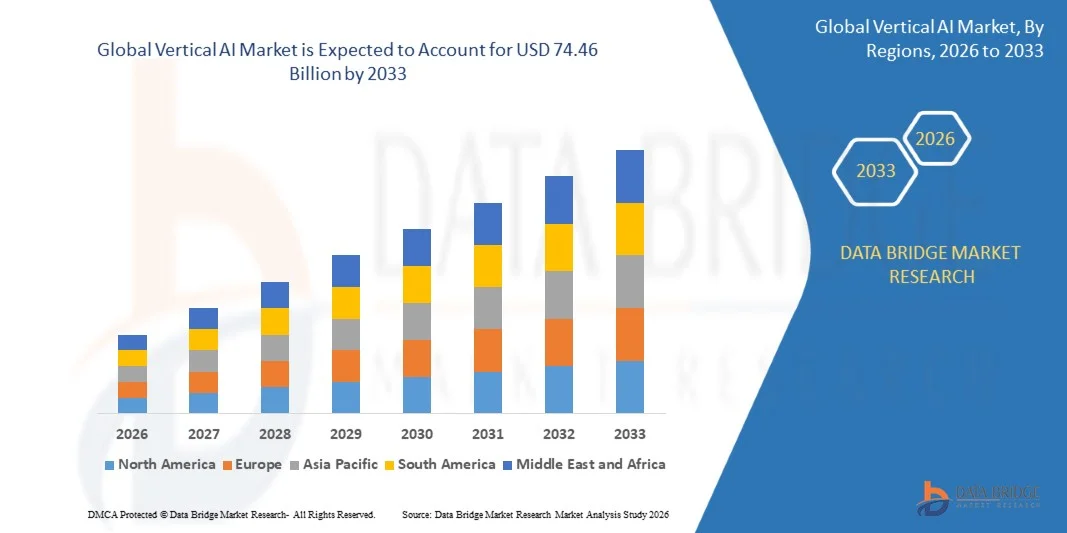
- The global vertical AI market size was valued at USD 10.27 billion in 2025 and is expected to reach USD 74.46 billion by 2033, at a CAGR of 28.10% during the forecast period
- The market growth is primarily driven by the increasing adoption of industry-specific AI solutions that cater to unique business needs across sectors such as healthcare, finance, manufacturing, and retail. These solutions offer tailored capabilities, including predictive analytics, process automation, and enhanced decision-making, which significantly improve operational efficiency and productivity
- For instance, companies such as C3.ai and Palantir Technologies are providing customized AI platforms for sectors such as energy and defense, enabling faster deployment, better insights, and reduced costs. This targeted approach is encouraging organizations to shift from general-purpose AI to vertical-specific solutions, further accelerating market expansion
Vertical AI Market Analysis
- Vertical AI refers to AI systems designed and optimized for a particular industry, incorporating domain-specific datasets, algorithms, and workflows to deliver actionable insights and automation. Unlike horizontal AI, which addresses generic tasks, vertical AI focuses on specialized applications that meet the regulatory, operational, and business requirements of specific industries
- The increasing need for data-driven decision-making in complex industry processes is fostering the adoption of vertical AI. Companies are leveraging these solutions to enhance predictive maintenance in manufacturing, personalized care in healthcare, and risk management in finance, thereby driving efficiency and reducing operational errors
- North America dominated the vertical AI market with a share of 37.3% in 2025, due to increasing adoption of AI solutions across industries such as BFSI, healthcare, and retail
- Asia-Pacific is expected to be the fastest growing region in the vertical AI market during the forecast period due to increasing urbanization, digitization, and rapid adoption of AI in countries such as China, Japan, and India
- Software segment dominated the market with a market share of 47.6% in 2025, due to the increasing deployment of AI-driven applications across multiple industries. Businesses prioritize software solutions due to their scalability, ease of integration with existing IT infrastructure, and the ability to continuously update models for improved performance. Software offerings often include pre-built AI models, APIs, and analytics tools, making them attractive for enterprises seeking rapid deployment and minimal upfront investment
Report Scope and Vertical AI Market Segmentation
|
Attributes |
Vertical AI Key Market Insights |
|
Segments Covered |
|
|
Countries Covered |
North America
Europe
Asia-Pacific
Middle East and Africa
South America
|
|
Key Market Players |
|
|
Market Opportunities |
|
|
Value Added Data Infosets |
In addition to the market insights such as market value, growth rate, market segments, geographical coverage, market players, and market scenario, the market report curated by the Data Bridge Market Research team includes in-depth expert analysis, import/export analysis, pricing analysis, production consumption analysis, and pestle analysis. |
Vertical AI Market Trends
“Rising Adoption of Industry-Specific AI Solutions”
- A key trend in the vertical AI market is the growing adoption of AI solutions tailored for specific industries, driven by the increasing need for operational efficiency, predictive analytics, and domain-specific automation across sectors such as healthcare, finance, retail, and manufacturing. These specialized solutions are enabling organizations to optimize processes, reduce costs, and enhance decision-making capabilities in ways that generic AI platforms cannot
- For instance, C3.ai offers AI applications specifically designed for energy, manufacturing, and defense sectors, providing predictive maintenance, demand forecasting, and anomaly detection capabilities. These tailored solutions help companies leverage real-time insights and operational intelligence, strengthening efficiency and productivity within their industry workflows
- Healthcare providers are increasingly deploying vertical AI platforms to support diagnostics, personalized treatment planning, and operational management. Solutions from Tempus AI are being used to analyze complex clinical and genomic data, improving patient outcomes and streamlining hospital operations
- Retail and e-commerce organizations are integrating vertical AI tools to enhance customer experience, optimize inventory management, and implement dynamic pricing strategies. Palantir Technologies provides industry-specific data analytics platforms that allow retailers to identify trends, forecast demand, and improve supply chain efficiency
- Financial institutions are adopting vertical AI systems for fraud detection, risk management, and automated customer support. IBM Corporation and Microsoft Corporation are offering AI solutions tailored for banking and insurance, enabling rapid analysis of transactional data and regulatory compliance
- Manufacturing and industrial enterprises are leveraging AI platforms to enable predictive maintenance, quality control, and energy optimization. Siemens Healthineers AG and H2O.ai provide AI solutions that integrate with industrial equipment and IoT devices, enhancing operational reliability and process automation
Vertical AI Market Dynamics
Driver
“Increasing Need for Data-Driven Decision-Making”
- The growing demand for actionable insights and predictive analytics is driving the adoption of vertical AI solutions across multiple industries. Businesses are seeking AI platforms that can handle complex, domain-specific datasets and provide precise recommendations for operational efficiency, risk mitigation, and customer engagement
- For instance, Palantir Technologies delivers AI-driven analytics for government and commercial sectors, allowing organizations to monitor critical operations and make informed strategic decisions. These solutions help streamline workflows, reduce inefficiencies, and improve resource allocation
- The integration of vertical AI with cloud computing and IoT devices is enhancing real-time decision-making capabilities, allowing companies to respond proactively to market and operational changes. This is critical for industries with dynamic processes such as logistics, manufacturing, and healthcare
- Companies are increasingly relying on AI to automate repetitive tasks and optimize internal processes, reducing human error and improving productivity. Vertical AI platforms enable customization for industry-specific applications, ensuring that insights are relevant and actionable
- The expanding availability of structured and unstructured data is creating opportunities for vertical AI adoption, as organizations seek to convert large datasets into strategic intelligence. Advanced machine learning algorithms and predictive models empower businesses to anticipate trends, optimize operations, and enhance competitiveness
Restraint/Challenge
“High Implementation Costs and Integration Complexity”
- The vertical AI market faces challenges due to the significant costs associated with deploying industry-specific AI solutions. Implementation requires investments in specialized hardware, software, data management, and skilled personnel, which can be prohibitive for small and mid-sized enterprises
- For instance, deploying C3.ai’s industrial AI solutions demands integration with existing IT infrastructure, extensive data cleaning, and model training, which increases project timelines and financial commitments. These complexities can slow adoption rates and reduce ROI for organizations with limited budgets
- Integration with legacy systems and diverse data sources further complicates deployment, requiring tailored workflows and ongoing maintenance. Companies must ensure compatibility across platforms, secure data handling, and continuous updates to maintain performance and compliance
- The need for highly skilled professionals to develop, implement, and manage vertical AI systems adds to operational costs and limits scalability. Recruiting and training talent for domain-specific AI applications remains a critical barrier for many organizations
- Managing change within organizations, including aligning AI initiatives with business goals and workflows, poses additional challenges. Resistance to adopting new technologies and the complexity of integrating AI insights into decision-making processes can slow overall market growth
Vertical AI Market Scope
The market is segmented on the basis of offering type, technology type, deployment mode, organization size, and end-use.
• By Offering Type
On the basis of offering type, the Vertical AI market is segmented into hardware, software, and services. The software segment dominated the largest market revenue share of 47.6% in 2025, driven by the increasing deployment of AI-driven applications across multiple industries. Businesses prioritize software solutions due to their scalability, ease of integration with existing IT infrastructure, and the ability to continuously update models for improved performance. Software offerings often include pre-built AI models, APIs, and analytics tools, making them attractive for enterprises seeking rapid deployment and minimal upfront investment. In addition, the rise of industry-specific AI applications in sectors such as BFSI, healthcare, and retail reinforces software’s leading position.
The services segment is expected to witness the fastest growth rate from 2026 to 2033, fueled by increasing demand for consulting, implementation, and managed AI services. Companies often rely on specialized AI service providers for model training, deployment, and maintenance, especially in complex environments with large datasets. The need for expertise in integrating AI into legacy systems and ensuring regulatory compliance further drives the adoption of services. Enterprises also value continuous support and optimization services to enhance model accuracy and operational efficiency, contributing to rapid growth in this segment.
• By Technology Type
On the basis of technology type, the Vertical AI market is segmented into machine learning (ML), natural language processing (NLP), computer vision, deep learning, and others. The machine learning segment held the largest market revenue share in 2025, driven by its widespread applicability in predictive analytics, recommendation engines, and anomaly detection across industries. ML models enable businesses to extract actionable insights from structured and unstructured data, enhancing decision-making processes. Industries such as retail, healthcare, and finance increasingly rely on ML to personalize customer experiences and optimize operational efficiency. The ease of deployment, flexibility in model development, and proven ROI contribute to ML’s dominant market position.
The computer vision segment is anticipated to witness the fastest growth rate from 2026 to 2033, fueled by increasing adoption in manufacturing, automotive, and security applications. Computer vision enables automation in quality inspection, surveillance, and autonomous vehicles, reducing human error and operational costs. Advancements in image recognition algorithms, coupled with declining hardware costs for cameras and sensors, further drive adoption. Organizations also leverage computer vision for enhanced analytics, inventory management, and customer behavior tracking, making it a high-growth segment in the Vertical AI market.
• By Deployment Mode
On the basis of deployment mode, the Vertical AI market is segmented into cloud and on-premises. The cloud segment dominated the largest market revenue share in 2025, driven by enterprises’ preference for scalable and cost-effective AI deployment. Cloud-based AI platforms provide access to high-performance computing, large storage capacity, and pre-trained models, enabling rapid experimentation and deployment. Organizations also benefit from seamless software updates, remote accessibility, and easy integration with other cloud services. The flexibility to scale resources according to demand and the reduced need for upfront infrastructure investment reinforce cloud AI’s dominance.
The on-premises segment is expected to witness the fastest CAGR from 2026 to 2033, driven by growing concerns around data security, privacy, and compliance in highly regulated industries. Organizations in BFSI, healthcare, and government sectors often prefer on-premises deployments to maintain full control over sensitive data. On-premises AI allows customization of infrastructure and integration with existing IT systems, enhancing security and performance. Enterprises also value reduced latency and real-time processing capabilities, which are critical for mission-critical applications, supporting rapid growth in this segment.
• By Organization Size
On the basis of organization size, the Vertical AI market is segmented into small & medium enterprises (SMEs) and large enterprises. Large enterprises dominated the largest market revenue share in 2025, driven by their greater financial resources, extensive data availability, and established IT infrastructure. Large organizations adopt Vertical AI to streamline complex operations, enhance customer experiences, and gain competitive advantage across industries. They often invest in both in-house AI capabilities and partnerships with technology providers to accelerate innovation. The presence of large-scale AI initiatives in banking, healthcare, and manufacturing further consolidates the leadership of large enterprises in this market.
The small & medium enterprise segment is expected to witness the fastest growth rate from 2026 to 2033, fueled by increasing availability of cost-effective AI solutions and cloud-based platforms. SMEs are leveraging AI to improve operational efficiency, automate routine tasks, and gain insights from limited datasets. The growing adoption of subscription-based AI services and user-friendly software platforms allows smaller businesses to implement AI without heavy upfront investments. Rising awareness of AI benefits and the availability of industry-specific AI tools drive rapid adoption in the SME segment.
• By End-Use
On the basis of end-use, the Vertical AI market is segmented into IT & telecommunications, BFSI, retail & e-commerce, healthcare, industrial/manufacturing, media & entertainment, automotive, and others. The BFSI segment dominated the largest market revenue share in 2025, driven by widespread adoption of AI in fraud detection, credit risk assessment, customer service automation, and trading analytics. Financial institutions increasingly rely on AI to enhance operational efficiency, improve decision-making, and meet stringent regulatory compliance standards. The use of machine learning and NLP in banking chatbots, transaction monitoring, and predictive analytics reinforces BFSI’s leading position in the market.
The retail & e-commerce segment is expected to witness the fastest growth rate from 2026 to 2033, fueled by the increasing adoption of AI for personalized marketing, demand forecasting, inventory management, and customer behavior analytics. Retailers use AI to optimize pricing strategies, improve supply chain efficiency, and enhance in-store and online customer experiences. Advancements in computer vision and NLP for virtual shopping assistants and visual search solutions further accelerate adoption. The growing emphasis on data-driven decision-making and omnichannel retail strategies contributes to rapid growth in this segment.
Vertical AI Market Regional Analysis
- North America dominated the vertical AI market with the largest revenue share of 37.3% in 2025, driven by increasing adoption of AI solutions across industries such as BFSI, healthcare, and retail
- Organizations in the region are prioritizing automation, predictive analytics, and data-driven decision-making, contributing to robust market growth. High disposable incomes, technological infrastructure, and a strong presence of AI startups and established tech companies further support widespread adoption
- Enterprises are leveraging cloud-based AI platforms, advanced ML models, and computer vision solutions to enhance operational efficiency and customer experience. The demand for specialized AI services, including consulting and managed solutions, is also propelling the market forward
U.S. Vertical AI Market Insight
The U.S. captured the largest revenue share of North America in 2025, fueled by rapid adoption of AI technologies in BFSI, IT & telecommunications, and retail sectors. Organizations increasingly invest in machine learning, NLP, and deep learning solutions to improve operational efficiency and customer engagement. The growing preference for cloud-based AI deployment, coupled with advanced analytics platforms, further accelerates market expansion. U.S. enterprises also focus on vertical-specific AI applications, such as fraud detection in finance and predictive maintenance in manufacturing, strengthening the market position. A thriving startup ecosystem and government support for AI innovation continue to contribute significantly to market growth.
Europe Vertical AI Market Insight
The Europe Vertical AI market is projected to expand at a substantial CAGR during the forecast period, driven by increasing AI adoption across BFSI, healthcare, and industrial sectors. Regulatory initiatives promoting AI integration, coupled with demand for automation and advanced analytics, support regional growth. Organizations in Europe are focusing on AI-based solutions for customer service, predictive analytics, and operational efficiency. The region sees significant investment in AI software and services, with adoption across both new and existing digital infrastructures. Governments and enterprises are emphasizing ethical AI deployment and secure data processing, further encouraging market expansion.
U.K. Vertical AI Market Insight
The U.K. Vertical AI market is expected to grow at a noteworthy CAGR, driven by increased adoption of AI for business process automation, predictive analytics, and customer engagement. Organizations prioritize secure, scalable AI platforms to enhance decision-making and operational efficiency. The country’s mature IT infrastructure, strong tech ecosystem, and digital-first consumer base support rapid adoption of vertical-specific AI solutions. Growing interest in AI-driven analytics for BFSI, healthcare, and e-commerce sectors strengthens market demand. Government initiatives promoting AI innovation and ethical usage also contribute to the market’s growth trajectory.
Germany Vertical AI Market Insight
The Germany Vertical AI market is anticipated to expand at a considerable CAGR, fueled by increasing investments in AI for industrial automation, manufacturing, and logistics. German enterprises emphasize AI solutions that enhance efficiency, reduce operational costs, and support predictive maintenance. Strong infrastructure, focus on sustainability, and high technological literacy facilitate AI adoption across industries. Integration of AI in enterprise systems and industrial IoT platforms drives demand for both software and AI services. Security, privacy, and compliance remain key factors shaping adoption, particularly in BFSI and healthcare verticals.
Asia-Pacific Vertical AI Market Insight
The Asia-Pacific Vertical AI market is poised to grow at the fastest CAGR during the forecast period, driven by increasing urbanization, digitization, and rapid adoption of AI in countries such as China, Japan, and India. The region is witnessing growing investments in AI startups, cloud-based AI platforms, and industry-specific AI applications. Rising demand for automation in manufacturing, BFSI, healthcare, and retail sectors is propelling market expansion. Government initiatives supporting AI research and smart city projects enhance adoption, while affordability and accessibility of AI solutions widen market reach. APAC’s emergence as a technology hub further strengthens regional growth.
Japan Vertical AI Market Insight
The Japan Vertical AI market is gaining momentum due to high technological adoption, rapid industrial automation, and strong demand for AI-driven analytics solutions. Japanese enterprises are implementing AI for predictive maintenance, customer experience optimization, and operational efficiency. Integration of AI with robotics, IoT, and connected devices is driving growth across manufacturing and healthcare sectors. The aging population and labor shortages are increasing demand for AI solutions that reduce human dependency and enhance productivity. Cloud-based and on-premises AI deployments are both seeing adoption in enterprise applications.
China Vertical AI Market Insight
The China Vertical AI market accounted for the largest revenue share in Asia-Pacific in 2025, driven by rapid technological adoption, expanding enterprise AI initiatives, and government support for AI innovation. Chinese organizations are implementing AI across BFSI, healthcare, retail, and manufacturing verticals to improve efficiency, automation, and decision-making. Strong presence of domestic AI technology providers, affordable AI solutions, and large-scale data availability support market growth. The push toward smart cities and digital transformation further fuels AI adoption in both public and private sectors. Cloud-based AI platforms and industry-specific applications are key drivers in the country’s market expansion.
Vertical AI Market Share
The vertical AI industry is primarily led by well-established companies, including:
- Microsoft Corporation (U.S.)
- Insitro (U.S.)
- Accenture (Ireland)
- C3.ai (U.S.)
- Siemens Healthineers AG (Germany)
- nCino (U.S.)
- PathAI (U.S.)
- Procore Technologies (U.S.)
- Salesforce, Inc. (U.S.)
- H2O.ai (U.S.)
- IBM Corporation (U.S.)
- Tempus AI (U.S.)
- Matellio Inc. (U.S.)
- Palantir Technologies (U.S.)
Latest Developments in Global Vertical AI Market
- In April 2026, ITC Infotech expanded its global innovation ecosystem by launching new Digital and AI Experience Centres in Bengaluru and Kolkata along with an advanced AI Studio in Pune, strengthening its focus on AI‑led digital transformation across industries such as BFSI, healthcare, retail, and manufacturing. This initiative enhances the company’s ability to collaborate with enterprise customers on vertical‑specific AI solutions and accelerate adoption of AI technologies that optimize workflows and business processes. Establishing innovation hubs increases access to expertise, fosters co‑creation of AI applications tailored to sector needs, and signals growing investment in localized AI capabilities that support faster deployment and training for enterprise customers seeking practical AI integration
- In February 2026, French AI research lab Mistral AI secured a strategic multi‑year partnership with global consulting firm Accenture to accelerate enterprise AI adoption worldwide. This collaboration leverages Accenture’s global consulting footprint and Mistral’s advanced AI technologies to help enterprises overcome implementation barriers and standardize deployment of production‑ready AI systems across sectors such as finance, telecommunications, and industrial services. By combining deep AI research with consulting expertise, the partnership is expected to drive broader enterprise confidence in adopting vertical AI solutions, reduce integration complexity, and improve scalability of domain‑specific AI use cases at large enterprises
- In December 2025, Microsoft Corporation announced an approximately USD 17.5 billion investment to expand its AI and cloud infrastructure ecosystem in India, focusing on strengthening Azure capabilities, advancing research, and accelerating enterprise adoption of AI‑driven solutions across healthcare, finance, and manufacturing sectors. The initiative also involves partnerships to develop industry‑specific AI applications and workforce skilling programs, enhancing the country’s AI ecosystem and supporting vertical AI deployment at scale
- In February 2025, Salesforce, Inc. collaborated with Accenture and major cloud technology providers to expand generative AI capabilities for enterprise CRM platforms, enabling scalable AI‑driven customer engagement, analytics, and workflow automation solutions across industries such as retail, financial services, and telecommunications. This initiative enhances productivity, personalization, and data‑driven decision‑making through integrated AI systems
- In January 2025, Accenture launched its AI Refinery™ for Industry platform to accelerate the development and deployment of industry‑specific AI agents across enterprise environments, enabling organizations to transform raw AI technologies into scalable systems that automate workflows, improve productivity, and generate actionable insights across telecommunications, financial services, insurance, and manufacturing
SKU-
Get online access to the report on the World's First Market Intelligence Cloud

- Interactive Data Analysis Dashboard
- Company Analysis Dashboard for high growth potential opportunities
- Research Analyst Access for customization & queries
- Competitor Analysis with Interactive dashboard
- Latest News, Updates & Trend analysis
- Harness the Power of Benchmark Analysis for Comprehensive Competitor Tracking
Research Methodology
Data collection and base year analysis are done using data collection modules with large sample sizes. The stage includes obtaining market information or related data through various sources and strategies. It includes examining and planning all the data acquired from the past in advance. It likewise envelops the examination of information inconsistencies seen across different information sources. The market data is analysed and estimated using market statistical and coherent models. Also, market share analysis and key trend analysis are the major success factors in the market report. To know more, please request an analyst call or drop down your inquiry.
The key research methodology used by DBMR research team is data triangulation which involves data mining, analysis of the impact of data variables on the market and primary (industry expert) validation. Data models include Vendor Positioning Grid, Market Time Line Analysis, Market Overview and Guide, Company Positioning Grid, Patent Analysis, Pricing Analysis, Company Market Share Analysis, Standards of Measurement, Global versus Regional and Vendor Share Analysis. To know more about the research methodology, drop in an inquiry to speak to our industry experts.
Customization Available
Data Bridge Market Research is a leader in advanced formative research. We take pride in servicing our existing and new customers with data and analysis that match and suits their goal. The report can be customized to include price trend analysis of target brands understanding the market for additional countries (ask for the list of countries), clinical trial results data, literature review, refurbished market and product base analysis. Market analysis of target competitors can be analyzed from technology-based analysis to market portfolio strategies. We can add as many competitors that you require data about in the format and data style you are looking for. Our team of analysts can also provide you data in crude raw excel files pivot tables (Fact book) or can assist you in creating presentations from the data sets available in the report.












