




Global Veterinary Artificial Insemination Market
Market Size in USD Billion
CAGR :
% 
 USD
8.27 Billion
USD
25.47 Billion
2025
2033
USD
8.27 Billion
USD
25.47 Billion
2025
2033
 Forecast Period Forecast Period |
2026 –2033 |
 Market Size (Base Year) Market Size (Base Year) |
USD 8.27 Billion |
 Market Size (Forecast Year) Market Size (Forecast Year) |
USD 25.47 Billion |
 CAGR CAGR |
% |
| Major Markets Players |
|
Veterinary Artificial Insemination Market Size
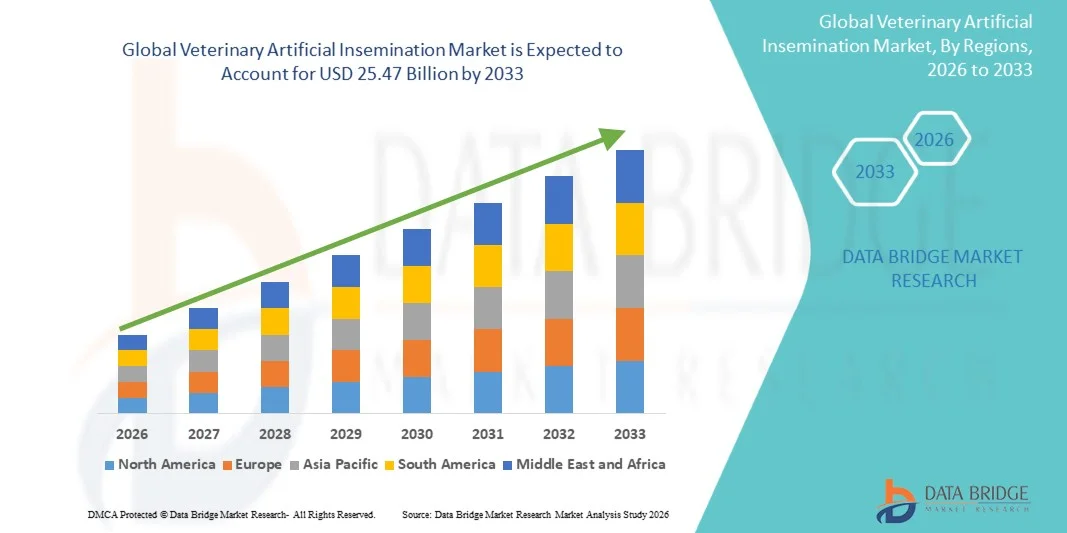
- The global veterinary artificial insemination market size was valued at USD 8.27 billion in 2025 and is expected to reach USD 25.47 billion by 2033, at a CAGR of 15.10% during the forecast period
- The market growth is largely fueled by the rising adoption of advanced animal breeding technologies, increasing demand for high-quality livestock genetics, and growing focus on improving productivity and reproductive efficiency in dairy and livestock farming systems
- Furthermore, increasing investments in animal husbandry practices, expanding commercial livestock production, and rising awareness about genetic improvement and disease control in breeding programs are establishing artificial insemination as a key modern reproductive technique. These converging factors are accelerating the uptake of veterinary artificial insemination solutions, thereby significantly boosting the industry's growth
Veterinary Artificial Insemination Market Analysis
- Veterinary artificial insemination, a controlled reproductive biotechnology used to enhance breeding efficiency and genetic improvement in animals, is increasingly becoming a vital component of modern livestock management systems due to its ability to improve fertility rates, accelerate genetic progress, and support large-scale animal production
- The escalating demand for veterinary artificial insemination is primarily fueled by rising global demand for animal protein, growing focus on improving livestock productivity, and increasing adoption of advanced reproductive technologies to enhance breeding outcomes and reduce dependence on natural mating
- North America dominated the veterinary artificial insemination market with the largest revenue share of 38.6% in 2025, supported by advanced animal husbandry practices, strong veterinary healthcare infrastructure, and high adoption of genetic improvement programs, with the U.S. leading in widespread use of AI techniques in cattle and swine breeding systems driven by continuous technological advancements in semen processing and preservation
- Asia-Pacific is expected to be the fastest growing region in the veterinary artificial insemination market during the forecast period due to expanding livestock populations, rapid modernization of dairy and meat production systems, and increasing government initiatives promoting genetic improvement and productivity enhancement in agriculture
- Cattle segment dominated the veterinary artificial insemination market with a market share of 46.8% in 2025, driven by high demand for dairy and beef production, strong adoption of genetic selection programs, and the widespread use of artificial insemination techniques to improve herd quality and reproductive efficiency
Report Scope and Veterinary Artificial Insemination Market Segmentation
|
Attributes |
Veterinary Artificial Insemination Key Market Insights |
|
Segments Covered |
|
|
Countries Covered |
North America
Europe
Asia-Pacific
Middle East and Africa
South America
|
|
Key Market Players |
|
|
Market Opportunities |
|
|
Value Added Data Infosets |
In addition to the insights on market scenarios such as market value, growth rate, segmentation, geographical coverage, and major players, the market reports curated by the Data Bridge Market Research also include in-depth expert analysis, patient epidemiology, pipeline analysis, pricing analysis, and regulatory framework |
Veterinary Artificial Insemination Market Trends
“Advancement in Precision Breeding and Genetic Optimization Technologies”
- A significant and accelerating trend in the global veterinary artificial insemination market is the increasing adoption of precision breeding technologies and genetic selection tools to improve livestock productivity and reproductive efficiency
- For instance, the use of sexed semen and genomic selection techniques in cattle breeding programs is enabling farmers to produce higher-value offspring with improved milk yield and disease resistance traits
- Integration of advanced reproductive technologies such as automated semen analysis, cryopreservation enhancements, and AI-assisted breeding timing is improving conception rates and optimizing insemination outcomes in livestock herds
- The growing use of digital livestock management platforms and IoT-enabled monitoring systems is enabling centralized tracking of animal reproductive cycles, improving planning and efficiency of insemination procedures across farms
- This trend toward highly precise, technology-driven breeding systems is reshaping traditional livestock reproduction practices and increasing reliance on controlled artificial insemination methods supported by veterinary expertise
- The demand for advanced artificial insemination solutions is rising rapidly across dairy and meat production sectors as producers increasingly prioritize genetic quality, productivity gains, and herd sustainability
- Growing collaboration between biotechnology firms and veterinary service providers is accelerating innovation in reproductive efficiency and expanding access to advanced insemination solutions globally
Veterinary Artificial Insemination Market Dynamics
Driver
“Rising Demand for High-Quality Livestock Production and Genetic Improvement Programs”
- The increasing global demand for high-quality animal protein and improved livestock productivity is a significant driver for the growing adoption of veterinary artificial insemination techniques
- For instance, in April 2025, several livestock development initiatives supported expanded use of controlled breeding programs to improve dairy output and enhance genetic quality in cattle populations
- As livestock producers face pressure to increase yield efficiency and disease resistance, artificial insemination offers a reliable method to accelerate genetic improvement and enhance reproductive performance
- Furthermore, growing awareness among farmers regarding the economic benefits of improved breeding efficiency and reduced dependency on natural mating is strengthening market adoption
- The increasing availability of veterinary services, semen processing technologies, and government-backed livestock improvement programs is further accelerating the use of artificial insemination in both developed and emerging markets
- Rising commercialization of dairy and meat production systems is encouraging large-scale farms to adopt structured breeding programs for consistent output and improved herd management
- Expanding insurance and financial support schemes for livestock farming is further motivating farmers to invest in advanced reproductive technologies such as artificial insemination
Restraint/Challenge
“High Technical Requirements and Limited Access in Rural Farming Regions”
- Concerns related to the requirement of skilled veterinary professionals and precise handling techniques pose a significant challenge to wider adoption of artificial insemination in livestock management
- For instance, improper semen handling or incorrect timing of insemination procedures can significantly reduce conception rates, leading to lower productivity outcomes for farmers
- Limited access to veterinary infrastructure and advanced reproductive technologies in rural and underdeveloped regions restricts the widespread implementation of artificial insemination practices
- In addition, the relatively high cost of semen storage equipment, training, and breeding services can act as a barrier for small and medium-scale livestock farmers in adopting these techniques
- While awareness of genetic improvement benefits is increasing, lack of technical expertise and infrastructure disparities continue to hinder consistent adoption across global livestock populations
- Overcoming these challenges through veterinary training programs, improved rural infrastructure, and cost-effective insemination solutions will be essential for sustained market expansion
- Cultural preference for traditional natural breeding methods in certain regions also slows down the transition toward artificial insemination practices
- Inadequate cold-chain logistics for semen storage and transport further limits accessibility and effectiveness of artificial insemination services in remote areas
Veterinary Artificial Insemination Market Scope
The market is segmented on the basis of animal type, product, end use, and technique.
- By Animal Type
On the basis of animal type, the veterinary artificial insemination market is segmented into cattle, swine, sheep, canine, and equine. The cattle segment dominated the market with the largest revenue share of 46.8% in 2025, driven by the high global demand for dairy and beef production and the widespread use of genetic improvement programs in bovine reproduction. Cattle artificial insemination is extensively adopted due to its proven effectiveness in improving milk yield, disease resistance, and herd productivity. The segment also benefits from strong veterinary infrastructure and government-supported livestock improvement initiatives in major dairy-producing countries. Increasing use of sexed semen and advanced cryopreservation techniques further strengthens cattle dominance in the market. Large-scale commercial dairy farms prefer artificial insemination for controlled breeding cycles and predictable genetic outcomes. Continuous technological advancements in bovine reproductive management further reinforce cattle’s leading position in this segment.
The swine segment is expected to witness the fastest growth rate of 16.4% from 2026 to 2033, fueled by rising global pork consumption and increasing commercialization of pig farming systems. Swine artificial insemination is gaining traction due to its ability to improve litter size, reproductive efficiency, and genetic quality of herds. The segment benefits from cost-effective breeding management and reduced disease transmission compared to natural mating. Growing adoption of centralized breeding farms and genetic selection programs is further supporting market expansion. Increasing investments in intensive pig production systems, especially in Asia-Pacific, are accelerating adoption. Technological improvements in semen preservation and transport logistics are also enabling wider use of artificial insemination in swine farming.
- By Product
On the basis of product, the market is segmented into normal semen and sexed semen. The normal semen segment dominated the market with the largest revenue share of 62.5% in 2025, due to its widespread availability, lower cost, and established use across all major livestock species. Normal semen is preferred by small and medium-scale farmers as it provides a cost-effective solution for routine breeding programs. It remains the standard choice in most developing regions where advanced reproductive technologies are still emerging. The segment also benefits from strong distribution networks and well-established semen processing facilities. Its high success rate in conventional artificial insemination practices supports its continued dominance. In addition, compatibility with all animal types makes it the most widely used product category globally.
The sexed semen segment is expected to witness the fastest growth rate of 18.9% from 2026 to 2033, driven by increasing demand for genetically optimized livestock and higher productivity outcomes. Sexed semen allows farmers to predetermine the gender of offspring, which is particularly valuable in dairy farming for producing female calves. The segment is gaining strong traction among large commercial farms focused on maximizing milk production efficiency. Rising adoption of advanced sorting technologies such as flow cytometry is improving semen accuracy and success rates. Increasing awareness about genetic selection benefits is further boosting demand. Government-backed dairy improvement programs and commercial breeding initiatives are also accelerating adoption of sexed semen globally.
- By End Use
On the basis of end use, the market is segmented into veterinary hospitals, animal husbandry, and others. The animal husbandry segment dominated the market with the largest revenue share of 68.3% in 2025, driven by large-scale livestock farming operations and the widespread use of artificial insemination for commercial breeding purposes. Animal husbandry facilities extensively rely on controlled breeding techniques to enhance productivity and maintain genetic quality of herds. The segment benefits from increasing global demand for dairy, meat, and poultry products. Strong adoption in dairy farms and organized livestock production systems further supports dominance. Availability of trained veterinary professionals and reproductive technologies enhances efficiency in this segment. Government support for livestock productivity improvement programs also strengthens its leading position.
The veterinary hospitals segment is expected to witness the fastest growth rate of 15.7% from 2026 to 2033, driven by increasing demand for specialized reproductive healthcare services and advanced breeding assistance. Veterinary hospitals are increasingly offering artificial insemination services as part of comprehensive animal reproductive care. Growing pet ownership and rising demand for canine and equine breeding services are contributing to segment expansion. The availability of skilled veterinarians and advanced diagnostic facilities improves insemination success rates. Increasing awareness among livestock owners about professional breeding services is also driving growth. Expansion of veterinary infrastructure in emerging markets further supports this segment’s rapid growth.
- By Technique
On the basis of technique, the market is segmented into intrauterine tubal peritoneal insemination, intracervical insemination, intrauterine insemination, and intratubal insemination. The intrauterine insemination segment dominated the market with the largest revenue share of 52.6% in 2025, due to its high efficiency, improved conception rates, and widespread adoption in cattle breeding programs. This technique allows direct placement of semen into the uterus, significantly increasing fertilization success compared to other methods. It is widely preferred in commercial dairy farming due to its reliability and cost-effectiveness. The segment also benefits from strong veterinary expertise and standardized procedures. Increasing use of frozen and sexed semen further enhances its effectiveness. Its adaptability across multiple livestock species supports continued dominance in the market.
The intracervical insemination segment is expected to witness the fastest growth rate of 17.2% from 2026 to 2033, driven by its simplicity, lower cost, and minimal equipment requirements. This technique is widely used in swine and small ruminant breeding due to ease of application and scalability in large herds. Rising adoption in developing regions with limited veterinary infrastructure is supporting its growth. It requires less technical expertise compared to advanced insemination methods, making it suitable for small and medium-scale farmers. Increasing commercialization of pig farming is further boosting demand. Continuous improvements in semen handling and delivery techniques are also enhancing adoption of intracervical insemination globally.
Veterinary Artificial Insemination Market Regional Analysis
- North America dominated the veterinary artificial insemination market with the largest revenue share of 38.6% in 2025, supported by advanced animal husbandry practices, strong veterinary healthcare infrastructure, and high adoption of genetic improvement programs
- Producers in the region highly value the improved productivity, higher conception rates, and enhanced herd quality offered by artificial insemination, particularly in cattle and swine breeding systems supported by advanced reproductive management practices
- This widespread adoption is further supported by high investment capacity in commercial dairy and meat production, strong government-backed livestock improvement programs, and increasing use of technologies such as sexed semen and precision breeding tools, establishing artificial insemination as a preferred solution for modern animal husbandry systems
U.S. Veterinary Artificial Insemination Market Insight
The U.S. veterinary artificial insemination market captured the largest revenue share within North America in 2025, driven by the strong presence of commercial dairy and beef production systems and advanced adoption of reproductive biotechnology. The country benefits from highly developed veterinary infrastructure, widespread use of genetic selection programs, and strong integration of precision livestock farming technologies. Farmers increasingly prioritize artificial insemination to improve milk yield, meat quality, and herd genetics. The growing use of sexed semen and automated breeding management systems is further enhancing productivity. In addition, strong investments from private livestock companies and biotechnology firms are accelerating innovation in semen processing and reproductive efficiency solutions.
Europe Veterinary Artificial Insemination Market Insight
The Europe veterinary artificial insemination market is projected to expand at a steady CAGR throughout the forecast period, primarily driven by stringent animal welfare regulations, strong emphasis on sustainable livestock production, and rising demand for high-quality animal protein. The region benefits from advanced veterinary healthcare systems and well-established dairy farming practices, particularly in countries such as France, Germany, and the Netherlands. European livestock producers are increasingly adopting artificial insemination to improve genetic quality, reduce disease transmission, and enhance breeding efficiency. Growing focus on reducing environmental impact through optimized livestock productivity is further supporting market expansion. In addition, strong adoption of sexed semen and precision breeding technologies is accelerating market growth across commercial farms.
U.K. Veterinary Artificial Insemination Market Insight
The U.K. veterinary artificial insemination market is anticipated to grow at a notable CAGR during the forecast period, driven by increasing demand for improved dairy productivity and rising adoption of advanced livestock breeding techniques. Farmers are increasingly shifting toward artificial insemination to enhance genetic performance and reduce dependency on natural mating systems. Concerns related to livestock disease control and biosecurity are also encouraging adoption of controlled breeding practices. The country’s strong veterinary service network and well-developed dairy industry further support market growth. In addition, increasing awareness of sexed semen benefits and herd optimization strategies is contributing to wider adoption across cattle farming operations.
Germany Veterinary Artificial Insemination Market Insight
The Germany veterinary artificial insemination market is expected to expand at a considerable CAGR during the forecast period, fueled by strong emphasis on livestock efficiency, technological advancement in animal breeding, and sustainability-focused agricultural practices. Germany’s highly organized dairy and meat production systems promote the adoption of artificial insemination to improve genetic quality and productivity. Farmers are increasingly integrating reproductive biotechnology with precision farming tools for better herd management. Growing demand for high-quality milk and meat products is further strengthening market uptake. In addition, Germany’s focus on animal welfare and reduced antibiotic use is encouraging controlled breeding methods such as artificial insemination.
Asia-Pacific Veterinary Artificial Insemination Market Insight
The Asia-Pacific veterinary artificial insemination market is poised to grow at the fastest CAGR of 15.10% during the forecast period of 2026 to 2033, driven by rising livestock population, increasing meat and dairy consumption, and rapid modernization of animal husbandry practices. Countries such as China, India, and Japan are witnessing strong adoption of artificial insemination to improve livestock productivity and genetic quality. Government initiatives supporting dairy development and rural income enhancement are further accelerating market growth. In addition, increasing availability of affordable veterinary reproductive services and semen products is expanding adoption across small and medium-scale farms. The region is also emerging as a key hub for livestock production expansion, supporting long-term market growth.
Japan Veterinary Artificial Insemination Market Insight
The Japan veterinary artificial insemination market is gaining momentum due to its advanced livestock breeding technologies, high focus on genetic improvement, and strong veterinary infrastructure. The country places significant emphasis on precision breeding, particularly in cattle to improve milk yield and meat quality. Artificial insemination is widely adopted due to limited agricultural land and the need for high-efficiency livestock production systems. Integration of digital monitoring tools and reproductive management systems is further enhancing breeding outcomes. In addition, Japan’s aging farming population is increasing reliance on automated and controlled breeding techniques to maintain productivity in livestock operations.
India Veterinary Artificial Insemination Market Insight
The India veterinary artificial insemination market accounted for the largest market revenue share in Asia-Pacific in 2025, attributed to rapid growth in dairy farming, expanding rural livestock population, and strong government-led breeding improvement programs. India is one of the largest milk-producing countries, driving widespread adoption of artificial insemination to improve cattle productivity and genetic quality. Increasing awareness among farmers regarding the benefits of controlled breeding is further supporting market growth. Government initiatives focused on dairy development and rural income enhancement are accelerating adoption across small and large farms. In addition, improving veterinary infrastructure and availability of affordable semen services is expanding access to artificial insemination across rural regions.
Veterinary Artificial Insemination Market Share
The Veterinary Artificial Insemination industry is primarily led by well-established companies, including:
- Genus plc (U.K.)
- ABS Global Inc. (U.S.)
- Select Sires Inc. (U.S.)
- CRV Holding B.V. (Netherlands)
- IMV Technologies (France)
- Semex Alliance (Canada)
- STgenetics Inc. (U.S.)
- URUS Group LP (U.S.)
- Alta Genetics Inc. (Canada)
- Swine Genetics International Ltd. (U.S.)
- VikingGenetics (Denmark)
- Cogent Breeding Ltd. (U.K.)
- Minitube International GmbH (Germany)
- Neogen Corporation (U.S.)
- Zoetis Inc. (U.S.)
- Merck & Co., (U.S.)
- Elanco Animal Health Incorporated (U.S.)
- Bovine Elite LLC (U.S.)
- Topigs Norsvin N.V. (Netherlands)
- Hendrix Genetics B.V. (Netherlands)
What are the Recent Developments in Global Veterinary Artificial Insemination Market?
- In April 2026, India announced the establishment of its first national canine semen bank at Guru Angad Dev Veterinary University to support advanced breeding and genetic preservation programs in companion animals. The facility utilizes cryopreservation and artificial insemination techniques to conserve elite canine genetics and improve controlled breeding outcomes
- In September 2025, Artificial intelligence and genomic selection tools were increasingly integrated into cattle artificial insemination programs to improve reproductive efficiency and genetic quality. These technologies enabled better fertility prediction, semen quality evaluation, and herd performance optimization
- In June 2025, Japan expanded the use of artificial insemination supported by AI-assisted reproductive monitoring and genetic improvement programs in cattle farming. The country focused on improving milk yield, disease resistance, and breeding efficiency through controlled insemination systems
- In August 2024, AI-based technologies such as computer vision and machine learning were increasingly adopted for animal identification and reproductive monitoring in livestock farms. These systems supported artificial insemination programs by improving tracking of breeding cycles and genetic selection accuracy
- In March 2021, Artificial intelligence models were introduced to improve embryo selection and reproductive success rates in assisted breeding systems, including artificial insemination workflows. These systems helped evaluate embryo viability and optimize breeding outcomes in controlled environments
SKU-
Get online access to the report on the World's First Market Intelligence Cloud

- Interactive Data Analysis Dashboard
- Company Analysis Dashboard for high growth potential opportunities
- Research Analyst Access for customization & queries
- Competitor Analysis with Interactive dashboard
- Latest News, Updates & Trend analysis
- Harness the Power of Benchmark Analysis for Comprehensive Competitor Tracking
Research Methodology
Data collection and base year analysis are done using data collection modules with large sample sizes. The stage includes obtaining market information or related data through various sources and strategies. It includes examining and planning all the data acquired from the past in advance. It likewise envelops the examination of information inconsistencies seen across different information sources. The market data is analysed and estimated using market statistical and coherent models. Also, market share analysis and key trend analysis are the major success factors in the market report. To know more, please request an analyst call or drop down your inquiry.
The key research methodology used by DBMR research team is data triangulation which involves data mining, analysis of the impact of data variables on the market and primary (industry expert) validation. Data models include Vendor Positioning Grid, Market Time Line Analysis, Market Overview and Guide, Company Positioning Grid, Patent Analysis, Pricing Analysis, Company Market Share Analysis, Standards of Measurement, Global versus Regional and Vendor Share Analysis. To know more about the research methodology, drop in an inquiry to speak to our industry experts.
Customization Available
Data Bridge Market Research is a leader in advanced formative research. We take pride in servicing our existing and new customers with data and analysis that match and suits their goal. The report can be customized to include price trend analysis of target brands understanding the market for additional countries (ask for the list of countries), clinical trial results data, literature review, refurbished market and product base analysis. Market analysis of target competitors can be analyzed from technology-based analysis to market portfolio strategies. We can add as many competitors that you require data about in the format and data style you are looking for. Our team of analysts can also provide you data in crude raw excel files pivot tables (Fact book) or can assist you in creating presentations from the data sets available in the report.












