


What is the Video Encoder Market Size and Growth Rate?
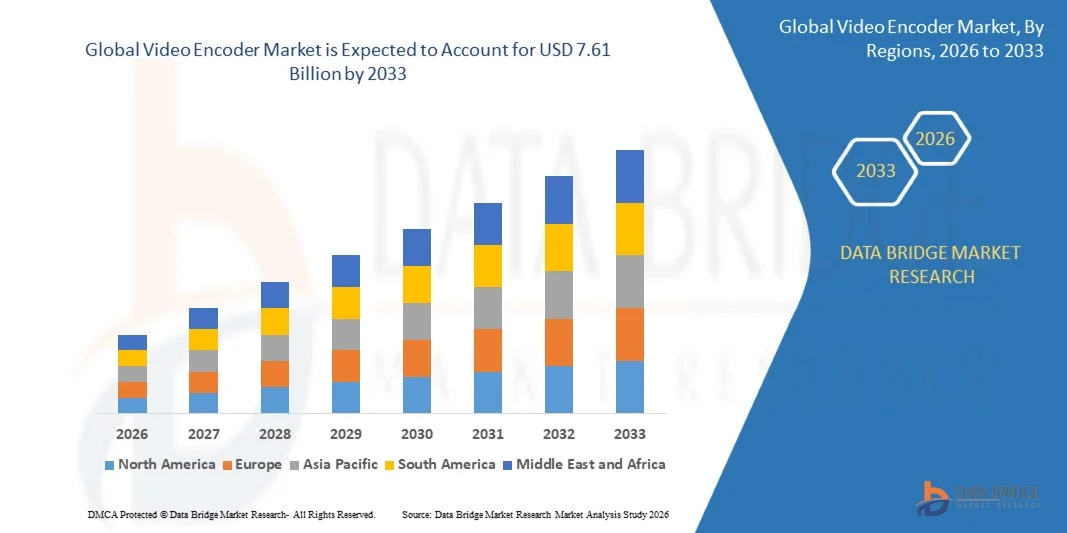
- As per Data Bridge Market Research analysis, the video encoder market was valued at USD 3.43 billion in 2025 and is projected to reach USD 7.61 billion by 2033, growing at a CAGR of 10.50% from 2026 to 2033.
- The market is experiencing strong growth driven by the global transition from legacy H.264/AVC infrastructure toward more efficient H.265/HEVC, AV1, and emerging VVC/H.266 standards, rising OTT streaming subscriptions, and expanding IP-based video surveillance deployments in smart-city programs worldwide.
- Growing consumer and broadcaster demand for 4K and 8K resolutions, rising adoption of cloud-native and AI-assisted encoding platforms, and continued expansion of low-latency live streaming and video conferencing applications are further accelerating market expansion.
Market Size & Forecast
- Global Market Value (2025): USD 3.43 Billion
- Expected Market Value (2033): USD 7.61 Billion
- Forecast CAGR (2026–2033): 10.50%
- Leading Region in 2025: North America
- Fastest Growing Region: Asia-Pacific
What are the Major Takeaways of the Video Encoder Market?
- North America dominated the global video encoder market with the largest revenue share of 36.50% in 2025, supported by a mature media and entertainment ecosystem, rapid 5G deployment, and the presence of leading encoder vendors.
- Asia-Pacific is expected to be the fastest-growing region at a CAGR of 13.80% from 2026 to 2033, fueled by large-scale smart-city IP camera deployments and rapid OTT and broadcast infrastructure expansion across China, India, and the Gulf states.
- The hardware encoders segment led the market with a 61.00% share in 2025, driven by processing efficiency and continued preference in live-broadcast and satellite-contribution environments.
- Cloud/SaaS encoders are the fastest-growing encoder type, projected to register a CAGR of 14.60%, reflecting rising demand for elastic, usage-based encoding infrastructure.
- The H.264/AVC segment dominated the encoding standard category with a 49.00% revenue share in 2025, reflecting its continued widespread compatibility across existing broadcast and streaming infrastructure.
- The broadcast & pay-TV application segment accounted for 58.40% of the market share in 2025, supported by continued global reliance on encoders for satellite, cable, and terrestrial broadcast distribution.
- The AV1 encoding standard is the fastest-growing category, with a CAGR of 15.80%, driven by its royalty-free licensing model and backing from the Alliance for Open Media.
Report Scope and Video Encoder Market Segmentation
|
Attributes |
Video Encoder Key Market Insights |
|
Segments Covered |
|
|
Countries Covered |
North America
Europe
Asia-Pacific
Middle East and Africa
South America
|
|
Key Market Players |
|
|
Market Opportunities |
|
|
Value Added Data Infosets |
In addition to the market insights such as market value, growth rate, market segments, geographical coverage, market players, and market scenario, the market report curated by the Data Bridge Market Research team includes in-depth expert analysis, import/export analysis, pricing analysis, production consumption analysis, and pestle analysis. |
What is the Key Trend in the Video Encoder Market?
- Encoder vendors are increasingly building multi-codec platforms that combine AV1 and VVC support, positioning themselves to take share from legacy-only incumbents as hardware-accelerated next-generation codec support advances from data-center GPUs to edge SoCs.
- For instance, in March 2025, Intel introduced new Xeon processors that embed VVC/H.266 acceleration, allowing data centers to handle next-generation codecs without add-on cards and lowering cloud-encoding costs by as much as 60% compared with software-only approaches.
- Cloud providers are continuing to expand global encoding infrastructure to reduce latency and support region-specific codec preferences for fast-growing streaming and surveillance markets.
- For instance, in July 2025, AWS Elemental enlarged its global encoding footprint with new facilities in Mumbai and São Paulo, cutting latency for Asia-Pacific and South American customers by up to 40% and featuring specialized AV1 hardware to serve growing interest in royalty-free compression.
- As next-generation codecs continue to mature and cloud infrastructure continues to expand globally, vendors are expected to accelerate investment in multi-codec, geographically distributed encoding platforms, reinforcing codec diversification as a core market trend.
What are the Key Drivers of the Video Encoder Market?
- The global push toward next-generation broadcast standards and the continued explosion of OTT video subscriptions, which surpassed 1.8 billion worldwide in 2024, are compelling operators and enterprises to upgrade encoding infrastructure on compressed timelines.
- For instance, in September 2025, Harmonic committed USD 85 million to advance VVC/H.266 hardware acceleration for 8K live streams in sports and entertainment venues, positioning itself to meet rising demand for ultra-high-definition workflows as premium 8K displays gain traction.
- Rapid growth of IP-based video surveillance deployments in smart-city programs across China, India, and the Gulf states is driving sustained demand for local encoding infrastructure ahead of network backhaul.
- For instance, in September 2024, AWS Elemental introduced AV1 hardware-accelerated encoding on AWS MediaLive, reducing per-stream cloud costs by an estimated 25% for early adopters, reflecting the commercial momentum building behind royalty-free codec adoption.
- With video now accounting for the majority of global internet traffic and enterprises continuing to prioritize bandwidth efficiency, sustained investment in advanced encoding infrastructure is expected to remain a key growth driver for the market.
Which Factors are Challenging the Growth of the Video Encoder Market?
- The technology transition from legacy H.264/AVC toward H.265/HEVC, AV1, and VVC/H.266 requires vendors and operators to support multiple codecs simultaneously, increasing R&D complexity and infrastructure costs during the multi-year migration period.
- Rising data-center electricity consumption associated with video transcoding, combined with tightening regulatory frameworks such as the EU's Energy Efficiency Directive targeting data-center power usage thresholds, is increasing pressure on vendors to demonstrate measurable efficiency improvements.
- The moderately fragmented competitive landscape, spanning hardware appliance incumbents and cloud-native challengers, creates pricing pressure and complicates long-term vendor selection for enterprise buyers.
- The combination of multi-codec transition complexity, rising regulatory and energy-efficiency pressure on data-center infrastructure, and a fragmented competitive landscape continues to complicate procurement decisions and moderate the pace of infrastructure upgrades for some operators.
How is the Video Encoder Market Segmented?
The video encoder market is segmented on the basis of encoder type, encoding standard, application, end-user industry, resolution support, deployment mode, latency type, channel capacity, component, and distribution channel.
- By Encoder Type
On the basis of encoder type, the global video encoder market is segmented into hardware encoders, software encoders, and cloud/SaaS encoders. The hardware encoders segment dominated the market with a 61.00% share in 2025, driven by their processing efficiency and continued preference in live-broadcast and satellite-contribution environments where sub-frame latency and deterministic performance remain non-negotiable.
The cloud/SaaS encoders segment is projected to register the fastest growth at a CAGR of 14.60% from 2026 to 2033, driven by growing demand for elastic, usage-based encoding infrastructure that supports remote production and multi-platform content delivery.
- By Encoding Standard
On the basis of encoding standard, the global video encoder market is segmented into H.264/AVC, H.265/HEVC, AV1, VVC/H.266, and other legacy codecs. The H.264/AVC segment dominated the market with a 49.00% share in 2025, reflecting its continued widespread compatibility and its position as the most extensively deployed codec across existing broadcast and streaming infrastructure.
The AV1 segment is expected to witness the fastest CAGR of 15.80% from 2026 to 2033, driven by its royalty-free licensing model and backing from the Alliance for Open Media, including Google, Apple, Meta, and Netflix, which is accelerating adoption among cost-sensitive, large-scale streaming deployments.
- By Application
On the basis of application, the global video encoder market is segmented into broadcast & pay-TV, OTT & live streaming, video surveillance, video conferencing & enterprise communication, and remote education & telehealth. The broadcast & pay-TV segment dominated the market with a 58.40% share in 2025, supported by continued global reliance on encoders for satellite, cable, and terrestrial broadcast contribution and distribution.
The OTT & live streaming segment is anticipated to witness the fastest CAGR of 13.20% from 2026 to 2033, driven by continued global growth in streaming subscriptions and rising consumer demand for high-resolution, low-latency live content delivery.
- By End-User Industry
On the basis of end-user industry, the global video encoder market is segmented into media & entertainment, enterprise/corporate, government & defense, healthcare, and education. The media & entertainment segment dominated the market with a 38.60% share in 2025, driven by rising 4K HDR broadcasting, OTT platform streaming, and live sports production requiring high-efficiency video compression.
The government & defense segment is expected to witness the fastest CAGR of 12.40% from 2026 to 2033, driven by rising investment in video surveillance, intelligence, and reconnaissance infrastructure requiring SWaP-optimized, standards-compliant encoding modules.
- By Resolution Support
On the basis of resolution support, the global video encoder market is segmented into HD, full HD, 4K, and 8K. The 4K segment dominated the market with a 44.00% share in 2025, supported by widespread consumer and broadcaster transition to ultra-high-definition content across streaming and live production workflows.
The 8K segment is projected to witness the fastest CAGR of 18.90% from 2026 to 2033, albeit from a smaller base, driven by growing premium display adoption and rising demand for next-generation codec-enabled ultra-high-definition sports and entertainment broadcasting.
- By Deployment Mode
On the basis of deployment mode, the global video encoder market is segmented into on-premise, cloud-based, and hybrid. The on-premise segment dominated the market with a 54.00% share in 2025, reflecting continued broadcaster and enterprise preference for dedicated, deterministic-performance encoding infrastructure in mission-critical live environments.
The cloud-based segment is expected to witness the fastest CAGR of 15.40% from 2026 to 2033, driven by rising adoption of elastic, pay-as-you-go encoding infrastructure that reduces capital expenditure and supports rapid multi-region scaling.
- By Latency Type
On the basis of latency type, the global video encoder market is segmented into ultra-low latency (<200ms), low latency, and standard latency. The standard latency segment dominated the market with a 48.00% share in 2025, supported by its continued widespread use across on-demand and non-time-sensitive broadcast and streaming applications.
The ultra-low latency segment is anticipated to witness the fastest CAGR of 13.70% from 2026 to 2033, driven by rising demand for sub-second delivery in live sports, interactive streaming, and real-time video conferencing applications.
- By Channel Capacity
On the basis of channel capacity, the global video encoder market is segmented into single-channel encoders and multi-channel encoders (4+ streams). The single-channel encoders segment dominated the market with a 52.00% share in 2025, reflecting their continued widespread use across smaller broadcast operations and dedicated point-to-point contribution links.
The multi-channel encoders segment is expected to witness the fastest CAGR of 12.90% from 2026 to 2033, driven by rising demand for simultaneous multi-destination streaming among content owners distributing across numerous OTT and social platforms.
- By Component
On the basis of component, the global video encoder market is segmented into encoder hardware/appliance, encoding software/SDK, and encoding services & support. The encoder hardware/appliance segment dominated the market with a 47.50% share in 2025, reflecting sustained broadcaster investment in dedicated, purpose-built encoding equipment for mission-critical live workflows.
The encoding software/SDK segment is projected to witness the fastest CAGR of 13.10% from 2026 to 2033, driven by rising adoption of software-defined, codec-agnostic encoding platforms that can be deployed flexibly across on-premise and cloud infrastructure.
- By Distribution Channel
On the basis of distribution channel, the global video encoder market is segmented into direct sales/OEM contracts, system integrators & distributors, and cloud marketplace. The direct sales/OEM contracts segment dominated the market with a 51.00% share in 2025, supported by large-scale broadcaster and enterprise procurement agreements that typically involve direct vendor engagement.
The cloud marketplace segment is expected to witness the fastest CAGR of 16.20% from 2026 to 2033, driven by growing enterprise procurement of encoding capacity directly through major cloud provider marketplaces.
Which Region Holds the Largest Share of the Video Encoder Market?
- North America dominated the video encoder market and accounted for the largest revenue share of 36.50% in 2025, supported by a mature media and entertainment ecosystem, rapid 5G deployment, and the presence of leading encoder vendors and cloud infrastructure providers.
- The region also benefits from early adoption of next-generation codecs, strong broadcaster and OTT platform investment in ultra-high-definition content, and continued infrastructure expansion from major cloud encoding providers, which continues to reinforce North America's leadership position in the global market.
U.S. Video Encoder Market Insight
The U.S. video encoder market is experiencing strong growth, supported by rapid adoption of next-generation codecs and continued investment from leading cloud and hardware encoder vendors. The presence of major streaming platforms, broadcasters, and technology companies continues to drive frequent product launches and competitive innovation. Growing enterprise demand for AI-assisted, cloud-native encoding platforms is further contributing to market growth in the U.S.
Germany Video Encoder Market Insight
The Germany video encoder market is expanding steadily, supported by the country's strong broadcast and industrial technology base. Manufacturers and broadcasters continue to invest in next-generation codec support to meet evolving content delivery and regulatory efficiency requirements. Continued innovation in low-latency and multi-codec encoding solutions is further shaping market growth in Germany.
Asia-Pacific Video Encoder Market Insight
The Asia-Pacific video encoder market is expected to witness the fastest growth globally, driven by large-scale smart-city IP camera deployments and rapid OTT and broadcast infrastructure expansion across China, India, and the Gulf states. Rising domestic manufacturing capacity and growing government investment in surveillance and broadcast infrastructure continue to support strong regional market expansion.
Japan Video Encoder Market Insight
The Japan video encoder market is witnessing consistent growth, supported by the country's advanced broadcast infrastructure and strong consumer demand for high-resolution content. Domestic and international vendors continue to introduce next-generation encoding solutions tailored to Japan's broadcast, surveillance, and enterprise communication requirements.
China Video Encoder Market Insight
The China video encoder market is growing rapidly, driven by large-scale smart-city surveillance deployments and rapid expansion of domestic OTT and broadcast platforms. Growing domestic manufacturing capacity among leading video technology companies is improving the affordability and availability of encoding infrastructure, while continued government investment in surveillance and broadcast infrastructure is further supporting long-term market growth across China.
Which are the Top Companies in Video Encoder Market?
The video encoder industry is primarily led by well-established companies, including:
- Harmonic Inc. (U.S.)
- Haivision Systems Inc. (Canada)
- Ateme SA (France)
- Telestream LLC (U.S.)
- AWS Elemental (U.S.)
- Cisco Systems, Inc. (U.S.)
- VITEC (France)
- Wowza Media Systems LLC (U.S.)
- Bitmovin, Inc. (Austria)
- Brightcove Inc. (U.S.)
- Imagine Communications Corp. (U.S.)
- NVIDIA Corporation (U.S.)
- Intel Corporation (U.S.)
- Hikvision (China)
- Axis Communications AB (Sweden)
What are Latest Developments in Video Encoder Market?
- In February 2026, Harmonic released a next-generation cloud-native video encoder that emphasizes seamless integration with major cloud platforms and content delivery networks, simplified orchestration for live workflows, and expanded codec support to increase operational agility and ease of deployment across broadcast and streaming environments.
- In September 2025, Harmonic committed USD 85 million to advance VVC/H.266 hardware acceleration for 8K live streams in sports and entertainment venues, positioning itself to meet rising demand for ultra-high-definition workflows as premium 8K displays gain traction.
- In July 2025, AWS Elemental enlarged its global encoding footprint with new facilities in Mumbai and São Paulo, cutting latency for Asia-Pacific and South American customers by up to 40% and featuring specialized AV1 hardware to serve growing interest in royalty-free compression.
- In March 2025, Intel introduced new Xeon processors that embed VVC/H.266 acceleration, allowing data centers to handle next-generation codecs without add-on cards and lowering cloud-encoding costs by as much as 60% compared with software-only approaches.
- In September 2024, AWS Elemental introduced AV1 hardware-accelerated encoding on AWS MediaLive, reducing per-stream cloud costs by an estimated 25% for early adopters, reflecting growing commercial momentum behind royalty-free codec adoption.

- Interactive Data Analysis Dashboard
- Company Analysis Dashboard for high growth potential opportunities
- Research Analyst Access for customization & queries
- Competitor Analysis with Interactive dashboard
- Latest News, Updates & Trend analysis
- Harness the Power of Benchmark Analysis for Comprehensive Competitor Tracking
Data collection and base year analysis are done using data collection modules with large sample sizes. The stage includes obtaining market information or related data through various sources and strategies. It includes examining and planning all the data acquired from the past in advance. It likewise envelops the examination of information inconsistencies seen across different information sources. The market data is analysed and estimated using market statistical and coherent models. Also, market share analysis and key trend analysis are the major success factors in the market report. To know more, please request an analyst call or drop down your inquiry.
The key research methodology used by DBMR research team is data triangulation which involves data mining, analysis of the impact of data variables on the market and primary (industry expert) validation. Data models include Vendor Positioning Grid, Market Time Line Analysis, Market Overview and Guide, Company Positioning Grid, Patent Analysis, Pricing Analysis, Company Market Share Analysis, Standards of Measurement, Global versus Regional and Vendor Share Analysis. To know more about the research methodology, drop in an inquiry to speak to our industry experts.
Data Bridge Market Research is a leader in advanced formative research. We take pride in servicing our existing and new customers with data and analysis that match and suits their goal. The report can be customized to include price trend analysis of target brands understanding the market for additional countries (ask for the list of countries), clinical trial results data, literature review, refurbished market and product base analysis. Market analysis of target competitors can be analyzed from technology-based analysis to market portfolio strategies. We can add as many competitors that you require data about in the format and data style you are looking for. Our team of analysts can also provide you data in crude raw excel files pivot tables (Fact book) or can assist you in creating presentations from the data sets available in the report.













