Global Viral Hemorrhagic Fever Market
Market Size in USD Billion
CAGR :
% 
 USD
1.71 Billion
USD
2.48 Billion
2025
2033
USD
1.71 Billion
USD
2.48 Billion
2025
2033
 Forecast Period Forecast Period |
2026 –2033 |
 Market Size (Base Year) Market Size (Base Year) |
USD 1.71 Billion |
 Market Size (Forecast Year) Market Size (Forecast Year) |
USD 2.48 Billion |
 CAGR CAGR |
% |
| Major Markets Players |
|
Viral Hemorrhagic Fever Market Size
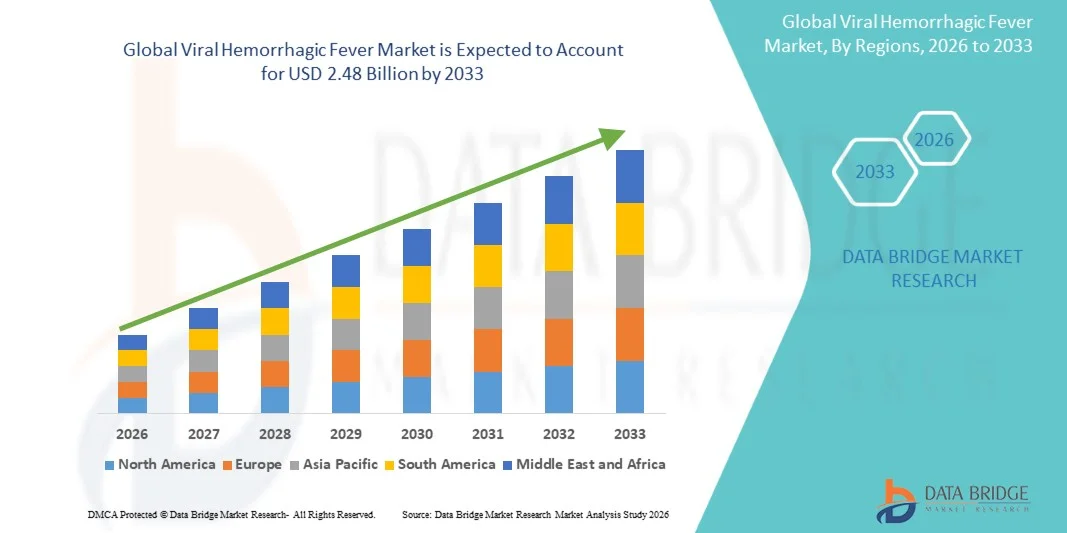
- The global viral hemorrhagic fever market size was valued at USD 1.71 billion in 2025and is expected to reach USD 2.48 billion by 2033, at a CAGR of 4.80% during the forecast period
- The market growth is largely fueled by the increasing incidence and outbreak frequency of high-risk viral hemorrhagic diseases such as Ebola, Dengue, Lassa fever, and Marburg virus disease, along with growing global preparedness initiatives and investments in infectious disease surveillance systems
- Furthermore, rising demand for rapid diagnostics, advanced antiviral therapeutics, and vaccine development, coupled with strengthening public health infrastructure and emergency response capabilities, is establishing improved disease management as a critical priority. These converging factors are accelerating the adoption of effective diagnostic and treatment solutions, thereby significantly boosting the industry's growth
Viral Hemorrhagic Fever Market Analysis
- Viral hemorrhagic fever (VHF) refers to a group of severe, often life-threatening infectious diseases caused by RNA viruses, characterized by high transmission risk, systemic complications, and the urgent need for intensive clinical care, strict isolation, and advanced biosafety measures in healthcare settings
- The escalating demand in the viral hemorrhagic fever market is primarily fueled by increasing outbreak frequency, rising global health security initiatives, expanding investments in antiviral research and vaccine development, and growing need for rapid diagnostic and supportive treatment solutions in epidemic preparedness frameworks
- North America dominated the viral hemorrhagic fever market with the largest revenue share of 38.6% in 2025, characterized by advanced healthcare infrastructure, strong government funding for infectious disease control, and robust R&D capabilities, with the U.S. leading in antiviral innovation, outbreak surveillance systems, and high-containment laboratory networks
- Asia-Pacific is expected to be the fastest growing region in the viral hemorrhagic fever market during the forecast period due to increasing outbreak susceptibility, improving healthcare infrastructure, rising public health investments, and expanding disease monitoring and early warning systems
- Antiviral segment dominated the viral hemorrhagic fever market with a market share of 52.4% in 2025, driven by its essential role as the primary targeted treatment option that helps inhibit viral replication, reduce disease severity, and improve survival outcomes during outbreak conditions
Report Scope and Viral Hemorrhagic Fever Market Segmentation
|
Attributes |
Viral Hemorrhagic Fever Key Market Insights |
|
Segments Covered |
|
|
Countries Covered |
North America · U.S. · Canada · Mexico Europe · Germany · France · U.K. · Netherlands · Switzerland · Belgium · Russia · Italy · Spain · Turkey · Rest of Europe Asia-Pacific · China · Japan · India · South Korea · Singapore · Malaysia · Australia · Thailand · Indonesia · Philippines · Rest of Asia-Pacific Middle East and Africa · Saudi Arabia · U.A.E. · South Africa · Egypt · Israel · Rest of Middle East and Africa South America · Brazil · Argentina · Rest of South America |
|
Key Market Players |
|
|
Market Opportunities |
· Expanding development of broad-spectrum antivirals and monoclonal antibody therapies · Increasing integration of AI-based outbreak prediction and real-time genomic surveillance systems |
|
Value Added Data Infosets |
In addition to the insights on market scenarios such as market value, growth rate, segmentation, geographical coverage, and major players, the market reports curated by the Data Bridge Market Research also include in-depth expert analysis, patient epidemiology, pipeline analysis, pricing analysis, and regulatory framework |
Viral Hemorrhagic Fever Market Trends
“Advancement in Rapid Diagnostics and Digital Surveillance Integration”
- A significant and accelerating trend in the global viral hemorrhagic fever market is the increasing adoption of rapid molecular diagnostics and digital disease surveillance systems, which is improving early detection and outbreak response capabilities across endemic and high-risk regions
- For instance, point-of-care RT-PCR platforms are being deployed in outbreak zones to enable faster identification of viruses such as Ebola and Lassa fever, significantly reducing diagnostic turnaround time
- The integration of genomic sequencing and AI-based epidemiological modeling is enhancing real-time tracking of viral mutations and transmission patterns, enabling more precise containment strategies and risk forecasting
- Mobile health platforms and cloud-based reporting systems are facilitating centralized disease monitoring, allowing healthcare authorities to coordinate faster response measures across hospitals and field units
- The expansion of global vaccine research collaborations and public-private partnerships is accelerating development pipelines for experimental vaccines and antibody-based therapies targeting high-risk hemorrhagic viruses
- This trend towards highly digitized, rapid, and data-driven outbreak management is fundamentally reshaping infectious disease control strategies and improving global preparedness for hemorrhagic fever events
- The demand for advanced diagnostic tools and integrated surveillance systems is growing rapidly across both developed and developing regions, as governments increasingly prioritize early warning systems and epidemic intelligence
Viral Hemorrhagic Fever Market Dynamics
Driver
“Rising Outbreak Incidence and Strengthening Global Health Security Investments”
- The increasing frequency of viral hemorrhagic fever outbreaks, coupled with expanding global health security initiatives, is a major driver accelerating demand for advanced diagnostics, therapeutics, and emergency response systems
- For instance, in March 2025, multiple countries in Africa strengthened their epidemic preparedness programs through enhanced funding for Ebola surveillance and rapid response infrastructure development
- The rising investments by international health organizations in epidemic preparedness funds and emergency stockpiling of antivirals are further supporting market expansion
- Furthermore, the growing collaboration between governments and pharmaceutical companies for accelerated vaccine development programs is boosting innovation in preventive and therapeutic solutions
- The rising awareness of zoonotic spillover risks and cross-border disease transmission is pushing healthcare systems to adopt stronger monitoring and containment frameworks
- The growing emphasis on rapid response capabilities, including mobile laboratories and emergency medical teams, is further propelling adoption of VHF-related diagnostic and treatment solutions in both public and private sectors
- The expansion of international funding mechanisms such as WHO-led outbreak response initiatives is further strengthening global access to diagnostics and treatment resources
- The increasing role of public-private partnerships in accelerating clinical trials for hemorrhagic fever therapeutics is further enhancing pipeline development and commercialization prospects
Restraint/Challenge
“Limited Treatment Availability and High Containment Requirements”
- Concerns related to limited availability of approved antiviral therapies and vaccines for several viral hemorrhagic fevers pose a significant challenge to effective disease management and market expansion
- For instance, only a small number of targeted treatments exist for diseases such as Lassa fever and Marburg virus, leading to heavy reliance on supportive care rather than curative options
- The requirement for high-level biosafety containment laboratories (BSL-4 facilities) for handling and studying these pathogens significantly restricts research and diagnostic capacity in many regions
- The risk of laboratory-acquired infections and strict regulatory compliance requirements further limit the number of facilities capable of conducting advanced research and testing
- The shortage of trained infectious disease specialists and biosafety-certified laboratory personnel further constrains diagnostic and research scalability in emerging economies
- High logistical challenges in transporting infectious samples under cold-chain and biosecure conditions also delay diagnostic confirmation and outbreak response timelines
- These challenges related to therapeutic limitations, infrastructure gaps, and stringent biosafety requirements continue to hinder widespread market penetration and delay large-scale treatment advancements
- The lack of standardized global treatment protocols for many hemorrhagic fever diseases creates inconsistencies in clinical management and delays optimal patient care delivery
Viral Hemorrhagic Fever Market Scope
The market is segmented on the basis of therapy type, route of administration, end-users, and distribution channel.
- By Therapy Type
On the basis of therapy type, the viral hemorrhagic fever market is segmented into antiviral, electrolytes, and others. The antiviral segment dominated the market with the largest revenue share of 52.4% in 2025, driven by its critical role in directly targeting viral replication and improving survival outcomes in life-threatening infections such as Ebola and Lassa fever. Antiviral therapies are widely prioritized in clinical management protocols as they offer the only disease-modifying approach compared to supportive care options. Increasing R&D investment in broad-spectrum antivirals and emergency use authorizations during outbreaks further strengthen this segment’s dominance. In addition, growing government stockpiling programs and international health initiatives continue to reinforce demand for antiviral-based treatment strategies.
The electrolytes segment is expected to witness the fastest growth rate of 18.6% from 2026 to 2033, driven by its essential role in supportive care management of dehydration, fluid imbalance, and organ failure associated with severe hemorrhagic fever cases. Electrolyte therapy is increasingly used in combination with antivirals to stabilize critically ill patients, especially in resource-limited outbreak settings. Rising adoption of standardized treatment protocols emphasizing early fluid resuscitation is further accelerating segment growth. In addition, increasing deployment of portable intravenous therapy solutions in field hospitals and emergency response units is supporting wider usage. Growing awareness of comprehensive supportive care approaches in improving patient survival rates is also boosting demand.
- By Route of Administration
On the basis of route of administration, the market is segmented into oral, parenteral, and others. The parenteral segment dominated the market with the largest revenue share of 61.3% in 2025, driven by its effectiveness in delivering rapid and direct systemic action in severe and emergency cases of viral hemorrhagic fever. Intravenous administration is the preferred method in hospital settings due to the critical condition of patients requiring immediate therapeutic intervention. Most antiviral and supportive care drugs used in VHFs are formulated for injectable use to ensure higher bioavailability and faster onset of action. The dominance of hospital-based treatment protocols and intensive care unit management further supports the strong share of this segment.
The oral segment is expected to witness the fastest growth rate of 16.9% from 2026 to 2033, driven by increasing research into oral antiviral formulations that can enable early-stage treatment and outpatient management. Oral therapies offer improved accessibility, especially in remote and resource-limited regions where hospital infrastructure is limited. The development of next-generation antiviral pills with improved stability and broad-spectrum efficacy is further driving adoption. In addition, growing emphasis on decentralized healthcare delivery and home-based treatment models is supporting this shift. Increasing demand for easier administration methods during outbreak emergencies is also accelerating growth.
- By End-Users
On the basis of end-users, the market is segmented into hospitals, homecare, and others. The hospitals segment dominated the market with the largest revenue share of 68.7% in 2025, driven by the need for intensive care management, isolation facilities, and advanced infection control infrastructure. Viral hemorrhagic fever cases require continuous monitoring, specialized treatment, and strict biosafety measures, all of which are primarily available in hospital environments. Hospitals also serve as the central point for administering antiviral therapies and managing severe complications. The presence of trained infectious disease specialists and critical care units further reinforces hospital dominance.
The homecare segment is expected to witness the fastest growth rate of 14.8% from 2026 to 2033, driven by the increasing development of milder treatment protocols and post-recovery care solutions that allow patient management outside hospital settings. Advancements in remote monitoring devices and telemedicine support are enabling safer home-based care for non-critical patients. Rising healthcare costs and hospital overcrowding during outbreaks are also encouraging homecare adoption. In addition, growing awareness of early symptom management and supportive care at home is contributing to segment expansion.
- By Distribution Channel
On the basis of distribution channel, the market is segmented into hospital pharmacy, online pharmacy, and retail pharmacy. The hospital pharmacy segment dominated the market with the largest revenue share of 72.5% in 2025, driven by centralized procurement systems and strict control over antiviral and emergency medication dispensing. Hospital pharmacies play a critical role in ensuring immediate availability of life-saving drugs during outbreak situations. The need for regulated storage, controlled distribution, and rapid drug deployment in emergency care settings strongly supports this segment. Integration with hospital treatment protocols and emergency stockpiling programs further strengthens its dominance.
The online pharmacy segment is expected to witness the fastest growth rate of 19.2% from 2026 to 2033, driven by increasing digitalization of healthcare services and expanding e-pharmacy infrastructure in developing regions. Online platforms are improving accessibility to supportive medications and preventive care drugs, especially in remote and underserved areas. Growing adoption of telemedicine consultations is further enabling prescription-based online drug delivery. In addition, rising consumer preference for contactless healthcare services post-outbreak scenarios is accelerating growth. Expanding regulatory support for digital pharmaceutical distribution is also contributing to segment expansion.
Viral Hemorrhagic Fever Market Regional Analysis
- North America dominated the viral hemorrhagic fever market with the largest revenue share of 38.6% in 2025, characterized by advanced healthcare infrastructure, strong government funding for infectious disease control, and robust R&D capabilities
- Healthcare systems in the region highly prioritize rapid outbreak response, advanced diagnostics, and development of antiviral therapies, alongside well-established biosafety level laboratories for handling high-risk pathogens
- This widespread leadership is further supported by high R&D investment, strong presence of leading biopharmaceutical companies, and continuous government initiatives for pandemic preparedness, establishing the region as a key hub for viral hemorrhagic fever research, treatment development, and emergency response capabilities
U.S. Viral Hemorrhagic Fever Market Insight
The United States dominated the North America market in 2025, supported by strong federal funding for infectious disease control, advanced research ecosystems, and highly efficient outbreak response systems. The country hosts a dense network of high-containment laboratories and leading academic institutions that focus on viral research, genomic sequencing, and therapeutic innovation. Collaboration between government bodies such as health agencies, biotechnology firms, and global health organizations further accelerates the development of antivirals and vaccines. In addition, continuous investments in pandemic preparedness programs, stockpiling of emergency therapeutics, and expansion of surveillance systems significantly strengthen the U.S. position as a global leader in managing viral hemorrhagic fever threats.
Europe Viral Hemorrhagic Fever Market
Europe viral hemorrhagic fever market is projected to expand at a steady CAGR throughout the forecast period, driven by strong regulatory frameworks, increasing investments in public health preparedness, and growing emphasis on infectious disease control. The region benefits from advanced healthcare systems and strong cross-border collaboration for disease surveillance and outbreak management. Ongoing research partnerships among universities, government agencies, and pharmaceutical companies are improving diagnostic and therapeutic capabilities. In addition, strengthening of centralized reporting systems and enhanced laboratory networks across countries is enabling faster detection and coordinated response to viral outbreaks.
U.K. Viral Hemorrhagic Fever Market
U.K. viral hemorrhagic fever market is expected to grow at a notable CAGR during the forecast period, supported by rising focus on epidemic preparedness and strong government funding for infectious disease research programs. The country is investing in upgrading its biosafety infrastructure, including expansion of high-containment laboratories for studying emerging pathogens. Strong collaboration between public health agencies, academic institutions, and biotech companies is accelerating innovation in antiviral development and rapid diagnostic technologies. Furthermore, the U.K.’s emphasis on early warning systems and preparedness planning is enhancing its overall outbreak response capabilities.
Germany Viral Hemorrhagic Fever Market
Germany viral hemorrhagic fever market is anticipated to grow steadily during the forecast period, driven by strong healthcare infrastructure, technological advancement, and increasing focus on biomedical innovation. The country is investing heavily in digital health integration, enabling improved disease monitoring, data analytics, and outbreak prediction capabilities. Expansion of laboratory networks and strengthening of infectious disease surveillance systems are further enhancing preparedness. In addition, Germany’s emphasis on research-driven healthcare and precision diagnostics supports the development of advanced solutions for managing viral hemorrhagic fever cases.
Asia-Pacific Viral Hemorrhagic Fever Market
Asia-Pacific viral hemorrhagic fever market is expected to grow at the fastest CAGR of 22% during 2026–2033, driven by rising outbreak susceptibility, improving healthcare infrastructure, and increasing government investment in disease surveillance systems. The region is witnessing rapid expansion in diagnostic capabilities, along with growing adoption of digital health technologies for early detection and outbreak tracking. International funding support and collaborations are also strengthening regional preparedness. In addition, the development of local manufacturing hubs for diagnostic kits and supportive care products is improving affordability and accessibility across emerging economies.
Japan Viral Hemorrhagic Fever Market
Japan viral hemorrhagic fever market is gaining momentum due to its advanced healthcare system, strong focus on infectious disease control, and early adoption of high-end diagnostic technologies. The country is integrating genomic sequencing and real-time surveillance tools to improve outbreak detection and response speed. Japan’s aging population and high healthcare standards are also increasing demand for advanced supportive care and antiviral therapies. Moreover, strong government preparedness initiatives and hospital infrastructure further support market growth.
India Viral Hemorrhagic Fever Market
India viral hemorrhagic fever market accounted for a significant share in Asia-Pacific in 2025, driven by its large population base, rising vulnerability to infectious disease outbreaks, and expanding healthcare infrastructure. The country is strengthening its public health surveillance systems and improving access to diagnostic and emergency care services across urban and rural areas. Government-led epidemic preparedness programs and increasing investment in healthcare modernization are further supporting market expansion. In addition, the growth of domestic manufacturing for diagnostic tools and supportive therapies is improving affordability and increasing treatment accessibility across the population.
Viral Hemorrhagic Fever Market Share
The Viral Hemorrhagic Fever industry is primarily led by well-established companies, including:
- Merck & Co., Inc., (U.S.)
- GSK plc (U.K.)
- SIGA Technologies, Inc. (U.S.)
- Moderna, Inc. (U.S.)
- BioNTech SE (Germany)
- Pfizer Inc. (U.S.)
- Sanofi (France)
- AbbVie Inc. (U.S.)
- Novartis AG (Switzerland)
- Takeda Pharmaceutical Company Limited (Japan)
- AstraZeneca (U.K.)
- Bavarian Nordic A/S (Denmark)
- Emergent BioSolutions Inc. (U.S.)
- Inovio Pharmaceuticals, Inc. (U.S.)
- Regeneron Pharmaceuticals, Inc. (U.S.)
- Eli Lilly and Company (U.S.)
- CSL Limited (Australia)
- DiaSorin S.p.A. (Italy)
What are the Recent Developments in Global Viral Hemorrhagic Fever Market?
- In January 2026, Ethiopia declared the end of its first-ever Marburg virus disease outbreak, marking a major containment success after 14 confirmed cases and 9 deaths were reported. The outbreak was officially closed after 42 days with no new cases, following WHO outbreak control guidelines and enhanced surveillance measures
- In December 2025, the Democratic Republic of Congo successfully declared the end of an Ebola outbreak after 42 days without new cases. The outbreak involved dozens of confirmed cases and deaths, but rapid surveillance and vaccination efforts helped contain transmission quickly
- In November 2025, Ethiopia confirmed its first outbreak of Marburg virus disease in the South Ethiopia region, triggering rapid international response from WHO and Africa CDC. The outbreak involved confirmed cases with high fatality rates, highlighting ongoing risks of viral hemorrhagic fever spillovers from bats to humans
- In September 2025, the Democratic Republic of Congo reported a new Ebola outbreak that caused dozens of infections and deaths before being contained within a few months. Strengthened surveillance systems and vaccination campaigns played a key role in stopping further spread
- In September 2025, a global resurgence of chikungunya virus infections was reported across multiple regions, with over 445,000 suspected and confirmed cases and several deaths. Although not strictly hemorrhagic such as Ebola or Marburg, it reinforced global concerns about outbreak-prone viral diseases and surveillance system readiness
SKU-
Get online access to the report on the World's First Market Intelligence Cloud

- Interactive Data Analysis Dashboard
- Company Analysis Dashboard for high growth potential opportunities
- Research Analyst Access for customization & queries
- Competitor Analysis with Interactive dashboard
- Latest News, Updates & Trend analysis
- Harness the Power of Benchmark Analysis for Comprehensive Competitor Tracking
Research Methodology
Data collection and base year analysis are done using data collection modules with large sample sizes. The stage includes obtaining market information or related data through various sources and strategies. It includes examining and planning all the data acquired from the past in advance. It likewise envelops the examination of information inconsistencies seen across different information sources. The market data is analysed and estimated using market statistical and coherent models. Also, market share analysis and key trend analysis are the major success factors in the market report. To know more, please request an analyst call or drop down your inquiry.
The key research methodology used by DBMR research team is data triangulation which involves data mining, analysis of the impact of data variables on the market and primary (industry expert) validation. Data models include Vendor Positioning Grid, Market Time Line Analysis, Market Overview and Guide, Company Positioning Grid, Patent Analysis, Pricing Analysis, Company Market Share Analysis, Standards of Measurement, Global versus Regional and Vendor Share Analysis. To know more about the research methodology, drop in an inquiry to speak to our industry experts.
Customization Available
Data Bridge Market Research is a leader in advanced formative research. We take pride in servicing our existing and new customers with data and analysis that match and suits their goal. The report can be customized to include price trend analysis of target brands understanding the market for additional countries (ask for the list of countries), clinical trial results data, literature review, refurbished market and product base analysis. Market analysis of target competitors can be analyzed from technology-based analysis to market portfolio strategies. We can add as many competitors that you require data about in the format and data style you are looking for. Our team of analysts can also provide you data in crude raw excel files pivot tables (Fact book) or can assist you in creating presentations from the data sets available in the report.