




Global Virtualization Security Market
Market Size in USD Billion
CAGR :
% 
 USD
3.14 Billion
USD
9.14 Billion
2025
2033
USD
3.14 Billion
USD
9.14 Billion
2025
2033
 Forecast Period Forecast Period |
2026 - 2033 |
 Market Size (Base Year) Market Size (Base Year) |
USD 3.14 Billion |
 Market Size (Forecast Year) Market Size (Forecast Year) |
USD 9.14 Billion |
 CAGR CAGR |
% |
| Major Markets Players |
|
Virtualization Security Market Overview
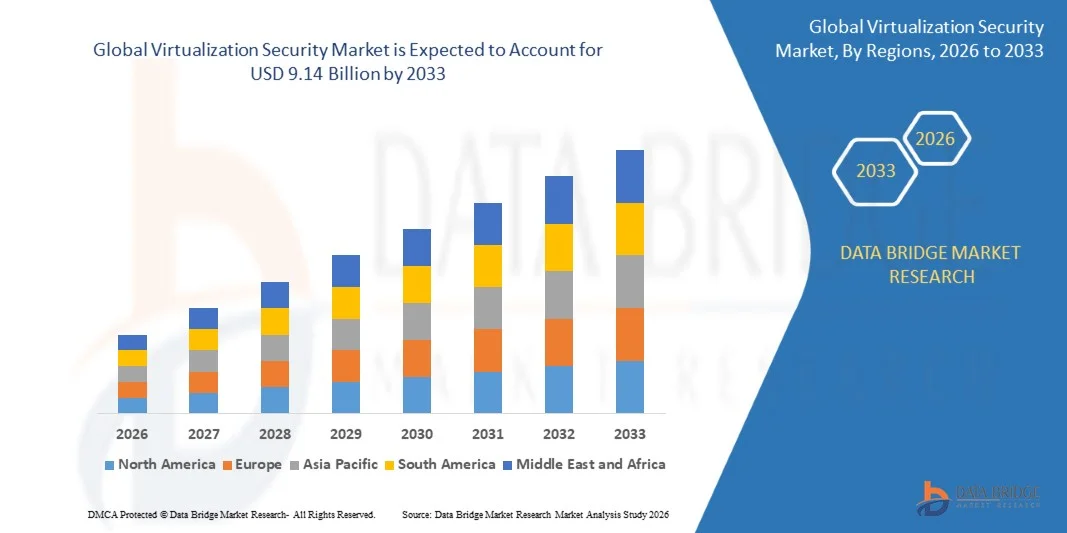
The Virtualization Security Market was valued at USD 3.14 billion in 2025 and is projected to reach USD 9.14 billion by 2033, growing at a CAGR of 14.30% from 2026 to 2033. The market is witnessing strong expansion driven by the rapid adoption of virtualized IT infrastructures, increasing migration of enterprises to cloud environments, and rising concerns over cybersecurity threats targeting virtual machines, containers, and hybrid cloud systems.
The growing complexity of enterprise IT ecosystems, combined with the widespread implementation of remote work models and digital transformation initiatives, is accelerating the demand for advanced virtualization security solutions. Organizations are increasingly deploying workload protection platforms, hypervisor-level security tools, and AI-driven threat detection systems to safeguard virtual environments, ensure regulatory compliance, and maintain business continuity across distributed IT infrastructures.
Key Market Trends & Insights
- North America dominated the virtualization security market with the largest revenue share of 39.6% in 2025, supported by rapid cloud adoption, strong presence of leading cybersecurity vendors, and widespread deployment of hybrid IT infrastructures across enterprises.
- Asia-Pacific is expected to be the fastest-growing region, recording a strong CAGR from 2026 to 2033 driven by rapid digital transformation, increasing cloud deployment, rising cybersecurity investments, and expansion of hyperscale data centers across emerging economies.
- The Solutions segment held the largest market revenue share of approximately 61.5% in 2025 driven by rising adoption of workload protection platforms, hypervisor security tools, and endpoint virtualization security solutions across enterprise IT environments. Organizations are increasingly investing in integrated security software to safeguard virtual machines, containers, and hybrid cloud workloads from evolving cyber threats.
- The Services segment is projected to register the fastest growth at a CAGR of 13.9% from 2026 to 2033, driven by increasing demand for managed security services, consulting, and deployment support. Growing complexity of multi-cloud environments and shortage of skilled cybersecurity professionals is accelerating reliance on outsourced virtualization security services for continuous monitoring and incident response.
- The On-premises segment held the largest market revenue share of approximately 54.2% in 2025, driven by strong adoption among regulated industries such as banking, defense, and healthcare that require strict data control, compliance adherence, and internal security governance.
- The Cloud segment is projected to register the fastest growth at a CAGR of 15.6% from 2026 to 2033, driven by rapid migration of enterprises toward cloud-native infrastructures and increasing adoption of hybrid and multi-cloud environments. The scalability, flexibility, and cost efficiency of cloud-based virtualization security solutions are accelerating adoption across SMEs and large enterprises.
- The Large Enterprises segment held the largest market revenue share of approximately 58.7% in 2025, driven by extensive IT infrastructure, high virtualization density, and increased exposure to advanced persistent threats requiring robust security frameworks.
- The Medium Enterprises segment is projected to register the fastest growth at a CAGR of 14.8% from 2026 to 2033, driven by accelerating digital transformation initiatives and increasing adoption of cost-effective cloud virtualization platforms. SMEs are increasingly implementing scalable security solutions to protect growing virtual workloads and remote workforce environments.
- The Enterprises segment held the largest market revenue share of approximately 63.9% in 2025, driven by widespread adoption of virtualization technologies across industries such as BFSI, IT and telecom, healthcare, and retail. Enterprises are increasingly prioritizing advanced security frameworks to protect sensitive data and ensure uninterrupted virtual operations.
- The Service Providers segment is projected to register the fastest growth at a CAGR of 16.2% from 2026 to 2033, driven by rising demand for secure cloud hosting, managed security services, and infrastructure-as-a-service offerings. Expanding hyperscale data center deployments and growing reliance on third-party cloud service providers are further accelerating segment growth.
Market Size & Forecast
- Global Market Value (2025): USD 3.14 Billion
- Expected Market Value (2033): USD 9.14 Billion
- Forecast CAGR (2026–2033): 14.30%
- Leading Region in 2025: North America
- Fastest Growing Region: Asia-Pacific
Report Scope and Virtualization Security Market Segmentation
|
Attributes |
Virtualization Security Key Market Insights |
|
Segments Covered |
· By Component: Solutions and Services · By Deployment: On-premises and Cloud · By Organization: Small Enterprises, Medium Enterprises, and Large Enterprises · By End User: Service Providers and Enterprises |
|
Countries Covered |
North America · U.S. · Canada · Mexico Europe · Germany · France · U.K. · Netherlands · Switzerland · Belgium · Russia · Italy · Spain · Turkey · Rest of Europe Asia-Pacific · China · Japan · India · South Korea · Singapore · Malaysia · Australia · Thailand · Indonesia · Philippines · Rest of Asia-Pacific Middle East and Africa · Saudi Arabia · U.A.E. · South Africa · Egypt · Israel · Rest of Middle East and Africa South America · Brazil · Argentina · Rest of South America |
|
Key Market Players |
• IBM (U.S.) |
|
Market Opportunities |
• Rapid Adoption Of Cloud-Native Security Solutions |
|
Value Added Data Infosets |
In addition to the market insights such as market value, growth rate, market segments, geographical coverage, market players, and market scenario, the market report curated by the Data Bridge Market Research team includes in-depth expert analysis, import/export analysis, pricing analysis, production consumption analysis, and pestle analysis. |
Virtualization Security Market Trends
Trend: Growth In Zero Trust Architecture And Cloud-Native Virtualization Security Deployment
Increasing adoption of distributed cloud environments, hybrid IT infrastructures, and remote workforce models is driving demand for advanced virtualization security frameworks across enterprise ecosystems. Traditional perimeter-based security models are becoming less effective due to the dynamic nature of virtual machines, containers, and multi-cloud workloads, pushing organizations toward Zero Trust Architecture and continuous identity verification-based security frameworks.
In modern enterprise cloud environments, organizations are integrating virtualization security platforms, For instance VMware-based NSX security and Microsoft Azure virtual network protection, to enforce micro-segmentation and isolate workloads within shared infrastructure, improving breach containment and reducing lateral movement risks in multi-tenant environments. In banking and financial services, virtualization security tools are being deployed to protect virtual desktops and sensitive transaction systems, reducing exposure to ransomware and insider threats while maintaining regulatory compliance such as GDPR and PCI DSS.
The rapid expansion of cloud-native applications and containerized workloads across industries such as IT services, healthcare, and retail is also increasing demand for real-time workload protection and runtime security monitoring solutions. In addition, government and defense organizations continue to adopt hardened virtualization security frameworks, such as FedRAMP-compliant cloud security architectures used in U.S. federal agencies, to secure classified and mission-critical virtual environments. Growing enterprise validation through large-scale hybrid cloud deployments in 2025, particularly across North America and Europe, is demonstrating significant reduction in security breach incidents by approximately 30–40% in organizations implementing Zero Trust-based virtualization security models
Virtualization Security Market Dynamics
Key Market Driver: Rising Adoption Of Cloud Migration And Virtualized Enterprise Infrastructure
Organizations worldwide are accelerating cloud migration strategies and replacing legacy physical infrastructure with virtualized computing environments to improve scalability, operational efficiency, and cost optimization. The increasing deployment of virtual machines, hyper-converged infrastructure, and multi-cloud ecosystems is generating strong demand for advanced security solutions capable of protecting dynamic and distributed workloads.
Industries such as banking, telecom, healthcare, and manufacturing are rapidly adopting virtualization technologies to support digital transformation initiatives and remote operations, requiring continuous security monitoring and automated threat detection across virtual environments. Enterprises are increasingly deploying AI-driven security analytics, workload isolation tools, and behavioral monitoring systems to prevent unauthorized access and mitigate cyber threats in real time.
Similarly, large-scale cloud service providers and data center operators are investing heavily in virtualization security platforms to secure shared infrastructure environments and maintain uptime reliability. Real-world enterprise deployments in 2024 across U.S. and European financial institutions implementing cloud-native security frameworks reported a reduction of approximately 25–35% in security incident response time due to automated threat detection and centralized policy enforcement systems.
Key Restraint/Challenge: High Complexity Of Integration And Skilled Workforce Shortage
The implementation of virtualization security solutions across heterogeneous IT environments remains highly complex due to integration challenges with legacy systems, multi-cloud platforms, and diverse virtualization technologies. Organizations often face difficulties in maintaining consistent security policies across different hypervisors, container platforms, and cloud service providers, increasing operational complexity and deployment time.
In addition, shortage of skilled cybersecurity professionals with expertise in virtualization security, cloud-native architectures, and Zero Trust frameworks is limiting widespread adoption, particularly in emerging markets. High initial deployment costs and ongoing management expenses associated with advanced security tools also create barriers for small and medium enterprises with limited IT budgets.
Industry assessments indicate that nearly 45–50% of enterprises globally report integration complexity and lack of skilled cybersecurity talent as primary obstacles in fully implementing virtualization security frameworks across hybrid cloud environments.
Key Market Opportunity: Expansion Of AI-Driven Security Automation And Multi-Cloud Protection Platforms
The increasing sophistication of cyber threats targeting virtual environments is creating strong opportunities for AI-driven security automation, predictive threat intelligence, and autonomous response systems across enterprise IT ecosystems. Organizations are increasingly shifting toward unified security platforms that provide visibility and protection across multiple cloud providers and virtual infrastructures.
Enterprises are actively deploying virtualization security solutions, For instance AI-powered workload protection platforms such as Palo Alto Networks Prisma Cloud and Trend Micro Cloud One, to enable continuous monitoring, anomaly detection, and automated incident response across distributed environments. In sectors such as e-commerce, fintech, and SaaS, demand for scalable multi-cloud security solutions is increasing rapidly due to growing data volumes and compliance requirements.
In addition, advancements in machine learning-based threat detection and security orchestration are enabling faster identification of zero-day vulnerabilities and reducing manual intervention in incident response processes. Large-scale cloud adoption projects in Asia-Pacific during 2025 are expected to increase virtualization security investment by nearly 18–22% annually, driven by rapid digitalization and expansion of hyperscale data centers.
Virtualization Security Market Scope
The market is segmented on the basis of component, deployment, organization, and end-use application.
- By Component
On the basis of component, the virtualization security market is segmented into Solutions and Services. The Solutions segment held the largest market revenue share of approximately 61.5% in 2025 driven by rising adoption of workload protection platforms, hypervisor security tools, and endpoint virtualization security solutions across enterprise IT environments. Organizations are increasingly investing in integrated security software to safeguard virtual machines, containers, and hybrid cloud workloads from evolving cyber threats.
The Services segment is projected to register the fastest growth at a CAGR of 13.9% from 2026 to 2033, driven by increasing demand for managed security services, consulting, and deployment support. Growing complexity of multi-cloud environments and shortage of skilled cybersecurity professionals is accelerating reliance on outsourced virtualization security services for continuous monitoring and incident response.
- By Deployment
On the basis of deployment, the virtualization security market is segmented into On-premises and Cloud. The On-premises segment held the largest market revenue share of approximately 54.2% in 2025, driven by strong adoption among regulated industries such as banking, defense, and healthcare that require strict data control, compliance adherence, and internal security governance.
The Cloud segment is projected to register the fastest growth at a CAGR of 15.6% from 2026 to 2033, driven by rapid migration of enterprises toward cloud-native infrastructures and increasing adoption of hybrid and multi-cloud environments. The scalability, flexibility, and cost efficiency of cloud-based virtualization security solutions are accelerating adoption across SMEs and large enterprises.
- By Organization
On the basis of organization size, the virtualization security market is segmented into Small Enterprises, Medium Enterprises, and Large Enterprises. The Large Enterprises segment held the largest market revenue share of approximately 58.7% in 2025, driven by extensive IT infrastructure, high virtualization density, and increased exposure to advanced persistent threats requiring robust security frameworks.
The Medium Enterprises segment is projected to register the fastest growth at a CAGR of 14.8% from 2026 to 2033, driven by accelerating digital transformation initiatives and increasing adoption of cost-effective cloud virtualization platforms. SMEs are increasingly implementing scalable security solutions to protect growing virtual workloads and remote workforce environments.
- By End User
On the basis of end user, the virtualization security market is segmented into Service Providers and Enterprises. The Enterprises segment held the largest market revenue share of approximately 63.9% in 2025, driven by widespread adoption of virtualization technologies across industries such as BFSI, IT and telecom, healthcare, and retail. Enterprises are increasingly prioritizing advanced security frameworks to protect sensitive data and ensure uninterrupted virtual operations.
The Service Providers segment is projected to register the fastest growth at a CAGR of 16.2% from 2026 to 2033, driven by rising demand for secure cloud hosting, managed security services, and infrastructure-as-a-service offerings. Expanding hyperscale data center deployments and growing reliance on third-party cloud service providers are further accelerating segment growth.
Virtualization Security Market Regional Analysis
North America Virtualization Security Market Insight
North America dominated the virtualization security market with the largest revenue share of 39.6% in 2025, supported by rapid cloud adoption, strong presence of leading cybersecurity vendors, and widespread deployment of hybrid IT infrastructures across enterprises. Organizations in the region are increasingly prioritizing advanced virtualization protection solutions to secure multi-cloud workloads, virtual machines, and containerized applications. This dominance is further reinforced by strict regulatory frameworks, high cybersecurity spending, and early adoption of Zero Trust security architectures, making virtualization security a critical component of enterprise IT strategy across both public and private sectors.
U.S. Virtualization Security Market Insight
The U.S. virtualization security market captured the largest revenue share in 2025 within North America, driven by rapid digital transformation initiatives, extensive cloud migration across enterprises, and increasing cyber threats targeting virtualized environments. Organizations are heavily investing in workload protection platforms, hypervisor-level security tools, and AI-powered threat detection systems to safeguard distributed IT infrastructures. Strong adoption of cloud-native architectures across BFSI, healthcare, and IT services, along with the presence of major cybersecurity companies, continues to accelerate market expansion in the country.
Europe Virtualization Security Market Insight
The Europe virtualization security market is expected to witness the fastest growth rate from 2026 to 2033, driven by stringent data protection regulations such as GDPR and increasing adoption of cloud computing across enterprises. Organizations in the region are focusing on securing hybrid cloud environments and virtual workloads as digital transformation accelerates across industries such as banking, manufacturing, and government services. Rising concerns over data sovereignty and cybersecurity threats are further encouraging the adoption of advanced virtualization security solutions.
U.K. Virtualization Security Market Insight
The U.K. virtualization security market is expected to witness strong growth from 2026 to 2033, driven by rapid adoption of cloud-based infrastructures and increasing demand for secure digital business operations. Enterprises are investing in Zero Trust security frameworks and virtualization protection platforms to mitigate ransomware risks and secure remote work environments. Growing reliance on financial services and digital banking ecosystems is also contributing significantly to market expansion.
Germany Virtualization Security Market Insight
The Germany virtualization security market is expected to witness steady growth from 2026 to 2033, fueled by strong industrial digitalization, increasing cloud adoption, and rising emphasis on cybersecurity compliance. Enterprises are integrating advanced virtualization security solutions into Industry 4.0 environments to protect industrial workloads and sensitive manufacturing data. Germany’s focus on data privacy, technological innovation, and secure cloud adoption is further strengthening market growth.
Asia-Pacific Virtualization Security Market Insight
The Asia-Pacific virtualization security market is expected to witness the fastest growth rate from 2026 to 2033, supported by rapid cloud expansion, increasing digital transformation initiatives, and rising cyber threat incidents across emerging economies. Countries such as China, India, and Japan are experiencing strong adoption of virtualized IT infrastructures across enterprises and government sectors. Growing investments in hyperscale data centers and cloud-native application development are significantly boosting demand for virtualization security solutions in the region.
Japan Virtualization Security Market Insight
The Japan virtualization security market is expected to witness strong growth from 2026 to 2033 due to advanced technological infrastructure, high cloud adoption rates, and increasing demand for secure enterprise IT environments. Organizations are focusing on protecting virtual workloads and hybrid cloud systems through AI-driven security platforms and automated threat detection solutions. Japan’s emphasis on digital transformation in manufacturing, finance, and public services is further supporting market expansion.
China Virtualization Security Market Insight
The China virtualization security market accounted for the largest market revenue share in Asia Pacific in 2025, attributed to rapid expansion of cloud computing, strong growth of domestic cybersecurity providers, and large-scale deployment of virtualized enterprise infrastructures. Government-led digitalization initiatives and smart city projects are driving widespread adoption of virtualization security solutions. Increasing cybersecurity investments across technology, finance, and industrial sectors are further strengthening market growth in the country.
Virtualization Security Market Share
The Virtualization Security industry is primarily led by well-established companies, including:
• IBM (U.S.)
• Dell (U.S.)
• Intel Corporation (U.S.)
• McAfee, LLC (U.S.)
• Trend Micro (Japan)
• VMware, Inc. (U.S.)
• Juniper Networks (U.S.)
• Fortinet, Inc. (U.S.)
• Sophos Ltd. (U.K.)
• Cisco Systems Inc. (U.S.)
• HP Development Company LP (U.S.)
• Symantec Corporation (U.S.)
• Huawei Technologies Co., Ltd. (China)
• AT&T (U.S.)
• DXC Technology Company (U.S.)
• BT (U.K.)
• Atos SE (France)
• Infosys Limited (India)
• Verizon (U.S.)
• Cognizant (U.S.)
• NTT DATA Corporation (Japan)
• SecureWorks, Inc. (U.S.)
• Broadcom (U.S.)
Latest Developments in Virtualization Security Market
- In April 2025, ArmorCode launched Anya, an agentic AI-powered application security platform designed for product security and AppSec teams, providing conversation-driven security intelligence to improve decision-making speed and reduce security expertise gaps. This development enhances automation in vulnerability management and strengthens enterprise application security operations through AI-assisted insights.
- In October 2024, Arcserve introduced Arcserve UDP 10, an integrated data protection solution combining backup, replication, high availability, and ransomware detection capabilities for multi-cloud environments. The solution is designed to improve business continuity, simplify data management, and strengthen cyber resilience for enterprises facing increasing ransomware threats and hybrid infrastructure complexity.
- In June 2024, Trend Micro Incorporated announced a new data center security solution leveraging NVIDIA technology, showcased at COMPUTEX 2024, aimed at AI-driven enterprise and government security applications. The solution integrates NVIDIA NIM microservices within Trend Vision One – Sovereign and Private Cloud to accelerate generative AI deployment while enhancing data protection across cloud, data center, and workstation environments, strengthening secure AI adoption.
- In April 2024, Cisco Systems Inc. completed its acquisition of Isovalent, a cloud-native security and networking company, to enhance its Cisco Security Cloud platform. This acquisition strengthens Cisco’s multicloud security capabilities by integrating advanced open-source technologies, improving threat detection, workload protection, and secure connectivity across distributed enterprise environments.
SKU-
Get online access to the report on the World's First Market Intelligence Cloud

- Interactive Data Analysis Dashboard
- Company Analysis Dashboard for high growth potential opportunities
- Research Analyst Access for customization & queries
- Competitor Analysis with Interactive dashboard
- Latest News, Updates & Trend analysis
- Harness the Power of Benchmark Analysis for Comprehensive Competitor Tracking
Research Methodology
Data collection and base year analysis are done using data collection modules with large sample sizes. The stage includes obtaining market information or related data through various sources and strategies. It includes examining and planning all the data acquired from the past in advance. It likewise envelops the examination of information inconsistencies seen across different information sources. The market data is analysed and estimated using market statistical and coherent models. Also, market share analysis and key trend analysis are the major success factors in the market report. To know more, please request an analyst call or drop down your inquiry.
The key research methodology used by DBMR research team is data triangulation which involves data mining, analysis of the impact of data variables on the market and primary (industry expert) validation. Data models include Vendor Positioning Grid, Market Time Line Analysis, Market Overview and Guide, Company Positioning Grid, Patent Analysis, Pricing Analysis, Company Market Share Analysis, Standards of Measurement, Global versus Regional and Vendor Share Analysis. To know more about the research methodology, drop in an inquiry to speak to our industry experts.
Customization Available
Data Bridge Market Research is a leader in advanced formative research. We take pride in servicing our existing and new customers with data and analysis that match and suits their goal. The report can be customized to include price trend analysis of target brands understanding the market for additional countries (ask for the list of countries), clinical trial results data, literature review, refurbished market and product base analysis. Market analysis of target competitors can be analyzed from technology-based analysis to market portfolio strategies. We can add as many competitors that you require data about in the format and data style you are looking for. Our team of analysts can also provide you data in crude raw excel files pivot tables (Fact book) or can assist you in creating presentations from the data sets available in the report.












