




Global Vitamin D Market
Market Size in USD Billion
CAGR :
% 
 USD
1.59 Billion
USD
2.73 Billion
2025
2033
USD
1.59 Billion
USD
2.73 Billion
2025
2033
 Forecast Period Forecast Period |
2026 - 2033 |
 Market Size (Base Year) Market Size (Base Year) |
USD 1.59 Billion |
 Market Size (Forecast Year) Market Size (Forecast Year) |
USD 2.73 Billion |
 CAGR CAGR |
% |
| Major Markets Players |
|
Vitamin D Market Overview
The Vitamin D Market was valued at USD 1.59 billion in 2025 and is projected to reach USD 2.73 billion by 2033, growing at a CAGR of 7.00% from 2026 to 2033. The market is experiencing steady growth driven by rising prevalence of vitamin D deficiency across global populations, increasing awareness of bone health and immunity, and growing adoption of dietary supplements and fortified food products. Expanding healthcare recommendations for preventive nutrition and rising consumption of functional foods are further supporting market expansion.
The increasing incidence of lifestyle-related disorders such as osteoporosis, rickets, and immune system deficiencies, combined with growing emphasis on preventive healthcare, is encouraging consumers to adopt vitamin D supplementation. Governments and health organizations across multiple regions are actively promoting vitamin D fortification programs in milk, cereals, and beverages to address widespread deficiency concerns. In addition, growing aging populations, increasing health-conscious consumer behavior, and expanding applications in pharmaceuticals, nutraceuticals, and animal nutrition are further driving demand for vitamin D globally.
Key Market Trends & Insights
- North America dominated the vitamin D market with the largest revenue share in 2025, supported by high supplement consumption, strong healthcare infrastructure, and widespread awareness of nutritional deficiencies.
- Asia-Pacific is expected to be the fastest-growing region, recording a strong CAGR from 2026 to 2033, driven by improving healthcare access, rising disposable incomes, urbanization, and increasing government initiatives promoting nutritional supplementation.
- The Vitamin D3 segment held the largest market revenue share of approximately 72.4% in 2025 driven by its higher bioavailability, superior absorption efficiency, and stronger effectiveness in maintaining optimal serum vitamin D levels. It is widely recommended by healthcare professionals for bone health, immune system support, and prevention of deficiency-related disorders. Vitamin D3 is extensively utilized in dietary supplements, pharmaceutical formulations, and fortified food products across global markets. Strong clinical validation and increasing consumer awareness are further strengthening its dominance.
- The Vitamin D2 segment is projected to register the fastest growth at a CAGR of 8.3% from 2026 to 2033, driven by rising adoption in vegan and plant-based supplement formulations. It is increasingly preferred by vegetarian and vegan populations seeking non-animal-derived alternatives. Food manufacturers and nutraceutical companies are expanding D2-based product portfolios to cater to clean-label and plant-based nutrition trends. Regulatory approvals for plant-derived fortification are further supporting segment growth.
- The 100,000 IU segment held the largest market revenue share of approximately 38.1% in 2025 driven by its widespread use in clinical treatment of moderate vitamin D deficiency. It is commonly prescribed in hospital settings and outpatient care for restoring optimal vitamin D levels efficiently. Its standardized dosing format makes it highly preferred in therapeutic protocols. Increasing diagnosis of deficiency cases globally is further driving segment dominance.
- The 500,000 IU segment is projected to register the fastest growth at a CAGR of 9.0% from 2026 to 2033, driven by rising demand for high-dose supplementation in severe deficiency conditions. It is increasingly used under medical supervision for rapid correction of critically low vitamin D levels. Hospitals and specialty clinics are adopting loading-dose therapies to improve patient recovery timelines. Expanding clinical research supporting high-dose efficacy is further accelerating adoption.
- The Dry segment held the largest market revenue share of approximately 66.9% in 2025 driven by its superior stability, longer shelf life, and ease of incorporation into capsules, tablets, and powder-based formulations. It is widely preferred in large-scale pharmaceutical and nutraceutical manufacturing due to cost efficiency and formulation flexibility. Dry forms also ensure consistent dosing accuracy and easier global distribution. Strong demand from supplement manufacturers continues to support segment leadership.
- The Liquid segment is projected to register the fastest growth at a CAGR of 8.7% from 2026 to 2033, driven by increasing demand for pediatric and geriatric-friendly formulations. Liquid vitamin D offers faster absorption and improved bioavailability compared to some solid forms. It is gaining traction in drop-based supplements and fortified beverages. Rising preference for easy-to-consume dosage formats is further accelerating segment expansion.
- The Pharmaceutical segment held the largest market revenue share of approximately 41.6% in 2025 driven by high prescription volumes for deficiency treatment and preventive healthcare programs. It is widely used in clinical therapies for osteoporosis, rickets, and immune-related conditions. Strong hospital-based distribution networks and regulatory approvals support its dominance. Increasing global deficiency prevalence further strengthens pharmaceutical demand.
- The Functional Food and Beverage segment is projected to register the fastest growth at a CAGR of 9.4% from 2026 to 2033, driven by rising fortification of dairy products, cereals, juices, and plant-based beverages. Consumers are increasingly seeking daily nutrition through fortified food sources rather than standalone supplements. Growing popularity of immunity-boosting functional drinks is further supporting adoption. Expanding clean-label and wellness food trends are accelerating segment growth.
- The Adult segment held the largest market revenue share of approximately 58.7% in 2025 driven by high prevalence of deficiency due to sedentary lifestyles and indoor working environments. Adults are the primary consumers of vitamin D supplements for bone strength and immune support. Increasing awareness of preventive healthcare is boosting supplementation rates. Expanding urban populations further reinforce segment dominance.
- The Pregnant Women segment is projected to register the fastest growth at a CAGR of 8.9% from 2026 to 2033, driven by rising maternal nutrition awareness and clinical recommendations for fetal bone and immune development. Healthcare professionals increasingly prescribe vitamin D during pregnancy to prevent complications. Growing prenatal care programs in emerging economies are strengthening demand. Rising focus on maternal and infant health is further accelerating growth.
- The Fish segment held the largest market revenue share of approximately 34.2% in 2025 driven by high natural vitamin D concentration in fatty fish species such as salmon and tuna. It is widely used in supplement extraction and food fortification applications. Strong availability of marine resources supports its dominance. Fish-derived vitamin D is also considered highly bioavailable and effective.
- The Seaweeds segment is projected to register the fastest growth at a CAGR of 9.6% from 2026 to 2033, driven by increasing demand for vegan and plant-based vitamin D sources. It is gaining popularity among consumers avoiding animal-derived ingredients. Advancements in algae cultivation and extraction technologies are improving production efficiency. Expanding plant-based nutrition trends are further driving adoption globally.
Market Size & Forecast
- Global Market Value (2025): USD 1.59 Billion
- Expected Market Value (2033): USD 2.73 Billion
- Forecast CAGR (2026–2033): 7.00%
- Leading Region in 2025: North America
- Fastest Growing Region: Asia-Pacific
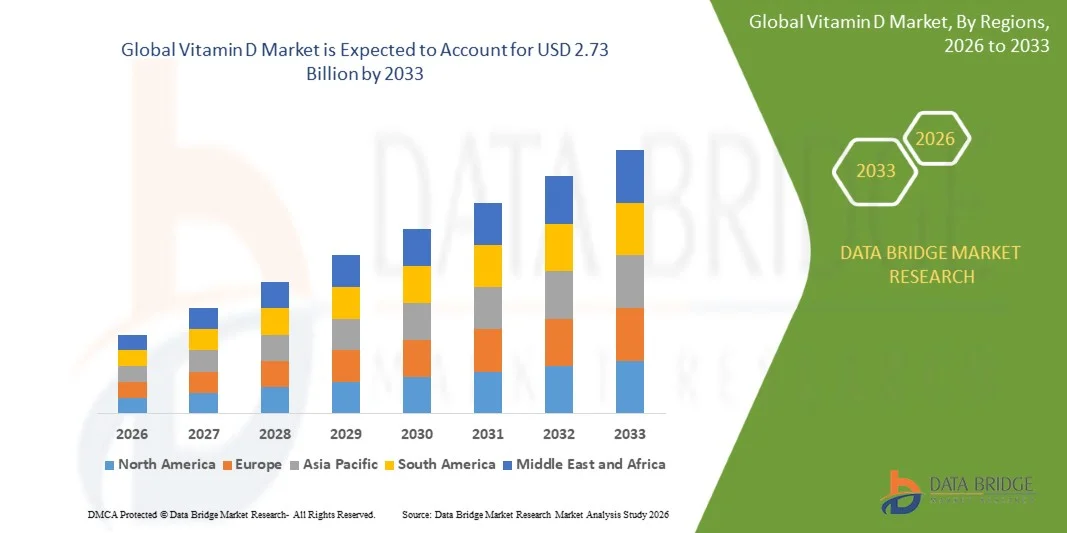
Report Scope and Vitamin D Market Segmentation
|
Attributes |
Vitamin D Key Market Insights |
|
Segments Covered |
· By Analog: Vitamin D2 and Vitamin D3 · By IU Strength: 500,000 IU, 100,000 IU, 40 MIU, and Others · By Form: Dry and Liquid · By Application: Feed and Pet Food, Pharmaceutical, Functional Food and Beverage, and Personal Care · By End- Users: Adult, Pregnant Women, and Children · By Source: Milk, Egg, Fish, Animal, Fruit and Vegetable, Seaweeds, and Others |
|
Countries Covered |
North America · U.S. · Canada · Mexico Europe · Germany · France · U.K. · Netherlands · Switzerland · Belgium · Russia · Italy · Spain · Turkey · Rest of Europe Asia-Pacific · China · Japan · India · South Korea · Singapore · Malaysia · Australia · Thailand · Indonesia · Philippines · Rest of Asia-Pacific Middle East and Africa · Saudi Arabia · U.A.E. · South Africa · Egypt · Israel · Rest of Middle East and Africa South America · Brazil · Argentina · Rest of South America |
|
Key Market Players |
• DSM (Netherlands) |
|
Market Opportunities |
• Expansion Of Vitamin D Fortified Food And Beverage Products • Rising Demand For Vitamin D In Nutraceutical And Pharmaceutical Applications |
|
Value Added Data Infosets |
In addition to the insights on market scenarios such as market value, growth rate, segmentation, geographical coverage, and major players, the market reports curated by the Data Bridge Market Research also include in-depth expert analysis, pricing analysis, brand share analysis, consumer survey, demography analysis, supply chain analysis, value chain analysis, raw material/consumables overview, vendor selection criteria, PESTLE Analysis, Porter Analysis, and regulatory framework. |
Vitamin D Market Trends
Trend: Rising Demand For Vitamin D Fortification, Preventive Healthcare, And Immunity-Enhancing Nutrition
The increasing global prevalence of vitamin D deficiency is driving strong demand for supplementation and fortified food products across healthcare and nutrition industries. Limited sun exposure due to urban lifestyles, indoor working environments, and changing dietary habits is contributing to widespread deficiency, encouraging consumers to adopt vitamin D-enriched solutions. Conventional diets often fail to meet daily vitamin D requirements, strengthening reliance on supplements and functional foods as primary sources of intake.
In modern healthcare nutrition systems, manufacturers are increasingly incorporating vitamin D into dairy products, cereals, and beverages. For instance, fortified milk and breakfast cereals are widely consumed in North America and Europe, where public health agencies have reported that nearly 35–40% of adults show insufficient vitamin D levels depending on seasonal variation and geography. Pharmaceutical companies are also expanding production of vitamin D3 supplements in capsule, tablet, and softgel formats to support bone health and immune system functioning.
The rapid expansion of preventive healthcare awareness is also increasing demand for vitamin D in immunity-focused formulations, particularly after global health crises that emphasized immune system strengthening. In addition, aging populations in countries such as Japan, Germany, and Italy are further accelerating consumption, as older adults are more susceptible to bone-related disorders such as osteoporosis. Industry reports from 2025 indicate rising adoption of vitamin D supplementation programs in public health initiatives across Europe and Asia-Pacific, with fortification policies expanding in multiple countries to address nutritional deficiencies.
Vitamin D Market Dynamics
Key Market Driver: Rising Prevalence Of Vitamin D Deficiency And Growth Of Preventive Healthcare
The global healthcare landscape is increasingly shifting toward preventive nutrition, driven by rising awareness of micronutrient deficiencies and their long-term health impacts. Vitamin D plays a critical role in bone health, immune regulation, and metabolic function, making it a key focus area for dietary supplementation and clinical nutrition programs.
Healthcare providers are increasingly recommending vitamin D supplementation, For instance in populations with limited sunlight exposure or higher risk of osteoporosis and immune dysfunction. Government-led fortification programs in countries such as the U.S., Canada, and the U.K. are mandating or encouraging vitamin D enrichment in staple foods such as milk and cereals to address widespread deficiency concerns.
Similarly, rising prevalence of chronic diseases and lifestyle-related disorders is increasing demand for preventive healthcare solutions. Real-world health surveys in 2024 indicated that vitamin D insufficiency affects a significant portion of urban populations globally, with deficiency rates exceeding 30% in several developed regions during winter months, further reinforcing the need for supplementation and fortified nutrition.
Key Restraint/Challenge: Over-Supplementation Risks And Regulatory Variability Across Regions
The vitamin D market faces challenges related to dosage regulation, consumer safety concerns, and varying regulatory standards across different countries. Excessive intake of vitamin D supplements can lead to toxicity risks such as hypercalcemia, creating the need for strict dosage control and medical supervision in high-dose formulations.
In addition, regulatory frameworks governing dietary supplements and fortified foods differ significantly across regions, creating compliance complexity for manufacturers operating globally. Product approval processes, labeling requirements, and permitted dosage levels vary between North America, Europe, and Asia-Pacific markets, increasing operational challenges for multinational companies.
Market assessments indicate that while demand for vitamin D supplements is rising, regulatory tightening in several regions is increasing development and compliance costs for manufacturers, particularly for high-potency formulations used in clinical nutrition and therapeutic applications.
Key Market Opportunity: Expansion Of Functional Foods And Personalized Nutrition Solutions
The growing demand for functional foods and personalized nutrition is creating significant opportunities for vitamin D manufacturers across healthcare, food, and nutraceutical industries. Consumers are increasingly seeking customized health solutions based on age, lifestyle, and dietary needs, driving demand for targeted vitamin D supplementation products.
Food and beverage companies are increasingly launching vitamin D-enriched products, For instance fortified plant-based milk alternatives, protein drinks, and wellness snacks designed to support immune health and bone strength. The rise of personalized health tracking devices and digital nutrition platforms is further enabling tailored vitamin D intake recommendations based on individual deficiency levels.
In addition, advancements in microencapsulation and bioavailability enhancement technologies are improving vitamin D absorption efficiency in supplements and fortified foods. Industry data from 2025 shows increasing investment in personalized supplement startups and functional nutrition brands across North America and Europe, reflecting strong growth potential in customized vitamin D delivery systems and preventive healthcare solutions.
Vitamin D Market Scope
The market is segmented on the basis of analog, IU strength, form, application, end-users, and source.
- By Analog
On the basis of analog, the vitamin D market is segmented into Vitamin D2 and Vitamin D3. The Vitamin D3 segment held the largest market revenue share of approximately 72.4% in 2025 driven by its higher bioavailability, superior absorption efficiency, and stronger effectiveness in maintaining optimal serum vitamin D levels. It is widely recommended by healthcare professionals for bone health, immune system support, and prevention of deficiency-related disorders. Vitamin D3 is extensively utilized in dietary supplements, pharmaceutical formulations, and fortified food products across global markets. Strong clinical validation and increasing consumer awareness are further strengthening its dominance.
The Vitamin D2 segment is projected to register the fastest growth at a CAGR of 8.3% from 2026 to 2033, driven by rising adoption in vegan and plant-based supplement formulations. It is increasingly preferred by vegetarian and vegan populations seeking non-animal-derived alternatives. Food manufacturers and nutraceutical companies are expanding D2-based product portfolios to cater to clean-label and plant-based nutrition trends. Regulatory approvals for plant-derived fortification are further supporting segment growth.
- By IU Strength
On the basis of IU strength, the vitamin D market is segmented into 500,000 IU, 100,000 IU, 40 MIU, and Others. The 100,000 IU segment held the largest market revenue share of approximately 38.1% in 2025 driven by its widespread use in clinical treatment of moderate vitamin D deficiency. It is commonly prescribed in hospital settings and outpatient care for restoring optimal vitamin D levels efficiently. Its standardized dosing format makes it highly preferred in therapeutic protocols. Increasing diagnosis of deficiency cases globally is further driving segment dominance.
The 500,000 IU segment is projected to register the fastest growth at a CAGR of 9.0% from 2026 to 2033, driven by rising demand for high-dose supplementation in severe deficiency conditions. It is increasingly used under medical supervision for rapid correction of critically low vitamin D levels. Hospitals and specialty clinics are adopting loading-dose therapies to improve patient recovery timelines. Expanding clinical research supporting high-dose efficacy is further accelerating adoption.
- By Form
On the basis of form, the vitamin D market is segmented into Dry and Liquid. The Dry segment held the largest market revenue share of approximately 66.9% in 2025 driven by its superior stability, longer shelf life, and ease of incorporation into capsules, tablets, and powder-based formulations. It is widely preferred in large-scale pharmaceutical and nutraceutical manufacturing due to cost efficiency and formulation flexibility. Dry forms also ensure consistent dosing accuracy and easier global distribution. Strong demand from supplement manufacturers continues to support segment leadership.
The Liquid segment is projected to register the fastest growth at a CAGR of 8.7% from 2026 to 2033, driven by increasing demand for pediatric and geriatric-friendly formulations. Liquid vitamin D offers faster absorption and improved bioavailability compared to some solid forms. It is gaining traction in drop-based supplements and fortified beverages. Rising preference for easy-to-consume dosage formats is further accelerating segment expansion.
- By Application
On the basis of application, the vitamin D market is segmented into Feed and Pet Food, Pharmaceutical, Functional Food and Beverage, and Personal Care. The Pharmaceutical segment held the largest market revenue share of approximately 41.6% in 2025 driven by high prescription volumes for deficiency treatment and preventive healthcare programs. It is widely used in clinical therapies for osteoporosis, rickets, and immune-related conditions. Strong hospital-based distribution networks and regulatory approvals support its dominance. Increasing global deficiency prevalence further strengthens pharmaceutical demand.
The Functional Food and Beverage segment is projected to register the fastest growth at a CAGR of 9.4% from 2026 to 2033, driven by rising fortification of dairy products, cereals, juices, and plant-based beverages. Consumers are increasingly seeking daily nutrition through fortified food sources rather than standalone supplements. Growing popularity of immunity-boosting functional drinks is further supporting adoption. Expanding clean-label and wellness food trends are accelerating segment growth.
- By End-Users
On the basis of end-users, the vitamin D market is segmented into Adult, Pregnant Women, and Children. The Adult segment held the largest market revenue share of approximately 58.7% in 2025 driven by high prevalence of deficiency due to sedentary lifestyles and indoor working environments. Adults are the primary consumers of vitamin D supplements for bone strength and immune support. Increasing awareness of preventive healthcare is boosting supplementation rates. Expanding urban populations further reinforce segment dominance.
The Pregnant Women segment is projected to register the fastest growth at a CAGR of 8.9% from 2026 to 2033, driven by rising maternal nutrition awareness and clinical recommendations for fetal bone and immune development. Healthcare professionals increasingly prescribe vitamin D during pregnancy to prevent complications. Growing prenatal care programs in emerging economies are strengthening demand. Rising focus on maternal and infant health is further accelerating growth.
- By Source
On the basis of source, the vitamin D market is segmented into Milk, Egg, Fish, Animal, Fruit and Vegetable, Seaweeds, and Others. The Fish segment held the largest market revenue share of approximately 34.2% in 2025 driven by high natural vitamin D concentration in fatty fish species such as salmon and tuna. It is widely used in supplement extraction and food fortification applications. Strong availability of marine resources supports its dominance. Fish-derived vitamin D is also considered highly bioavailable and effective.
The Seaweeds segment is projected to register the fastest growth at a CAGR of 9.6% from 2026 to 2033, driven by increasing demand for vegan and plant-based vitamin D sources. It is gaining popularity among consumers avoiding animal-derived ingredients. Advancements in algae cultivation and extraction technologies are improving production efficiency. Expanding plant-based nutrition trends are further driving adoption globally.
Vitamin D Market Regional Analysis
North America Vitamin D Market Insight
North America dominated the vitamin D market with the largest revenue share of 34.2% in 2025, supported by rising prevalence of vitamin D deficiency, strong consumer awareness regarding preventive healthcare, and high adoption of dietary supplements and fortified food products. The region benefits from well-established nutraceutical and pharmaceutical industries, widespread availability of vitamin D supplements, and increasing incorporation of vitamin D into functional foods and beverages. High disposable incomes, active health management practices, and growing focus on immunity and bone health are further strengthening market growth across the region.
U.S. Vitamin D Market Insight
The U.S. vitamin D market captured the largest revenue share in 2025 within North America, driven by high supplement consumption rates, strong healthcare recommendations, and increasing prevalence of lifestyle-related disorders such as osteoporosis and obesity-linked deficiencies. Consumers are increasingly adopting vitamin D3 supplements in capsule, softgel, and gummy formats for daily wellness. Expanding retail pharmacy networks, e-commerce penetration, and rising demand for immunity-boosting products post-pandemic are further accelerating market growth.
Europe Vitamin D Market Insight
The Europe vitamin D market is expected to witness the fastest growth rate from 2026 to 2033, primarily driven by widespread deficiency across populations, strong government-led fortification programs, and increasing adoption of preventive healthcare practices. Countries across the region are actively promoting vitamin D supplementation in food products such as milk, cereals, and infant nutrition. Growing awareness of bone health, aging population demographics, and rising demand for natural health supplements are further supporting market expansion.
U.K. Vitamin D Market Insight
The U.K. vitamin D market is expected to witness strong growth from 2026 to 2033, driven by increasing public health campaigns addressing widespread vitamin D deficiency, particularly during winter months. Rising consumption of dietary supplements, fortified foods, and wellness products is supporting market expansion. The growing popularity of immunity-focused nutrition and expanding availability of over-the-counter vitamin D products through pharmacies and online platforms are further contributing to market growth.
Germany Vitamin D Market Insight
The Germany vitamin D market is expected to witness steady growth from 2026 to 2033, fueled by increasing health awareness, strong pharmaceutical demand, and rising adoption of preventive nutrition solutions. Germany’s aging population is a key driver of vitamin D consumption due to higher risk of osteoporosis and bone-related disorders. Expanding use of vitamin D in clinical supplementation programs and fortified food products is further strengthening market demand.
Asia-Pacific Vitamin D Market Insight
The Asia-Pacific vitamin D market is expected to witness the fastest growth rate from 2026 to 2033, supported by rising awareness of nutritional deficiencies, increasing healthcare expenditure, and growing adoption of dietary supplements across emerging economies. Countries such as China, India, and Japan are witnessing strong demand for vitamin D products due to changing lifestyles and increasing prevalence of deficiency-related health issues. Expanding nutraceutical industries and growing fortification initiatives are further driving regional growth.
Japan Vitamin D Market Insight
The Japan vitamin D market is expected to witness strong growth from 2026 to 2033 due to high aging population, increased focus on bone health, and rising demand for preventive healthcare solutions. Limited sun exposure among urban populations is contributing to widespread deficiency, driving supplement consumption. Increasing use of vitamin D in functional foods, medical nutrition products, and geriatric care formulations is further supporting market expansion.
China Vitamin D Market Insight
The China vitamin D market accounted for the largest market revenue share in Asia-Pacific in 2025, attributed to rapid urbanization, rising health awareness, and growing demand for dietary supplements and fortified food products. Expanding middle-class population and increasing focus on immunity and nutrition are driving consumption. Strong domestic production capabilities, rising e-commerce penetration, and government support for public health nutrition programs are key factors propelling market growth in China.
Vitamin D Market Share
The Vitamin D industry is primarily led by well-established companies, including:
• DSM (Netherlands)
• Zhejiang Garden Biochemical High-Tech Co., Ltd. (China)
• Fermenta Biotech Limited (India)
• BASF SE (Germany)
• Dishman Carbogen Amcis Ltd (India)
• Taizhou Hisound Pharmaceutical Co., Ltd. (China)
• ZMC (China)
• Glanbia plc (Ireland)
• Bio-Tech Pharmacal (U.S.)
• GlaxoSmithKline plc (U.K.)
• Nestlé (Switzerland)
• Pfizer Inc. (U.S.)
• The Kraft Heinz Company (U.S.)
• Abbott (U.S.)
• Lycored (Israel)
• Divi’s Nutraceuticals (India)
• Source Naturals, Inc. (U.S.)
• BIOGENIX INC. PVT. LTD. (India)
Latest Developments in Vitamin D Market
- In August 2024, Abbott India, product expansion initiative, aimed to transform its multi-speciality portfolio including vitamin D and micronutrient supplements for thyroid patients into strong branded offerings, strengthening its pipeline and enhancing market penetration in the nutraceutical segment while driving higher consumer trust and demand
- In May 2024, Entod, product launch initiative, introduced vitamin D3-enriched lubricating eye drops designed to improve eye health and provide relief from dry eyes, expanding the functional application of vitamin D and supporting growth in ophthalmic nutraceutical innovations
- In February 2024, Cadila Pharmaceuticals, product innovation initiative, launched the world’s first aqueous formulation of cholecalciferol, improving bioavailability and treatment effectiveness for vitamin D deficiency, thereby setting new clinical benchmarks and accelerating pharmaceutical advancement in vitamin D therapeutics
- In December 2023, Diataal, marketing and product expansion initiative, launched the DilChaheSirfDiataalD campaign featuring Malaika Arora to strengthen brand visibility for its vitamin D-enriched multivitamin range, boosting consumer engagement and driving growth in the preventive healthcare and supplement market
- In July 2023, PanGenomic Health Inc., digital health expansion initiative, through its subsidiary MUJN Diagnostics Inc., introduced a vitamin D health assessment service and launched its website mujn.ai, enhancing personalized health monitoring and supporting the growing trend of digital nutraceutical diagnostics and preventive care adoption
SKU-
Get online access to the report on the World's First Market Intelligence Cloud

- Interactive Data Analysis Dashboard
- Company Analysis Dashboard for high growth potential opportunities
- Research Analyst Access for customization & queries
- Competitor Analysis with Interactive dashboard
- Latest News, Updates & Trend analysis
- Harness the Power of Benchmark Analysis for Comprehensive Competitor Tracking
Global Vitamin D Market, Supply Chain Analysis and Ecosystem Framework
To support market growth and help clients navigate the impact of geopolitical shifts, DBMR has integrated in-depth supply chain analysis into its Global Vitamin D Market research reports. This addition empowers clients to respond effectively to global changes affecting their industries. The supply chain analysis section includes detailed insights such as Global Vitamin D Market consumption and production by country, price trend analysis, the impact of tariffs and geopolitical developments, and import and export trends by country and HSN code. It also highlights major suppliers with data on production capacity and company profiles, as well as key importers and exporters. In addition to research, DBMR offers specialized supply chain consulting services backed by over a decade of experience, providing solutions like supplier discovery, supplier risk assessment, price trend analysis, impact evaluation of inflation and trade route changes, and comprehensive market trend analysis.
Research Methodology
Data collection and base year analysis are done using data collection modules with large sample sizes. The stage includes obtaining market information or related data through various sources and strategies. It includes examining and planning all the data acquired from the past in advance. It likewise envelops the examination of information inconsistencies seen across different information sources. The market data is analysed and estimated using market statistical and coherent models. Also, market share analysis and key trend analysis are the major success factors in the market report. To know more, please request an analyst call or drop down your inquiry.
The key research methodology used by DBMR research team is data triangulation which involves data mining, analysis of the impact of data variables on the market and primary (industry expert) validation. Data models include Vendor Positioning Grid, Market Time Line Analysis, Market Overview and Guide, Company Positioning Grid, Patent Analysis, Pricing Analysis, Company Market Share Analysis, Standards of Measurement, Global versus Regional and Vendor Share Analysis. To know more about the research methodology, drop in an inquiry to speak to our industry experts.
Customization Available
Data Bridge Market Research is a leader in advanced formative research. We take pride in servicing our existing and new customers with data and analysis that match and suits their goal. The report can be customized to include price trend analysis of target brands understanding the market for additional countries (ask for the list of countries), clinical trial results data, literature review, refurbished market and product base analysis. Market analysis of target competitors can be analyzed from technology-based analysis to market portfolio strategies. We can add as many competitors that you require data about in the format and data style you are looking for. Our team of analysts can also provide you data in crude raw excel files pivot tables (Fact book) or can assist you in creating presentations from the data sets available in the report.












