




Global Voice Assistant Market
Market Size in USD Billion
CAGR :
% 
 USD
7.84 Billion
USD
48.78 Billion
2025
2033
USD
7.84 Billion
USD
48.78 Billion
2025
2033
 Forecast Period Forecast Period |
2026 –2033 |
 Market Size (Base Year) Market Size (Base Year) |
USD 7.84 Billion |
 Market Size (Forecast Year) Market Size (Forecast Year) |
USD 48.78 Billion |
 CAGR CAGR |
% |
| Major Markets Players |
|
What is the Global Voice Assistant Market Size and Growth Rate?
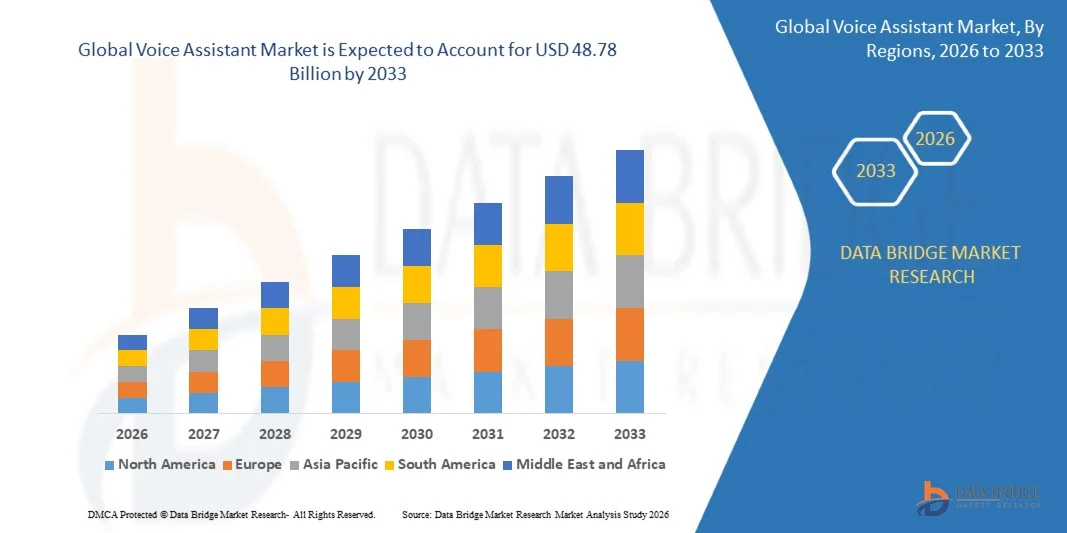
- The global voice assistant market size was valued at USD 7.84 billion in 2025 and is expected to reach USD 48.78 billion by 2033, at a CAGR of 25.66% during the forecast period
- The rapid automation in manufacturing sectors acts as one of the major factors driving the growth of voice assistant market. The increase in demand for remote device management and user behavior analysis to enhance customer service, and rise in demand for AI voice assistant and improvements in artificial intelligence and other infrastructure oriented technologies accelerate the market growth
What are the Major Takeaways of Voice Assistant Market?
- The increase in adoption of voice assistant as they deliver better conversational responses enabling enhanced customer experience, and high dependency of people on the platform for working remotely to perform their tasks further influence the market
- In addition, businesses leveraging social media platforms as a prime marketing channel, omni-channel deployment and advancement in NLP and ASR ecosystem positively affect the voice assistant market. Furthermore, popularity of connected devices and preferences for smart home extend profitable opportunities to the market players
- North America dominated the voice assistant market with a 41.8% revenue share in 2025, driven by the strong presence of leading technology companies, widespread adoption of smart devices, and rapid advancements in artificial intelligence and cloud computing across the U.S. and Canada
- Asia-Pacific is projected to register the fastest CAGR of 9.57% from 2026 to 2033, driven by rapid growth in smartphone adoption, expanding internet penetration, and increasing integration of AI-powered voice technologies across consumer electronics and digital platforms in China, Japan, India, South Korea, and Southeast Asia
- The Speech Recognition segment dominated the market with a 41.6% share in 2025, as it forms the foundational layer that enables voice assistants to accurately convert spoken language into machine-readable text
Report Scope and Voice Assistant Market Segmentation
|
Attributes |
Voice Assistant Key Market Insights |
|
Segments Covered |
|
|
Countries Covered |
North America
Europe
Asia-Pacific
Middle East and Africa
South America
|
|
Key Market Players |
|
|
Market Opportunities |
|
|
Value Added Data Infosets |
In addition to the insights on market scenarios such as market value, growth rate, segmentation, geographical coverage, and major players, the market reports curated by the Data Bridge Market Research also include in-depth expert analysis, pricing analysis, brand share analysis, consumer survey, demography analysis, supply chain analysis, value chain analysis, raw material/consumables overview, vendor selection criteria, PESTLE Analysis, Porter Analysis, and regulatory framework. |
What is the Key Trend in the Voice Assistant Market?
“Rapid Integration of AI-Powered Conversational Intelligence in Voice Assistants”
- The voice assistant market is witnessing strong adoption of AI-driven conversational systems that deliver natural language understanding, contextual responses, and personalized user interactions across smartphones, smart speakers, vehicles, and smart home devices
- Technology providers are integrating large language models (LLMs), speech recognition engines, and real-time natural language processing to enhance accuracy, contextual awareness, and multilingual communication capabilities
- Growing demand for hands-free interaction, smart home automation, and voice-enabled digital services is accelerating adoption across consumer electronics, healthcare, automotive infotainment systems, and enterprise platforms
- For instance, companies such as Amazon, Google, Apple, and Microsoft are enhancing their voice assistants with generative AI capabilities, improved contextual memory, and deeper integration with cloud services and connected devices
- Increasing use of voice interfaces in vehicles, wearables, banking services, and enterprise productivity tools is expanding the scope of voice assistants beyond consumer smart speakers
- As AI technology advances and connected ecosystems expand, voice assistants will remain central to intuitive human-machine interaction and next-generation digital experiences
What are the Key Drivers of Voice Assistant Market?
- Rising demand for hands-free digital interaction and smart home automation is increasing adoption of voice assistants across smartphones, smart speakers, smart TVs, and connected appliances
- For instance, in 2025, leading technology companies such as Amazon, Apple, and Google introduced advanced generative-AI upgrades and expanded device compatibility to improve voice recognition accuracy and contextual responses
- Rapid growth of IoT ecosystems, connected vehicles, wearable devices, and smart healthcare solutions is creating new applications for voice-enabled interfaces across North America, Europe, and Asia-Pacific
- Advancements in speech recognition algorithms, cloud computing infrastructure, and edge AI processing have significantly improved response speed, accuracy, and data processing efficiency
- Increasing use of voice-enabled customer service, voice commerce, and enterprise productivity tools is expanding the commercial adoption of voice assistants across retail, banking, and corporate environments
- Supported by ongoing investments in AI research, smart device ecosystems, and digital transformation initiatives, the Voice Assistant market is expected to witness strong long-term growth
Which Factor is Challenging the Growth of the Voice Assistant Market?
- Privacy and data security concerns related to voice recordings, user data storage, and continuous listening capabilities remain a key challenge for widespread adoption
- For instance, during 2024–2025, regulatory scrutiny and evolving data protection frameworks in regions such as Europe and North America increased compliance requirements for companies developing voice-enabled AI platforms
- Variability in speech recognition accuracy across accents, languages, and noisy environments continues to limit consistent performance in certain real-world applications
- Limited consumer awareness regarding voice assistant security controls and data management practices also raises concerns about trust and adoption in emerging markets
- Competition from touch-based interfaces, chatbot systems, and AI-powered mobile applications creates technological overlap and reduces the necessity for voice-first interaction in some use cases
- To overcome these challenges, companies are focusing on on-device processing, stronger encryption, multilingual AI models, and transparent privacy frameworks to enhance user trust and expand global adoption of voice assistants
How is the Voice Assistant Market Segmented?
The market is segmented on the basis of technology, hardware, application, and end-user.
• By Technology
On the basis of technology, the Voice Assistant market is segmented into Speech Recognition, Natural Language Processing (NLP), Text-to-Speech Recognition, and Voice Recognition. The Speech Recognition segment dominated the market with a 41.6% share in 2025, as it forms the foundational layer that enables voice assistants to accurately convert spoken language into machine-readable text. Rapid improvements in deep learning algorithms, acoustic modeling, and multilingual speech databases have significantly improved accuracy and real-time processing capabilities. The technology is widely deployed across smartphones, smart speakers, automotive infotainment systems, and enterprise voice platforms. Its ability to support hands-free interaction, voice search, and command-based operations continues to drive large-scale adoption across consumer and enterprise devices.
The Natural Language Processing (NLP) segment is expected to grow at the fastest CAGR from 2026 to 2033, driven by increasing demand for context-aware conversation, AI-driven customer engagement, and integration of generative AI models in voice assistants. NLP enables assistants to understand intent, context, and sentiment, making interactions more human-such as and efficient across digital services.
• By Hardware
On the basis of hardware, the Voice Assistant market is segmented into Set-top Boxes, Smartphones & Tablets, and Smart Speakers. The Smartphones & Tablets segment dominated the market with a 52.3% share in 2025, primarily due to the massive global penetration of smartphones and the built-in integration of voice assistants such as mobile-based digital assistants. Smartphones provide a convenient platform for voice search, navigation, messaging, smart home control, and digital commerce. Continuous advancements in mobile processors, on-device AI capabilities, and edge computing have further enhanced real-time speech processing and voice interaction. In addition, increasing adoption of voice-based services in mobile applications and digital ecosystems continues to strengthen the dominance of this segment.
The Smart Speakers segment is projected to grow at the fastest CAGR from 2026 to 2033, driven by rising adoption of smart home ecosystems, connected appliances, and voice-controlled home automation. Growing consumer demand for hands-free device control, entertainment management, and integrated home assistants is accelerating the deployment of AI-enabled smart speakers globally.
• By Application
On the basis of application, the Voice Assistant market is segmented into Messenger Bots, Websites, and Contact Centers. The Websites segment dominated the market with a 38.7% share in 2025, as organizations increasingly integrate voice-enabled search and navigation tools to improve user engagement and accessibility. Voice assistants embedded in websites allow users to interact with digital platforms through conversational commands, enabling faster information retrieval and improved customer experience. E-commerce platforms, travel portals, and service-based websites are widely adopting voice-based interaction to streamline browsing, product discovery, and service inquiries. Growing demand for conversational interfaces and voice-enabled browsing is further strengthening the role of voice assistants across digital platforms.
The Contact Centers segment is expected to grow at the fastest CAGR from 2026 to 2033, supported by rising adoption of AI-driven virtual agents, automated customer support systems, and voice-based analytics tools. Enterprises are increasingly deploying voice assistants to automate routine queries, reduce operational costs, and improve customer service efficiency.
• By End-User
On the basis of end-user, the Voice Assistant market is segmented into Individual Users, SMEs, and Large Enterprises. The Individual User segment dominated the market with a 57.8% share in 2025, driven by widespread consumer adoption of voice assistants across smartphones, smart speakers, wearable devices, and connected home appliances. Consumers increasingly rely on voice assistants for everyday tasks such as scheduling reminders, controlling smart devices, accessing information, and performing voice-based searches. Rising digital connectivity, growing adoption of IoT-enabled homes, and improved voice recognition accuracy are further accelerating usage among individual consumers worldwide.
The Large Enterprises segment is projected to grow at the fastest CAGR from 2026 to 2033, as organizations increasingly integrate voice assistants into enterprise software platforms, customer support systems, and workplace productivity tools. Enterprises are leveraging voice-enabled AI solutions for workflow automation, customer engagement, data retrieval, and internal collaboration, driving rapid expansion of voice assistant adoption across corporate environments.
Which Region Holds the Largest Share of the Voice Assistant Market?
- North America dominated the voice assistant market with a 41.8% revenue share in 2025, driven by the strong presence of leading technology companies, widespread adoption of smart devices, and rapid advancements in artificial intelligence and cloud computing across the U.S. and Canada. High penetration of smartphones, smart speakers, connected vehicles, and IoT-enabled home automation systems continues to accelerate demand for voice-enabled digital interfaces across consumer and enterprise environments
- Major technology companies in the region are continuously enhancing voice assistants with AI-powered conversational capabilities, multilingual processing, and deeper integration with cloud ecosystems, strengthening North America’s leadership in innovation and product development. Growing investments in generative AI, edge computing, and intelligent virtual assistants further expand the application scope across healthcare, automotive, retail, and enterprise productivity platforms
- Strong digital infrastructure, high consumer adoption of smart technologies, and continuous investments in AI research and software innovation further reinforce the region’s dominant position in the global Voice Assistant market
U.S. Voice Assistant Market Insight
The U.S. represents the largest contributor within North America, supported by strong technological innovation, high adoption of smart home ecosystems, and the presence of major technology companies developing advanced voice assistant platforms. Voice assistants are widely integrated across smartphones, smart speakers, wearable devices, connected cars, and enterprise applications. Rapid development of AI-powered digital assistants, generative AI models, and cloud-based voice platforms is further expanding market opportunities. Enterprises across sectors such as retail, healthcare, banking, and telecommunications are increasingly deploying voice assistants for automated customer support, workflow management, and digital engagement. Strong startup ecosystems, significant AI research investments, and expanding smart device ecosystems continue to accelerate Voice Assistant adoption across the country.
Canada Voice Assistant Market Insight
Canada contributes steadily to regional growth, driven by expanding adoption of smart home devices, AI-based digital services, and voice-enabled enterprise applications. Technology companies and research institutions are actively investing in artificial intelligence, natural language processing, and speech recognition innovations. Voice assistants are increasingly utilized across customer service platforms, smart appliances, healthcare solutions, and connected vehicles. Universities and AI research centers in Canada are also contributing to advancements in multilingual speech processing and conversational AI technologies. Government initiatives supporting digital innovation, AI development programs, and growing investments in smart infrastructure further encourage adoption of voice-enabled technologies across multiple industries.
Asia-Pacific Voice Assistant Market
Asia-Pacific is projected to register the fastest CAGR of 9.57% from 2026 to 2033, driven by rapid growth in smartphone adoption, expanding internet penetration, and increasing integration of AI-powered voice technologies across consumer electronics and digital platforms in China, Japan, India, South Korea, and Southeast Asia. Rapid expansion of smart home ecosystems, e-commerce platforms, and digital services is accelerating the deployment of voice-enabled interfaces across multiple applications. The region’s strong electronics manufacturing base and rising investments in AI innovation also support large-scale development of voice-enabled products such as smart speakers, connected appliances, and voice-enabled mobile applications. Increasing demand for multilingual voice assistants capable of supporting regional languages further contributes to strong market growth across Asia-Pacific.
China Voice Assistant Market Insight
China represents the largest market within Asia-Pacific, supported by massive smartphone penetration, rapid development of artificial intelligence technologies, and strong domestic technology ecosystems. Major Chinese technology companies are actively investing in speech recognition, natural language processing, and AI-driven conversational platforms. Voice assistants are widely integrated into smartphones, smart home devices, automotive infotainment systems, and digital payment platforms. Government initiatives supporting AI innovation and smart city development further strengthen market expansion. Rapid growth in smart devices and voice-enabled digital services continues to accelerate the adoption of voice assistant technologies across both consumer and enterprise applications.
Japan Voice Assistant Market Insight
Japan shows consistent growth in the Voice Assistant market, supported by its advanced consumer electronics industry, robotics innovation, and strong telecommunications infrastructure. Japanese companies are increasingly integrating voice assistants into smart home devices, automotive infotainment systems, and industrial automation platforms. Growing demand for hands-free control, voice-enabled appliances, and AI-powered service robots is further expanding the use of voice technologies across households and businesses. Continuous technological innovation, strong focus on precision engineering, and high consumer demand for advanced digital services support long-term growth of voice assistants in the Japanese market.
India Voice Assistant Market Insight
India is emerging as a major growth hub for voice assistant adoption, driven by rapid smartphone expansion, increasing internet accessibility, and strong demand for regional language digital services. Voice assistants are increasingly used for voice search, digital payments, e-commerce navigation, and smart home control. The availability of voice interfaces in multiple Indian languages has significantly improved accessibility for a large population base. Growing digital transformation initiatives, expanding startup ecosystems, and government-backed digital infrastructure programs further accelerate the development and adoption of AI-powered voice technologies across the country.
South Korea Voice Assistant Market Insight
South Korea contributes significantly to the regional market due to its advanced telecommunications infrastructure, high smartphone penetration, and strong consumer electronics manufacturing sector. Voice assistants are widely integrated across smartphones, connected home appliances, automotive infotainment systems, and wearable devices. The country’s rapid advancements in 5G connectivity, artificial intelligence, and smart home ecosystems support seamless voice-enabled interactions across multiple platforms. Strong technological innovation, growing digital ecosystems, and increasing demand for intelligent consumer devices continue to drive sustained growth of the Voice Assistant market in South Korea.
Which are the Top Companies in Voice Assistant Market?
The voice assistant industry is primarily led by well-established companies, including:
- Advanced Voice Recognition Systems Inc. (U.S.)
- Agnitio S.L. (Spain)
- Amazon, Inc. (U.S.)
- Apple, Inc. (U.S.)
- iFlytek Co., Ltd. (China)
- Baidu, Inc. (China)
- BioTrust ID B.V. (Netherlands)
- Castle Software, LLC. (U.S.)
- Facebook, Inc. (U.S.)
- Google, Inc. (U.S.)
- IBM (U.S.)
- LumenVox (U.S.)
- M2SYS Technology (U.S.)
- Microsoft Corporation (U.S.)
- MModal Inc. (U.S.)
- Nortex Holdings Inc. (U.S.)
- Nuance Communications, Inc. (U.S.)
- SemVox GmbH (Germany)
- Raytheon Technologies Corporation (U.S.)
- Sensory Inc. (U.S.)
- Voice Technologies Corporation (Switzerland)
- VoiceVault Inc. (U.S.)
What are the Recent Developments in Global Voice Assistant Market?
- In November 2022, Sony Group Corporation introduced a new voice assistant for customer support in India through a collaboration with Yellow.ai, launching an AI-powered multilingual virtual agent named “Isha” designed to interact with customers in Bengali, Hindi, and English, respond to service queries, and seamlessly escalate complex issues to human support agents when required, strengthening Sony’s digital customer engagement capabilities in the Indian market
SKU-
Get online access to the report on the World's First Market Intelligence Cloud

- Interactive Data Analysis Dashboard
- Company Analysis Dashboard for high growth potential opportunities
- Research Analyst Access for customization & queries
- Competitor Analysis with Interactive dashboard
- Latest News, Updates & Trend analysis
- Harness the Power of Benchmark Analysis for Comprehensive Competitor Tracking
Research Methodology
Data collection and base year analysis are done using data collection modules with large sample sizes. The stage includes obtaining market information or related data through various sources and strategies. It includes examining and planning all the data acquired from the past in advance. It likewise envelops the examination of information inconsistencies seen across different information sources. The market data is analysed and estimated using market statistical and coherent models. Also, market share analysis and key trend analysis are the major success factors in the market report. To know more, please request an analyst call or drop down your inquiry.
The key research methodology used by DBMR research team is data triangulation which involves data mining, analysis of the impact of data variables on the market and primary (industry expert) validation. Data models include Vendor Positioning Grid, Market Time Line Analysis, Market Overview and Guide, Company Positioning Grid, Patent Analysis, Pricing Analysis, Company Market Share Analysis, Standards of Measurement, Global versus Regional and Vendor Share Analysis. To know more about the research methodology, drop in an inquiry to speak to our industry experts.
Customization Available
Data Bridge Market Research is a leader in advanced formative research. We take pride in servicing our existing and new customers with data and analysis that match and suits their goal. The report can be customized to include price trend analysis of target brands understanding the market for additional countries (ask for the list of countries), clinical trial results data, literature review, refurbished market and product base analysis. Market analysis of target competitors can be analyzed from technology-based analysis to market portfolio strategies. We can add as many competitors that you require data about in the format and data style you are looking for. Our team of analysts can also provide you data in crude raw excel files pivot tables (Fact book) or can assist you in creating presentations from the data sets available in the report.












