What is the Voice Recognition Vehicle Access Market Size and Growth Rate?
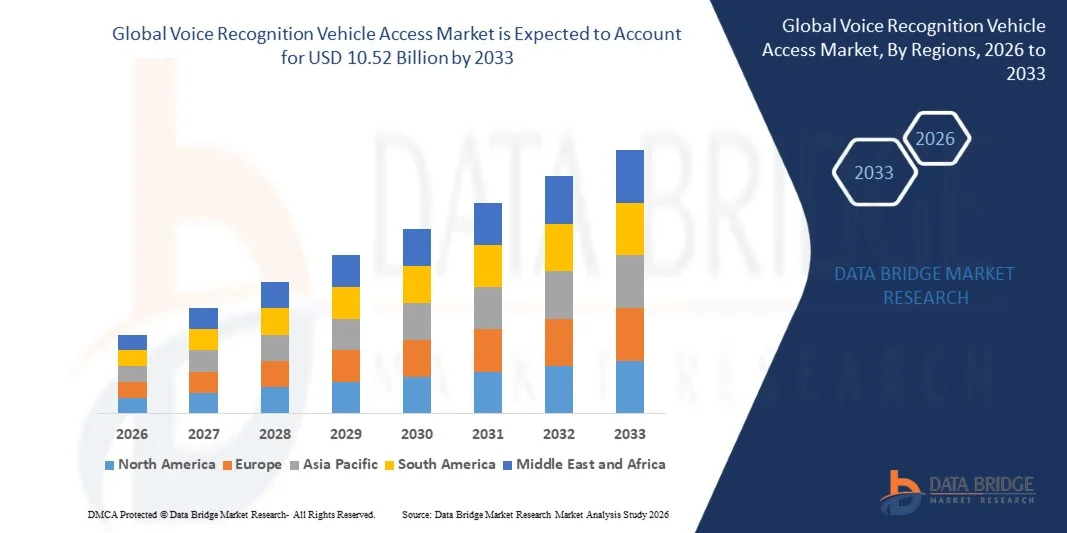
- As per Data Bridge Market Research analysis, the global Voice Recognition Vehicle Access market was valued at USD 4.47 Billion in 2025 and is projected to reach USD 10.52 Billion by 2033, growing at a CAGR of 11.30% from 2026 to 2033.
- The market is experiencing strong growth driven by increasing consumer demand for connected and intelligent vehicles, rapid advancements in artificial intelligence and natural language processing technologies, and expanding integration of voice-enabled systems across passenger and commercial vehicles.
- The growing emphasis on driver safety and hands-free vehicle operation, combined with rising adoption of advanced infotainment systems and connected car technologies, is compelling automotive manufacturers and technology providers to deploy sophisticated voice recognition solutions. AI-powered voice assistants are increasingly replacing conventional manual controls in many vehicle models, offering enhanced convenience, personalized user experiences, and seamless interaction with navigation, entertainment, climate control, and vehicle diagnostics systems.
Market Size & Forecast
- Market Value (2025): USD 4.47 Billion
- Expected Market Value (2033): USD 10.52 Billion
- Forecast CAGR (2026–2033): 11.30%
- Leading Region in 2025: North America
- Fastest Growing Region: Asia Pacific
What are the Major Takeaways of the Voice Recognition Vehicle Access Market?
- North America dominated the global Voice Recognition Vehicle Access Market, accounting for a 42.75% market share in 2025, supported by rapid adoption of connected and smart vehicles, increasing automotive production, rising consumer demand for hands-free technologies, and growing investments in artificial intelligence and voice-enabled automotive systems across China, Japan, South Korea, and India.
- Asia Pacific is expected to be among the fastest-growing regions in the global Voice Recognition Vehicle Access Market, with a CAGR of 7.70% from 2026 to 2033, supported by increasing adoption of connected vehicles, advanced driver interfaces, biometric authentication, automotive cybersecurity solutions, and voice-enabled vehicle control systems.
- Passenger Cars represented the leading vehicle type, accounting for a 62.40% market share in 2025, supported by high adoption of connected-car technologies, increasing consumer preference for hands-free vehicle interaction, integration of voice assistants into passenger vehicles, and growing demand for convenient and secure vehicle access solutions.
- Voice Biometrics represented the leading technology segment, accounting for a 46.80% market share in 2025, supported by increasing demand for secure driver authentication, personalized vehicle access, anti-spoofing capabilities, and integration of biometric technologies with connected vehicle platforms. Voice biometrics and natural language processing are identified among the key technology segments in current market studies.
- Authentication represented the leading application segment, accounting for a 44.60% market share in 2025, supported by increasing concerns regarding vehicle security, growing adoption of keyless access technologies, demand for personalized user authentication, and integration of voice recognition with other automotive security systems. Authentication and vehicle control are identified as major application categories.
- Software represented the leading component segment, accounting for a 58.30% market share in 2025, supported by increasing deployment of AI-powered speech processing, machine learning algorithms, cloud-based voice recognition, natural language processing, and software-based authentication platforms.
Report Scope Voice Recognition Vehicle Access Market Segmentation
|
Attributes |
Voice Recognition Vehicle Access Market Key Market Insights |
|
Segments Covered |
|
|
Countries Covered |
North America
Europe
Asia-Pacific
Middle East and Africa
South America
|
|
Key Market Players |
|
|
Market Opportunities |
|
|
Value Added Data Infosets |
In addition to the market insights such as market value, growth rate, market segments, geographical coverage, market players, and market scenario, the market report curated by the Data Bridge Market Research team includes in-depth expert analysis, import/export analysis, pricing analysis, production consumption analysis, and pestle analysis. |
What is the Key Trend in the Voice Recognition Vehicle Access Market?
- Growing consumer preference for connected, intelligent, and hands-free driving experiences is accelerating the adoption of automotive voice recognition systems across the automotive industry. Automakers are increasingly integrating AI-powered voice assistants into vehicles to enhance driver convenience, improve safety, and deliver personalized in-car experiences.
- Advancements in natural language processing (NLP), generative AI, and cloud connectivity, coupled with increasing demand for connected vehicles, are further strengthening the adoption of voice-enabled automotive technologies.
- The rapid expansion of electric, connected, and software-defined vehicles is creating sustained demand for advanced voice recognition platforms capable of controlling navigation, infotainment, climate settings, and vehicle diagnostics through conversational interfaces.
- For instance, in January 2025, Mercedes-Benz and Google Cloud announced the expansion of their strategic partnership to introduce Google Cloud's Automotive AI Agent into the MBUX Virtual Assistant. Built using Gemini on Vertex AI, the technology will debut in the new Mercedes-Benz CLA and provide natural language conversations, personalized navigation, and real-time information from Google Maps Platform. This development reflects increasing industry investment in AI-powered in-car experiences that directly support demand for automotive voice recognition systems.
- The growing shift toward intelligent mobility and continued investments in AI-enabled automotive technologies are expected to reinforce long-term demand for automotive voice recognition systems, positioning manufacturers to benefit from increasing adoption of connected and autonomous vehicles.
What are the Key Drivers of the Voice Recognition Vehicle Access Market?
- The automotive industry continues to experience rising demand for connected vehicles due to their enhanced convenience, safety, and digital capabilities. Consumers are increasingly expecting seamless interaction with their vehicles, encouraging automakers to integrate sophisticated voice recognition systems that enable hands-free operation and personalized user experiences.
- Major automotive manufacturers continue investing in voice-enabled technologies to meet growing consumer demand. For instance, in January 2024, Volkswagen announced at CES 2024 that it would integrate ChatGPT into its IDA voice assistant across several vehicle models, including the ID. family, Tiguan, Passat, and Golf.
- The integration enables drivers to access richer conversational capabilities and enhanced information retrieval while maintaining a hands-free driving experience. This sustained investment in generative AI is directly increasing demand for automotive voice recognition systems across passenger vehicles, electric vehicles, and premium mobility applications.
- As connected vehicle adoption continues to expand, automotive voice recognition system providers are expected to benefit from sustained demand driven by digital cockpit trends, improved AI capabilities, and increasing investments in intelligent vehicle infrastructure.
Which Factors are Challenging the Growth of the Voice Recognition Vehicle Access Market?
- Automotive voice recognition system providers remain challenged by data privacy concerns, exposing manufacturers to increasing regulatory scrutiny and cybersecurity requirements. Variability in regional languages, accents, ambient noise levels, and connectivity limitations continues to affect voice recognition accuracy and deployment efficiency, particularly for automotive platforms.
- In addition, manufacturers must manage evolving privacy regulations while maintaining seamless user experiences. automotive companies operating in Europe must comply with the European Union's General Data Protection Regulation (GDPR), which imposes strict requirements regarding the collection, storage, and processing of voice data generated through connected vehicle platforms. These market conditions continue to create development and compliance challenges across the automotive voice recognition ecosystem.
- For instance, In September 2026, a peer-reviewed review published in Artificial Intelligence Review identified audio deepfakes, adversarial spoofing, adversarial perturbations, and data poisoning as major attack vectors against voice-authentication systems. The study also noted that existing anti-spoofing measures can be bypassed by adaptive attacks. This creates a significant security challenge for voice-based vehicle access, where an unauthorized person could potentially imitate a registered user's voice.
- Despite robust market demand, data privacy concerns and ongoing language processing complexities are expected to remain significant restraints, increasing development costs, pressuring deployment timelines, and limiting uniform user experiences throughout the forecast period.
How is the Voice Recognition Vehicle Access Market Segmented?
The market is segmented on the basis of technology, application, and vehicle type.
- By Technology
On the basis of technology, the automotive voice recognition system market is segmented into embedded and hybrid. The embedded segment held the largest market revenue share of approximately 61.4% in 2025, driven by its widespread deployment across passenger vehicles and premium automotive platforms. Embedded voice recognition systems are preferred due to their low latency, offline functionality, enhanced data security, and seamless integration with infotainment and navigation systems. Their ability to deliver reliable voice interactions without requiring continuous internet connectivity continues to support segment dominance across major automotive markets.
The hybrid segment is projected to register the fastest growth at a CAGR of 12.6% from 2026 to 2033, driven by increasing adoption of cloud-connected vehicles and advancements in artificial intelligence. Hybrid systems combine on-device processing with cloud-based capabilities, enabling more sophisticated natural language understanding and personalized in-vehicle experiences. Rising investments in software-defined vehicles and generative AI-powered assistants are accelerating segment expansion.
- By Application
On the basis of application, the market is segmented into AI and non-AI. The AI segment accounted for the largest market revenue share of approximately 68.2% in 2025 owing to growing demand for intelligent voice assistants capable of understanding context, intent, and conversational commands. Automotive manufacturers are increasingly integrating AI-powered systems to enhance user experiences, improve safety, and support hands-free vehicle operation. The proliferation of connected vehicles and advancements in natural language processing technologies continue to strengthen the segment's position.
The non-ai segment is expected to grow at a CAGR of approximately 9.60% from 2026 to 2033, supported by continued demand for basic voice-command and vehicle-access functions in cost-sensitive and entry-level vehicle models. non-ai systems remain relevant where simple voice recognition capabilities, lower implementation complexity, and affordability are prioritized. their adoption is expected to remain particularly relevant in emerging automotive markets where manufacturers seek to introduce voice-enabled functions without the higher cost associated with advanced ai-based platforms.
- By Vehicle Type
On the basis of vehicle type, the market is segmented into passenger vehicle and commercial vehicle. The passenger vehicle segment held the largest market revenue share of approximately 74.9% in 2025, driven by high consumer demand for connected car technologies, advanced infotainment systems, and enhanced in-cabin experiences. Increasing production of electric and luxury vehicles equipped with voice-enabled assistants is further contributing to segment dominance. Automotive OEMs continue to prioritize voice recognition capabilities as a differentiating feature across passenger vehicle portfolios.
The commercial vehicle segment is projected to witness a CAGR of approximately 18.60% from 2026 to 2033, making it the faster-growing vehicle segment. Growth is driven by increasing adoption of connected fleet technologies, driver-assistance systems, hands-free communication, fleet authentication, and real-time navigation solutions. voice recognition can support drivers in accessing vehicle functions while reducing the need for manual interaction, which is particularly relevant for trucks, buses, delivery vehicles, and fleet-operated vehicles. increasing investment in connected logistics and smart fleet management is expected to create further opportunities for voice recognition vehicle access systems in commercial applications.
Which Region Holds the Largest Share of the Voice Recognition Vehicle Access Market?
- North America dominated the global Voice Recognition Vehicle Access Market, accounting for a 42.75% market share in 2025, supported by rapid adoption of connected and smart vehicles, increasing automotive production, rising consumer demand for hands-free technologies, and growing investments in artificial intelligence and voice-enabled automotive systems across China, Japan, South Korea, and India.
- Asia Pacific is expected to be among the fastest-growing regions in the global Voice Recognition Vehicle Access Market, with a CAGR of 7.70% from 2026 to 2033, supported by increasing adoption of connected vehicles, advanced driver interfaces, biometric authentication, automotive cybersecurity solutions, and voice-enabled vehicle control system.
U.S. Voice Recognition Vehicle Access Market Insight
The U.S. automotive voice recognition system market captured the largest revenue share in 2025 within North America, fueled by the rapid uptake of connected vehicles and the expanding trend of software-defined mobility. Consumers are increasingly prioritizing enhanced driving experiences through intelligent voice assistants and AI-enabled infotainment systems. The growing preference for electric vehicles, combined with robust demand for cloud-connected services and mobile application integration, further propels the market. Moreover, increasing collaborations between automakers and technology providers such as Google, Amazon, and Qualcomm are significantly contributing to market expansion.
Europe Voice Recognition Vehicle Access Market Insight
The Europe automotive voice recognition system market is expected to witness the fastest growth rate from 2026 to 2033, primarily driven by stringent vehicle safety regulations and the escalating demand for connected and electric vehicles. The increase in digitalization, coupled with advancements in artificial intelligence, is fostering the adoption of automotive voice recognition systems. European consumers are also drawn to the convenience and personalization these systems offer. The region is experiencing significant growth across passenger and luxury vehicle applications, with voice assistants increasingly being incorporated into both new vehicle launches and software updates.
U.K. Voice Recognition Vehicle Access Market Insight
The U.K. automotive voice recognition system market is expected to witness the fastest growth rate from 2026 to 2033, driven by the accelerating adoption of connected vehicles and a desire for enhanced in-car convenience and safety. In addition, increasing investments in autonomous and electric vehicle technologies are encouraging automakers to deploy sophisticated voice-enabled solutions. The U.K.'s strong digital infrastructure, alongside its growing ecosystem of mobility technology companies, is expected to continue stimulating market growth.
Germany Voice Recognition Vehicle Access Market Insight
The Germany automotive voice recognition system market is expected to witness the fastest growth rate from 2026 to 2033, fueled by the country's leadership in automotive manufacturing and increasing demand for technologically advanced mobility solutions. Germany's well-developed automotive ecosystem, combined with its emphasis on innovation and engineering excellence, promotes the adoption of voice recognition technologies, particularly in premium and luxury vehicles. The integration of AI-powered assistants within connected vehicle platforms is also becoming increasingly prevalent, aligning with consumer preferences for intelligent and secure in-car experiences.
Asia-Pacific Voice Recognition Vehicle Access Market Insight
The Asia-Pacific automotive voice recognition system market is expected to witness the fastest growth rate from 2026 to 2033, supported by increasing vehicle production, rising disposable incomes, and technological advancements in countries such as China, Japan, South Korea, and India. The region's growing inclination toward connected and electric vehicles, supported by government initiatives promoting digitalization and smart mobility, is driving the adoption of automotive voice recognition systems. Furthermore, as APAC emerges as a manufacturing hub for automotive electronics and semiconductors, the affordability and accessibility of voice-enabled technologies are expanding to a wider consumer base.
Japan Voice Recognition Vehicle Access Market Insight
The Japan automotive voice recognition system market is expected to witness the fastest growth rate from 2026 to 2033 due to the country's high-tech culture, mature automotive industry, and strong demand for convenience. The Japanese market places significant emphasis on innovation and user experience, and the adoption of automotive voice recognition systems is driven by increasing deployment of connected vehicles and intelligent mobility solutions. The integration of voice assistants with navigation, infotainment, and vehicle control functions is fueling growth. Moreover, Japan's leadership in autonomous vehicle development is expected to spur demand for advanced voice-enabled interfaces across passenger and commercial vehicles.
China Voice Recognition Vehicle Access Market Insight
The China automotive voice recognition system market accounted for the largest market revenue share in Asia-Pacific in 2025, attributed to the country's expanding middle class, rapid urbanization, and high rates of automotive technology adoption. China stands as one of the largest markets for electric and connected vehicles, and automotive voice recognition systems are becoming increasingly popular across passenger, commercial, and shared mobility applications. The push toward smart vehicles and the availability of affordable AI-powered automotive technologies, alongside strong domestic manufacturers, are key factors propelling the market in China.
Which are the Top Companies in Voice Recognition Vehicle Access Market?
The Voice Recognition Vehicle Access market industry is primarily led by well-established companies, including:
- Nuance Communications, Inc. (U.S.)
- Microsoft Corporation (U.S.)
- Alphabet Inc. (Google)v (U.S.)
- Amazon.com, Inc. (U.S.)
- Apple Inc. (U.S.)
- Robert Bosch GmbH (Germany)
- Continental AG (Germany)
- DENSO Corporation (Japan)
- Harman International Industries, Incorporated (U.S.)
- Valeo SA (France)
- Cerence Inc. (U.S.)
- SoundHound AI, Inc. (U.S.)
- Sensory, Inc. (U.S.)
- Garmin Ltd. (Switzerland)
- Hyundai MOBIS Co., Ltd. (South Korea)
What are Latest Developments in Voice Recognition Vehicle Access Market?
- In April 2025, SoundHound AI announced a strategic partnership with Tencent Intelligent Mobility to integrate its conversational AI and voice commerce capabilities into intelligent cockpit platforms used by global automotive brands. The collaboration will provide drivers with hands-free access to navigation, entertainment, vehicle controls, and generative AI services across multiple markets. This development is expected to accelerate the adoption of AI-powered in-vehicle assistants and strengthen the evolution of connected mobility ecosystems.
- In April 2025, Gentex Corporation completed its acquisition of VOXX International Inc. at USD 7.50 per share, expanding its portfolio of automotive electronics, premium audio brands, and connected vehicle technologies. The acquisition enhances Gentex's capabilities in delivering integrated in-cabin experiences, including advanced audio and voice-enabled solutions. The transaction is expected to support innovation across automotive infotainment and voice recognition applications.
- In April 2025, Kia expanded its generative AI-powered voice assistant across Europe through Kia AI Assistant, enabling more natural conversations, contextual responses, and over-the-air updates. The technology enhances driver convenience by providing intelligent support for navigation, vehicle settings, and information retrieval. Its deployment highlights the growing role of large language models in next-generation automotive voice recognition systems.
- In January 2025, Cerence AI expanded its collaboration with NVIDIA to accelerate optimization of its CaLLM family of automotive language models using the NVIDIA AI Enterprise platform. The partnership is designed to improve inference speed, scalability, and multilingual capabilities for in-vehicle assistants. The initiative is expected to enhance the performance of generative AI-enabled voice systems and support broader adoption among global automotive OEMs.

- Interactive Data Analysis Dashboard
- Company Analysis Dashboard for high growth potential opportunities
- Research Analyst Access for customization & queries
- Competitor Analysis with Interactive dashboard
- Latest News, Updates & Trend analysis
- Harness the Power of Benchmark Analysis for Comprehensive Competitor Tracking
Data collection and base year analysis are done using data collection modules with large sample sizes. The stage includes obtaining market information or related data through various sources and strategies. It includes examining and planning all the data acquired from the past in advance. It likewise envelops the examination of information inconsistencies seen across different information sources. The market data is analysed and estimated using market statistical and coherent models. Also, market share analysis and key trend analysis are the major success factors in the market report. To know more, please request an analyst call or drop down your inquiry.
The key research methodology used by DBMR research team is data triangulation which involves data mining, analysis of the impact of data variables on the market and primary (industry expert) validation. Data models include Vendor Positioning Grid, Market Time Line Analysis, Market Overview and Guide, Company Positioning Grid, Patent Analysis, Pricing Analysis, Company Market Share Analysis, Standards of Measurement, Global versus Regional and Vendor Share Analysis. To know more about the research methodology, drop in an inquiry to speak to our industry experts.
Data Bridge Market Research is a leader in advanced formative research. We take pride in servicing our existing and new customers with data and analysis that match and suits their goal. The report can be customized to include price trend analysis of target brands understanding the market for additional countries (ask for the list of countries), clinical trial results data, literature review, refurbished market and product base analysis. Market analysis of target competitors can be analyzed from technology-based analysis to market portfolio strategies. We can add as many competitors that you require data about in the format and data style you are looking for. Our team of analysts can also provide you data in crude raw excel files pivot tables (Fact book) or can assist you in creating presentations from the data sets available in the report.