


Global Water Dispensers Market
Market Size in USD Billion
CAGR :
% 
 USD
3.61 Billion
USD
6.68 Billion
2025
2033
USD
3.61 Billion
USD
6.68 Billion
2025
2033
 Forecast Period Forecast Period |
2026 - 2033 |
 Market Size (Base Year) Market Size (Base Year) |
USD 3.61 Billion |
 Market Size (Forecast Year) Market Size (Forecast Year) |
USD 6.68 Billion |
 CAGR CAGR |
% |
| Major Markets Players |
|
Water Dispensers Market Overview
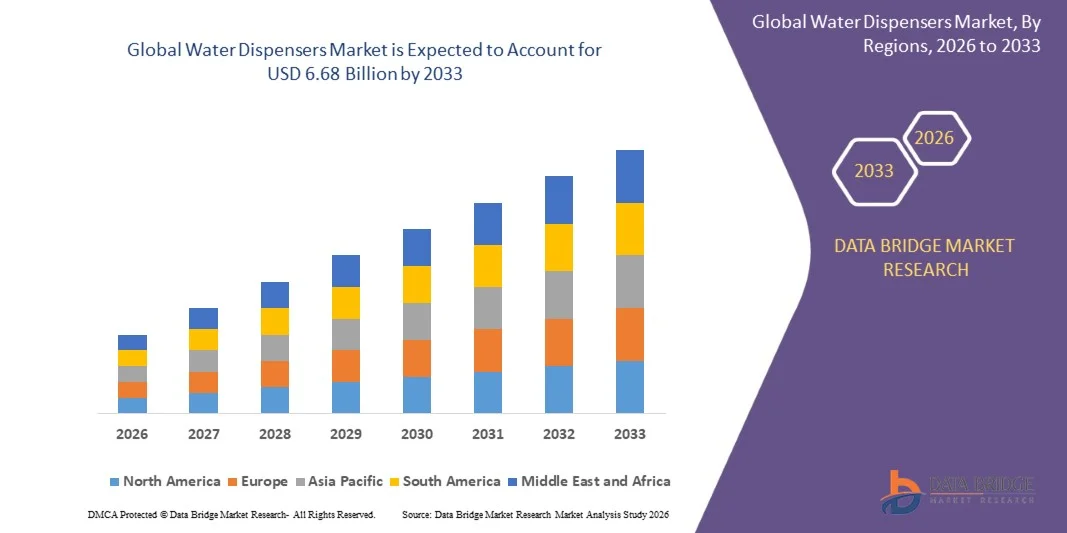
The Water Dispensers Market was valued at USD 3.61 billion in 2025 and is projected to reach USD 6.68 billion by 2033, growing at a CAGR of 8.00% from 2026 to 2033. The market is witnessing strong growth driven by increasing consumer awareness regarding safe drinking water, rapid urbanization, and rising demand for convenient hydration solutions across residential, commercial, and institutional sectors.
The growing concerns over water contamination and the increasing adoption of purified drinking water systems are encouraging households, offices, healthcare facilities, and educational institutions to install advanced water dispensing solutions. Modern countertop and bottom-loading dispensers equipped with filtration systems, touchless dispensing technology, and energy-efficient cooling and heating functions are increasingly replacing traditional bottled water consumption methods in many regions, offering improved hygiene, convenience, and cost efficiency.
Key Market Trends & Insights
- North America dominated the water dispensers market with the largest revenue share in 2025, supported by strong adoption of bottleless water dispensing systems, high consumer spending on smart appliances, and increasing demand for hygienic and sustainable drinking water solutions across workplaces and households.
- Asia-Pacific is expected to be the fastest-growing region, recording a strong CAGR from 2026 to 2033. Growth is driven by rapid urbanization, rising disposable incomes, increasing awareness regarding water purification, and expanding demand for affordable water dispensing systems in countries such as China and India.
- The Bottled Water Dispensers segment held the largest market revenue share of approximately 58.7% in 2025 driven by its widespread adoption across residential households, offices, and small commercial establishments due to ease of installation and lower infrastructure dependency. Bottled dispensers are preferred in regions with inconsistent municipal water quality and limited direct filtration infrastructure. Their portability and minimal plumbing requirements make them highly suitable for rental spaces, temporary offices, and institutional facilities. In addition, increasing demand for ready-to-use hydration systems in emerging economies is supporting continued adoption of bottled dispenser systems across urban and semi-urban markets.
- The Direct Piping/Point Of Use segment is projected to register the fastest growth at a CAGR of 9.6% from 2026 to 2033, driven by rising demand for sustainable bottleless systems, lower operational costs, and increasing installation across corporate offices, healthcare facilities, and smart commercial buildings. Growing environmental concerns regarding plastic waste generation and rising adoption of centralized water filtration infrastructure are further accelerating demand for point-of-use dispensing solutions globally.
- The 3 Ltr/Hr segment held the largest market revenue share of approximately 34.9% in 2025 driven by its balanced cooling efficiency, affordability, and suitability for medium-sized residential and office applications. These systems are extensively deployed across apartments, clinics, and educational institutions where moderate water consumption levels are observed. Manufacturers are increasingly introducing energy-efficient compressors and smart temperature control systems within this category to improve user convenience and reduce electricity consumption.
- The More Than 5 Ltr/Hr segment is projected to witness the fastest growth at a CAGR of 10.2% from 2026 to 2033, supported by rising demand from hotels, hospitals, educational institutions, and industrial facilities requiring continuous high-volume water dispensing solutions. Increasing commercial infrastructure development and rising footfall in public facilities are further supporting deployment of large-capacity water dispensers globally.
- The 80 liters segment accounted for the largest market revenue share of approximately 29.4% in 2025 driven by its extensive usage across schools, offices, restaurants, and healthcare facilities requiring moderate-volume water storage capacity. These systems provide an optimal balance between compact design and operational efficiency, making them suitable for medium-scale institutional environments. Rising installation across coworking spaces and educational campuses is also contributing to segment dominance.
- The 150 liters segment is expected to register the fastest growth at a CAGR of 9.8% from 2026 to 2033, fueled by increasing adoption in industrial facilities, public infrastructure projects, and high-footfall commercial environments. Growing demand for uninterrupted hydration access in manufacturing plants, transportation hubs, and large hospitality establishments is accelerating deployment of higher-capacity storage systems.
- The 400X400X1060 MM segment held the largest market revenue share of approximately 27.6% in 2025 driven by its compact structure, ergonomic design, and suitability for office spaces, retail stores, and residential kitchens. These dispensers are increasingly preferred in urban residential environments where space optimization remains a key purchasing factor. Their compatibility with modular interiors and ease of mobility are further strengthening product adoption.
- The 755X575X1240 MM segment is projected to witness the fastest growth at a CAGR of 8.9% from 2026 to 2033 due to rising deployment in large commercial facilities and institutions requiring higher dispensing and storage capacity. Increasing installations across airports, hospitals, and educational campuses are further supporting growth of larger dispenser dimensions.
- The Combined segment held the largest market revenue share of approximately 46.8% in 2025 driven by increasing consumer preference for multifunctional dispensers capable of delivering both hot and cold water for residential and commercial applications. These systems are highly preferred in offices and hospitality environments where year-round temperature flexibility improves operational convenience. Manufacturers are also integrating energy-saving heating and cooling systems to improve efficiency and enhance user experience.
- The Hot Water segment is projected to witness the fastest growth at a CAGR of 8.7% from 2026 to 2033 supported by increasing demand in offices, healthcare facilities, and hospitality environments where instant hot water accessibility improves operational convenience. Rising consumption of instant beverages such as tea and coffee in workplaces and commercial facilities is also accelerating segment expansion.
- The White segment accounted for the largest market revenue share of approximately 39.5% in 2025 driven by strong consumer preference for clean aesthetics, compatibility with residential interiors, and widespread availability across entry-level and mid-range dispenser categories. White-colored dispensers are widely used in homes, clinics, and educational institutions due to their minimalistic appearance and cost-effective manufacturing advantages.
- The Black segment is expected to register the fastest growth at a CAGR of 8.4% from 2026 to 2033 due to increasing demand for premium and modern-looking appliances in corporate offices, luxury hotels, and smart home environments. Growing consumer preference for high-end kitchen appliances and contemporary interior aesthetics is further contributing to segment growth.
- The Without Refrigerated Compartment segment held the largest market revenue share of approximately 61.2% in 2025 driven by lower product costs, reduced maintenance requirements, and higher adoption in residential and institutional applications. These systems are widely preferred across schools, small offices, and public facilities where affordability and ease of maintenance remain major purchasing considerations.
- The With Refrigerated Compartment segment is projected to register the fastest growth at a CAGR of 9.3% from 2026 to 2033 due to increasing preference for multifunctional water coolers offering additional beverage and food storage convenience in commercial spaces. Rising adoption across hospitality facilities, premium offices, and recreational centers is further supporting segment expansion.
- The Supermarkets/Hypermarkets segment accounted for the largest market revenue share of approximately 36.7% in 2025 driven by strong retail visibility, product comparison convenience, and extensive consumer footfall. Consumers continue to prefer physical retail channels for appliance purchases due to the ability to evaluate product size, build quality, and dispensing features before purchase. In-store promotional campaigns and financing offers are also supporting higher sales volumes through organized retail channels.
- The E-Commerce segment is projected to witness the fastest growth at a CAGR of 11.1% from 2026 to 2033 supported by rising digital adoption, competitive pricing, doorstep delivery convenience, and expanding online appliance retail platforms globally. Increasing smartphone penetration and growing consumer trust in online appliance purchases are significantly accelerating segment growth.
- The Osmosis segment held the largest market revenue share of approximately 57.8% in 2025 driven by increasing consumer preference for advanced purification technologies capable of removing dissolved impurities, heavy metals, and microbial contaminants. Reverse osmosis systems are increasingly adopted across regions facing hard water and contamination issues due to their superior purification performance and long-term reliability.
- The Filtration Cartridge segment is expected to witness the fastest growth at a CAGR of 8.5% from 2026 to 2033 supported by lower maintenance complexity, compact system integration, and growing adoption in portable and countertop water dispensers. Rising demand for affordable and easy-to-maintain filtration systems in urban residential applications is further accelerating segment expansion.
- The Water Pressure Regulator segment accounted for the largest market revenue share of approximately 18.6% in 2025 driven by its critical role in maintaining stable water flow and protecting dispensing systems from pressure fluctuations. Increasing integration of advanced pressure management systems in smart dispensers is improving operational safety and extending equipment lifespan.
- The Anti Flood Devices segment is projected to register the fastest growth at a CAGR of 9.9% from 2026 to 2033 due to rising focus on leak prevention technologies and increasing adoption of automated smart dispensing systems in commercial environments. Growing installation of IoT-enabled monitoring systems is also enhancing demand for advanced anti-flood safety components.
- The Corporate Offices segment held the largest market revenue share of approximately 31.8% in 2025 driven by growing workplace hygiene awareness, increasing installation of bottleless dispensers, and rising employee wellness initiatives across corporate infrastructure. Large organizations are increasingly adopting smart dispensers equipped with touchless operation and energy-efficient systems to improve employee convenience and sustainability compliance.
- The Residential segment is projected to witness the fastest growth at a CAGR of 10.4% from 2026 to 2033 supported by rising urbanization, increasing health consciousness, growing smart kitchen adoption, and expanding demand for compact home water purification and dispensing systems. Rising disposable income levels and growing awareness regarding safe drinking water quality are further strengthening residential market expansion.
Market Size & Forecast
- Global Market Value (2025): USD 3.61 Billion
- Expected Market Value (2033): USD 6.68 Billion
- Forecast CAGR (2026–2033): 8.00%
- Leading Region in 2025: North America
- Fastest Growing Region: Asia-Pacific
Report Scope and Water Dispensers Market Segmentation
|
Attributes |
Water Dispensers Key Market Insights |
|
Segments Covered |
· By Type: Direct Piping/Point Of Use and Bottled Water Dispensers · By Cooling Capacity: 2 Ltr/Hr, 3 Ltr/Hr, 5 Ltr/Hr, and More Than 5 Ltr/Hr · By Storage Capacity: 20 liters, 40 liters, 80 liters, 120 liters, 150 liters, 380 liters, and Others · By Dimension: 315X330X490 MM, 400X400X1060 MM, 440X440X1185 MM, 665X485X1210 MM, 755X575X1240 MM, 812X612X1210 MM and Others · By Water Type: Combined, Hot Water, Cold Water, and Normal Water · By Color: Black, Silver, White, and Others · By Compartment-Type Water Cooler: With Refrigerated Compartment and Without Refrigerated Compartment · By Distribution Channel: Direct, Supermarkets/Hypermarkets, Specialty Stores, E-Commerce, and Others · By Filtration Technology: Osmosis and Filtration Cartridg · By Components: Electro Valves, Flow Meters, Soda Regulation Screws, Pressure Switches/Transducers, Quick Adapter Tubes, Anti Flood Devices, Water Pressure Regulator, Drip Tray, Puncture Tube Pencil Needle, and Others · By Application: Residential, Corporate Offices, Schools/University Hospitals, Hotels, Restaurants and Bars, Industrial, and Others |
|
Countries Covered |
North America · U.S. · Canada · Mexico Europe · Germany · France · U.K. · Netherlands · Switzerland · Belgium · Russia · Italy · Spain · Turkey · Rest of Europe Asia-Pacific · China · Japan · India · South Korea · Singapore · Malaysia · Australia · Thailand · Indonesia · Philippines · Rest of Asia-Pacific Middle East and Africa · Saudi Arabia · U.A.E. · South Africa · Egypt · Israel · Rest of Middle East and Africa South America · Brazil · Argentina · Rest of South America |
|
Key Market Players |
• Blue Star Limited (India) |
|
Market Opportunities |
|
|
Value Added Data Infosets |
In addition to the insights on market scenarios such as market value, growth rate, segmentation, geographical coverage, and major players, the market reports curated by the Data Bridge Market Research also include in-depth expert analysis, pricing analysis, brand share analysis, consumer survey, demography analysis, supply chain analysis, value chain analysis, raw material/consumables overview, vendor selection criteria, PESTLE Analysis, Porter Analysis, and regulatory framework. |
Water Dispensers Market Trends
Trend: Rising Adoption Of Smart, Touchless, And Energy-Efficient Water Dispensing Solutions
Increasing consumer demand for hygienic, convenient, and energy-efficient drinking water solutions across residential, commercial, and institutional sectors is accelerating innovation in the Water Dispensers Market. Traditional bottled water dispensing methods often involve manual handling, higher maintenance, and hygiene concerns, encouraging consumers and businesses to adopt advanced touchless and filtration-integrated water dispensing systems with improved operational efficiency.
In modern workplaces and healthcare facilities, organizations are increasingly installing sensor-based touchless dispensers, For instance with UV purification and IoT-enabled monitoring systems, to reduce contamination risks and improve user convenience. In residential applications, smart countertop dispensers with instant hot and cold water functionality are gaining popularity due to increasing urbanization and compact housing trends.
The rapid expansion of smart homes and connected appliances is also increasing demand for digitally integrated water dispensers capable of monitoring water quality and filter replacement schedules through mobile applications. In addition, hospitality and educational institutions are adopting bottleless water dispensing systems to reduce plastic waste and support sustainability initiatives. Growing industry validation through commercial installations in 2025 across airports and corporate offices demonstrated reduction of nearly 25–30% in single-use plastic bottle consumption after deploying bottleless smart water dispensers.
Water Dispensers Market Dynamics
Key Market Driver: Rising Demand For Safe Drinking Water And Hygiene Awareness
Consumers worldwide are increasingly prioritizing access to clean and safe drinking water due to growing concerns regarding water contamination, waterborne diseases, and declining municipal water quality. Rapid urbanization and rising health awareness are encouraging households, offices, hospitals, and educational institutions to install advanced water dispensing systems integrated with purification technologies.
Commercial establishments such as corporate offices, healthcare centers, and hospitality facilities are increasingly deploying water dispensers equipped with RO and UV filtration systems to improve hygiene standards and ensure continuous access to purified drinking water. For instance, healthcare facilities and airports across Asia-Pacific and North America are expanding installation of touchless dispensers to minimize direct contact and improve public hygiene standards.
Similarly, educational institutions and manufacturing facilities are replacing traditional bottled water systems with energy-efficient bottleless dispensers to reduce operational costs and improve sustainability. Real-world commercial installations during 2024 across large office complexes in the U.S. and Japan demonstrated operational cost reductions of around 15–20% after transitioning from bottled water delivery systems to centralized filtration-based dispensers.
Key Restraint/Challenge: High Maintenance Costs And Limited Infrastructure In Emerging Regions
Advanced water dispensers equipped with purification technologies require regular maintenance, periodic filter replacement, and continuous servicing to ensure optimal performance and water quality compliance. The recurring maintenance costs associated with RO membranes, UV lamps, and filtration cartridges create affordability concerns for price-sensitive consumers and small businesses.
In addition, limited access to stable electricity supply and purified water infrastructure in certain developing regions restricts adoption of technologically advanced water dispensers. Operational issues such as leakage, microbial contamination from poor maintenance, and higher initial installation costs further limit penetration in rural and low-income markets.
Commercial benchmarking studies indicate that maintenance and filter replacement expenses for premium bottleless water dispensers can account for approximately 15–25% of total ownership costs annually, creating adoption barriers among cost-sensitive consumers and small commercial establishments.
Key Market Opportunity: Expansion Of Smart Bottleless Systems And Sustainable Commercial Solutions
Growing global focus on sustainability, plastic waste reduction, and smart appliance integration is creating strong growth opportunities for advanced bottleless water dispenser manufacturers. Organizations are increasingly replacing traditional bottled water systems with filtration-based dispensers to reduce plastic consumption and improve operational efficiency across offices, hotels, educational institutions, and public infrastructure.
Manufacturers are increasingly introducing IoT-enabled water dispensers, For instance with real-time water quality monitoring, automated maintenance alerts, and energy-saving features, to improve consumer convenience and support smart building integration. In commercial sectors, increasing green building initiatives and ESG-focused corporate policies are accelerating adoption of eco-friendly water dispensing systems.
In addition, advancements in compact filtration technology and AI-powered monitoring systems are expanding product adoption across smart homes, healthcare facilities, and high-density urban environments in Asia-Pacific and North America. Smart dispenser pilot programs conducted in 2025 across commercial buildings in Singapore and South Korea reported reductions of nearly 20–35% in bottled water procurement costs after deployment of centralized bottleless water dispensing systems.
Water Dispensers Market Scope
The market is segmented on the basis of type, cooling capacity, storage capacity, dimension, water type, color, compartment-type water cooler, distribution channel, filtration technology, components, and application.
- By Type
On the basis of type, the water dispensers market is segmented into Direct Piping/Point Of Use and Bottled Water Dispensers. The Bottled Water Dispensers segment held the largest market revenue share of approximately 58.7% in 2025 driven by its widespread adoption across residential households, offices, and small commercial establishments due to ease of installation and lower infrastructure dependency. Bottled dispensers are preferred in regions with inconsistent municipal water quality and limited direct filtration infrastructure. Their portability and minimal plumbing requirements make them highly suitable for rental spaces, temporary offices, and institutional facilities. In addition, increasing demand for ready-to-use hydration systems in emerging economies is supporting continued adoption of bottled dispenser systems across urban and semi-urban markets.
The Direct Piping/Point Of Use segment is projected to register the fastest growth at a CAGR of 9.6% from 2026 to 2033, driven by rising demand for sustainable bottleless systems, lower operational costs, and increasing installation across corporate offices, healthcare facilities, and smart commercial buildings. Growing environmental concerns regarding plastic waste generation and rising adoption of centralized water filtration infrastructure are further accelerating demand for point-of-use dispensing solutions globally.
- By Cooling Capacity
On the basis of cooling capacity, the market is segmented into 2 Ltr/Hr, 3 Ltr/Hr, 5 Ltr/Hr, and More Than 5 Ltr/Hr. The 3 Ltr/Hr segment held the largest market revenue share of approximately 34.9% in 2025 driven by its balanced cooling efficiency, affordability, and suitability for medium-sized residential and office applications. These systems are extensively deployed across apartments, clinics, and educational institutions where moderate water consumption levels are observed. Manufacturers are increasingly introducing energy-efficient compressors and smart temperature control systems within this category to improve user convenience and reduce electricity consumption.
The More Than 5 Ltr/Hr segment is projected to witness the fastest growth at a CAGR of 10.2% from 2026 to 2033, supported by rising demand from hotels, hospitals, educational institutions, and industrial facilities requiring continuous high-volume water dispensing solutions. Increasing commercial infrastructure development and rising footfall in public facilities are further supporting deployment of large-capacity water dispensers globally.
- By Storage Capacity
On the basis of storage capacity, the market is segmented into 20 liters, 40 liters, 80 liters, 120 liters, 150 liters, 380 liters, and Others. The 80 liters segment accounted for the largest market revenue share of approximately 29.4% in 2025 driven by its extensive usage across schools, offices, restaurants, and healthcare facilities requiring moderate-volume water storage capacity. These systems provide an optimal balance between compact design and operational efficiency, making them suitable for medium-scale institutional environments. Rising installation across coworking spaces and educational campuses is also contributing to segment dominance.
The 150 liters segment is expected to register the fastest growth at a CAGR of 9.8% from 2026 to 2033, fueled by increasing adoption in industrial facilities, public infrastructure projects, and high-footfall commercial environments. Growing demand for uninterrupted hydration access in manufacturing plants, transportation hubs, and large hospitality establishments is accelerating deployment of higher-capacity storage systems.
- By Dimension
On the basis of dimension, the market is segmented into 315X330X490 MM, 400X400X1060 MM, 440X440X1185 MM, 665X485X1210 MM, 755X575X1240 MM, 812X612X1210 MM, and Others. The 400X400X1060 MM segment held the largest market revenue share of approximately 27.6% in 2025 driven by its compact structure, ergonomic design, and suitability for office spaces, retail stores, and residential kitchens. These dispensers are increasingly preferred in urban residential environments where space optimization remains a key purchasing factor. Their compatibility with modular interiors and ease of mobility are further strengthening product adoption.
The 755X575X1240 MM segment is projected to witness the fastest growth at a CAGR of 8.9% from 2026 to 2033 due to rising deployment in large commercial facilities and institutions requiring higher dispensing and storage capacity. Increasing installations across airports, hospitals, and educational campuses are further supporting growth of larger dispenser dimensions.
- By Water Type
On the basis of water type, the market is segmented into Combined, Hot Water, Cold Water, and Normal Water. The Combined segment held the largest market revenue share of approximately 46.8% in 2025 driven by increasing consumer preference for multifunctional dispensers capable of delivering both hot and cold water for residential and commercial applications. These systems are highly preferred in offices and hospitality environments where year-round temperature flexibility improves operational convenience. Manufacturers are also integrating energy-saving heating and cooling systems to improve efficiency and enhance user experience.
The Hot Water segment is projected to witness the fastest growth at a CAGR of 8.7% from 2026 to 2033 supported by increasing demand in offices, healthcare facilities, and hospitality environments where instant hot water accessibility improves operational convenience. Rising consumption of instant beverages such as tea and coffee in workplaces and commercial facilities is also accelerating segment expansion.
- By Color
On the basis of color, the market is segmented into Black, Silver, White, and Others. The White segment accounted for the largest market revenue share of approximately 39.5% in 2025 driven by strong consumer preference for clean aesthetics, compatibility with residential interiors, and widespread availability across entry-level and mid-range dispenser categories. White-colored dispensers are widely used in homes, clinics, and educational institutions due to their minimalistic appearance and cost-effective manufacturing advantages.
The Black segment is expected to register the fastest growth at a CAGR of 8.4% from 2026 to 2033 due to increasing demand for premium and modern-looking appliances in corporate offices, luxury hotels, and smart home environments. Growing consumer preference for high-end kitchen appliances and contemporary interior aesthetics is further contributing to segment growth.
- By Compartment-Type Water Cooler
On the basis of compartment-type water cooler, the market is segmented into With Refrigerated Compartment and Without Refrigerated Compartment. The Without Refrigerated Compartment segment held the largest market revenue share of approximately 61.2% in 2025 driven by lower product costs, reduced maintenance requirements, and higher adoption in residential and institutional applications. These systems are widely preferred across schools, small offices, and public facilities where affordability and ease of maintenance remain major purchasing considerations.
The With Refrigerated Compartment segment is projected to register the fastest growth at a CAGR of 9.3% from 2026 to 2033 due to increasing preference for multifunctional water coolers offering additional beverage and food storage convenience in commercial spaces. Rising adoption across hospitality facilities, premium offices, and recreational centers is further supporting segment expansion.
- By Distribution Channel
On the basis of distribution channel, the market is segmented into Direct, Supermarkets/Hypermarkets, Specialty Stores, E-Commerce, and Others. The Supermarkets/Hypermarkets segment accounted for the largest market revenue share of approximately 36.7% in 2025 driven by strong retail visibility, product comparison convenience, and extensive consumer footfall. Consumers continue to prefer physical retail channels for appliance purchases due to the ability to evaluate product size, build quality, and dispensing features before purchase. In-store promotional campaigns and financing offers are also supporting higher sales volumes through organized retail channels.
The E-Commerce segment is projected to witness the fastest growth at a CAGR of 11.1% from 2026 to 2033 supported by rising digital adoption, competitive pricing, doorstep delivery convenience, and expanding online appliance retail platforms globally. Increasing smartphone penetration and growing consumer trust in online appliance purchases are significantly accelerating segment growth.
- By Filtration Technology
On the basis of filtration technology, the market is segmented into Osmosis and Filtration Cartridge. The Osmosis segment held the largest market revenue share of approximately 57.8% in 2025 driven by increasing consumer preference for advanced purification technologies capable of removing dissolved impurities, heavy metals, and microbial contaminants. Reverse osmosis systems are increasingly adopted across regions facing hard water and contamination issues due to their superior purification performance and long-term reliability.
The Filtration Cartridge segment is expected to witness the fastest growth at a CAGR of 8.5% from 2026 to 2033 supported by lower maintenance complexity, compact system integration, and growing adoption in portable and countertop water dispensers. Rising demand for affordable and easy-to-maintain filtration systems in urban residential applications is further accelerating segment expansion.
- By Components
On the basis of components, the market is segmented into Electro Valves, Flow Meters, Soda Regulation Screws, Pressure Switches/Transducers, Quick Adapter Tubes, Anti Flood Devices, Water Pressure Regulator, Drip Tray, Puncture Tube Pencil Needle, and Others. The Water Pressure Regulator segment accounted for the largest market revenue share of approximately 18.6% in 2025 driven by its critical role in maintaining stable water flow and protecting dispensing systems from pressure fluctuations. Increasing integration of advanced pressure management systems in smart dispensers is improving operational safety and extending equipment lifespan.
The Anti Flood Devices segment is projected to register the fastest growth at a CAGR of 9.9% from 2026 to 2033 due to rising focus on leak prevention technologies and increasing adoption of automated smart dispensing systems in commercial environments. Growing installation of IoT-enabled monitoring systems is also enhancing demand for advanced anti-flood safety components.
- By Application
On the basis of application, the market is segmented into Residential, Corporate Offices, Schools/University Hospitals, Hotels, Restaurants and Bars, Industrial, and Others. The Corporate Offices segment held the largest market revenue share of approximately 31.8% in 2025 driven by growing workplace hygiene awareness, increasing installation of bottleless dispensers, and rising employee wellness initiatives across corporate infrastructure. Large organizations are increasingly adopting smart dispensers equipped with touchless operation and energy-efficient systems to improve employee convenience and sustainability compliance.
The Residential segment is projected to witness the fastest growth at a CAGR of 10.4% from 2026 to 2033 supported by rising urbanization, increasing health consciousness, growing smart kitchen adoption, and expanding demand for compact home water purification and dispensing systems. Rising disposable income levels and growing awareness regarding safe drinking water quality are further strengthening residential market expansion.
Water Dispensers Market Regional Analysis
North America Water Dispensers Market Insight
North America dominated the water dispensers market with the largest revenue share of approximately 37.2% in 2025, supported by increasing consumer awareness regarding safe drinking water, strong adoption of bottleless water dispensing systems, and rising demand for smart kitchen and workplace appliances. Consumers in the region highly value convenience, hygiene, and energy-efficient dispensing solutions integrated with filtration and touchless technologies. The market is further supported by high disposable income levels, strong commercial infrastructure, and increasing replacement of bottled water systems with sustainable point-of-use dispensers across residential and corporate environments.
U.S. Water Dispensers Market Insight
The U.S. water dispensers market captured the largest revenue share in 2025 within North America, fueled by rising health awareness, growing demand for purified drinking water, and increasing adoption of smart home appliances. Consumers are increasingly prioritizing touchless dispensing systems, UV purification technologies, and energy-efficient cooling and heating functions for both residential and office use. The rapid expansion of hybrid workplaces and employee wellness initiatives is further accelerating installation of bottleless water dispensers across corporate offices and public infrastructure. Moreover, increasing concerns regarding plastic waste are encouraging adoption of sustainable filtration-based water dispensing systems throughout the country.
Europe Water Dispensers Market Insight
The Europe water dispensers market is expected to witness steady growth from 2026 to 2033, primarily driven by increasing environmental awareness, rising demand for sustainable hydration solutions, and stringent regulations regarding plastic waste reduction. European consumers are increasingly adopting bottleless water dispensers and filtration-integrated systems to minimize dependency on single-use plastic bottles. The region is also witnessing strong demand across offices, healthcare facilities, hospitality infrastructure, and educational institutions where hygiene and energy efficiency remain major purchasing considerations. Increasing smart appliance adoption and modernization of commercial infrastructure are further supporting market expansion across Europe.
U.K. Water Dispensers Market Insight
The U.K. water dispensers market is expected to witness strong growth from 2026 to 2033, driven by rising awareness regarding workplace hydration, increasing adoption of sustainable office solutions, and growing demand for compact smart kitchen appliances. Concerns regarding plastic waste and increasing emphasis on ESG compliance are encouraging organizations to replace bottled water systems with direct piping dispensers integrated with advanced filtration technologies. The country’s strong commercial office infrastructure, hospitality sector growth, and increasing consumer preference for premium home appliances are expected to continue supporting market expansion.
Germany Water Dispensers Market Insight
The Germany water dispensers market is expected to witness steady expansion from 2026 to 2033, fueled by increasing focus on energy-efficient appliances, strong environmental regulations, and rising demand for advanced filtration systems. Germany’s emphasis on sustainability and eco-conscious infrastructure is accelerating adoption of bottleless water dispensers across commercial buildings, healthcare facilities, and manufacturing environments. In addition, consumers are increasingly preferring high-quality and durable dispensing systems integrated with smart monitoring technologies and low-energy consumption features. The integration of water dispensers within smart kitchens and automated office infrastructure is also becoming increasingly prevalent across the country.
Asia-Pacific Water Dispensers Market Insight
The Asia-Pacific water dispensers market is expected to witness the fastest growth rate from 2026 to 2033, supported by rapid urbanization, rising disposable incomes, and increasing awareness regarding safe drinking water in countries such as China, India, Japan, and South Korea. The region’s growing middle-class population and expanding commercial infrastructure are significantly increasing demand for affordable and technologically advanced water dispensing systems. Government initiatives promoting public health, improved sanitation, and clean drinking water accessibility are further supporting market growth. In addition, APAC’s emergence as a manufacturing hub for consumer appliances is improving affordability and product accessibility across both urban and semi-urban markets.
Japan Water Dispensers Market Insight
The Japan water dispensers market is expected to witness strong growth from 2026 to 2033 due to the country’s advanced technological infrastructure, strong hygiene standards, and increasing adoption of compact smart appliances. Japanese consumers highly prioritize water purity, convenience, and energy efficiency, driving demand for advanced filtration-based water dispensers equipped with IoT-enabled monitoring systems. The integration of touchless dispensing technologies and compact countertop systems is increasing across homes, offices, healthcare facilities, and transportation hubs. Moreover, Japan’s aging population is encouraging adoption of user-friendly and accessible hydration systems with automated dispensing features.
China Water Dispensers Market Insight
The China water dispensers market accounted for the largest market revenue share in Asia-Pacific in 2025, attributed to rapid urbanization, increasing middle-class population, and rising concerns regarding water quality and contamination. China represents one of the largest markets for household and commercial water purification appliances, with strong demand for bottleless and filtration-integrated dispensers across residential, educational, and corporate sectors. The government’s focus on clean water infrastructure, combined with the availability of affordable domestic manufacturing, is significantly accelerating market growth. In addition, rapid expansion of e-commerce platforms and smart appliance adoption is further improving accessibility of advanced water dispensing systems across the country.
Water Dispensers Market Share
The Water Dispensers industry is primarily led by well-established companies, including:
- Blue Star Limited (India)
- Voltas Inc, (India)
- Atlantis Products Pvt. Ltd. (India)
- Avalon Water Coolers (U.S.)
- Mistral Solutions Pvt. Ltd., (India)
- Midea Group (China)
- Ningbo Jewin Electrical Appliances (China)
- Aqua Clara International (U.S.)
- Alpine Coolers (U.S.)
- Ningbo Lamo Drinking Water Equipment Co. Ltd., (China)
- Bibo (China)
- Glug Glug Glug (U.K)
- Arctic Coolers (Switzerland)
- AquAid Franchising Limited (U.K)
- BRITA (Germany)
- Vista France (France)
- Sure International (UAE)
- Fuji Springs Inc., (Japan)
- Aimex Australia (Australia)
- Royalsovereign, Inc. (U.S)
- Alfred Kärcher SE & Co. KG (Germany)
Latest Developments in Water Dispensers Market
- In April 2026, Aqualume launched an eco-friendly bottleless water cooler as a product launch initiative to provide sustainable hydration solutions for commercial workplaces across Southern California. The system directly connects to existing water lines and integrates advanced filtration technology to deliver purified drinking water while reducing dependence on single-use plastic bottles and recurring water deliveries. This development is expected to strengthen adoption of sustainable workplace hydration systems, lower operational costs for businesses, and accelerate market demand for environmentally responsible water dispensing solutions.
- In February 2026, Glacier Fresh introduced the Coolon countertop cold water dispenser as part of its product expansion strategy focused on compact and user-friendly hydration systems. The dispenser features nano-filtration technology and a plug-and-play installation design that delivers instant chilled and filtered water without plumbing requirements. This launch is expected to strengthen the company’s presence in residential and small-office segments while supporting rising consumer demand for convenient, space-efficient, and sustainable alternatives to bottled water consumption.
- In June 2022, A. O. Smith Corporation completed the acquisition of Atlantic Filter Corporation as part of its business expansion and water treatment portfolio strengthening strategy. Through this acquisition, the company aimed to expand its regional footprint beyond Florida while enhancing its capabilities in residential and commercial water treatment solutions. The acquisition is expected to strengthen A. O. Smith’s distribution network, improve service capabilities, and increase competitive positioning within the North American water treatment and dispensing market.
- In February 2021, Voltas Limited inaugurated a new brand store in Rourkela, Odisha, as part of its retail expansion initiative to strengthen consumer access to its appliance and water dispensing product portfolio. The store showcases a wide range of products including water dispensers, water coolers, refrigerators, washing machines, and air conditioners. This expansion is expected to improve the company’s retail presence in Eastern India, enhance brand visibility, and support rising consumer demand for smart and energy-efficient household appliances across urban markets.
SKU-
Get online access to the report on the World's First Market Intelligence Cloud

- Interactive Data Analysis Dashboard
- Company Analysis Dashboard for high growth potential opportunities
- Research Analyst Access for customization & queries
- Competitor Analysis with Interactive dashboard
- Latest News, Updates & Trend analysis
- Harness the Power of Benchmark Analysis for Comprehensive Competitor Tracking
Research Methodology
Data collection and base year analysis are done using data collection modules with large sample sizes. The stage includes obtaining market information or related data through various sources and strategies. It includes examining and planning all the data acquired from the past in advance. It likewise envelops the examination of information inconsistencies seen across different information sources. The market data is analysed and estimated using market statistical and coherent models. Also, market share analysis and key trend analysis are the major success factors in the market report. To know more, please request an analyst call or drop down your inquiry.
The key research methodology used by DBMR research team is data triangulation which involves data mining, analysis of the impact of data variables on the market and primary (industry expert) validation. Data models include Vendor Positioning Grid, Market Time Line Analysis, Market Overview and Guide, Company Positioning Grid, Patent Analysis, Pricing Analysis, Company Market Share Analysis, Standards of Measurement, Global versus Regional and Vendor Share Analysis. To know more about the research methodology, drop in an inquiry to speak to our industry experts.
Customization Available
Data Bridge Market Research is a leader in advanced formative research. We take pride in servicing our existing and new customers with data and analysis that match and suits their goal. The report can be customized to include price trend analysis of target brands understanding the market for additional countries (ask for the list of countries), clinical trial results data, literature review, refurbished market and product base analysis. Market analysis of target competitors can be analyzed from technology-based analysis to market portfolio strategies. We can add as many competitors that you require data about in the format and data style you are looking for. Our team of analysts can also provide you data in crude raw excel files pivot tables (Fact book) or can assist you in creating presentations from the data sets available in the report.












