




Global Wearable Tracking Devices Market
Market Size in USD Billion
CAGR :
% 
 USD
84.74 Billion
USD
375.33 Billion
2025
2033
USD
84.74 Billion
USD
375.33 Billion
2025
2033
 Forecast Period Forecast Period |
2026 - 2033 |
 Market Size (Base Year) Market Size (Base Year) |
USD 84.74 Billion |
 Market Size (Forecast Year) Market Size (Forecast Year) |
USD 375.33 Billion |
 CAGR CAGR |
% |
| Major Markets Players |
|
Wearable Tracking Devices Market Overview
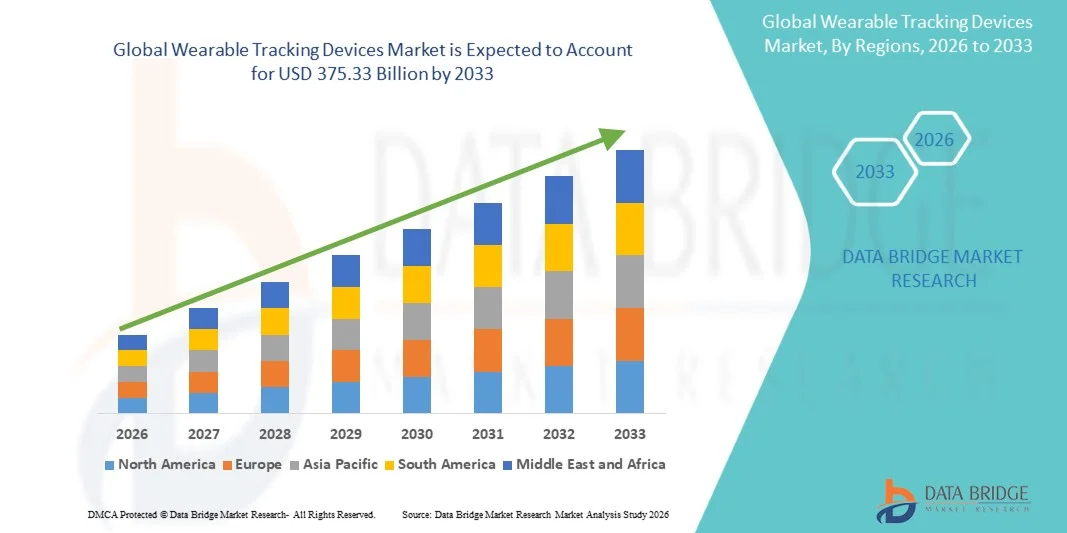
The Wearable Tracking Devices Market was valued at USD 84.74 billion in 2025 and is projected to reach USD 375.33 billion by 2033, growing at a CAGR of 15.87% from 2026 to 2033. Market growth is supported by rising health consciousness among consumers, increasing prevalence of chronic diseases such as diabetes, cardiovascular disorders, and obesity, alongside the widespread adoption of connected health and fitness monitoring technologies.
The growing integration of advanced sensors, artificial intelligence, and real-time health analytics into wearable devices is driving adoption among both individual consumers and healthcare institutions. Wearable tracking devices offer continuous monitoring of vital signs, physical activity, sleep patterns, and location tracking, enabling proactive health management and improved patient outcomes. Ongoing technological advancements in miniaturization, battery life, and wireless connectivity are expanding the clinical and consumer applicability of wearable tracking devices across fitness, medical monitoring, and personal safety applications. In addition, growing smartphone penetration, favorable reimbursement policies for remote patient monitoring, and the expansion of e-commerce distribution channels are creating new opportunities for stakeholders across the forecast period.
Key Market Trends & Insights
- North America dominated the Wearable Tracking Devices Market with the largest revenue share of 38.6% in 2025, supported by high adoption rates of connected health technologies, strong consumer spending on fitness devices, and the presence of leading market players.
- Asia-Pacific is expected to be the fastest-growing region at a CAGR of 18.45% from 2026 to 2033, driven by expanding smartphone penetration, rising health awareness, and increasing disposable incomes.
- The Wrist Wear segment led the market with a 52.3% market share in 2025, reflecting its widespread popularity as the preferred form factor for smartwatches and fitness trackers among consumers globally.
- The Fitness Bands segment is anticipated to be the fastest-growing type category, driven by increasing demand for affordable health and activity monitoring solutions among fitness enthusiasts and first-time wearable users.
- The Consumer Electronics segment dominated the application category with a 61.8% market share in 2025, supported by strong demand for fitness tracking, smartwatch features, and lifestyle-oriented wearable devices.
- The Healthcare segment is expected to witness strong growth during the forecast period, driven by rising adoption of remote patient monitoring, chronic disease management, and clinical-grade wearable devices.
- The Online segment dominated the sales channel category with a 58.2% market share in 2025, supported by e-commerce expansion, direct-to-consumer brand strategies, and increasing digital shopping preferences.
- The Sports Person segment dominated the end-user category with a 54.5% market share in 2025, driven by growing fitness culture, performance tracking demand, and wearable technology integration in athletic training.
Market Size & Forecast
- Global Market Value (2025): USD 84.74 Billion
- Expected Market Value (2033): USD 375.33 Billion
- Forecast CAGR (2026–2033): 15.87%
- Leading Region in 2025: North America
- Fastest Growing Region: Asia-Pacific
Report Scope and Wearable Tracking Devices Market Segmentation
|
Attributes |
Wearable Tracking Devices Key Market Insights |
|
Segments Covered |
|
|
Countries Covered |
North America · U.S. · Canada · Mexico Europe · Germany · France · U.K. · Netherlands · Switzerland · Belgium · Russia · Italy · Spain · Turkey · Rest of Europe Asia-Pacific · China · Japan · India · South Korea · Singapore · Malaysia · Australia · Thailand · Indonesia · Philippines · Rest of Asia-Pacific Middle East and Africa · Saudi Arabia · U.A.E. · South Africa · Egypt · Israel · Rest of Middle East and Africa South America · Brazil · Argentina · Rest of South America |
|
Key Market Players |
|
|
Market Opportunities |
· Expansion of clinical-grade wearable devices for remote patient monitoring and chronic disease management in healthcare systems · Development of AI-powered predictive health analytics and personalized wellness recommendations integrated into wearable platforms |
|
Value Added Data Infosets |
In addition to the insights on market scenarios such as market value, growth rate, segmentation, geographical coverage, and major players, the market reports curated by the Data Bridge Market Research also include depth expert analysis, patient epidemiology, pipeline analysis, pricing analysis, and regulatory framework. |
Wearable Tracking Devices Market Trends
Trend: Integration of Advanced Health Monitoring Sensors and AI-Powered Analytics
Clinical and consumer adoption of wearable tracking devices continues to accelerate as technological innovations improve health monitoring precision, real-time analytics, and personalized insights. Advanced biosensors enabling continuous monitoring of heart rate, blood oxygen saturation (SpO2), electrocardiogram (ECG), skin temperature, and blood glucose levels are transforming wearables from fitness accessories into comprehensive health management tools. Artificial intelligence algorithms embedded within wearable platforms analyze biometric data to detect anomalies, predict health risks, and provide actionable wellness recommendations.
For instance,
Apple Watch Series 10 and Samsung Galaxy Watch 7 have introduced advanced atrial fibrillation detection, sleep apnea screening, and stress monitoring features, enabling users to identify potential health concerns before clinical symptoms emerge. These capabilities are driving adoption among health-conscious consumers and patients managing chronic conditions.
In addition, research demonstrates that continuous glucose monitoring wearables reduce HbA1c levels in diabetic patients by enabling real-time dietary and medication adjustments, supporting broader clinical adoption of wearable health technologies across endocrinology and primary care settings.
The integration of AI-powered health analytics and advanced biosensors is expected to strengthen adoption of wearable tracking devices across consumer and healthcare applications globally.
Wearable Tracking Devices Market Dynamics
Key Market Driver: Rising Health Consciousness and Chronic Disease Prevalence
The growing awareness of preventive health management among consumers is a primary driver of market growth. Wearable tracking devices enable continuous monitoring of physical activity, sleep quality, heart rate, and other vital signs, empowering users to make informed lifestyle decisions. The increasing global prevalence of chronic diseases, including diabetes, cardiovascular disorders, obesity, and respiratory conditions, is expanding the patient population seeking proactive health monitoring solutions.
For instance,
A 2025 global health survey indicated that over 65% of adults in developed markets expressed interest in using wearable devices for health tracking, with cardiovascular health monitoring and fitness goal achievement cited as primary motivations.
Rising consumer demand for personalized health insights is expected to accelerate wearable tracking device adoption worldwide.
Key Restraint/Challenge: Data Privacy and Security Concerns
The collection, storage, and transmission of sensitive personal health data by wearable devices presents significant privacy and security challenges. Consumers and healthcare providers express concerns regarding unauthorized data access, potential data breaches, and unclear data ownership policies. Regulatory requirements for health data protection, including HIPAA in the U.S. and GDPR in Europe, impose compliance burdens on device manufacturers and service providers.
For instance,
High-profile data breach incidents involving fitness tracking platforms have heightened consumer awareness of privacy risks, leading some potential users to delay or avoid wearable device adoption until stronger data protection assurances are provided.
Data privacy and security concerns may constrain adoption, particularly among privacy-sensitive consumer segments and regulated healthcare institutions.
Key Market Opportunity: Expansion of Remote Patient Monitoring and Telehealth Integration
The accelerating adoption of remote patient monitoring (RPM) and telehealth services is creating significant opportunities for clinical-grade wearable tracking devices. Healthcare systems are increasingly deploying wearables for chronic disease management, post-surgical recovery monitoring, and elderly care applications. Integration of wearable data with electronic health records (EHRs) and telehealth platforms enables real-time clinical oversight and timely intervention.
The expansion of remote patient monitoring and telehealth integration is expected to drive substantial growth in healthcare-oriented wearable tracking device adoption.
Wearable Tracking Devices Market Scope
The wearable tracking devices market is segmented on the basis of types, application, sales channel, and end-user.
By Types
On the basis of types, the Wearable Tracking Devices Market is segmented into wrist wear, fitness bands, and foot wear. The Wrist Wear segment dominated the market with a 52.3% market share in 2025, driven by the widespread popularity of smartwatches and advanced wrist-worn fitness trackers among consumers globally. Smartwatches from leading brands such as Apple, Samsung, and Garmin combine health monitoring, communication, and lifestyle features in a single device, driving strong consumer preference.
The Fitness Bands segment is expected to witness the fastest growth at a CAGR of 17.25% from 2026 to 2033, driven by increasing demand for entry-level wearable devices, expanding distribution in emerging markets, and growing health awareness among younger demographics. Affordable pricing, extended battery life, and focused fitness tracking features position fitness bands as accessible options for consumers seeking basic health monitoring without the full functionality of smartwatches.
By Application
On the basis of application, the Wearable Tracking Devices Market is segmented into healthcare and consumer electronics. The Consumer Electronics segment dominated the market with a 61.8% market share in 2025, supported by strong demand for fitness tracking, smartwatch features, and lifestyle-oriented wearable devices. Consumer electronics wearables serve diverse functions including activity tracking, sleep monitoring, mobile notifications, and music playback, driving broad adoption across demographic groups.
The Healthcare segment is expected to witness the fastest growth at a CAGR of 18.95% from 2026 to 2033, driven by rising prevalence of chronic diseases, aging populations, expanding telehealth infrastructure, and favorable reimbursement policies for remote patient monitoring. Clinical-grade wearables capable of continuous glucose monitoring, cardiac rhythm analysis, and respiratory health tracking are gaining regulatory approvals and clinical acceptance, accelerating adoption in hospital, outpatient, and home care settings.
By Sales Channel
On the basis of sales channel, the Wearable Tracking Devices Market is segmented into online and offline. The Online segment dominated the market with a 58.2% market share in 2025, driven by e-commerce expansion, direct-to-consumer brand strategies, and increasing digital shopping preferences among consumers. Online platforms offer extensive product selection, competitive pricing, customer reviews, and convenient delivery options, supporting strong sales growth for wearable devices.
The Online segment is expected to witness the fastest growth at a CAGR of 17.10% from 2026 to 2033, driven by expanding e-commerce penetration in emerging markets, growing consumer comfort with online purchasing, and strategic investments by wearable brands in digital marketing and direct sales platforms. Subscription-based wearable services and online-exclusive product launches are further strengthening the online sales channel.
By End-User
On the basis of end-user, the Wearable Tracking Devices Market is segmented into sports person and patients. The Sports Person segment dominated the market with a 54.5% market share in 2025, driven by growing fitness culture, performance tracking demand, and wearable technology integration in athletic training. Professional athletes, fitness enthusiasts, and recreational sports participants use wearable devices to monitor training intensity, recovery metrics, and performance improvements.
The Patients segment is expected to witness the fastest growth at a CAGR of 18.65% from 2026 to 2033, driven by rising chronic disease prevalence, aging global populations, expanding remote patient monitoring programs, and increasing acceptance of wearable devices within clinical care pathways. Healthcare providers and payers are increasingly incorporating wearable-generated health data into treatment protocols and reimbursement frameworks, supporting accelerated adoption among patient populations.
Wearable Tracking Devices Market Regional Analysis
North America dominated the wearable tracking devices market with a revenue share of 38.6% in 2025, supported by high adoption rates of connected health technologies, strong consumer spending on fitness devices, advanced healthcare infrastructure, and the presence of leading market players including Apple, Fitbit (Google), and Garmin. Favorable regulatory pathways for medical-grade wearables, robust reimbursement frameworks for remote patient monitoring, and extensive digital health ecosystem integration contribute to regional market leadership.
U.S. Wearable Tracking Devices Market Insight
The U.S. wearable tracking devices market benefits from the highest consumer adoption rates globally, extensive brand competition, and strong integration of wearables with healthcare delivery systems. Academic medical centers, large health systems, and employer wellness programs continue to expand wearable-based health monitoring initiatives. Favorable Medicare and commercial payer reimbursement for remote patient monitoring supports device adoption in clinical applications. The U.S. held the dominant country share within North America at 82.4% in 2025.
Europe Wearable Tracking Devices Market Insight
The Europe wearable tracking devices market remains a major contributor, with strong consumer adoption of fitness wearables and growing integration of clinical-grade devices within national healthcare systems across Germany, the U.K., France, and Italy. Regulatory harmonization under the EU Medical Device Regulation (MDR) is supporting market entry for advanced health monitoring wearables. Privacy-focused consumer preferences are driving demand for wearables with robust data protection features.
U.K. Wearable Tracking Devices Market Insight
The U.K. wearable tracking devices market is characterized by expanding adoption of fitness trackers and smartwatches among health-conscious consumers, alongside growing deployment of remote patient monitoring wearables within NHS digital health initiatives. Investment in wearable-based chronic disease management programs is improving patient outcomes and reducing healthcare system costs.
Germany Wearable Tracking Devices Market Insight
Germany's robust healthcare infrastructure and strong consumer electronics market support comprehensive adoption of wearable tracking devices across fitness and healthcare applications. Favorable reimbursement policies for digital health applications (DiGA) are driving clinical adoption of certified wearable health devices.
Asia-Pacific Wearable Tracking Devices Market Insight
The Asia-Pacific wearable tracking devices market is poised for rapid growth with a CAGR of 18.45% during the forecast period, driven by expanding smartphone penetration, rising health awareness, increasing disposable incomes, and growing urbanization. Strong demand from China, Japan, India, South Korea, and Southeast Asian markets is accelerating adoption of both consumer fitness wearables and healthcare monitoring devices.
China Wearable Tracking Devices Market Insight
The China wearable tracking devices market is experiencing substantial growth driven by large consumer base, competitive domestic manufacturing, and rising health consciousness among urban populations. Domestic brands including Xiaomi, Huawei, and Amazfit have achieved significant market penetration through affordable, feature-rich wearable devices. China held the dominant country share within Asia-Pacific at 41.8% in 2025.
Japan Wearable Tracking Devices Market Insight
The Japan wearable tracking devices market benefits from advanced technology infrastructure, aging population demographics, and strong consumer interest in health monitoring solutions. Clinical-grade wearables for elderly care, fall detection, and chronic disease management are gaining adoption within healthcare and assisted living settings.
India Wearable Tracking Devices Market Insight
The India wearable tracking devices market is emerging as a high-growth opportunity, driven by expanding smartphone penetration, growing fitness awareness among younger demographics, and increasing availability of affordable fitness bands and smartwatches. India is expected to be among the fastest-growing countries within Asia-Pacific at a CAGR of 20.15% from 2026 to 2033.
Wearable Tracking Devices Market Share
The wearable tracking devices industry is primarily led by well-established companies, including:
- Apple Inc. (U.S.)
- Samsung Electronics Co., Ltd. (South Korea)
- Fitbit LLC (Google LLC) (U.S.)
- Garmin Ltd. (Switzerland)
- Xiaomi Corporation (China)
- Huawei Technologies Co., Ltd. (China)
- WHOOP, Inc. (U.S.)
- Oura Health Ltd. (Finland)
- Amazfit (Zepp Health Corporation) (U.S.)
- Polar Electro Oy (Finland)
- Withings (France)
- Fossil Group, Inc. (U.S.)
Latest Developments in Wearable Tracking Devices Market
- In March 2026, Apple Inc. announced the launch of Apple Watch Series 11 featuring advanced blood pressure monitoring, enhanced sleep apnea detection, and expanded atrial fibrillation screening capabilities. The new device integrates AI-powered health insights and deeper integration with Apple Health Records, positioning Apple Watch as a comprehensive personal health management platform.
- In February 2026, Samsung Electronics Co., Ltd. unveiled the Galaxy Ring 2 at Mobile World Congress 2026, featuring continuous glucose monitoring capabilities through non-invasive optical sensing technology. The compact form factor and extended battery life target health-conscious consumers seeking discreet, always-on health monitoring.
- In January 2026, Garmin Ltd. announced the expansion of its Garmin Health Enterprise Solutions platform, enabling healthcare providers to integrate Garmin wearable data directly into electronic health record systems. The partnership ecosystem expansion supports remote patient monitoring programs for cardiovascular, diabetes, and respiratory care applications.
- In November 2025, WHOOP, Inc. secured USD 200 million in Series F funding to accelerate development of clinical-grade health monitoring features and expand enterprise wellness partnerships. The funding supports WHOOP's strategy to position its subscription-based wearable platform as a comprehensive health optimization tool for athletes and general consumers.
- In September 2025, Oura Health Ltd. announced FDA clearance for its Oura Ring Gen 4 as a Class II medical device for continuous heart rate and heart rate variability monitoring. The regulatory milestone enables Oura to market its wearable ring for clinical health monitoring applications in the United States.
- In July 2025, Xiaomi Corporation launched the Xiaomi Smart Band 9 Pro featuring blood oxygen monitoring, stress tracking, and women's health features at an accessible price point targeting emerging market consumers. The product launch supported Xiaomi's strategy to expand wearable adoption in Asia-Pacific, Latin America, and Africa.
- In May 2025, Fitbit LLC (Google LLC) announced the integration of Fitbit wearable data with Google Cloud Healthcare API, enabling healthcare providers to incorporate patient-generated health data into clinical workflows. The integration supports remote patient monitoring and population health management initiatives.
SKU-
Get online access to the report on the World's First Market Intelligence Cloud

- Interactive Data Analysis Dashboard
- Company Analysis Dashboard for high growth potential opportunities
- Research Analyst Access for customization & queries
- Competitor Analysis with Interactive dashboard
- Latest News, Updates & Trend analysis
- Harness the Power of Benchmark Analysis for Comprehensive Competitor Tracking
Research Methodology
Data collection and base year analysis are done using data collection modules with large sample sizes. The stage includes obtaining market information or related data through various sources and strategies. It includes examining and planning all the data acquired from the past in advance. It likewise envelops the examination of information inconsistencies seen across different information sources. The market data is analysed and estimated using market statistical and coherent models. Also, market share analysis and key trend analysis are the major success factors in the market report. To know more, please request an analyst call or drop down your inquiry.
The key research methodology used by DBMR research team is data triangulation which involves data mining, analysis of the impact of data variables on the market and primary (industry expert) validation. Data models include Vendor Positioning Grid, Market Time Line Analysis, Market Overview and Guide, Company Positioning Grid, Patent Analysis, Pricing Analysis, Company Market Share Analysis, Standards of Measurement, Global versus Regional and Vendor Share Analysis. To know more about the research methodology, drop in an inquiry to speak to our industry experts.
Customization Available
Data Bridge Market Research is a leader in advanced formative research. We take pride in servicing our existing and new customers with data and analysis that match and suits their goal. The report can be customized to include price trend analysis of target brands understanding the market for additional countries (ask for the list of countries), clinical trial results data, literature review, refurbished market and product base analysis. Market analysis of target competitors can be analyzed from technology-based analysis to market portfolio strategies. We can add as many competitors that you require data about in the format and data style you are looking for. Our team of analysts can also provide you data in crude raw excel files pivot tables (Fact book) or can assist you in creating presentations from the data sets available in the report.












