




Global Web Application Firewall Market
Market Size in USD Billion
CAGR :
% 
 USD
9.77 Billion
USD
38.76 Billion
2025
2033
USD
9.77 Billion
USD
38.76 Billion
2025
2033
 Forecast Period Forecast Period |
2026 –2033 |
 Market Size (Base Year) Market Size (Base Year) |
USD 9.77 Billion |
 Market Size (Forecast Year) Market Size (Forecast Year) |
USD 38.76 Billion |
 CAGR CAGR |
% |
| Major Markets Players |
|
Web Application Firewall Market Size
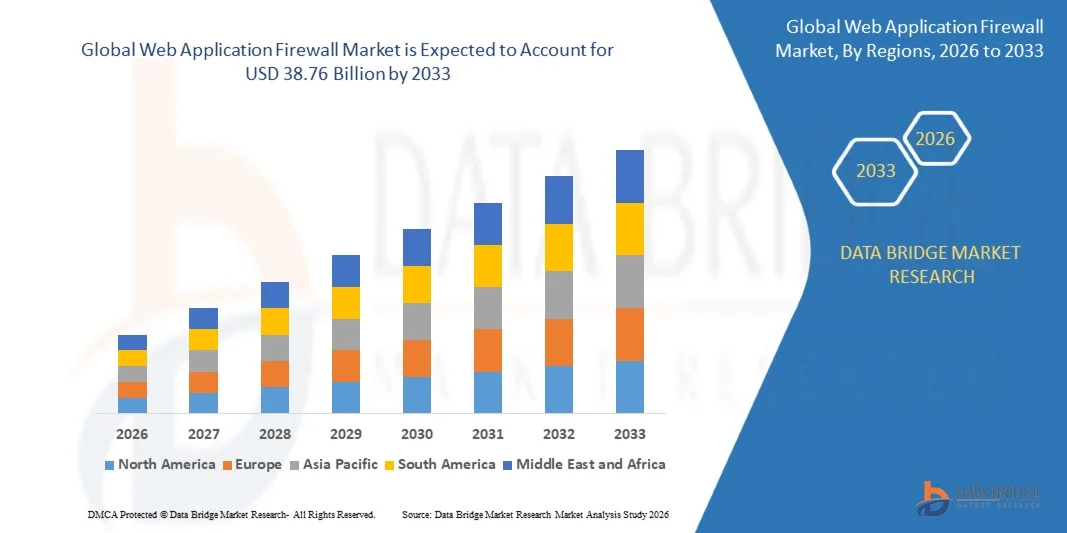
- The global web application firewall market size was valued at USD 9.77 billion in 2025 and is expected to reach USD 38.76 billion by 2033, at a CAGR of 18.8% during the forecast period
- The Web Application Firewall market growth is largely fueled by the rising frequency and sophistication of cyberattacks targeting web applications, APIs, and cloud-based services, leading to increased demand for advanced application-layer security solutions across enterprises
- Furthermore, the rapid adoption of cloud computing, digital transformation initiatives, and remote work environments is accelerating the need for continuous web traffic monitoring and real-time threat prevention, significantly boosting WAF deployment across industries
Web Application Firewall Market Analysis
- Web Application Firewalls are cybersecurity solutions designed to monitor, filter, and block HTTP/HTTPS traffic between web applications and the internet, protecting organizations from threats such as SQL injection, cross-site scripting, and DDoS attacks. These solutions are widely deployed across cloud, on-premises, and hybrid environments to secure critical digital assets and ensure business continuity
- The increasing adoption of Web Application Firewalls is primarily driven by the expansion of digital services, growing reliance on cloud-based applications, and rising regulatory compliance requirements for data protection and cybersecurity across sectors such as BFSI, healthcare, and IT and telecommunications
- North America dominated the web application firewall market with a share of 39.23% in 2025, due to the rising frequency of cyberattacks and strong adoption of advanced cybersecurity solutions across enterprises
- Asia-Pacific is expected to be the fastest growing region in the web application firewall market during the forecast period due to rapid digitalization, rising internet penetration, and increasing cyber threats across emerging economies
- Solutions segment dominated the market with a market share of 71.79% in 2025, due to the growing need for real-time threat detection and protection against sophisticated web-based attacks such as SQL injection and cross-site scripting. Organizations are increasingly investing in robust WAF solutions to safeguard critical applications, driven by rising cyber threats and stringent regulatory compliance requirements
Report Scope and Web Application Firewall Market Segmentation
|
Attributes |
Web Application Firewall Key Market Insights |
|
Segments Covered |
|
|
Countries Covered |
North America
Europe
Asia-Pacific
Middle East and Africa
South America
|
|
Key Market Players |
|
|
Market Opportunities |
|
|
Value Added Data Infosets |
In addition to the market insights such as market value, growth rate, market segments, geographical coverage, market players, and market scenario, the market report curated by the Data Bridge Market Research team includes in-depth expert analysis, import/export analysis, pricing analysis, production consumption analysis, and pestle analysis. |
Web Application Firewall Market Trends
“Rising Adoption of Cloud-Based and AI-Driven WAF Solutions”
- A significant trend in the Web Application Firewall market is the increasing shift toward cloud-based deployment models and AI-driven threat detection systems, driven by the need for real-time protection against evolving application-layer attacks across distributed digital infrastructures. This shift is strengthening the role of WAF solutions in securing APIs, cloud workloads, and hybrid environments where traditional perimeter security is no longer sufficient
- For instance, Cloudflare and Akamai Technologies Inc. provide cloud-native WAF platforms that leverage machine learning and behavioral analytics to detect and mitigate automated attacks such as credential stuffing and bot-driven traffic. These solutions enhance response speed and reduce dependency on manual rule configuration while improving accuracy in threat identification
- The adoption of AI-enabled WAF capabilities is expanding rapidly as enterprises seek adaptive security systems capable of learning from traffic patterns and evolving attack behaviors. This is particularly important for organizations operating high-volume digital platforms such as e-commerce and fintech, where downtime or breaches can result in significant financial losses
- The growing integration of WAF solutions with DevSecOps pipelines is enabling continuous security testing during application development and deployment cycles. This ensures vulnerabilities are identified earlier in the software lifecycle, reducing exposure risks in production environments
- Industries are increasingly prioritizing scalable and automated security frameworks that can dynamically adjust to traffic fluctuations without compromising performance. This is reinforcing demand for intelligent WAF systems that combine cloud scalability with advanced analytics and automation capabilities
Web Application Firewall Market Dynamics
Driver
“Increasing Cybersecurity Threats Targeting Web Applications and APIs”
- The Web Application Firewall market is primarily driven by the rising frequency and sophistication of cyberattacks targeting web applications, APIs, and cloud-native services, leading to increased demand for robust application-layer protection across enterprises. The expansion of digital ecosystems and increased reliance on online platforms are significantly amplifying the attack surface for organizations
- For instance, Imperva and F5 Networks Inc. have reported growing demand for WAF solutions due to rising incidents of SQL injection, cross-site scripting, and API abuse attacks across financial services and e-commerce platforms. These attacks are forcing enterprises to deploy advanced WAF systems to ensure data protection and uninterrupted service delivery
- The rapid expansion of API-driven architectures in modern applications is increasing vulnerabilities that cybercriminals exploit for unauthorized access and data breaches. This is driving organizations to adopt WAF solutions capable of deep packet inspection and API-specific security enforcement
- The surge in ransomware and automated bot attacks is further intensifying the need for real-time traffic filtering and behavioral anomaly detection. Enterprises are increasingly relying on WAF solutions integrated with threat intelligence platforms to proactively block malicious activity
- The growing regulatory pressure around data protection and cybersecurity compliance is compelling organizations to strengthen their application security posture. This is reinforcing WAF adoption as a critical component of enterprise cybersecurity frameworks across regulated industries such as BFSI and healthcare
Restraint/Challenge
“Complexity in Managing False Positives and Security Rule Configurations”
- A major challenge in the Web Application Firewall market is the complexity involved in managing false positives and configuring security rules accurately, which can lead to disruption of legitimate user traffic if not properly tuned. This issue increases operational burden for security teams and impacts application performance when improperly configured policies block valid requests
- For instance, Fortinet and Radware Ltd. solutions often require continuous tuning and customization to balance security enforcement with user experience across diverse application environments. Without proper configuration, organizations risk blocking genuine customer transactions or allowing malicious traffic to pass through
- The dynamic nature of modern web applications makes it difficult to maintain static rule sets that effectively address evolving threat patterns. This requires constant updates and skilled cybersecurity professionals to manage WAF policies effectively
- High dependency on manual rule optimization increases operational complexity and raises the risk of misconfiguration in large-scale enterprise environments. This can result in inefficiencies and increased workload for security operations teams
- Organizations operating multi-cloud and hybrid infrastructures face additional challenges in maintaining consistent WAF policies across different environments. This complexity continues to limit seamless deployment and increases the total cost of managing Web Application Firewall solutions
Web Application Firewall Market Scope
The market is segmented on the basis of component, solution, service, professional service, organization size, and industry vertical.
• By Component
On the basis of component, the Web Application Firewall market is segmented into solutions and services. The solutions segment dominated the largest market revenue share of 71.79% in 2025, driven by the growing need for real-time threat detection and protection against sophisticated web-based attacks such as SQL injection and cross-site scripting. Organizations are increasingly investing in robust WAF solutions to safeguard critical applications, driven by rising cyber threats and stringent regulatory compliance requirements. The scalability and deployment flexibility of solution offerings, including on-premise and cloud-based models, further strengthen their adoption across enterprises.
The services segment is anticipated to witness the fastest growth rate from 2026 to 2033, fueled by the increasing complexity of cybersecurity environments and the need for specialized expertise. Enterprises are relying on service providers for efficient deployment, monitoring, and management of WAF systems to ensure optimal performance and continuous protection. The growing trend of outsourcing security operations and the shortage of in-house cybersecurity professionals are further accelerating the demand for WAF-related services.
• By Solution
On the basis of solution, the Web Application Firewall market is segmented into hardware appliances, virtual appliances, and cloud-based. The cloud-based segment dominated the largest market revenue share in 2025, driven by the rapid adoption of cloud computing and the need for scalable, cost-effective security solutions. Cloud-based WAFs offer seamless updates, centralized management, and ease of deployment, making them highly suitable for organizations with distributed digital infrastructures. Their ability to provide real-time threat intelligence and integrate with cloud-native applications further enhances their demand.
The virtual appliances segment is expected to witness the fastest growth rate from 2026 to 2033, fueled by the increasing adoption of virtualization technologies and hybrid IT environments. Virtual WAFs provide flexibility in deployment across private and public clouds, enabling organizations to maintain consistent security policies. Their cost efficiency and ability to adapt to dynamic workloads make them an attractive choice for enterprises undergoing digital transformation.
• By Service
On the basis of service, the Web Application Firewall market is segmented into professional services and managed services. The managed services segment dominated the largest market revenue share in 2025, driven by the increasing preference for outsourced security management and continuous threat monitoring. Organizations are leveraging managed WAF services to reduce operational burden while ensuring 24/7 protection against evolving cyber threats. The ability of managed service providers to deliver expertise, real-time analytics, and rapid incident response significantly contributes to their widespread adoption.
The professional services segment is anticipated to witness the fastest growth rate from 2026 to 2033, fueled by the growing need for customized implementation and optimization of WAF solutions. Enterprises require consulting, integration, and training services to effectively deploy and manage WAF systems in complex IT environments. The increasing demand for tailored security strategies and compliance support is further driving the expansion of professional services.
• By Professional Service
On the basis of professional service, the Web Application Firewall market is segmented into consulting, support and maintenance, training and education, and system integration. The support and maintenance segment dominated the largest market revenue share in 2025, driven by the continuous need to ensure optimal performance and timely updates of WAF systems. Organizations prioritize ongoing support services to address vulnerabilities, maintain compliance, and adapt to emerging threat landscapes. The critical role of regular monitoring and system upgrades further strengthens the demand for this segment.
The system integration segment is expected to witness the fastest growth rate from 2026 to 2033, fueled by the increasing complexity of IT infrastructures and the need to integrate WAF solutions with existing security frameworks. Enterprises are focusing on seamless integration with SIEM, IAM, and other cybersecurity tools to enhance overall protection. The rise of multi-cloud and hybrid environments further accelerates the need for efficient system integration services.
• By Organization Size
On the basis of organization size, the Web Application Firewall market is segmented into small and medium-sized enterprises and large enterprises. The large enterprises segment dominated the largest market revenue share in 2025, driven by their extensive digital assets and higher exposure to cyber threats. These organizations invest significantly in advanced security solutions to protect sensitive data and maintain regulatory compliance. The presence of dedicated IT security teams and higher budgets further supports the adoption of comprehensive WAF solutions.
The small and medium-sized enterprises segment is anticipated to witness the fastest growth rate from 2026 to 2033, fueled by the increasing awareness of cybersecurity risks and the growing adoption of digital platforms. SMEs are increasingly deploying cost-effective and cloud-based WAF solutions to secure their web applications. The availability of scalable security offerings and managed services is making WAF solutions more accessible to smaller organizations.
• By Industry Vertical
On the basis of industry vertical, the Web Application Firewall market is segmented into banking, financial services and insurance, retail, IT and telecommunications, government and defense, healthcare, energy and utilities, education, and others. The banking, financial services and insurance segment dominated the largest market revenue share in 2025, driven by the high volume of sensitive financial transactions and stringent regulatory requirements. Financial institutions prioritize WAF deployment to prevent data breaches, fraud, and unauthorized access, ensuring secure digital banking experiences. The increasing adoption of online banking and fintech services further strengthens the demand in this segment.
The healthcare segment is expected to witness the fastest growth rate from 2026 to 2033, fueled by the rapid digitalization of healthcare systems and the increasing volume of sensitive patient data. Healthcare organizations are investing in WAF solutions to protect electronic health records and ensure compliance with data protection regulations. The rise in cyberattacks targeting healthcare infrastructure and the expansion of telehealth services are further driving the growth of this segment.
Web Application Firewall Market Regional Analysis
- North America dominated the web application firewall market with the largest revenue share of 39.23% in 2025, driven by the rising frequency of cyberattacks and strong adoption of advanced cybersecurity solutions across enterprises
- Organizations in the region prioritize application security due to increasing reliance on cloud platforms, digital services, and regulatory compliance requirements across industries such as BFSI and healthcare
- This widespread adoption is further supported by the presence of leading cybersecurity vendors, high IT spending, and early adoption of advanced technologies, establishing WAF solutions as a critical component of enterprise security strategies
U.S. Web Application Firewall Market Insight
The U.S. Web Application Firewall market captured the largest revenue share in North America in 2025, driven by rapid digital transformation and the increasing sophistication of cyber threats targeting enterprise applications. Organizations are deploying WAF solutions to secure web portals, APIs, and cloud-native applications against breaches and service disruptions. The market is further strengthened by strong adoption of zero-trust architectures, high cloud penetration, and the presence of major cybersecurity and cloud service providers accelerating advanced WAF deployment across industries.
Europe Web Application Firewall Market Insight
The Europe Web Application Firewall market is projected to expand at a substantial CAGR during the forecast period, driven by strict data protection regulations and rising cybersecurity awareness among enterprises. Organizations across the region are increasingly adopting WAF solutions to ensure compliance and safeguard sensitive customer and business data from evolving web-based threats. The growing adoption of cloud services, e-commerce platforms, and digital banking solutions is further accelerating demand for advanced application security across multiple industry verticals.
U.K. Web Application Firewall Market Insight
The U.K. Web Application Firewall market is anticipated to grow at a noteworthy CAGR during the forecast period, driven by accelerating digital transformation and rising concerns regarding data privacy and cyberattacks. Businesses are increasingly deploying WAF solutions to protect online applications, particularly in financial services, retail, and government sectors. The strong fintech ecosystem, expanding cloud adoption, and growing reliance on digital services are further supporting sustained market growth in the U.K.
Germany Web Application Firewall Market Insight
The Germany Web Application Firewall market is expected to expand at a considerable CAGR during the forecast period, driven by increasing focus on cybersecurity resilience and stringent data protection standards. Enterprises are prioritizing WAF deployment to secure web applications and maintain compliance within highly regulated industries. The country’s strong industrial digitalization trend, advanced IT infrastructure, and emphasis on secure enterprise networks are further driving adoption across manufacturing and enterprise environments.
Asia-Pacific Web Application Firewall Market Insight
The Asia-Pacific Web Application Firewall market is poised to grow at the fastest CAGR from 2026 to 2033, driven by rapid digitalization, rising internet penetration, and increasing cyber threats across emerging economies. The region’s strong expansion of cloud computing, e-commerce platforms, and mobile-first applications is significantly boosting demand for WAF solutions. Government-led cybersecurity initiatives, along with rising enterprise investments in digital security infrastructure, are further accelerating market growth across Asia-Pacific.
Japan Web Application Firewall Market Insight
The Japan Web Application Firewall market is gaining momentum due to advanced digital infrastructure and a strong focus on cybersecurity resilience across enterprises. Organizations are increasingly adopting WAF solutions to protect critical applications and ensure uninterrupted business operations against evolving cyber threats. Integration of WAF systems with AI-based threat detection and cloud security platforms is further enhancing adoption across both enterprise and government sectors in Japan.
China Web Application Firewall Market Insight
The China Web Application Firewall market accounted for the largest revenue share in Asia Pacific in 2025, driven by rapid digital transformation, widespread cloud adoption, and strong growth in e-commerce and online services. Enterprises are increasingly investing in WAF solutions to protect applications from sophisticated cyberattacks and comply with evolving cybersecurity regulations. The presence of strong domestic technology providers and large-scale digital infrastructure development continues to accelerate market expansion in China.
Web Application Firewall Market Share
The web application firewall industry is primarily led by well-established companies, including:
- Akamai Technologies Inc. (U.S.)
- Citrix Systems Inc. (U.S.)
- F5 Networks Inc. (U.S.)
- Imperva Inc. (U.S.)
- Fortinet Inc. (U.S.)
- Applicure Technologies Ltd. (Israel)
- Qualys Inc. (U.S.)
- Cloudflare Inc. (U.S.)
- Radware Ltd. (Israel)
- NSFOCUS (China)
- Penta Security (South Korea)
- Sophos (U.K.)
- Wallarm (U.S.)
Latest Developments in Global Web Application Firewall Market
- In March 2026, Fastly enhanced its Next-Gen WAF platform with AI-driven behavioral anomaly detection to improve automated threat identification and response accuracy. This advancement strengthens protection against sophisticated application-layer attacks by analyzing user behavior patterns in real time and identifying deviations more effectively. Enterprises benefit from reduced incident response time and improved accuracy in blocking advanced persistent threats. The development further accelerates the adoption of intelligent, adaptive Web Application Firewall solutions across digital-first organizations
- In February 2026, Cloudflare introduced adaptive rate-limiting that dynamically adjusts thresholds based on live traffic behavior, improving detection accuracy while reducing false positives by around 30%. This development significantly enhances the efficiency of Web Application Firewall operations by enabling more precise differentiation between legitimate traffic spikes and malicious bot activity. As a result, enterprises benefit from stronger protection against credential stuffing and automated attacks without disrupting user experience. The advancement also strengthens market demand for AI-driven and self-optimizing WAF solutions that reduce manual tuning efforts for security teams
- In January 2026, the U.S. Department of Health and Human Services issued updated cybersecurity guidance mandating virtual patching, SIEM integration, and a minimum 90-day log retention under HIPAA. This regulatory push is increasing reliance on Web Application Firewalls in the healthcare sector as organizations are required to implement continuous monitoring and rapid vulnerability mitigation. WAF solutions are becoming essential for maintaining compliance while securing sensitive patient data from rising ransomware and application-layer attacks. The guidance is further driving adoption of integrated security architectures combining WAF, SIEM, and endpoint monitoring tools
- In December 2025, Palo Alto Networks expanded its partnership with Google Cloud by integrating Prisma Cloud with Cloud Armor to enable unified multi-cloud security policy enforcement. This integration strengthens Web Application Firewall capabilities by improving centralized visibility and consistent policy management across hybrid and multi-cloud environments. Enterprises are increasingly adopting such integrated solutions to reduce configuration gaps and improve threat response efficiency. The development also supports growing demand for platform-based cybersecurity ecosystems rather than standalone WAF deployments
- In December 2024, Akamai completed its acquisition of Noname Security for USD 450 million, expanding its API discovery and protection capabilities. This acquisition enhances Akamai’s Web Application Firewall portfolio by addressing the rapidly growing attack surface created by API-driven applications. It enables improved detection of API abuse, shadow APIs, and data exposure risks, which are becoming major security concerns for enterprises. The move also reinforces the strategic shift toward converged WAF and API security solutions within the broader application security market
SKU-
Get online access to the report on the World's First Market Intelligence Cloud

- Interactive Data Analysis Dashboard
- Company Analysis Dashboard for high growth potential opportunities
- Research Analyst Access for customization & queries
- Competitor Analysis with Interactive dashboard
- Latest News, Updates & Trend analysis
- Harness the Power of Benchmark Analysis for Comprehensive Competitor Tracking
Research Methodology
Data collection and base year analysis are done using data collection modules with large sample sizes. The stage includes obtaining market information or related data through various sources and strategies. It includes examining and planning all the data acquired from the past in advance. It likewise envelops the examination of information inconsistencies seen across different information sources. The market data is analysed and estimated using market statistical and coherent models. Also, market share analysis and key trend analysis are the major success factors in the market report. To know more, please request an analyst call or drop down your inquiry.
The key research methodology used by DBMR research team is data triangulation which involves data mining, analysis of the impact of data variables on the market and primary (industry expert) validation. Data models include Vendor Positioning Grid, Market Time Line Analysis, Market Overview and Guide, Company Positioning Grid, Patent Analysis, Pricing Analysis, Company Market Share Analysis, Standards of Measurement, Global versus Regional and Vendor Share Analysis. To know more about the research methodology, drop in an inquiry to speak to our industry experts.
Customization Available
Data Bridge Market Research is a leader in advanced formative research. We take pride in servicing our existing and new customers with data and analysis that match and suits their goal. The report can be customized to include price trend analysis of target brands understanding the market for additional countries (ask for the list of countries), clinical trial results data, literature review, refurbished market and product base analysis. Market analysis of target competitors can be analyzed from technology-based analysis to market portfolio strategies. We can add as many competitors that you require data about in the format and data style you are looking for. Our team of analysts can also provide you data in crude raw excel files pivot tables (Fact book) or can assist you in creating presentations from the data sets available in the report.












