


Global Wireless Charging Market
Market Size in USD Billion
CAGR :
% 
 USD
5.72 Billion
USD
10.54 Billion
2025
2033
USD
5.72 Billion
USD
10.54 Billion
2025
2033
 Forecast Period Forecast Period |
2026 –2033 |
 Market Size (Base Year) Market Size (Base Year) |
USD 5.72 Billion |
 Market Size (Forecast Year) Market Size (Forecast Year) |
USD 10.54 Billion |
 CAGR CAGR |
% |
| Major Markets Players |
|
What is the Global Wireless Charging Market Size and Growth Rate?
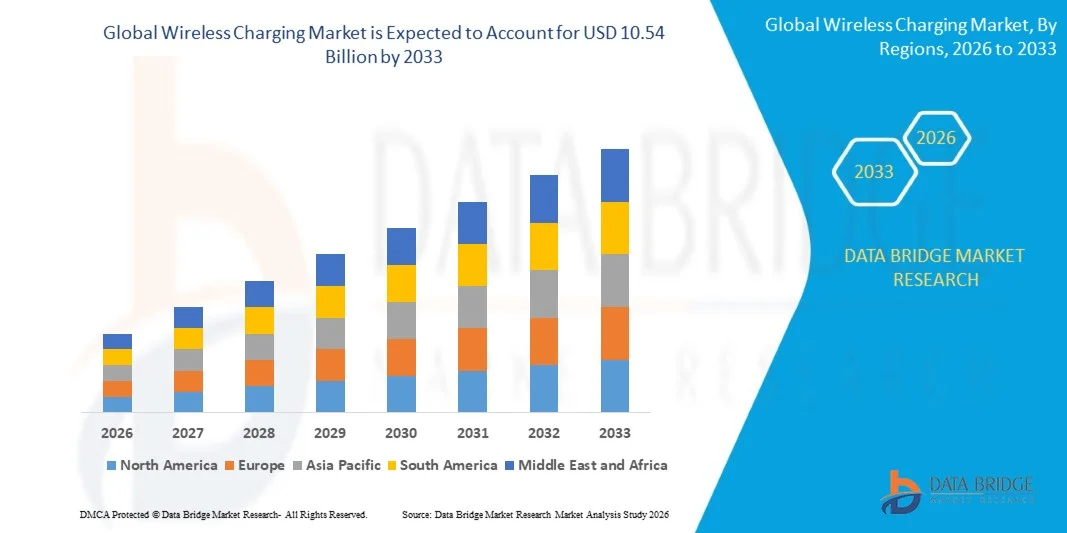
- The global wireless charging market size was valued at USD 5.72 billion in 2025 and is expected to reach USD 10.54 billion by 2033, at a CAGR of 22.6% during the forecast period
- Major factors that are expected to boost the growth of the wireless charging market in the forecast period are the rise in the adoption of wireless technology in consumer electronic devices. Furthermore, the growing sales of electric vehicles is further anticipated to propel the growth of the wireless charging market
What are the Major Takeaways of Wireless Charging Market?
- The instantaneous charging of multiple devices is further estimated to cushion the growth of the wireless charging market. On the other hand, the concern regarding compatibility is further projected to impede the growth of the wireless charging market in the timeline period
- In addition, the growing use of wireless technology to charge warehouse trucks will further provide potential opportunities for the growth of the wireless charging market in the coming years
- Europe dominated the wireless charging market with a 39.8% revenue share in 2025, driven by strong adoption of smart consumer electronics, electric vehicles, advanced automotive infotainment systems, and increasing investments in wireless power technologies across countries such as Germany, the U.K., France, and Italy
- Asia-Pacific is projected to register the fastest CAGR of 11.2% from 2026 to 2033, driven by rapid expansion of consumer electronics manufacturing, smartphone penetration, electric vehicle adoption, and smart device ecosystems across China, Japan, India, South Korea, and Southeast Asia
- The Inductive segment dominated the market with a 48.6% share in 2025, as it remains the most widely adopted wireless charging technology across smartphones, smartwatches, earbuds, and other portable consumer electronics
Report Scope and Wireless Charging Market Segmentation
|
Attributes |
Wireless Charging Key Market Insights |
|
Segments Covered |
|
|
Countries Covered |
North America
Europe
Asia-Pacific
Middle East and Africa
South America
|
|
Key Market Players |
|
|
Market Opportunities |
|
|
Value Added Data Infosets |
In addition to the insights on market scenarios such as market value, growth rate, segmentation, geographical coverage, and major players, the market reports curated by the Data Bridge Market Research also include in-depth expert analysis, pricing analysis, brand share analysis, consumer survey, demography analysis, supply chain analysis, value chain analysis, raw material/consumables overview, vendor selection criteria, PESTLE Analysis, Porter Analysis, and regulatory framework. |
What is the Key Trend in the Wireless Charging Market?
“Increasing Shift Toward Fast-Charging, Multi-Device, and Long-Distance Wireless Charging Solutions”
- The Wireless Charging market is witnessing strong adoption of fast-charging technologies, compact charging pads, and multi-device charging stations designed for smartphones, wearables, earbuds, electric vehicles, and industrial electronics
- Manufacturers are introducing high-efficiency resonant and inductive charging systems that offer better power transfer, reduced heat generation, and compatibility with evolving device ecosystems
- Growing demand for cable-free convenience, sleek device designs, and clutter-free charging environments is driving adoption across consumer electronics, automotive interiors, healthcare devices, and smart furniture
- For instance, companies such as Qualcomm, Samsung, Sony, and WiTricity are upgrading wireless charging solutions with higher wattage support, improved alignment technologies, and multi-coil charging platforms
- Increasing need for rapid charging, seamless mobility, and interoperability across multiple devices is accelerating the shift toward next-generation wireless charging systems
- As smart devices become more integrated into daily life, Wireless Charging solutions will remain essential for convenience, device safety, and future-ready power ecosystems
What are the Key Drivers of Wireless Charging Market?
- Rising demand for convenient, cable-free, and fast charging solutions across smartphones, smartwatches, earbuds, and portable consumer electronics is driving market expansion
- For instance, in 2025, leading companies such as Samsung, Qualcomm, and Anker upgraded their wireless charging portfolios to support higher charging speeds, multi-device compatibility, and advanced thermal management
- Growing adoption of electric vehicles, smart home devices, medical wearables, and IoT-enabled electronics is boosting demand for wireless power transfer technologies across the U.S., Europe, and Asia-Pacific
- Advancements in magnetic resonance, inductive coupling, and power management ICs have significantly improved charging efficiency and device compatibility
- Rising use of premium smartphones, autonomous devices, and wireless EV charging infrastructure is creating strong demand for high-performance charging systems
- Supported by steady investments in consumer electronics innovation, automotive electrification, and smart infrastructure, the Wireless Charging market is expected to witness strong long-term growth
Which Factor is Challenging the Growth of the Wireless Charging Market?
- High costs associated with advanced fast-charging systems, EV wireless charging platforms, and premium charging accessories restrict adoption among price-sensitive consumers and SMEs
- For instance, during 2024–2025, fluctuations in semiconductor prices, magnetic component costs, and supply chain disruptions increased manufacturing expenses for several global vendors
- Complexity in maintaining efficient power transfer, heat control, and charging stability across different devices and distances increases technological challenges
- Limited awareness in emerging markets regarding charging standards, device compatibility, and safety certifications slows adoption
- Competition from ultra-fast wired charging technologies, high-capacity batteries, and conventional charging accessories creates pricing pressure and reduces product differentiation
- To address these issues, companies are focusing on cost-optimized designs, universal standards, thermal optimization, and higher charging efficiency to increase global adoption of wireless charging solutions
How is the Wireless Charging Market Segmented?
The market is segmented on the basis of technology, transmission range, and application.
• By Technology
On the basis of technology, the wireless charging market is segmented into Magnetic Resonance, Inductive, and Radio Frequency Technologies. The Inductive segment dominated the market with a 48.6% share in 2025, as it remains the most widely adopted wireless charging technology across smartphones, smartwatches, earbuds, and other portable consumer electronics. Inductive charging offers high efficiency, strong safety standards, easy integration, and compatibility with established charging ecosystems such as Qi-enabled devices, which has driven large-scale adoption across both premium and mid-range devices. Its reliability and cost-effectiveness make it the preferred choice for OEMs and charging accessory manufacturers.
The Magnetic Resonance segment is expected to grow at the fastest CAGR from 2026 to 2033, driven by increasing demand for greater spatial freedom, simultaneous multi-device charging, and improved charging convenience. Rising deployment in automotive wireless charging pads, smart furniture, and industrial charging applications is further accelerating segment growth.
• By Transmission Range
On the basis of transmission range, the market is segmented into Short Range, Medium Range, and Long Range. The Short Range segment dominated the market with a 52.3% share in 2025, supported by its extensive use in consumer electronics, wearable devices, wireless earbuds, and charging docks. Short-range charging solutions offer higher power transfer efficiency, faster charging speeds, lower energy loss, and strong compatibility with existing infrastructure, making them highly suitable for daily-use electronics and commercial charging stations. Increasing penetration of smartphones and connected devices continues to strengthen this segment’s leadership.
The Long Range segment is projected to grow at the fastest CAGR from 2026 to 2033, driven by rapid advancements in radio frequency and over-the-air charging technologies. Growing interest in contactless charging for IoT sensors, medical implants, industrial automation systems, and smart home devices is expected to drive strong demand. Continuous innovation in power transfer distance and efficiency is further supporting long-term expansion.
• By Application
On the basis of application, the wireless charging market is segmented into Consumer Electronics, Defense, Healthcare, Automotive, Industrial, and Others. The Consumer Electronics segment dominated the market with a 44.8% share in 2025, driven by the widespread use of wireless charging in smartphones, tablets, smartwatches, earbuds, and portable gaming devices. Rising consumer preference for convenience, cable-free charging experiences, and premium device aesthetics has significantly increased adoption. Major device manufacturers continue to integrate wireless charging as a standard feature, further strengthening this segment.
The Automotive segment is expected to grow at the fastest CAGR from 2026 to 2033, propelled by rising adoption of wireless charging pads in vehicles, electric vehicle charging infrastructure, and smart cabin technologies. Increasing demand for EV wireless charging systems, autonomous vehicles, and in-car connected devices is accelerating market expansion across global automotive markets.
Which Region Holds the Largest Share of the Wireless Charging Market?
- Europe dominated the wireless charging market with a 39.8% revenue share in 2025, driven by strong adoption of smart consumer electronics, electric vehicles, advanced automotive infotainment systems, and increasing investments in wireless power technologies across countries such as Germany, the U.K., France, and Italy. High penetration of premium smartphones, wearable devices, EV charging infrastructure, and smart home solutions continues to fuel demand for wireless charging systems across residential, automotive, and commercial applications
- Leading companies in Europe are introducing high-efficiency charging pads, in-vehicle wireless charging systems, and next-generation resonant charging technologies, strengthening the region’s technological leadership. Continuous investment in electric mobility, Industry 4.0 infrastructure, and connected consumer ecosystems supports long-term market growth
- Strong automotive manufacturing capabilities, rising sustainability initiatives, and robust R&D activities further reinforce Europe’s leadership in the global wireless charging market
Germany Wireless Charging Market Insight
Germany is the largest contributor in Europe, supported by its strong automotive manufacturing base, growing EV ecosystem, and advanced consumer electronics market. Increasing integration of wireless charging modules in premium vehicles, autonomous driving platforms, and smart cockpit systems is significantly driving market demand. Strong presence of automotive OEMs, industrial automation leaders, and electronics innovation hubs further accelerates adoption across the country.
U.K. Wireless Charging Market Insight
The U.K. contributes significantly to regional growth, driven by rising adoption of smartphones, wearable electronics, healthcare devices, and wireless charging-enabled public infrastructure. Growing investments in smart city projects, electric mobility, and advanced consumer electronics distribution networks continue to strengthen market penetration. Innovation-led startups and retail electronics demand further support long-term growth.
France Wireless Charging Market Insight
France shows steady growth supported by increasing use of wireless charging solutions in automotive, healthcare, and smart home applications. Rising consumer preference for premium mobile devices, connected appliances, and cable-free charging experiences is boosting demand. Government initiatives supporting sustainable transport and EV infrastructure further contribute to market expansion.
Asia-Pacific Wireless Charging Market
Asia-Pacific is projected to register the fastest CAGR of 11.2% from 2026 to 2033, driven by rapid expansion of consumer electronics manufacturing, smartphone penetration, electric vehicle adoption, and smart device ecosystems across China, Japan, India, South Korea, and Southeast Asia. High-volume production of smartphones, wearables, tablets, and EV components significantly increases demand for advanced wireless charging technologies. Growth in IoT devices, smart appliances, and automotive electrification continues to accelerate regional market expansion.
China Wireless Charging Market Insight
China is the largest contributor to Asia-Pacific due to its massive consumer electronics manufacturing capacity, strong EV production ecosystem, and cost-competitive component supply chains. Rising development of smartphones, wireless earbuds, connected home devices, and electric vehicles is driving strong demand for wireless charging modules. Local manufacturing scale and export capabilities further strengthen market leadership.
Japan Wireless Charging Market Insight
Japan shows stable growth supported by advanced consumer electronics innovation, automotive technology leadership, and strong demand for premium smart devices. Increasing adoption of wireless charging in healthcare devices, robotics, and automotive cabins supports long-term market growth.
India Wireless Charging Market Insight
India is emerging as a major growth hub, driven by rapid smartphone adoption, growing wearable device sales, and expanding domestic electronics manufacturing initiatives. Rising demand for wireless charging accessories, EV infrastructure, and smart home electronics is accelerating market penetration.
South Korea Wireless Charging Market Insight
South Korea contributes significantly due to strong demand for premium smartphones, consumer electronics, EV systems, and connected devices. Rapid innovation in battery technology, smart devices, and automotive electronics continues to support sustained growth in wireless charging adoption.
Which are the Top Companies in Wireless Charging Market?
The wireless charging industry is primarily led by well-established companies, including:
- Qualcomm Technologies, Inc. (U.S.)
- Leggett & Platt, Inc. (U.S.)
- Murata Manufacturing Co., Ltd. (Japan)
- Powermat (Israel)
- Fulton Innovation LLC (U.S.)
- Texas Instruments Incorporated (U.S.)
- WiTricity Corporation (U.S.)
- Renesas Electronics Corporation (Japan)
- Murata Manufacturing Co., Ltd. (Japan)
- ConvenientPower HK Limited (Hong Kong)
- Energizer Holdings, Inc. (U.S.)
- ExploraStore, LLC. (U.S.)
- Anker Technology (UK) Ltd (U.K.)
- SAMSUNG (South Korea)
- Sony Corporation (Japan)
- Mojo Mobility, Inc. (U.S.)
- GETPOWERPAD (U.S.)
What are the Recent Developments in Global Wireless Charging Market?
- In May 2024, Purdue University engineers in collaboration with the Indiana Department of Transportation (INDOT) advanced the development of wireless charging infrastructure for electric vehicles, ranging from passenger cars to heavy-duty tractor-trailers, through the construction of a quarter-mile test track on U.S. Highway 231. This initiative highlights the growing focus on dynamic in-motion charging technologies and is expected to significantly support the future expansion of highway-based EV charging infrastructure
- In May 2024, WiTricity, a leading provider of wireless EV charging solutions, partnered with International Transportation Service LLC (ITS) to launch an innovative six-month pilot program at the Port of Long Beach. The program is designed to evaluate the performance, efficiency, and commercial viability of WiTricity’s patented wireless charging technology in real-world port logistics operations, thereby strengthening the market potential for industrial EV charging applications
- In November 2023, Electreon, a global pioneer in wireless electric vehicle charging, entered into a strategic partnership with BDX Företagen AB, a major Sweden-based road and freight distribution company, to deploy a next-generation wireless charging project for commercial transport vehicles. This development is expected to accelerate adoption of wireless charging solutions in last-mile freight and commercial mobility applications
- In November 2023, Electreon also announced a breakthrough collaboration to deliver an advanced wireless charging initiative for Ahlsell AB through BDX Företagen AB in Sweden. This project further reinforces the growing demand for sustainable and automated charging systems in the logistics and transportation sector
- In April 2023, Genesis, a leading luxury automotive manufacturer, initiated trials of its new wireless charging technology in South Korea, including successful testing with the GV60 and Electrified GV70 models. This trial reflects rising integration of wireless charging capabilities in premium electric vehicles and is such asly to support broader OEM adoption
- In March 2023, LG Corporation signed an agreement to divest its automotive charging business to printed circuit board manufacturer BH, enabling BH to strengthen its role as a tier-1 supplier to global original equipment manufacturers. This strategic move is expected to enhance supply chain efficiency and boost wireless charging innovation in the automotive sector
- In August 2023, Siemens AG partnered with MAHLE to jointly develop and commercialize wireless inductive charging stations for autonomous and electric vehicles. This collaboration is anticipated to strengthen smart mobility infrastructure and accelerate next-generation EV charging deployment globally
SKU-
Get online access to the report on the World's First Market Intelligence Cloud

- Interactive Data Analysis Dashboard
- Company Analysis Dashboard for high growth potential opportunities
- Research Analyst Access for customization & queries
- Competitor Analysis with Interactive dashboard
- Latest News, Updates & Trend analysis
- Harness the Power of Benchmark Analysis for Comprehensive Competitor Tracking
Global Wireless Charging Market, Supply Chain Analysis and Ecosystem Framework
To support market growth and help clients navigate the impact of geopolitical shifts, DBMR has integrated in-depth supply chain analysis into its Global Wireless Charging Market research reports. This addition empowers clients to respond effectively to global changes affecting their industries. The supply chain analysis section includes detailed insights such as Global Wireless Charging Market consumption and production by country, price trend analysis, the impact of tariffs and geopolitical developments, and import and export trends by country and HSN code. It also highlights major suppliers with data on production capacity and company profiles, as well as key importers and exporters. In addition to research, DBMR offers specialized supply chain consulting services backed by over a decade of experience, providing solutions like supplier discovery, supplier risk assessment, price trend analysis, impact evaluation of inflation and trade route changes, and comprehensive market trend analysis.
Research Methodology
Data collection and base year analysis are done using data collection modules with large sample sizes. The stage includes obtaining market information or related data through various sources and strategies. It includes examining and planning all the data acquired from the past in advance. It likewise envelops the examination of information inconsistencies seen across different information sources. The market data is analysed and estimated using market statistical and coherent models. Also, market share analysis and key trend analysis are the major success factors in the market report. To know more, please request an analyst call or drop down your inquiry.
The key research methodology used by DBMR research team is data triangulation which involves data mining, analysis of the impact of data variables on the market and primary (industry expert) validation. Data models include Vendor Positioning Grid, Market Time Line Analysis, Market Overview and Guide, Company Positioning Grid, Patent Analysis, Pricing Analysis, Company Market Share Analysis, Standards of Measurement, Global versus Regional and Vendor Share Analysis. To know more about the research methodology, drop in an inquiry to speak to our industry experts.
Customization Available
Data Bridge Market Research is a leader in advanced formative research. We take pride in servicing our existing and new customers with data and analysis that match and suits their goal. The report can be customized to include price trend analysis of target brands understanding the market for additional countries (ask for the list of countries), clinical trial results data, literature review, refurbished market and product base analysis. Market analysis of target competitors can be analyzed from technology-based analysis to market portfolio strategies. We can add as many competitors that you require data about in the format and data style you are looking for. Our team of analysts can also provide you data in crude raw excel files pivot tables (Fact book) or can assist you in creating presentations from the data sets available in the report.












