


Global Wireless Display Market
Market Size in USD Billion
CAGR :
% 
 USD
6,272.57 Billion
USD
35,151.20 Billion
2025
2033
USD
6,272.57 Billion
USD
35,151.20 Billion
2025
2033
 Forecast Period Forecast Period |
2026 –2033 |
 Market Size (Base Year) Market Size (Base Year) |
USD 6,272.57 Billion |
 Market Size (Forecast Year) Market Size (Forecast Year) |
USD 35,151.20 Billion |
 CAGR CAGR |
% |
| Major Markets Players |
|
What is the Global Wireless Display Market Size and Growth Rate?
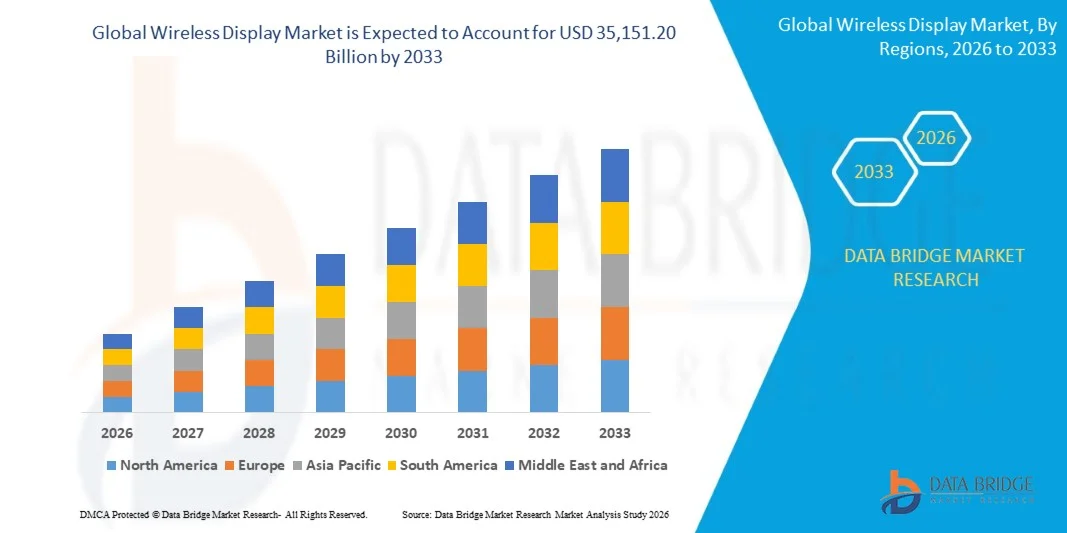
- The global wireless display market size was valued at USD 6272.57 billion in 2025 and is expected to reach USD 35,151.20 billion by 2033, at a CAGR of 22.32% during the forecast period
- The growing digitization or digitalization which has created demand for IOT enabled devices, rising disposable income along with adopting on-demand entertainment and easy connection and setup is simplified across the globe which will emerge as the major factor driving market growth
What are the Major Takeaways of Wireless Display Market?
- The increasing usage of smartphones, smart TVs, tablets and computers and rise in preference for visual advertising and promotional strategies in commercial spaces will further aggravate the market value. On the other hand, the factors such as cheap substitutes in wired connectivity devices such as USB and HDMI and low awareness about wireless display technology hammer down the growth rate for the market
- In addition to this, growth in DOOH market and digital signage generate new opportunities for growing the market within the forecast period. However, high costs involved in wireless display technology will dampen the growth rate that further result as a challenge for the market
- North America dominated the wireless displays market with a 34.26% revenue share in 2025, driven by strong adoption of smart devices, advanced display technologies, and rapid expansion of digital collaboration ecosystems across the U.S. and Canada
- Asia-Pacific is projected to register the fastest CAGR of 6.59% from 2026 to 2033, driven by rapid expansion of consumer electronics manufacturing, increasing smartphone penetration, 5G deployment, and rising adoption of smart devices across China, Japan, India, South Korea, and Southeast Asia
- The Hardware segment dominated the market with a 46.7% share in 2025, as it includes key components such as wireless display adapters, dongles, smart TVs, and integrated display systems widely used across consumer and enterprise environments
Report Scope and Wireless Display Market Segmentation
|
Attributes |
Wireless Display Key Market Insights |
|
Segments Covered |
|
|
Countries Covered |
North America
Europe
Asia-Pacific
Middle East and Africa
South America
|
|
Key Market Players |
|
|
Market Opportunities |
|
|
Value Added Data Infosets |
In addition to the insights on market scenarios such as market value, growth rate, segmentation, geographical coverage, and major players, the market reports curated by the Data Bridge Market Research also include in-depth expert analysis, pricing analysis, brand share analysis, consumer survey, demography analysis, supply chain analysis, value chain analysis, raw material/consumables overview, vendor selection criteria, PESTLE Analysis, Porter Analysis, and regulatory framework. |
What is the Key Trend in the Wireless Display Market?
“Growing Adoption of Seamless, Low-Latency, and Multi-Device Wireless Display Solutions”
- The wireless displays market is witnessing strong adoption of low-latency, high-resolution, and wireless streaming solutions designed to support screen mirroring, real-time collaboration, and content sharing across consumer and enterprise environments
- Manufacturers are introducing compact dongles, integrated smart displays, and software-based wireless display platforms with enhanced compatibility across operating systems, devices, and cloud ecosystems
- Growing demand for cable-free connectivity, flexible workspaces, and remote collaboration is driving adoption across corporate offices, education institutions, and smart homes
- For instance, companies such as Apple Inc., Microsoft, Google, and Amazon have enhanced their wireless display ecosystems with features such as AirPlay, Miracast, Chromecast, and Fire TV integration
- Increasing need for high-quality video streaming, real-time presentations, and multi-device connectivity is accelerating the shift toward wireless and software-defined display solutions
- As digital ecosystems become more interconnected, Wireless Displays will remain critical for seamless communication, content sharing, and immersive viewing experiences
What are the Key Drivers of Wireless Display Market?
- Rising demand for wireless screen mirroring and casting solutions across smartphones, laptops, smart TVs, and enterprise collaboration tools is significantly driving market growth
- For instance, in 2025, companies such as Intel Corporation, Qualcomm, and Netgear introduced advanced chipsets and wireless display solutions with improved latency, resolution, and connectivity performance
- Growing adoption of hybrid work models, online education, and digital conferencing is boosting demand for wireless display technologies across the U.S., Europe, and Asia-Pacific
- Advancements in Wi-Fi 6, 5G connectivity, cloud streaming, and edge computing have significantly enhanced wireless display performance, stability, and scalability
- Rising use of smart TVs, streaming devices, and interactive displays in homes and enterprises is creating demand for integrated and easy-to-use wireless display solutions
- Supported by increasing investments in smart infrastructure, digital transformation, and connected ecosystems, the Wireless Displays market is expected to witness strong long-term growth
Which Factor is Challenging the Growth of the Wireless Display Market?
- High costs associated with advanced wireless display hardware, smart TVs, and enterprise-grade collaboration systems restrict adoption among small businesses and budget-conscious consumers
- For instance, during 2024–2025, fluctuations in semiconductor supply, rising component costs, and global logistics challenges impacted pricing and availability of wireless display devices
- Latency issues, signal interference, and compatibility challenges across devices and operating systems increase complexity in deployment and user experience
- Limited awareness and technical expertise in emerging markets regarding wireless display standards and configurations slow adoption
- Competition from traditional wired display systems (HDMI, DisplayPort) and alternative streaming technologies creates pricing pressure and limits differentiation
- To address these challenges, companies are focusing on cost-effective solutions, improved interoperability, enhanced security features, and cloud-based wireless display platforms to increase global adoption of wireless displays
How is the Wireless Display Market Segmented?
The market is segmented on the basis of offering, technology protocol, and application.
• By Offering
On the basis of offering, the wireless displays market is segmented into Hardware, Software, and Services. The Hardware segment dominated the market with a 46.7% share in 2025, as it includes key components such as wireless display adapters, dongles, smart TVs, and integrated display systems widely used across consumer and enterprise environments. These devices enable seamless screen mirroring, high-definition streaming, and real-time content sharing, driving strong adoption across homes, offices, and educational institutions. Increasing demand for plug-and-play solutions, enhanced connectivity, and improved user experience further strengthens hardware adoption.
The Software segment is expected to grow at the fastest CAGR from 2026 to 2033, driven by rising demand for cloud-based display solutions, cross-platform compatibility, and remote collaboration tools. Growth in SaaS platforms and virtual workspaces is accelerating software-driven wireless display adoption.
• By Technology Protocol
On the basis of technology protocol, the market is segmented into Wireless HD, WIDI, Miracast, AirPlay, Google Cast, DLNA, and Others. The Miracast segment dominated the market with a 34.2% share in 2025, supported by its wide compatibility with multiple operating systems, ease of use, and strong adoption across consumer electronics and enterprise devices. It enables peer-to-peer wireless streaming without requiring internet connectivity, making it highly suitable for real-time applications.
The Google Cast segment is projected to grow at the fastest CAGR from 2026 to 2033, driven by increasing adoption of smart TVs, streaming devices, and integration with cloud-based applications. Rising demand for content streaming, OTT platforms, and smart home ecosystems is further accelerating growth in this segment.
• By Application
On the basis of application, the wireless displays market is segmented into Consumer, Commercial and Corporate, Broadcast, Digital Signage, Government, Healthcare, Education, and Others. The Consumer segment dominated the market with a 41.3% share in 2025, driven by widespread use of wireless display technologies in smart TVs, smartphones, tablets, and home entertainment systems. Increasing demand for streaming content, gaming, and smart home integration continues to boost adoption.
The Corporate and Commercial segment is expected to grow at the fastest CAGR from 2026 to 2033, propelled by rising adoption of hybrid work models, digital collaboration tools, and wireless conferencing solutions. Increasing demand for efficient presentations, real-time data sharing, and cable-free meeting environments is driving strong growth across enterprise settings.
Which Region Holds the Largest Share of the Wireless Display Market?
- North America dominated the wireless displays market with a 34.26% revenue share in 2025, driven by strong adoption of smart devices, advanced display technologies, and rapid expansion of digital collaboration ecosystems across the U.S. and Canada. High penetration of smart TVs, streaming devices, and enterprise wireless presentation solutions continues to fuel demand for Wireless Displays across corporate offices, educational institutions, healthcare facilities, and smart homes
- Leading companies in North America such as Apple Inc., Microsoft, and Google are introducing advanced wireless display solutions with enhanced compatibility, low latency, and cloud-based integration, strengthening the region’s technological leadership. Continuous investment in 5G, Wi-Fi 6, and smart infrastructure drives long-term market expansion
- High consumer adoption, strong innovation ecosystems, and increasing demand for seamless connectivity further reinforce regional market leadership
U.S. Wireless Displays Market Insight
The U.S. is the largest contributor in North America, supported by high adoption of streaming platforms, strong presence of leading technology companies, and widespread use of wireless display solutions across enterprise and consumer environments. Increasing demand for real-time collaboration tools, smart home devices, and digital conferencing solutions drives market growth. Continuous advancements in wireless communication technologies and strong R&D investments further enhance adoption across industries
Canada Wireless Displays Market Insight
Canada contributes significantly to regional growth, driven by rising adoption of digital education platforms, smart workplaces, and connected devices. Increasing investment in telecom infrastructure, cloud services, and enterprise mobility solutions supports the deployment of Wireless Displays across corporate and institutional environments. Growing demand for remote collaboration and smart technologies strengthens market penetration
Asia-Pacific Wireless Displays Market
Asia-Pacific is projected to register the fastest CAGR of 6.59% from 2026 to 2033, driven by rapid expansion of consumer electronics manufacturing, increasing smartphone penetration, 5G deployment, and rising adoption of smart devices across China, Japan, India, South Korea, and Southeast Asia. High demand for affordable smart TVs, streaming devices, and wireless display adapters is accelerating market growth across both urban and rural areas Growth in e-learning, digital transformation, smart cities, and industrial automation is further increasing demand for wireless display technologies across multiple applications
China Wireless Displays Market Insight
China is the largest contributor to Asia-Pacific due to its massive consumer electronics production, strong domestic demand, and government support for digital infrastructure development. Increasing adoption of smart TVs, IoT devices, and advanced display technologies drives demand for Wireless Displays. Competitive manufacturing capabilities and pricing advantages further expand domestic and global market reach
Japan Wireless Displays Market Insight
Japan shows steady growth supported by advanced consumer electronics industry, high technology adoption, and strong focus on innovation. Increasing demand for high-quality display solutions, gaming systems, and enterprise collaboration tools drives adoption of Wireless Displays. Continuous advancements in connectivity and display technologies support long-term growth
India Wireless Displays Market Insight
India is emerging as a major growth hub, driven by rising smartphone usage, expanding digital infrastructure, and increasing demand for affordable smart TVs and streaming devices. Growth in online education, remote work, and digital entertainment fuels adoption of Wireless Displays. Government initiatives promoting digitalization and increasing investments in telecom infrastructure further accelerate market expansion
South Korea Wireless Displays Market Insight
South Korea contributes significantly due to strong presence of leading electronics manufacturers and high demand for advanced display technologies. Increasing adoption of 5G-enabled devices, smart TVs, and high-performance consumer electronics drives demand for Wireless Displays. Technological innovation, strong R&D capabilities, and growing digital ecosystems support sustained market growth
Which are the Top Companies in Wireless Display Market?
The wireless display industry is primarily led by well-established companies, including:
- Qualcomm Technologies, Inc. (U.S.)
- Amazon.com (U.S.)
- Microsoft (U.S.)
- Google (U.S.)
- Apple Inc. (U.S.)
- Intel Corporation (U.S.)
- Belkin International, Inc. (U.S.)
- Splashtop Inc. (U.S.)
- Roku Inc. (U.S.)
- Marvell (U.S.)
- Lattice Semiconductor (U.S.)
- BELKIN INTERNATIONAL INC. (U.S.)
- ACTIONTEC ELECTRONICS INC. (U.S.)
- Netgear (U.S.)
- Airtame Inc. (Denmark)
- Splashtop (U.S.)
- Actiontec Electronics, Inc. (U.S.)
- Squirrels LLC (U.S.)
- App Dynamic ehf (Iceland)
- RF Wireless World (India)
- ScreenBeam Inc (U.S.)
What are the Recent Developments in Global Wireless Display Market?
- In July 2024, LG Electronics introduced its latest OLED TV featuring a fully wireless design, equipped with a transparent 77-inch 4K display and a wireless transmitter box for seamless audio and video transmission, eliminating visible cables and enhancing user experience, thereby highlighting the growing shift toward clutter-free and advanced wireless display technologies
- In January 2024, LG Electronics unveiled the world’s first wireless TV with a transparent display, the Signature OLED T integrated with the Zero Connect Box that enables seamless transmission of 4K visuals and sound, thereby reinforcing innovation in next-generation wireless display solutions
- In March 2023, Google launched Chromecast with Google TV, a wireless display solution designed to enable seamless content streaming from multiple devices to televisions, thereby supporting the increasing demand for integrated and user-friendly streaming ecosystems
- In February 2023, Amazon introduced the Fire TV Stick 4K Max, offering enhanced speed and responsiveness for wireless streaming compared to previous versions, thereby strengthening the adoption of high-performance wireless display devices
- In January 2023, Roku launched the Roku Express 4K+, delivering a cost-effective 4K streaming experience with improved performance, thereby expanding accessibility and affordability of wireless display solutions globally
SKU-
Get online access to the report on the World's First Market Intelligence Cloud

- Interactive Data Analysis Dashboard
- Company Analysis Dashboard for high growth potential opportunities
- Research Analyst Access for customization & queries
- Competitor Analysis with Interactive dashboard
- Latest News, Updates & Trend analysis
- Harness the Power of Benchmark Analysis for Comprehensive Competitor Tracking
Global Wireless Display Market, Supply Chain Analysis and Ecosystem Framework
To support market growth and help clients navigate the impact of geopolitical shifts, DBMR has integrated in-depth supply chain analysis into its Global Wireless Display Market research reports. This addition empowers clients to respond effectively to global changes affecting their industries. The supply chain analysis section includes detailed insights such as Global Wireless Display Market consumption and production by country, price trend analysis, the impact of tariffs and geopolitical developments, and import and export trends by country and HSN code. It also highlights major suppliers with data on production capacity and company profiles, as well as key importers and exporters. In addition to research, DBMR offers specialized supply chain consulting services backed by over a decade of experience, providing solutions like supplier discovery, supplier risk assessment, price trend analysis, impact evaluation of inflation and trade route changes, and comprehensive market trend analysis.
Research Methodology
Data collection and base year analysis are done using data collection modules with large sample sizes. The stage includes obtaining market information or related data through various sources and strategies. It includes examining and planning all the data acquired from the past in advance. It likewise envelops the examination of information inconsistencies seen across different information sources. The market data is analysed and estimated using market statistical and coherent models. Also, market share analysis and key trend analysis are the major success factors in the market report. To know more, please request an analyst call or drop down your inquiry.
The key research methodology used by DBMR research team is data triangulation which involves data mining, analysis of the impact of data variables on the market and primary (industry expert) validation. Data models include Vendor Positioning Grid, Market Time Line Analysis, Market Overview and Guide, Company Positioning Grid, Patent Analysis, Pricing Analysis, Company Market Share Analysis, Standards of Measurement, Global versus Regional and Vendor Share Analysis. To know more about the research methodology, drop in an inquiry to speak to our industry experts.
Customization Available
Data Bridge Market Research is a leader in advanced formative research. We take pride in servicing our existing and new customers with data and analysis that match and suits their goal. The report can be customized to include price trend analysis of target brands understanding the market for additional countries (ask for the list of countries), clinical trial results data, literature review, refurbished market and product base analysis. Market analysis of target competitors can be analyzed from technology-based analysis to market portfolio strategies. We can add as many competitors that you require data about in the format and data style you are looking for. Our team of analysts can also provide you data in crude raw excel files pivot tables (Fact book) or can assist you in creating presentations from the data sets available in the report.












