




Global Wood Preservative Market
Market Size in USD Billion
CAGR :
% 
 USD
2.23 Billion
USD
3.50 Billion
2025
2033
USD
2.23 Billion
USD
3.50 Billion
2025
2033
 Forecast Period Forecast Period |
2026 –2033 |
 Market Size (Base Year) Market Size (Base Year) |
USD 2.23 Billion |
 Market Size (Forecast Year) Market Size (Forecast Year) |
USD 3.50 Billion |
 CAGR CAGR |
% |
| Major Markets Players |
|
Wood Preservative Market Size
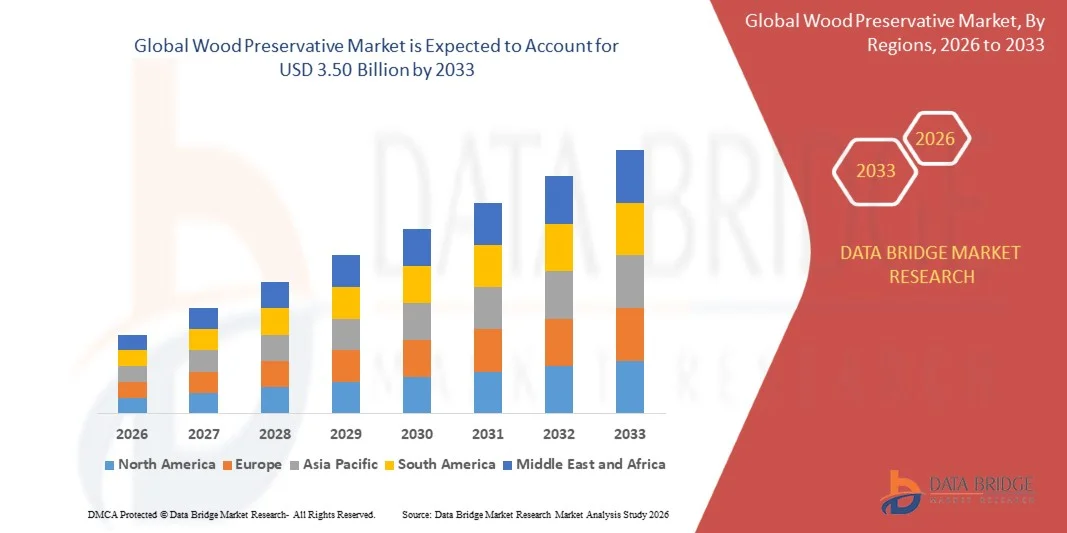
- The global wood preservative market size was valued at USD 2.23 billion in 2025 and is expected to reach USD 3.50 billion by 2033, at a CAGR of 5.8% during the forecast period
- The market growth is largely fueled by the increasing demand for durable and long-lasting wood protection solutions across residential, commercial, and industrial applications, driven by the need to prevent decay, insect attacks, and weather-related damage
- Furthermore, rising awareness of sustainable building practices and stricter environmental regulations are encouraging the adoption of eco-friendly and water-based wood preservatives. These converging factors are accelerating the uptake of advanced preservative solutions, thereby significantly boosting the industry's growth
Wood Preservative Market Analysis
- Wood preservatives are chemical solutions applied to timber to protect against fungal decay, insects, and environmental damage, extending the service life and maintaining the structural integrity of wood in various applications
- The escalating demand for wood preservatives is primarily fueled by growing construction activities, increased use of wooden furniture and decking, and rising emphasis on sustainable and eco-conscious building materials across global markets
- North America dominated the wood preservative market with a share of 36.1% in 2025, due to stringent building codes, high adoption of treated wood in construction, and increasing awareness of wood protection technologies
- Asia-Pacific is expected to be the fastest growing region in the wood preservative market during the forecast period due to rapid urbanization, rising construction activities, and increasing awareness of wood treatment technologies in countries such as China, Japan, and India
- Water based segment dominated the market with a market share of 73.7% in 2025, due to its eco-friendly nature, low VOC emissions, and ease of application, making it suitable for both residential and commercial wood treatment. Its compatibility with various wood types and effectiveness in providing long-lasting protection against decay, fungi, and insects further reinforced its strong adoption across multiple end-use sectors
Report Scope and Wood Preservative Market Segmentation
|
Attributes |
Wood Preservative Key Market Insights |
|
Segments Covered |
|
|
Countries Covered |
North America
Europe
Asia-Pacific
Middle East and Africa
South America
|
|
Key Market Players |
|
|
Market Opportunities |
|
|
Value Added Data Infosets |
In addition to the insights on market scenarios such as market value, growth rate, segmentation, geographical coverage, and major players, the market reports curated by the Data Bridge Market Research also include import export analysis, production capacity overview, production consumption analysis, price trend analysis, climate change scenario, supply chain analysis, value chain analysis, raw material/consumables overview, vendor selection criteria, PESTLE Analysis, Porter Analysis, and regulatory framework. |
Wood Preservative Market Trends
“Rising Adoption of Eco-Friendly and High-Performance Wood Preservatives”
- A significant trend in the wood preservative market is the increasing preference for eco-friendly and high-performance preservatives, driven by the demand for sustainable construction and furniture solutions. This shift is encouraging the development of advanced formulations that extend wood life while minimizing environmental impact
- For instance, companies such as Lonza Group supply copper-based and bio-based wood preservatives that meet stringent environmental standards and provide long-lasting protection against decay, fungi, and insects. These solutions support sustainable forestry practices and reduce harmful chemical exposure in both residential and commercial applications
- The adoption of waterborne and low-VOC preservatives is growing as construction and outdoor furniture industries focus on reducing toxic emissions. Such innovations are enhancing market acceptance and aligning wood treatment practices with green building certifications and sustainability goals
- Manufacturers are increasingly offering high-performance preservatives designed for extreme weather and marine conditions, providing superior resistance against moisture, rot, and insect damage. This trend is driving the preference for products capable of maintaining structural integrity over extended service periods
- The DIY and home improvement segment is showing rising interest in user-friendly and safe wood preservatives, prompting companies to develop formulations that are easy to apply and maintain. This is broadening market reach beyond industrial applications into residential consumer segments
- The market is experiencing growth in specialized preservatives for engineered wood and outdoor structures where durability and aesthetic retention are critical. This rising integration of advanced preservative solutions reinforces the overall expansion of sustainable and high-performance wood protection technologies
Wood Preservative Market Dynamics
Driver
“Increasing Demand for Durable Wood Protection Solutions”
- The wood preservative market is largely driven by the growing need for durable solutions that extend wood lifespan in construction, furniture, and infrastructure applications. Enhanced durability reduces maintenance costs and prevents premature structural degradation, supporting long-term investment in wood products
- For instance, companies such as Arch Wood Protection provide treated lumber solutions with advanced copper azole and micronized copper formulations that ensure prolonged resistance against decay and termites. These offerings address the demand for reliable and high-performance wood protection in commercial and residential projects
- Rising awareness of the economic benefits of long-lasting wood materials is encouraging builders and contractors to adopt high-quality preservative treatments. This trend is reinforcing the importance of wood protection in cost management and sustainability strategies
- The expansion of outdoor leisure and decking markets is increasing demand for preservatives that withstand UV exposure, moisture, and insect damage. This growth is creating opportunities for innovative preservative chemistries tailored to specific environmental conditions
- The demand for treated wood in furniture, flooring, and paneling applications continues to rise, strengthening this driver. Manufacturers and suppliers are investing in technologies that ensure consistent quality, longevity, and compliance with environmental regulations
Restraint/Challenge
“Stringent Environmental Regulations and Compliance Challenges”
- The wood preservative market faces challenges from strict environmental regulations governing chemical use and emissions. Compliance with legislation such as the U.S. EPA’s pesticide regulations and the EU Biocidal Products Regulation increases complexity for manufacturers and affects market dynamics
- For instance, companies such as BASF must ensure their wood preservative products meet multiple national and regional standards while maintaining performance, which can constrain innovation and increase production costs
- Restrictions on certain toxic chemicals, including chromated copper arsenate (CCA), have prompted the industry to shift toward safer alternatives, posing technical and cost challenges. Reformulation to meet regulatory standards requires research, testing, and validation, adding to operational burden
- Monitoring and reporting requirements for chemical handling, worker safety, and environmental impact introduce additional operational hurdles. Companies must invest in compliance systems and certifications, which can slow market responsiveness
- The challenge of balancing high-performance preservation with environmental safety continues to affect product development strategies. Manufacturers must navigate regulatory frameworks while addressing consumer and industry demand for durable and sustainable wood protection solutions
Wood Preservative Market Scope
The market is segmented on the basis of formulation and application.
• By Formulation
On the basis of formulation, the wood preservative market is segmented into water-based, solvent-based, and oil-based. The water-based segment dominated the largest market revenue share of 73.7% in 2025, driven by its eco-friendly nature, low VOC emissions, and ease of application, making it suitable for both residential and commercial wood treatment. Its compatibility with various wood types and effectiveness in providing long-lasting protection against decay, fungi, and insects further reinforced its strong adoption across multiple end-use sectors. Growing awareness of sustainable building practices and regulations promoting green products has also supported the widespread use of water-based preservatives.
The solvent-based segment is anticipated to witness the fastest growth rate from 2026 to 2033, fueled by its superior penetration into wood fibers and high durability, which makes it ideal for industrial and outdoor applications. For instance, companies such as Lonza and AkzoNobel have promoted solvent-based preservatives that provide enhanced resistance against harsh environmental conditions, driving increased adoption in construction and infrastructure projects. Rising demand for high-performance wood protection solutions in extreme climates is expected to further accelerate the growth of this segment.
• By Application
On the basis of application, the wood preservative market is segmented into residential, commercial, and industrial. The industrial segment dominated the largest market revenue share in 2025, driven by extensive use in infrastructure, furniture, and outdoor structures that require high durability and long-term protection. Industrial applications demand preservatives that can withstand extreme weather, moisture, and pest exposure, making high-performance formulations critical for maintaining structural integrity. Companies in this segment also benefit from bulk procurement and standardized treatment processes, further strengthening the segment’s market position.
The residential segment is expected to witness the fastest CAGR from 2026 to 2033, driven by increasing home renovation projects and consumer focus on wood aesthetics and longevity. For instance, Sherwin-Williams has promoted residential wood preservatives with easy application methods suitable for DIY homeowners. The growing popularity of wooden furniture, decking, and flooring in residential spaces fuels demand for safe and effective preservative solutions. Eco-friendly and water-based products are increasingly preferred by homeowners, contributing to the rapid growth of this segment.
Wood Preservative Market Regional Analysis
- North America dominated the wood preservative market with the largest revenue share of 36.1% in 2025, driven by stringent building codes, high adoption of treated wood in construction, and increasing awareness of wood protection technologies
- Consumers and industries in the region prioritize long-lasting, high-performance wood protection solutions that prevent decay, insect attacks, and weather-related damage
- This widespread adoption is further supported by advanced manufacturing infrastructure, rising construction activities, and regulatory encouragement for sustainable wood preservation methods, establishing treated wood as a preferred choice across residential, commercial, and industrial sectors
U.S. Wood Preservative Market Insight
The U.S. wood preservative market captured the largest revenue share in 2025 within North America, fueled by extensive use in construction, furniture, and outdoor structures. Growing awareness of environmental regulations and sustainable practices is pushing manufacturers to adopt eco-friendly formulations, particularly water-based preservatives. Residential and commercial construction projects are increasingly incorporating treated wood to enhance durability and safety. In addition, the rising demand for DIY home improvement solutions and easy-to-apply wood treatment products further propels the market. The expansion of green building initiatives and preference for long-lasting wood protection continues to strengthen market growth in the U.S.
Europe Wood Preservative Market Insight
The Europe wood preservative market is projected to expand at a substantial CAGR throughout the forecast period, primarily driven by strict environmental regulations and high demand for durable, treated wood. Countries such as Germany and France are witnessing growth due to increased adoption of eco-friendly water-based preservatives and solvent-based solutions for industrial and commercial applications. Urbanization, coupled with modern construction and renovation trends, is fostering the use of treated wood in residential and commercial buildings. European consumers are increasingly opting for solutions that combine wood protection with sustainability, enhancing market penetration across multiple applications.
U.K. Wood Preservative Market Insight
The U.K. wood preservative market is anticipated to grow at a noteworthy CAGR during the forecast period, driven by rising residential and commercial construction activities and heightened awareness regarding wood durability. Concerns regarding structural longevity, pest control, and weather-related damage are encouraging the use of both water-based and solvent-based preservatives. The growing adoption of sustainable building practices and government regulations promoting eco-friendly treatments are further supporting market growth. In addition, the popularity of wooden furniture, decking, and flooring in residential spaces is expanding the demand for effective wood protection solutions.
Germany Wood Preservative Market Insight
The Germany wood preservative market is expected to expand at a considerable CAGR during the forecast period, fueled by increasing awareness of sustainable construction and technologically advanced wood treatment solutions. Germany’s emphasis on innovation and eco-conscious infrastructure promotes the adoption of high-performance preservatives in residential and commercial projects. Industrial demand for durable, solvent-based preservatives for outdoor structures and infrastructure also contributes to market growth. The integration of effective, long-lasting wood protection solutions in both renovation and new construction projects is supporting sustained adoption across the region.
Asia-Pacific Wood Preservative Market Insight
The Asia-Pacific wood preservative market is poised to grow at the fastest CAGR during the forecast period of 2026 to 2033, driven by rapid urbanization, rising construction activities, and increasing awareness of wood treatment technologies in countries such as China, Japan, and India. The region is witnessing a growing inclination towards sustainable and high-performance wood protection solutions for residential, commercial, and industrial applications. Government initiatives promoting safe and durable construction materials are boosting the adoption of preservatives. Furthermore, the presence of local manufacturers and increasing affordability of advanced formulations are expanding market penetration to a wider consumer base.
Japan Wood Preservative Market Insight
The Japan wood preservative market is gaining momentum due to the country’s emphasis on high-quality construction, technological advancement, and sustainability. Japanese consumers and industries prioritize durable wood protection against moisture, pests, and decay, particularly in residential and commercial buildings. The integration of water-based and low-VOC preservatives is rising due to strict environmental guidelines. In addition, the aging population is likely to increase demand for easily maintainable and long-lasting wooden structures. The adoption of advanced wood preservation solutions in renovations and new constructions continues to drive market growth.
China Wood Preservative Market Insight
The China wood preservative market accounted for the largest market revenue share in Asia-Pacific in 2025, attributed to rapid urbanization, increasing residential and commercial construction, and a growing middle-class population. Rising awareness regarding wood durability, combined with strong government support for sustainable building practices, is accelerating adoption. The presence of domestic manufacturers offering both water-based and solvent-based preservatives at competitive prices further strengthens market growth. In addition, large-scale infrastructure projects, the push towards smart cities, and rising demand for treated wood in furniture and outdoor applications are key factors propelling the market in China.
Wood Preservative Market Share
The wood preservative industry is primarily led by well-established companies, including:
- RUTGERS (U.S.)
- Bostik (France)
- Quality Borate, LLC. (U.S.)
- Janssen Global Services, LLC. (U.S.)
- Borax (U.S.)
- Kurt Obermeier GmbH & Co. KG (Germany)
- Dattashri Enterprises (India)
- Avadata Organics Pvt. Ltd. (India)
- Jubilant Life Sciences Limited (India)
- Buckman Laboratories International, Inc. (U.S.)
- Parikh Enterprises Pvt. Ltd. (India)
- Advanced Agriresearch Limited (India)
- Nisus Corporation (U.S.)
- Koppers Inc. (U.S.)
- BASF SE (Germany)
- Lonza (Switzerland)
- Troy Corporation (U.S.)
- LANXESS (Germany)
- KMG Corporate (India)
Latest Developments in Global Wood Preservative Market
- In April 2026, Lonza introduced its new Lonza VACSOL 6118 preservative solution, reinforcing its product portfolio with advanced wood protection technology that complies with evolving regulatory standards and supports enhanced customer outcomes. This launch responds to increasing demand for innovative, regulation‑aligned formulations that help manufacturers meet environmental compliance and performance expectations, thus strengthening Lonza’s competitive positioning and boosting customer confidence in long-term wood durability
- In March 2026, the industry witnessed a heightened focus on low‑leaching wood preservative chemicals designed to reduce environmental impact and meet stricter global safety standards. This shift toward low‑mobility, environmentally safer formulations is reshaping the competitive landscape, encouraging manufacturers to develop products that protect wood effectively while aligning with rising regulatory and consumer demand for sustainability
- In September 2025, BASF SE expanded its production capabilities in North America by investing in a new facility dedicated to wood preservation technologies. This expansion increases manufacturing capacity, reduces delivery times to key markets, and demonstrates BASF's commitment to meeting rising demand for innovative wood preservation solutions, strengthening its competitive positioning in the region
- In August 2025, Koppers Inc. launched a new line of bio-based wood preservatives aimed at reducing environmental impact. This strategic move aligns with growing consumer demand for sustainable products and positions Koppers as a leader in eco-friendly solutions. The introduction of these products is expected to enhance market share and appeal to environmentally conscious consumers
- In July 2025, Lonza Group AG entered into a strategic partnership with a leading technology firm to integrate AI-driven analytics into their wood preservation processes. This collaboration aims to optimize product formulations and improve application techniques, leading to enhanced performance and customer satisfaction. The integration of advanced technologies reflects a broader trend toward digitalization and innovation, positioning Lonza favorably against competitors
SKU-
Get online access to the report on the World's First Market Intelligence Cloud

- Interactive Data Analysis Dashboard
- Company Analysis Dashboard for high growth potential opportunities
- Research Analyst Access for customization & queries
- Competitor Analysis with Interactive dashboard
- Latest News, Updates & Trend analysis
- Harness the Power of Benchmark Analysis for Comprehensive Competitor Tracking
Global Wood Preservative Market, Supply Chain Analysis and Ecosystem Framework
To support market growth and help clients navigate the impact of geopolitical shifts, DBMR has integrated in-depth supply chain analysis into its Global Wood Preservative Market research reports. This addition empowers clients to respond effectively to global changes affecting their industries. The supply chain analysis section includes detailed insights such as Global Wood Preservative Market consumption and production by country, price trend analysis, the impact of tariffs and geopolitical developments, and import and export trends by country and HSN code. It also highlights major suppliers with data on production capacity and company profiles, as well as key importers and exporters. In addition to research, DBMR offers specialized supply chain consulting services backed by over a decade of experience, providing solutions like supplier discovery, supplier risk assessment, price trend analysis, impact evaluation of inflation and trade route changes, and comprehensive market trend analysis.
Research Methodology
Data collection and base year analysis are done using data collection modules with large sample sizes. The stage includes obtaining market information or related data through various sources and strategies. It includes examining and planning all the data acquired from the past in advance. It likewise envelops the examination of information inconsistencies seen across different information sources. The market data is analysed and estimated using market statistical and coherent models. Also, market share analysis and key trend analysis are the major success factors in the market report. To know more, please request an analyst call or drop down your inquiry.
The key research methodology used by DBMR research team is data triangulation which involves data mining, analysis of the impact of data variables on the market and primary (industry expert) validation. Data models include Vendor Positioning Grid, Market Time Line Analysis, Market Overview and Guide, Company Positioning Grid, Patent Analysis, Pricing Analysis, Company Market Share Analysis, Standards of Measurement, Global versus Regional and Vendor Share Analysis. To know more about the research methodology, drop in an inquiry to speak to our industry experts.
Customization Available
Data Bridge Market Research is a leader in advanced formative research. We take pride in servicing our existing and new customers with data and analysis that match and suits their goal. The report can be customized to include price trend analysis of target brands understanding the market for additional countries (ask for the list of countries), clinical trial results data, literature review, refurbished market and product base analysis. Market analysis of target competitors can be analyzed from technology-based analysis to market portfolio strategies. We can add as many competitors that you require data about in the format and data style you are looking for. Our team of analysts can also provide you data in crude raw excel files pivot tables (Fact book) or can assist you in creating presentations from the data sets available in the report.












