Global Wound Care Biologics Market
Market Size in USD Billion
CAGR :
% 
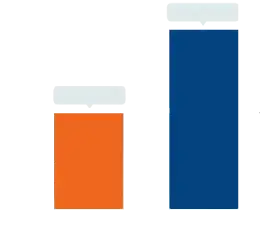 USD
2.67 Billion
USD
3.61 Billion
2025
2033
USD
2.67 Billion
USD
3.61 Billion
2025
2033
 Forecast Period Forecast Period |
2026 –2033 |
 Market Size (Base Year) Market Size (Base Year) |
USD 2.67 Billion |
 Market Size (Forecast Year) Market Size (Forecast Year) |
USD 3.61 Billion |
 CAGR CAGR |
% |
| Major Markets Players |
|
What is the Global Wound Care Biologics Market Size and Growth Rate?
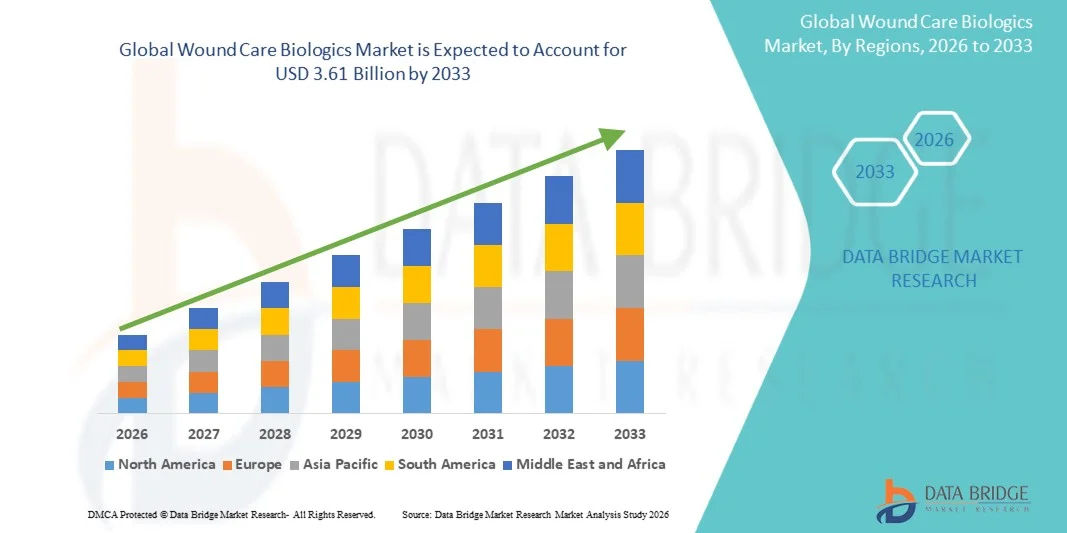
- The global wound care biologics market size was valued at USD 2.67 billion in 2025 and is expected to reach USD 3.61 billion by 2033, at a CAGR of 3.80% during the forecast period
- One of the major factors driving the growth of the wound care biologics market is the increase in wound care treatment and management programmes
- The rise in diabetes incidences due to obesity, poor diet, and physical inactivity, as well as the rise in chronic wounds, particularly foot ulcers, among the diabetic population, are driving market growth
What are the Major Takeaways of Wound Care Biologics Market?
- The increase in the funding by the federal government to drive the adoption of these solutions further influence the market
- In addition, the surge in healthcare expenditure, advancements in healthcare infrastructure, and high demand for expanded care delivery positively affect the wound care biologics market
- North America dominated the wound care biologics market with a 45.58% revenue share in 2025, driven by the high prevalence of diabetic foot ulcers, pressure ulcers, venous leg ulcers, and surgical wounds across the U.S. and Canada
- Asia-Pacific is projected to register the fastest CAGR of 12.25% from 2026 to 2035, driven by the rapidly increasing prevalence of diabetes-related ulcers, burns, and surgical wounds across China, Japan, India, South Korea, and Southeast Asia
- The Biologic Skin Substitutes segment dominated the market with a 63.4% share in 2025, as it remains the preferred treatment option for chronic wounds, diabetic foot ulcers, venous leg ulcers, and complex surgical wounds
Report Scope and Wound Care Biologics Market Segmentation
|
Attributes |
Wound Care Biologics Key Market Insights |
|
Segments Covered |
|
|
Countries Covered |
North America
Europe
Asia-Pacific
Middle East and Africa
South America
|
|
Key Market Players |
|
|
Market Opportunities |
|
|
Value Added Data Infosets |
In addition to the insights on market scenarios such as market value, growth rate, segmentation, geographical coverage, and major players, the market reports curated by the Data Bridge Market Research also include in-depth expert analysis, pricing analysis, brand share analysis, consumer survey, demography analysis, supply chain analysis, value chain analysis, raw material/consumables overview, vendor selection criteria, PESTLE Analysis, Porter Analysis, and regulatory framework. |
What is the Key Trend in the Wound Care Biologics Market?
“Increasing Shift Toward Advanced Regenerative Therapies and Bioengineered Skin Substitutes”
- The wound care biologics market is witnessing strong adoption of advanced skin substitutes, growth factor-based therapies, and bioengineered tissue products designed to accelerate healing in chronic and complex wounds
- Manufacturers are introducing cell-based biologics, acellular matrices, collagen dressings, and amniotic membrane products that offer enhanced tissue regeneration, reduced healing time, and improved patient outcomes
- Growing demand for cost-efficient, clinically effective, and minimally invasive wound healing solutions is driving usage across hospitals, wound care clinics, ambulatory surgical centers, and home healthcare settings
- For instance, companies such as Smith & Nephew, Organogenesis, Mölnlycke, and Integra LifeSciences have expanded their advanced wound biologics portfolios with innovative skin grafts and regenerative products
- Increasing need for faster healing of diabetic foot ulcers, pressure ulcers, burns, and surgical wounds is accelerating the shift toward advanced biologic therapies
- As chronic wound burden continues to rise globally, wound care biologics will remain vital for tissue repair, infection reduction, and improved healing outcomes
What are the Key Drivers of Wound Care Biologics Market?
- Rising prevalence of chronic wounds such as diabetic foot ulcers, venous leg ulcers, and pressure sores is a major driver supporting market growth
- For instance, in 2025–2026, leading companies such as Smith & Nephew and Organogenesis strengthened their wound biologics portfolios through product innovation and clinical expansion
- Growing adoption of advanced wound healing products across hospitals, specialty clinics, and outpatient settings is boosting demand across the U.S., Europe, and Asia-Pacific
- Advancements in cell-based therapy, collagen matrices, acellular dermal substitutes, and regenerative medicine have significantly strengthened product performance and clinical outcomes
- Rising incidence of diabetes, obesity, vascular disorders, and aging population is creating strong demand for high-performance wound healing biologics
- Supported by steady investments in healthcare infrastructure, advanced wound care centers, and regenerative medicine R&D, the Wound Care Biologics market is expected to witness strong long-term growth
Which Factor is Challenging the Growth of the Wound Care Biologics Market?
- High costs associated with advanced skin substitutes, cellular therapies, and biologic graft products restrict adoption among small healthcare facilities and cost-sensitive markets
- For instance, during 2024–2025, rising costs of biologic tissue processing, storage requirements, and regulatory compliance increased overall product expenses
- Complexity in clinical application, patient-specific wound assessment, and reimbursement approval processes increases the need for skilled professionals and specialist training
- Limited awareness in emerging markets regarding advanced wound care biologics and regenerative treatment protocols slows adoption
- Competition from traditional wound dressings, negative pressure wound therapy, and synthetic healing products creates pricing pressure and reduces product differentiation
- To address these issues, companies are focusing on cost-optimized biologics, stronger reimbursement support, and clinical education programs to increase global adoption of Wound Care Biologics
How is the Wound Care Biologics Market Segmented?
The market is segmented on the basis of product, wound type, and end user.
• By Product
On the basis of product, the wound care biologics market is segmented into Biologic Skin Substitutes and Topical Agents. The Biologic Skin Substitutes segment dominated the market with a 63.4% share in 2025, as it remains the preferred treatment option for chronic wounds, diabetic foot ulcers, venous leg ulcers, and complex surgical wounds. These products provide enhanced tissue regeneration, cellular repair support, and faster wound closure, making them highly effective in advanced wound care settings. Their growing adoption across hospitals and specialty wound clinics is further supported by rising clinical evidence demonstrating improved healing outcomes and reduced hospitalization time. Increasing use of amniotic membranes, collagen matrices, and acellular dermal substitutes continues to strengthen segment leadership.
The Topical Agents segment is expected to grow at the fastest CAGR from 2026 to 2033, driven by increasing demand for growth factor-based gels, biologic creams, and easy-to-apply regenerative wound solutions across outpatient and homecare settings.
• By Wound Type
On the basis of wound type, the market is segmented into Ulcers, Surgical and Traumatic Wounds, and Burns. The Ulcers segment dominated the market with a 46.9% share in 2025, supported by the rising global prevalence of diabetic foot ulcers, pressure ulcers, and venous leg ulcers, particularly among the aging population and diabetic patients. Chronic ulcers require long-term treatment and advanced healing solutions, which significantly drives the adoption of wound care biologics. Increasing incidence of obesity, diabetes, and vascular disorders continues to support strong demand for regenerative wound healing products in this segment. Biologics are widely used to promote faster tissue repair, infection control, and lower recurrence rates.
The Burns segment is projected to grow at the fastest CAGR from 2026 to 2033, driven by increasing use of bioengineered skin grafts, tissue matrices, and regenerative therapies in severe burn management. Rising trauma cases and improved access to advanced burn care are further accelerating growth.
• By End User
On the basis of end user, the wound care biologics market is segmented into Hospitals, ASCs, Burn Centers, and Wound Clinics. The Hospitals segment dominated the market with a 48.7% share in 2025, driven by the high volume of chronic wound treatments, post-surgical wound management, and trauma care procedures performed in hospital settings. Hospitals remain the primary treatment centers for complex wounds due to the availability of advanced infrastructure, specialist physicians, and access to biologic skin substitutes and regenerative therapies. Growing patient admissions for diabetes-related ulcers, burn injuries, and surgical wound complications continue to support segment dominance.
The Wound Clinics segment is expected to grow at the fastest CAGR from 2026 to 2033, propelled by increasing preference for specialized outpatient wound management services, faster treatment cycles, and cost-efficient care delivery. Rising investments in dedicated wound care centers and personalized biologic treatment protocols are significantly boosting growth.
Which Region Holds the Largest Share of the Wound Care Biologics Market?
- North America dominated the wound care biologics market with a 45.58% revenue share in 2025, driven by the high prevalence of diabetic foot ulcers, pressure ulcers, venous leg ulcers, and surgical wounds across the U.S. and Canada. Strong healthcare infrastructure, advanced reimbursement frameworks, and early adoption of skin substitutes, acellular matrices, and growth factor-based therapies continue to fuel demand across hospitals, wound clinics, and specialty care centers
- Leading companies in North America are introducing next-generation biologic skin substitutes, placental tissue grafts, and regenerative wound healing solutions, strengthening the region’s technological advantage. Continuous investment in chronic wound management, diabetic care programs, and advanced hospital infrastructure drives long-term market expansion
- High concentration of specialist wound care centers, strong physician awareness, and sustained investment in biologics-based therapies further reinforce regional market leadership
U.S. Wound Care Biologics Market Insight
The U.S. is the largest contributor in North America, supported by a rising burden of diabetes, obesity, vascular disorders, and an aging population, which significantly increases chronic wound incidence. Increasing adoption of advanced wound care biologics across hospitals, ASCs, and outpatient wound clinics continues to strengthen demand. Presence of major players such as Smith & Nephew, Organogenesis, and Integra LifeSciences, along with strong reimbursement support, further drives market growth
Canada Wound Care Biologics Market Insight
Canada contributes significantly to regional growth, driven by expanding use of advanced biologic dressings, skin substitutes, and regenerative therapies across hospitals and specialty clinics. Growing investment in chronic disease management, wound care awareness, and elderly healthcare services continues to strengthen adoption across the country
Asia-Pacific Wound Care Biologics Market
Asia-Pacific is projected to register the fastest CAGR of 12.25% from 2026 to 2035, driven by the rapidly increasing prevalence of diabetes-related ulcers, burns, and surgical wounds across China, Japan, India, South Korea, and Southeast Asia. Rising healthcare infrastructure investments, improved access to advanced wound care, and growing awareness of regenerative medicine continue to accelerate regional growth. High patient volume, improving reimbursement systems, and increasing adoption of advanced skin substitutes and topical biologics are significantly boosting demand across the region
China Wound Care Biologics Market Insight
China is the largest contributor to Asia-Pacific due to strong investments in hospital infrastructure, diabetic wound management, and advanced surgical care. Rising demand for bioengineered skin substitutes and wound healing biologics in urban hospitals and specialty centers continues to support market expansion
Japan Wound Care Biologics Market Insight
Japan shows steady growth supported by a rapidly aging population, rising chronic ulcer prevalence, and advanced healthcare systems. Strong focus on high-quality wound healing products and regenerative therapies reinforces long-term market expansion
India Wound Care Biologics Market Insight
India is emerging as a major growth hub, driven by the rising prevalence of diabetes, pressure ulcers, and trauma-related wounds. Growing government healthcare initiatives, improving access to specialty wound clinics, and rising awareness of biologic treatment options are accelerating market penetration
South Korea Wound Care Biologics Market Insight
South Korea contributes significantly due to strong demand from burn centers, surgical care units, and advanced wound treatment facilities. Rapid adoption of innovative skin grafts and regenerative biologic therapies continues to support sustained growth
Which are the Top Companies in Wound Care Biologics Market?
The wound care biologics industry is primarily led by well-established companies, including:
- Smith & Nephew plc (U.K.)
- Mölnlycke Health Care AB (Sweden)
- Integra LifeSciences Corporation (U.S.)
- Wright Medical Group N.V. (U.S.)
- MiMedx Group, Inc. (U.S.)
- Vericel Corporation (U.S.)
- Anika Therapeutics, Inc. (U.S.)
- Osiris Therapeutics, Inc. (U.S.)
- Organogenesis Holdings Inc. (U.S.)
- Kerecis (Iceland)
- Solsys Medical (U.S.)
- ACell, Inc. (U.S.)
- Lavior Inc. (U.S.)
- Marine Polymer Technologies, Inc. (U.S.)
What are the Recent Developments in Global Wound Care Biologics Market?
- In September 2022, MiMedx Group, Inc. launched AMNIOEFFECT, a tri-layer PURION-processed human tissue allograft specifically developed for surgical wound management applications. In this product launch, the company expanded its surgical recovery portfolio by offering an advanced biologic solution designed to improve healing outcomes and support post-operative wound closure. In addition, this innovation strengthened MiMedx’s competitive position in the wound care biologics market through portfolio enhancement and clinical differentiation. In conclusion, this launch is expected to support stronger product penetration and reinforce the company’s leadership in advanced wound healing solutions
- In July 2022, Tides Medical introduced Artacent AC, a tri-layer skin graft developed for the treatment of complex and difficult-to-heal wounds. In this development, the company focused on addressing the growing demand for advanced biologic grafts in chronic wound care and specialty treatment settings. In particular, the product was designed to support faster tissue regeneration and improved healing performance in severe wound cases. In conclusion, this launch is expected to strengthen Tides Medical’s market presence and contribute to the expansion of advanced wound biologics adoption
- In March 2022, Convatec Group Plc acquired Triad Life Sciences Inc., a U.S.-based medical device company specializing in biologically derived products for surgical wounds, chronic wounds, and burns. In this strategic acquisition, Convatec entered the wound care biologics market and significantly expanded its product portfolio to address unmet clinical needs across advanced wound care applications. In addition, the acquisition enhanced the company’s ability to deliver regenerative wound healing solutions across hospitals and specialty care centers. In conclusion, this acquisition is expected to strengthen Convatec’s long-term growth strategy and improve its competitive positioning in the global wound care biologics market
SKU-
Get online access to the report on the World's First Market Intelligence Cloud

- Interactive Data Analysis Dashboard
- Company Analysis Dashboard for high growth potential opportunities
- Research Analyst Access for customization & queries
- Competitor Analysis with Interactive dashboard
- Latest News, Updates & Trend analysis
- Harness the Power of Benchmark Analysis for Comprehensive Competitor Tracking
Research Methodology
Data collection and base year analysis are done using data collection modules with large sample sizes. The stage includes obtaining market information or related data through various sources and strategies. It includes examining and planning all the data acquired from the past in advance. It likewise envelops the examination of information inconsistencies seen across different information sources. The market data is analysed and estimated using market statistical and coherent models. Also, market share analysis and key trend analysis are the major success factors in the market report. To know more, please request an analyst call or drop down your inquiry.
The key research methodology used by DBMR research team is data triangulation which involves data mining, analysis of the impact of data variables on the market and primary (industry expert) validation. Data models include Vendor Positioning Grid, Market Time Line Analysis, Market Overview and Guide, Company Positioning Grid, Patent Analysis, Pricing Analysis, Company Market Share Analysis, Standards of Measurement, Global versus Regional and Vendor Share Analysis. To know more about the research methodology, drop in an inquiry to speak to our industry experts.
Customization Available
Data Bridge Market Research is a leader in advanced formative research. We take pride in servicing our existing and new customers with data and analysis that match and suits their goal. The report can be customized to include price trend analysis of target brands understanding the market for additional countries (ask for the list of countries), clinical trial results data, literature review, refurbished market and product base analysis. Market analysis of target competitors can be analyzed from technology-based analysis to market portfolio strategies. We can add as many competitors that you require data about in the format and data style you are looking for. Our team of analysts can also provide you data in crude raw excel files pivot tables (Fact book) or can assist you in creating presentations from the data sets available in the report.