




Global Yellow Tea Market
Market Size in USD Billion
CAGR :
% 
 USD
2.52 Billion
USD
3.65 Billion
2025
2033
USD
2.52 Billion
USD
3.65 Billion
2025
2033
 Forecast Period Forecast Period |
2026 –2033 |
 Market Size (Base Year) Market Size (Base Year) |
USD 2.52 Billion |
 Market Size (Forecast Year) Market Size (Forecast Year) |
USD 3.65 Billion |
 CAGR CAGR |
% |
| Major Markets Players |
|
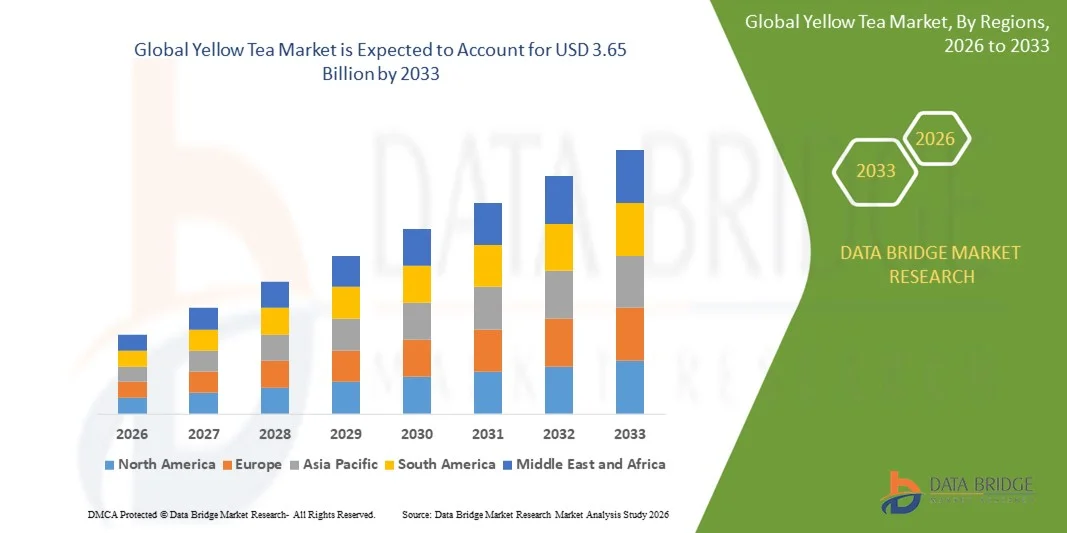
What is the Global Yellow Tea Market Size and Growth Rate?
- The global yellow tea market size was valued at USD 2.52 billion in 2025 and is expected to reach USD 3.65 billion by 2033, at a CAGR of4.75% during the forecast period
- Increase in the awareness about the exceptional health benefits of yellow tea is the major driver escalating the market growth, also rise in the research and development activities and rise in the demand form emerging economies are the major factors among others driving the yellow tea market growth
What are the Major Takeaways of Yellow Tea Market?
- Rise in the technological advancement and modernization in the production techniques will further create new opportunities for the yellow tea market
- However, rise in the cost of research and development activities acts is the major factor acting as a restraint, and will further challenge the growth of yellow tea market
- North America dominated the yellow tea market with an estimated 38.6% revenue share in 2025, driven by rising consumer awareness of premium and functional teas, growing preference for natural wellness beverages, and strong demand for antioxidant-rich products across the U.S. and Canada
- Asia-Pacific is projected to register the fastest CAGR of 8.32% from 2026 to 2033, driven by deep-rooted tea culture, expanding middle-class population, and rising global exports of premium Yellow Tea varieties
- The Jun Shan Yin Zhen segment dominated the market with an estimated 41.6% share in 2025, owing to its premium positioning, limited production, and strong association with traditional Chinese tea heritage. Known for its smooth taste, low bitterness, and high antioxidant content
Report Scope and Yellow Tea Market Segmentation
|
Attributes |
Yellow Tea Key Market Insights |
|
Segments Covered |
|
|
Countries Covered |
North America
Europe
Asia-Pacific
Middle East and Africa
South America
|
|
Key Market Players |
|
|
Market Opportunities |
|
|
Value Added Data Infosets |
In addition to the insights on market scenarios such as market value, growth rate, segmentation, geographical coverage, and major players, the market reports curated by the Data Bridge Market Research also include in-depth expert analysis, pricing analysis, brand share analysis, consumer survey, demography analysis, supply chain analysis, value chain analysis, raw material/consumables overview, vendor selection criteria, PESTLE Analysis, Porter Analysis, and regulatory framework. |
What is the Key Trend in the Yellow Tea Market?
Increasing Shift Toward Premium, Functional, and Traditionally Crafted Yellow Teas
- The yellow tea market is witnessing growing adoption of premium, low-oxidation teas produced using traditional Chinese processing techniques that preserve delicate flavor profiles and bioactive compounds
- Manufacturers are focusing on small-batch production, artisanal processing, and origin-specific sourcing to highlight authenticity, terroir, and craftsmanship
- Rising consumer preference for mild taste, smooth aroma, and reduced bitterness compared to green tea is driving demand across wellness-focused and premium beverage segments
- For instance, specialty tea brands and heritage producers in China are expanding offerings of Junshan Yinzhen and Meng Ding Huang Ya through global e-commerce and specialty retail channels
- Increasing awareness of antioxidant content, metabolism support, and digestive benefits is accelerating adoption among health-conscious consumers
- As consumers seek refined, functional, and culturally rooted beverages, Yellow Tea is expected to gain stronger positioning in the global premium tea landscape
What are the Key Drivers of Yellow Tea Market?
- Rising demand for functional beverages that support immunity, digestion, and overall wellness is boosting Yellow Tea consumption
- For instance, in 2024–2025, premium tea brands expanded Yellow Tea portfolios targeting clean-label, antioxidant-rich, and low-caffeine consumer preferences
- Growing adoption of traditional Asian wellness practices and herbal infusions across the U.S., Europe, and Asia-Pacific is supporting market growth
- Advancements in processing consistency, quality control, and sustainable tea farming have improved product availability and shelf stability
- Increasing use of Yellow Tea in specialty cafés, luxury hospitality, and curated tea subscriptions is expanding commercial demand
- Supported by rising disposable incomes and interest in premium beverages, the Yellow Tea market is expected to witness steady long-term growth
Which Factor is Challenging the Growth of the Yellow Tea Market?
- High production costs and limited availability due to labor-intensive processing techniques restrict large-scale adoption
- For instance, during 2024–2025, fluctuations in tea leaf yields and rising labor costs impacted pricing for premium Yellow Tea varieties
- Limited consumer awareness outside East Asia regarding processing methods and health benefits slows global penetration
- Short shelf life and sensitivity to storage conditions increase logistics and quality maintenance challenges
- Competition from more widely recognized teas such as green, black, and oolong tea creates visibility and pricing pressure
- To overcome these challenges, producers are investing in consumer education, storytelling, premium branding, and controlled supply chains to strengthen global adoption of Yellow Tea
How is the Yellow Tea Market Segmented?
The market is segmented on the basis of variety and distribution channel.
- By Variety
On the basis of variety, the yellow tea market is segmented into Jun Shan Yin Zhen, Meng Ding Huang Ya, and Mo Gan Huang Ya. The Jun Shan Yin Zhen segment dominated the market with an estimated 41.6% share in 2025, owing to its premium positioning, limited production, and strong association with traditional Chinese tea heritage. Known for its smooth taste, low bitterness, and high antioxidant content, Jun Shan Yin Zhen is widely preferred by premium tea consumers, luxury hotels, and specialty tea retailers. Its strong demand across Asia-Pacific and growing popularity in North America and Europe support its leading market position.
The Meng Ding Huang Ya segment is expected to grow at the fastest CAGR from 2026 to 2033, driven by rising global awareness of functional teas and increasing availability through specialty and online channels. Its balanced flavor profile, perceived wellness benefits, and relatively wider production base make it attractive to both new consumers and health-focused buyers, supporting strong future growth.
- By Distribution Channel
On the basis of distribution channel, the yellow tea market is segmented into Supermarkets and Hypermarkets, Specialty Stores, Online, and Others. The Specialty Stores segment dominated the market with a 38.9% share in 2025, supported by strong consumer preference for expert guidance, premium product curation, and assured authenticity. Specialty tea outlets and wellness stores play a critical role in educating consumers about Yellow Tea varieties, brewing methods, and health benefits, making them a key sales channel for high-value products.
The Online segment is projected to grow at the fastest CAGR from 2026 to 2033, driven by expanding e-commerce platforms, cross-border trade, and direct-to-consumer strategies by tea brands. Online channels offer wider product availability, access to rare Yellow Tea varieties, subscription models, and competitive pricing. Rising digital adoption, especially among younger and global consumers, is expected to significantly accelerate online sales growth in the coming years.
Which Region Holds the Largest Share of the Yellow Tea Market?
- North America dominated the yellow tea market with an estimated 38.6% revenue share in 2025, driven by rising consumer awareness of premium and functional teas, growing preference for natural wellness beverages, and strong demand for antioxidant-rich products across the U.S. and Canada. Increasing adoption of specialty teas as alternatives to sugary drinks, along with expanding distribution through specialty stores and online platforms, continues to support market growth across the region
- Leading tea brands in North America are expanding premium Yellow Tea offerings, clean-label positioning, and sustainable sourcing practices, strengthening consumer trust and brand penetration. Continuous innovation in packaging, flavor infusions, and wellness-focused formulations further accelerates regional demand
- High disposable income, strong health-conscious consumer base, and well-developed retail and e-commerce infrastructure further reinforce North America’s leadership in the global Yellow Tea market
U.S. Yellow Tea Market Insight
The U.S. is the largest contributor in North America, supported by strong demand for premium teas, rapid growth of the wellness beverage segment, and increasing interest in traditional Chinese teas. Rising consumption among health-focused consumers, along with availability through specialty tea retailers, organic stores, and e-commerce platforms, continues to drive market expansion.
Canada Yellow Tea Market Insight
Canada contributes steadily to regional growth, driven by increasing popularity of herbal and specialty teas, expanding organic product consumption, and growing awareness of tea’s health benefits. Strong retail penetration and rising online sales support wider adoption across the country.
Asia-Pacific Yellow Tea Market
Asia-Pacific is projected to register the fastest CAGR of 8.32% from 2026 to 2033, driven by deep-rooted tea culture, expanding middle-class population, and rising global exports of premium Yellow Tea varieties. Growing demand for traditional, functional, and artisanal teas across China, Japan, India, and Southeast Asia continues to accelerate regional growth.
China Yellow Tea Market Insight
China is the largest contributor to Asia-Pacific due to its historical dominance in Yellow Tea production, strong domestic consumption, and increasing exports. Government support for traditional tea cultivation and rising premiumization further boost market growth.
Japan Yellow Tea Market Insight
Japan shows steady growth supported by high consumer preference for premium teas, wellness-focused consumption patterns, and strong specialty retail networks. Interest in rare and functional teas reinforces long-term demand.
India Yellow Tea Market Insight
India is emerging as a key growth market, driven by rising disposable income, expanding tea culture beyond black tea, and growing awareness of specialty and wellness teas.
South Korea Yellow Tea Market Insight
South Korea contributes significantly due to increasing health-conscious consumption, premium beverage trends, and strong online retail adoption, supporting sustained growth in the Yellow Tea market.
Which are the Top Companies in Yellow Tea Market?
The yellow tea industry is primarily led by well-established companies, including:
- Unilever (U.K.)
- Betjeman and Barton (France)
- Basilur Tea (Sri Lanka)
- Celestial Seasonings, Inc. (U.S.)
- R. Twining and Company Limited (U.K.)
- Bigelow Tea (U.S.)
- adagio teas (U.S.)
- TWG Tea Company Pte Ltd (Singapore)
- Barry's Tea (Ireland)
- ITO EN (North America) INC. (Japan)
- The Republic of Tea (U.S.)
SKU-
Get online access to the report on the World's First Market Intelligence Cloud

- Interactive Data Analysis Dashboard
- Company Analysis Dashboard for high growth potential opportunities
- Research Analyst Access for customization & queries
- Competitor Analysis with Interactive dashboard
- Latest News, Updates & Trend analysis
- Harness the Power of Benchmark Analysis for Comprehensive Competitor Tracking
Global Yellow Tea Market, Supply Chain Analysis and Ecosystem Framework
To support market growth and help clients navigate the impact of geopolitical shifts, DBMR has integrated in-depth supply chain analysis into its Global Yellow Tea Market research reports. This addition empowers clients to respond effectively to global changes affecting their industries. The supply chain analysis section includes detailed insights such as Global Yellow Tea Market consumption and production by country, price trend analysis, the impact of tariffs and geopolitical developments, and import and export trends by country and HSN code. It also highlights major suppliers with data on production capacity and company profiles, as well as key importers and exporters. In addition to research, DBMR offers specialized supply chain consulting services backed by over a decade of experience, providing solutions like supplier discovery, supplier risk assessment, price trend analysis, impact evaluation of inflation and trade route changes, and comprehensive market trend analysis.
Research Methodology
Data collection and base year analysis are done using data collection modules with large sample sizes. The stage includes obtaining market information or related data through various sources and strategies. It includes examining and planning all the data acquired from the past in advance. It likewise envelops the examination of information inconsistencies seen across different information sources. The market data is analysed and estimated using market statistical and coherent models. Also, market share analysis and key trend analysis are the major success factors in the market report. To know more, please request an analyst call or drop down your inquiry.
The key research methodology used by DBMR research team is data triangulation which involves data mining, analysis of the impact of data variables on the market and primary (industry expert) validation. Data models include Vendor Positioning Grid, Market Time Line Analysis, Market Overview and Guide, Company Positioning Grid, Patent Analysis, Pricing Analysis, Company Market Share Analysis, Standards of Measurement, Global versus Regional and Vendor Share Analysis. To know more about the research methodology, drop in an inquiry to speak to our industry experts.
Customization Available
Data Bridge Market Research is a leader in advanced formative research. We take pride in servicing our existing and new customers with data and analysis that match and suits their goal. The report can be customized to include price trend analysis of target brands understanding the market for additional countries (ask for the list of countries), clinical trial results data, literature review, refurbished market and product base analysis. Market analysis of target competitors can be analyzed from technology-based analysis to market portfolio strategies. We can add as many competitors that you require data about in the format and data style you are looking for. Our team of analysts can also provide you data in crude raw excel files pivot tables (Fact book) or can assist you in creating presentations from the data sets available in the report.












